Categories
College Bookssss >
BA PU Chandigarh
BSC PU Chandigarh
MSC PU Chandigarh
BBA PU Chandigarh
MA PU Chandigarh
Medical Books
Engineering Books
Management Books
PGDCA Books
BCOM PU Chandigarh
MCOM PU Chandigarh
BCA PU Chandigarh
MCA PU Chandigarh
animate-books

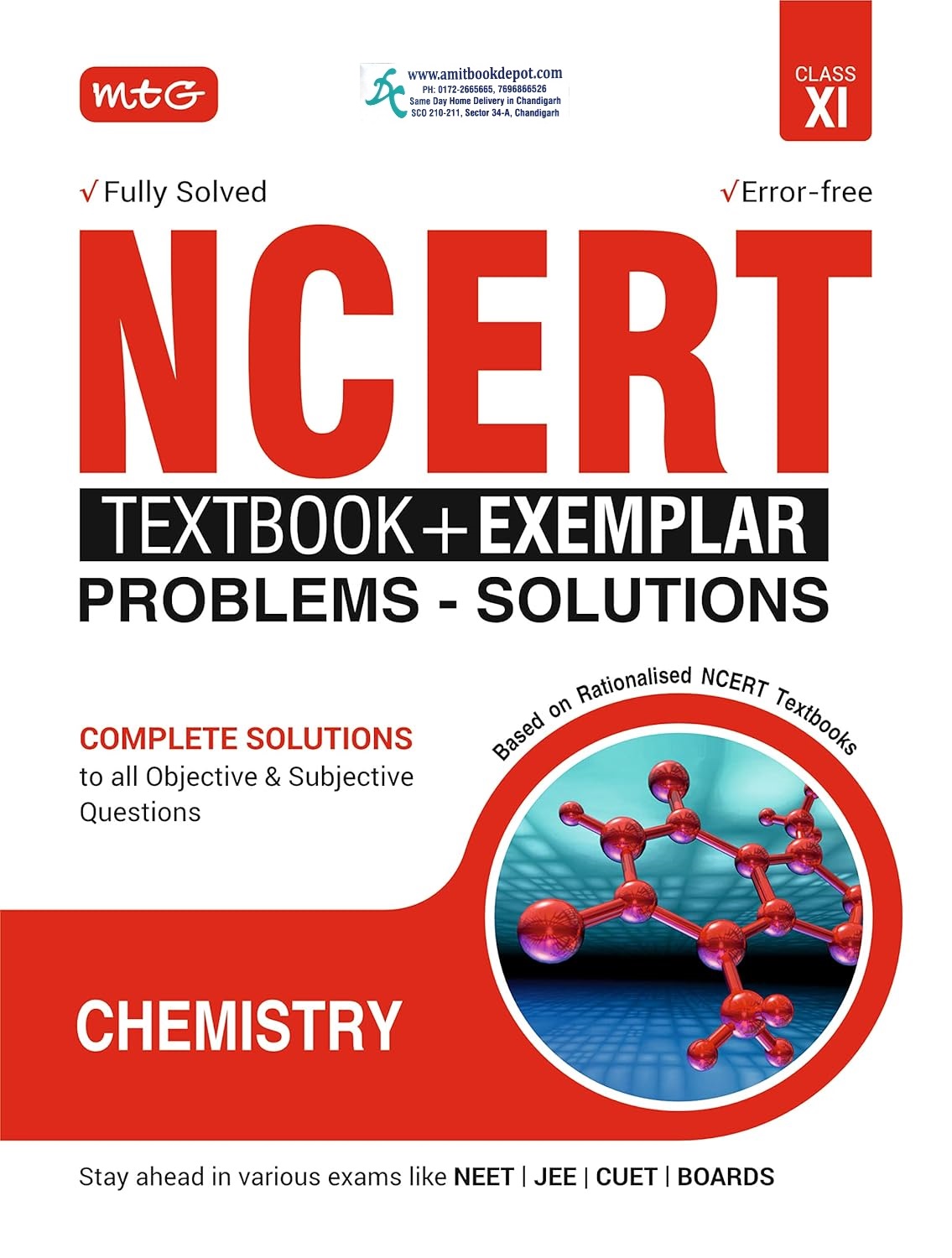
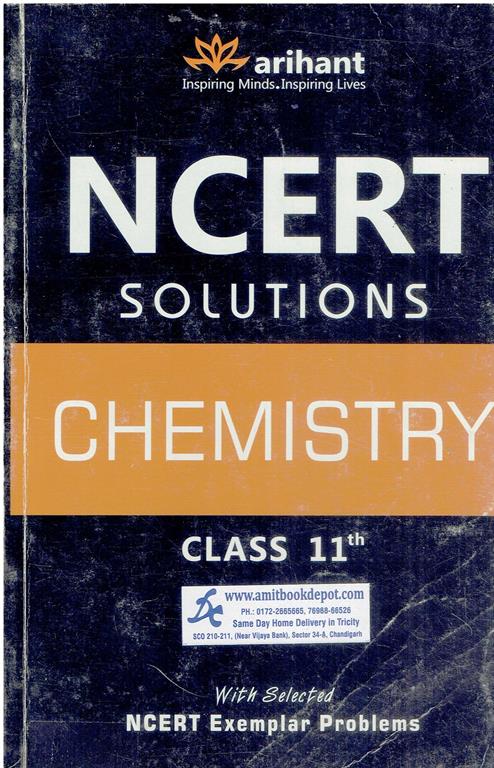
MTG NCERT Textbook and Exemplar Problems Solutions Chemistry for Class 11th

by Madhurima
₹191 ₹225.00(-/ off)

Rating & Reviews

23 Customer Review

The MTG NCERT book and Exemplar Problems Solutions Chemistry for Class 11 by MTG Editorial Board provides 100% authentic, step-by-step solutions to all NCERT book and Exemplar problems. Covering Class 11 chapters from Structure of Atom, Chemical Bonding, and Thermodynamics to Hydrocarbons, this error-free guide simplifies complex topics like equilibrium, redox reactions, and organic mechanisms. Designed for CBSE school exams, NEET, and JEE preparation, each solution follows the latest syllabus and marking scheme. Strengthen your mole concept, periodic properties, and reaction-based problem-solving with this indispensable chemistry resource. Perfect for achieving high scores and building a strong conceptual foundation.

Have Doubts Regarding This Product ? Ask Your Question

  • Q1
    Does this book provide solutions to both NCERT textbook exercises and Exemplar problems?
    A1

    Yes, it contains error-free solutions to all NCERT textbook questions and every Exemplar problem for Class 11 Chemistry, ensuring complete exam preparation.

  • Q2
    Are complex topics like hybridisation and VSEPR theory explained step-by-step?
    A2

    Yes, solutions include detailed step-by-step explanations for hybridisation (sp, sp², sp³), VSEPR theory, and molecular shapes for easy understanding.

  • Q3
    Does it cover the mole concept and stoichiometry calculations thoroughly?
    A3

    Absolutely. Unit 1 provides detailed solutions on mole concept, molar mass, percentage composition, empirical formula, and stoichiometry-based problems.

  • Q4
    Is this book useful for NEET and JEE Main aspirants?
    A4

    Yes, it includes HOTS and application-based solutions from NCERT Exemplar, which are frequently asked in NEET, JEE Main, and other competitive exams.

  • Q5
    Are numerical problems from Thermodynamics and Equilibrium solved in detail?
    A5

    Yes, all numericals on enthalpy, entropy, Gibbs energy, Kc, Kp, pH, and buffer solutions are solved with proper steps and units.

  • Q6
    Does it cover the IUPAC nomenclature of organic compounds?
    A6

    Yes, Unit 9 includes systematic solutions for IUPAC nomenclature, classification, and purification methods of organic compounds.

  • Q7
    Are organic reaction mechanisms like electrophilic substitution explained?
    A7

    Yes, mechanisms for nitration, sulfonation, halogenation, and Friedel-Crafts reactions of benzene are clearly explained stepwise.

  • Q8
    Is the content aligned with the latest CBSE Class 11 Chemistry syllabus?
    A8

    Yes, the book is strictly based on the NCERT Class 11 Chemistry textbook (Parts 1 & 2) and follows the current CBSE syllabus.

  • Q9
    Does it explain quantum numbers and electronic configuration?
    A9

    Yes, detailed solutions cover quantum numbers, Aufbau principle, Pauli’s exclusion principle, Hund’s rule, and electronic configurations.

  • Q10
    Does this book cover the acidic character of alkynes?
    A10

    Yes, Unit 10 includes solutions on acidic nature of terminal alkynes, their reactions, and comparison with alkenes and alkanes.


0.00

0 Overall Rating
  • 5
    0
  • 4
    0
  • 3
    0
  • 2
    0
  • 1
    0

Try this product & share your review & thoughts

1. Some Basic Concepts of Chemistry
2. Structure of Atom
3. Classification of Elements and Periodicity in Properties
4. Chemical Bonding and Molecular Structure
5. Thermodynamics
6. Equilibrium
7. Redox Reactions
8. Organic Chemistry - Some Basic Principles and Techniques
9. Hydrocarbons

Syllabus of the NCERT Chemistry Part 1 Textbook for Class 11


Unit I: Some Basic Concepts of Chemistry
General Introduction: Importance and Scope of Chemistry.
Historical approach to the particulate nature of matter, laws of chemical combination, and Dalton’s atomic theory: concept of elements, atoms, and molecules.
Atomic and molecular masses. Mole concept and molar mass; percentage composition and empirical and molecular formula; chemical reactions, stoichiometry, and calculations based on stoichiometry.

Unit II: Structure of Atom 
Discovery of electron, proton, and neutron; atomic number; isotopes; and isobars. Thomson's model and its limitations, Rutherford’s model and its limitations, Bohr’s model and its limitations, and the concept of shells and subshells, dual nature of matter and light, de Broglie’s relationship, Heisenberg uncertainty principle, concept of orbitals, quantum numbers, shapes of s, p, and d orbitals, rules for filling electrons in orbitals—Aufbau principle, Pauli exclusion principle, Hund’s rule, electronic configuration of atoms, and stability of half-filled and completely filled orbitals.

Unit III: Classification of Elements and Periodicity in Properties
Significance of classification, brief history of the development of the periodic table, modern periodic law and the present form of the periodic table, and periodic trends in properties of elements—atomic radii, ionic radii, inert gas radii, ionisation enthalpy, electron gain enthalpy, electronegativity, and valence. Nomenclature of
elements with atomic numbers greater than 100.

Unit IV: Chemical Bonding and Molecular Structure
Valence electrons, ionic bonds, covalent bonds, bond parameters, Lewis structures, polar character of covalent bonds, covalent character of ionic bonds, valence bond theory, resonance, geometry of covalent molecules, VSEPR theory, the concept of hybridisation involving s, p, and d orbitals, the shapes of some simple molecules, and molecular orbital theory of homonuclear diatomic molecules (qualitative idea only). Hydrogen bond.

Unit V: States of Matter: Gases and Liquids
Three states of matter, intermolecular interactions, types of bonding, melting and boiling points, and the role of gas laws in elucidating the concept of the molecule: Boyle’s law, Charles’s law, Gay-Lussac’s law, Avogadro’s law, ideal behaviour, empirical derivation of the gas equation, Avogadro number, and the ideal gas equation. Kinetic energy and molecular speeds (elementary idea), deviation from ideal behaviour, liquefaction of gases, and critical temperature.
Liquid State—Vapour pressure, viscosity, and surface tension (qualitative idea only, no mathematical derivations).

Unit VI: Thermodynamics 
Concepts of systems, types of systems, surroundings, work, heat, energy, extensive and intensive properties, and state functions.
First law of thermodynamics—internal energy and enthalpy, heat capacity and specific heat, measurement of ΔU and ΔH, Hess’s law of constant heat summation, enthalpy of bond dissociation, combustion, formation, atomisation, sublimation, phase transition, ionisation, solution, and dilution.
Introduction of entropy as a state function, the second law of thermodynamics, Gibbs energy change for spontaneous and non-spontaneous processes, and criteria for equilibrium.
Third law of thermodynamics—brief introduction.

Unit VII: Equilibrium
Equilibrium in physical and chemical processes, dynamic nature of equilibrium, law of mass action equilibrium constant, factors affecting equilibrium—Le Chatelier’s principle; ionic equilibrium—ionisation of acids and bases, strong and weak electrolytes, degree of ionisation, ionisation of polybasic acids, acid strength, concept of pH. Hydrolysis of salts (elementary idea), buffer solutions, the Henderson equation, solubility product, and the common ion effect (with illustrative examples)


Syllabus of the NCERT Chemistry Part 2 Textbook for Class 11


Unit VIII: Redox Reactions
Concept of oxidation and reduction, redox reactions, oxidation number, balancing redox reactions in terms of loss and gain of electrons and change in oxidation numbers, and applications of redox reactions.

Unit IX: Organic Chemistry—Some Basic Principles and Techniques
General introduction, methods of purification, qualitative and quantitative analysis, classification, and IUPAC nomenclature of organic compounds.
Electronic displacements in a covalent bond: inductive effect, electromeric effect, resonance, and hyperconjugation.
Homolytic and heterolytic fission of a covalent bond: free radicals, carbocations, and carbanions; electrophiles and nucleophiles; and types of organic reactions.

Unit X: Hydrocarbons
Classification of Hydrocarbons.

Aliphatic Hydrocarbons:
Alkanes—Nomenclature, isomerism, conformations (ethane only), physical properties, chemical reactions, including the free radical mechanism of halogenation, combustion, and pyrolysis.

Alkenes—Nomenclature, structure of double bond (ethene), geometrical isomerism, physical properties, methods of preparation; chemical reactions: addition of hydrogen, halogen, water, and hydrogen halides
(Markovnikov’s addition and peroxide effect), ozonolysis, oxidation, and mechanism of electrophilic addition.

Alkynes—Nomenclature, structure of triple bond (ethyne), physical properties, methods of preparation, chemical reactions: acidic character of alkynes, addition reaction of hydrogen, halogens, hydrogen halides, and water.

Aromatic hydrocarbons—Introduction, IUPAC nomenclature; Benzene: resonance, aromaticity; chemical properties: mechanism of electrophilic substitution—nitration, sulfonation, halogenation, Friedel-Crafts alkylation and acylation; directive influence of functional group in mono-substituted benzene; carcinogenicity and toxicity

Product: MTG NCERT book and exemplar problems solutions for chemistry for Class 11
Author: MTG Editorial Board
Publisher: MTG Learning Media Pvt Ltd.

The MTG NCERT book and Exemplar Problems Solutions Chemistry for Class 11 are a comprehensive, error-free, and strictly NCERT-aligned guide designed to help Class 11 students master the conceptual and application-based aspects of chemistry. This book serves as an indispensable resource for those aiming to excel in school examinations, periodic tests, and competitive entrance exams such as NEET and JEE Main, where NCERT is the primary reference.

Developed by the expert MTG Editorial Board, this book provides 100% authentic solutions to all questions present in the NCERT Chemistry books (Parts 1 & 2) and the NCERT Exemplar Problems for Class 11. The solution approach is methodical, step-by-step, and adheres strictly to the CBSE marking scheme, ensuring clarity and conceptual understanding. The content is systematically divided into ten key units, covering the entire Class 11 syllabus from "Some Basic Concepts of Chemistry" and "Structure of Atom" to "Organic Chemistry: Some Basic Principles and Techniques" and "Hydrocarbons".

Key Features & Benefits:

1. Complete Coverage: Includes solutions to every question—NCERT in-text, exercise, and exemplar problems—across all chapters such as Chemical Bonding and Molecular Structure, Thermodynamics, Equilibrium, and Redox Reactions.
2. Error-Free Content: All solutions have been meticulously verified to eliminate common errors, providing students with accurate and reliable study material.
3. Competitive Exam Orientation: Many solutions integrate higher-order thinking skills (HOTS) and application-based approaches relevant for NEET and JEE, strengthening problem-solving speed and accuracy.
4. Simplified Explanations: Complex topics like mole concept, quantum numbers, VSEPR theory, hybridisation, entropy, Gibbs free energy, Le Chatelier’s principle, and the mechanism of electrophilic substitution are explained in a student-friendly manner.
5. Exemplar Problem Focus: The book dedicates significant attention to NCERT exemplar problems—which are known to appear frequently in competitive exams—offering detailed, step-wise reasoning for multiple-choice, very short, short, and long answer questions.

Unit-wise Breakdown:
The solutions strictly follow the NCERT syllabus:

1. Some Basic Concepts of Chemistry: Mole concept, stoichiometry, empirical & molecular formulae.
2. Structure of Atom: Bohr’s model, quantum numbers, electronic configuration, de Broglie equation.
3. Classification of Elements: Periodic trends, electronegativity, ionisation enthalpy.
4. Chemical Bonding: VSEPR theory, hybridisation (sp, sp², sp³), molecular orbital theory, hydrogen bonding.
5. Thermodynamics: First law, enthalpy, entropy, Gibbs energy, and spontaneous processes.
6. Equilibrium: Equilibrium constant (Kc, Kp), Le Chatelier’s principle, pH, buffer solutions, and solubility product.
7. Redox Reactions: Oxidation number method, ion-electron method, and balancing equations.
8. Organic Chemistry: IUPAC nomenclature, inductive & resonance effects, reaction mechanisms, and purification methods.
9. Hydrocarbons: Alkanes, alkenes, alkynes, and benzene – properties and reactions including Markovnikov’s rule and Friedel-Crafts reactions.

This book is more than just a solution set; it is a self-study tool that bridges the gap between rote learning and genuine conceptual clarity. Whether you are preparing for your school’s annual exams or building a foundation for medical and engineering entrances, the MTG NCERT book and Exemplar Problems Solutions Chemistry for Class 11 are must-have companions.

1. Some Basic Concepts of Chemistry
2. Structure of Atom
3. Classification of Elements and Periodicity in Properties
4. Chemical Bonding and Molecular Structure
5. Thermodynamics
6. Equilibrium
7. Redox Reactions
8. Organic Chemistry - Some Basic Principles and Techniques
9. Hydrocarbons

Have Doubts Regarding This Product ? Ask Your Question

  • Q1
    Does this book provide solutions to both NCERT textbook exercises and Exemplar problems?
    A1

    Yes, it contains error-free solutions to all NCERT textbook questions and every Exemplar problem for Class 11 Chemistry, ensuring complete exam preparation.

  • Q2
    Are complex topics like hybridisation and VSEPR theory explained step-by-step?
    A2

    Yes, solutions include detailed step-by-step explanations for hybridisation (sp, sp², sp³), VSEPR theory, and molecular shapes for easy understanding.

  • Q3
    Does it cover the mole concept and stoichiometry calculations thoroughly?
    A3

    Absolutely. Unit 1 provides detailed solutions on mole concept, molar mass, percentage composition, empirical formula, and stoichiometry-based problems.

  • Q4
    Is this book useful for NEET and JEE Main aspirants?
    A4

    Yes, it includes HOTS and application-based solutions from NCERT Exemplar, which are frequently asked in NEET, JEE Main, and other competitive exams.

  • Q5
    Are numerical problems from Thermodynamics and Equilibrium solved in detail?
    A5

    Yes, all numericals on enthalpy, entropy, Gibbs energy, Kc, Kp, pH, and buffer solutions are solved with proper steps and units.

  • Q6
    Does it cover the IUPAC nomenclature of organic compounds?
    A6

    Yes, Unit 9 includes systematic solutions for IUPAC nomenclature, classification, and purification methods of organic compounds.

  • Q7
    Are organic reaction mechanisms like electrophilic substitution explained?
    A7

    Yes, mechanisms for nitration, sulfonation, halogenation, and Friedel-Crafts reactions of benzene are clearly explained stepwise.

  • Q8
    Is the content aligned with the latest CBSE Class 11 Chemistry syllabus?
    A8

    Yes, the book is strictly based on the NCERT Class 11 Chemistry textbook (Parts 1 & 2) and follows the current CBSE syllabus.

  • Q9
    Does it explain quantum numbers and electronic configuration?
    A9

    Yes, detailed solutions cover quantum numbers, Aufbau principle, Pauli’s exclusion principle, Hund’s rule, and electronic configurations.

  • Q10
    Does this book cover the acidic character of alkynes?
    A10

    Yes, Unit 10 includes solutions on acidic nature of terminal alkynes, their reactions, and comparison with alkenes and alkanes.

Syllabus of the NCERT Chemistry Part 1 Textbook for Class 11


Unit I: Some Basic Concepts of Chemistry
General Introduction: Importance and Scope of Chemistry.
Historical approach to the particulate nature of matter, laws of chemical combination, and Dalton’s atomic theory: concept of elements, atoms, and molecules.
Atomic and molecular masses. Mole concept and molar mass; percentage composition and empirical and molecular formula; chemical reactions, stoichiometry, and calculations based on stoichiometry.

Unit II: Structure of Atom 
Discovery of electron, proton, and neutron; atomic number; isotopes; and isobars. Thomson's model and its limitations, Rutherford’s model and its limitations, Bohr’s model and its limitations, and the concept of shells and subshells, dual nature of matter and light, de Broglie’s relationship, Heisenberg uncertainty principle, concept of orbitals, quantum numbers, shapes of s, p, and d orbitals, rules for filling electrons in orbitals—Aufbau principle, Pauli exclusion principle, Hund’s rule, electronic configuration of atoms, and stability of half-filled and completely filled orbitals.

Unit III: Classification of Elements and Periodicity in Properties
Significance of classification, brief history of the development of the periodic table, modern periodic law and the present form of the periodic table, and periodic trends in properties of elements—atomic radii, ionic radii, inert gas radii, ionisation enthalpy, electron gain enthalpy, electronegativity, and valence. Nomenclature of
elements with atomic numbers greater than 100.

Unit IV: Chemical Bonding and Molecular Structure
Valence electrons, ionic bonds, covalent bonds, bond parameters, Lewis structures, polar character of covalent bonds, covalent character of ionic bonds, valence bond theory, resonance, geometry of covalent molecules, VSEPR theory, the concept of hybridisation involving s, p, and d orbitals, the shapes of some simple molecules, and molecular orbital theory of homonuclear diatomic molecules (qualitative idea only). Hydrogen bond.

Unit V: States of Matter: Gases and Liquids
Three states of matter, intermolecular interactions, types of bonding, melting and boiling points, and the role of gas laws in elucidating the concept of the molecule: Boyle’s law, Charles’s law, Gay-Lussac’s law, Avogadro’s law, ideal behaviour, empirical derivation of the gas equation, Avogadro number, and the ideal gas equation. Kinetic energy and molecular speeds (elementary idea), deviation from ideal behaviour, liquefaction of gases, and critical temperature.
Liquid State—Vapour pressure, viscosity, and surface tension (qualitative idea only, no mathematical derivations).

Unit VI: Thermodynamics 
Concepts of systems, types of systems, surroundings, work, heat, energy, extensive and intensive properties, and state functions.
First law of thermodynamics—internal energy and enthalpy, heat capacity and specific heat, measurement of ΔU and ΔH, Hess’s law of constant heat summation, enthalpy of bond dissociation, combustion, formation, atomisation, sublimation, phase transition, ionisation, solution, and dilution.
Introduction of entropy as a state function, the second law of thermodynamics, Gibbs energy change for spontaneous and non-spontaneous processes, and criteria for equilibrium.
Third law of thermodynamics—brief introduction.

Unit VII: Equilibrium
Equilibrium in physical and chemical processes, dynamic nature of equilibrium, law of mass action equilibrium constant, factors affecting equilibrium—Le Chatelier’s principle; ionic equilibrium—ionisation of acids and bases, strong and weak electrolytes, degree of ionisation, ionisation of polybasic acids, acid strength, concept of pH. Hydrolysis of salts (elementary idea), buffer solutions, the Henderson equation, solubility product, and the common ion effect (with illustrative examples)


Syllabus of the NCERT Chemistry Part 2 Textbook for Class 11


Unit VIII: Redox Reactions
Concept of oxidation and reduction, redox reactions, oxidation number, balancing redox reactions in terms of loss and gain of electrons and change in oxidation numbers, and applications of redox reactions.

Unit IX: Organic Chemistry—Some Basic Principles and Techniques
General introduction, methods of purification, qualitative and quantitative analysis, classification, and IUPAC nomenclature of organic compounds.
Electronic displacements in a covalent bond: inductive effect, electromeric effect, resonance, and hyperconjugation.
Homolytic and heterolytic fission of a covalent bond: free radicals, carbocations, and carbanions; electrophiles and nucleophiles; and types of organic reactions.

Unit X: Hydrocarbons
Classification of Hydrocarbons.

Aliphatic Hydrocarbons:
Alkanes—Nomenclature, isomerism, conformations (ethane only), physical properties, chemical reactions, including the free radical mechanism of halogenation, combustion, and pyrolysis.

Alkenes—Nomenclature, structure of double bond (ethene), geometrical isomerism, physical properties, methods of preparation; chemical reactions: addition of hydrogen, halogen, water, and hydrogen halides
(Markovnikov’s addition and peroxide effect), ozonolysis, oxidation, and mechanism of electrophilic addition.

Alkynes—Nomenclature, structure of triple bond (ethyne), physical properties, methods of preparation, chemical reactions: acidic character of alkynes, addition reaction of hydrogen, halogens, hydrogen halides, and water.

Aromatic hydrocarbons—Introduction, IUPAC nomenclature; Benzene: resonance, aromaticity; chemical properties: mechanism of electrophilic substitution—nitration, sulfonation, halogenation, Friedel-Crafts alkylation and acylation; directive influence of functional group in mono-substituted benzene; carcinogenicity and toxicity

0.00

0 Overall Rating
  • 5
    0
  • 4
    0
  • 3
    0
  • 2
    0
  • 1
    0

Try this product & share your review & thoughts

Top Trending Product

Related Product

Related Product

Related Blog Posts

Latest Blogs

Latest Blogs

blog-img
Classic Literature Reimagined: Discuss modern twists on classic novels.
Lorem ipsum dolor sit amet, consectetur adipiscing elit, sed do eiusmod tempor incididunt ut labore et dolore magna aliqua. Ut enim ad minim veniam, quis nostrud exercitation ullamco Lorem ipsum dolor sit amet, consectetur adipiscing elit, sed do eiusmod tempor incididunt ut labore et dolore magna aliqua. Utenim ad minim veniam, quis nostrud exercitation ullamco Lorem ipsum dolor sit amet, consecte...
Read more
Author name | 10 jan, 2025
blog-img
Classic Literature Reimagined: Discuss modern twists on classic novels.
Lorem ipsum dolor sit amet, consectetur adipiscing elit, sed do eiusmod tempor incididunt ut labore et dolore magna aliqua. Ut enim ad minim veniam, quis nostrud exercitation ullamco Lorem ipsum dolor sit amet, consectetur adipiscing elit, sed do eiusmod tempor incididunt ut labore et dolore magna aliqua. Utenim ad minim veniam, quis nostrud exercitation ullamco Lorem ipsum dolor sit amet, consecte...
Read more
Author name | 10 jan, 2025
blog-img
Classic Literature Reimagined: Discuss modern twists on classic novels.
Lorem ipsum dolor sit amet, consectetur adipiscing elit, sed do eiusmod tempor incididunt ut labore et dolore magna aliqua. Ut enim ad minim veniam, quis nostrud exercitation ullamco Lorem ipsum dolor sit amet, consectetur adipiscing elit, sed do eiusmod tempor incididunt ut labore et dolore magna aliqua. Utenim ad minim veniam, quis nostrud exercitation ullamco Lorem ipsum dolor sit amet, consecte...
Read more
Author name | 10 jan, 2025
blog-img
Classic Literature Reimagined: Discuss modern twists on classic novels.
Lorem ipsum dolor sit amet, consectetur adipiscing elit...
Read more
Author Name | 10 Jan, 2025
blog-img
Classic Literature Reimagined: Discuss modern twists on classic novels.
Lorem ipsum dolor sit amet, consectetur adipiscing elit...
Read more
Author Name | 10 Jan, 2025
blog-img
Classic Literature Reimagined: Discuss modern twists on classic novels.
Lorem ipsum dolor sit amet, consectetur adipiscing elit...
Read more
Author Name | 10 Jan, 2025
blog-img
Classic Literature Reimagined: Discuss modern twists on classic novels.
Lorem ipsum dolor sit amet, consectetur adipiscing elit...
Read more
Author Name | 10 Jan, 2025
blog-img
Classic Literature Reimagined: Discuss modern twists on classic novels.
Lorem ipsum dolor sit amet, consectetur adipiscing elit...
Read more
Author Name | 10 Jan, 2025
blog-img
Classic Literature Reimagined: Discuss modern twists on classic novels.
Lorem ipsum dolor sit amet, consectetur adipiscing elit...
Read more
Author Name | 10 Jan, 2025
blog-img
Classic Literature Reimagined: Discuss modern twists on classic novels.
Lorem ipsum dolor sit amet, consectetur adipiscing elit...
Read more
Author Name | 10 Jan, 2025
blog-img
Classic Literature Reimagined: Discuss modern twists on classic novels.
Lorem ipsum dolor sit amet, consectetur adipiscing elit...
Read more
Author Name | 10 Jan, 2025
blog-img
Classic Literature Reimagined: Discuss modern twists on classic novels.
Lorem ipsum dolor sit amet, consectetur adipiscing elit...
Read more
Author Name | 10 Jan, 2025