Categories
College Bookssss >
BA PU Chandigarh
BSC PU Chandigarh
MSC PU Chandigarh
BBA PU Chandigarh
MA PU Chandigarh
Medical Books
Engineering Books
Management Books
PGDCA Books
BCOM PU Chandigarh
MCOM PU Chandigarh
BCA PU Chandigarh
MCA PU Chandigarh
animate-books

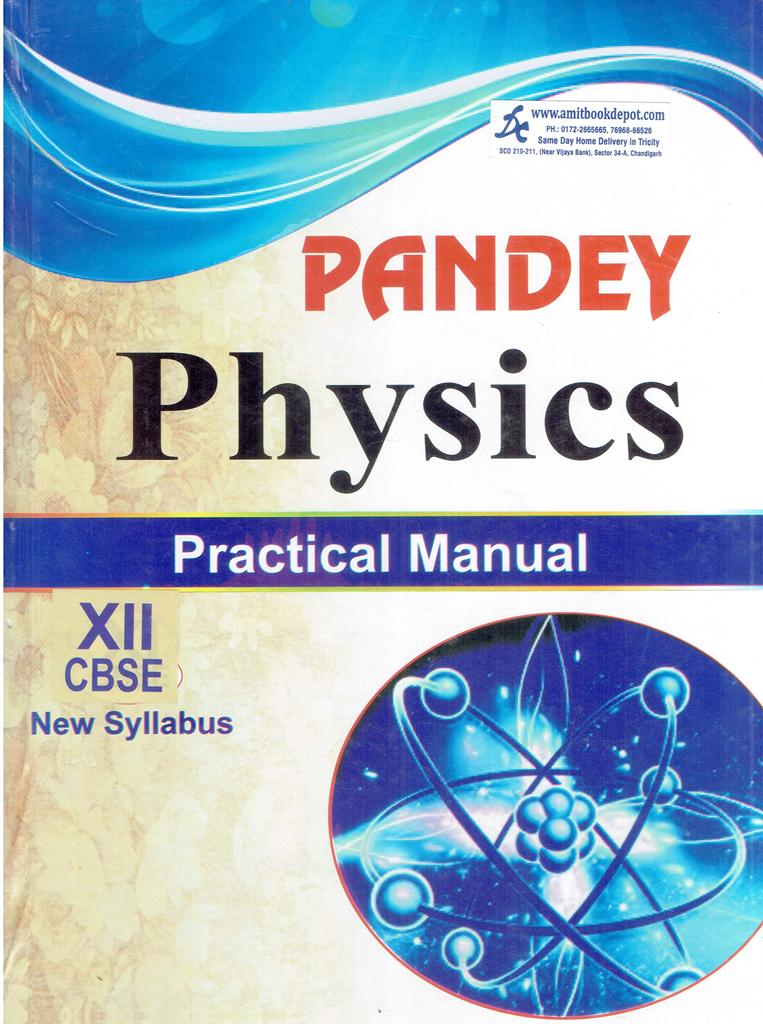
Pandey Physics Practical Manual CBSE Class 12

by Madhurima
₹358 ₹358.00(-/ off)

Rating & Reviews

23 Customer Review

Pandey Physics Practical Manual CBSE Class 12 by Dr Anil Kumar, published by Pandey Book House, is a complete laboratory guide aligned with the latest CBSE syllabus. This manual covers all essential experiments from Section A (Electricity), including metre bridge resistance determination, galvanometer conversion to ammeter and voltmeter, and household circuit assembly. Section B (Optics) includes experiments on finding the focal length of a concave mirror and convex lens, determining the angle of minimum deviation of a prism, and plotting the I-V characteristic curve of a p-n junction diode. The book also features activities on LDR, polarisation of light using polaroids, and diffraction of light, plus eight investigatory projects. With clear diagrams, observation tables, graph plotting methods, and viva voce questions, this manual helps students master practical skills, reduce errors, and excel in the CBSE Class 12 Physics practical exam. Ideal for lab work, project preparation, and final assessment.

Have Doubts Regarding This Product ? Ask Your Question

  • Q1
    Which experiment determines wire resistance using potential difference vs. current graph?
    A1

    Experiment 1 of Section A plots V-I graph to determine resistance of two or three wires.

  • Q2
    How is a galvanometer converted to a voltmeter as per this manual?
    A2

    Experiment 5a connects a high resistance in series with the galvanometer for desired voltage range.

  • Q3
    Which activity teaches assembly of a three-bulb household circuit?
    A3

    Activity 3 of Section A assembles three bulbs, three switches, a fuse, and power source.

  • Q4
    Which prism experiment requires plotting angle of incidence vs. deviation graph?
    A4

    Experiment 5 of Section B determines minimum deviation for a glass prism using graph.

  • Q5
    How is refractive index of a liquid measured in this manual?
    A5

    Experiment 7 of Section B uses a convex lens and plane mirror to find liquid's refractive index.

  • Q6
    Which experiment plots forward and reverse bias I-V characteristics?
    A6

    Experiment 9 of Section B draws characteristic curve for a p-n junction diode.

  • Q7
    How to identify a diode, LED, resistor, and capacitor from a mixed collection?
    A7

    Activity 1 of Section B teaches component identification using physical appearance and multimeter.

  • Q8
    Which activity demonstrates polarisation of light using two polaroids?
    A8

    Activity 5 of Section B observes polarisation by rotating one polaroid against another.

  • Q9
    Which project investigates internal resistance and EMF of a cell?
    A9

    Project 1 studies factors like electrode distance and electrolyte concentration affecting internal resistance.

  • Q10
    How to find frequency of A.C. mains using a sonometer?
    A10

    Experiment 6 of Section A uses resonance with tuning forks to calculate A.C. mains frequency.

0.00

0 Overall Rating
  • 5
    0
  • 4
    0
  • 3
    0
  • 2
    0
  • 1
    0

Try this product & share your review & thoughts

SECTION A

EXPERIMENTS

1. To determine resistance of two/three wires by plotting a graph for potential difference vs. current.
2. To find the resistance of a given wire using a metre bridge and hence determine the resistivity (specific resistance) of its material.
3. To verify the laws of combination (series) of resistances using a metre bridge.
3b. To verify the laws of combination (parallel) of resistances using a metre bridge.
4. To determine the resistance of a galvanometer by the half-deflection method and to find its figure of merit.
5. To convert the given galvanometer (of known resistance and figure of merit) into a voltmeter of desired range and to verify the same.
5b. To convert the given galvanometer (of known resistance and figure of merit) into an ammeter of desired range and to verify the same.
6. To find the frequency of the A.C. mains with a sonometer.

ACTIVITIES

1. To measure the resistance and impedance of an inductor with or without an iron core.
2. To measure resistance, voltage (AC/DC) and current (AC) and check continuity of a given circuit using a multimeter. 2.
3. To assemble a household circuit comprising three bulbs, three (ON-OFF) switches, a fuse and a power source.
4. To assemble the components of a given electrical circuit and find current by measuring voltage across a given resistor.
5. To study the variation in potential drop with length of a wire for a steady current.
6. To draw the diagram of a given open circuit, comprising at least a battery, a resistor/rheostat, a key, an ammeter and a voltmeter. Mark the components that are not connected in proper order and also correct the circuit and the circuit diagram. 

SECTION B

EXPERIMENTS

1. To find the value of v for different values of u in case of a concave mirror and to find the focal length.
2. To find the focal length of a convex mirror using a convex lens.
3. To find the focal length of a convex lens by plotting graphs between u and y or between
4. To find the focal length of a concave lens using a convex lens.
5. To determine the angle of minimum deviation for a given glass prism by plotting a graph between the angle of incidence and the angle of deviation.
6. To determine the refractive index of a glass slab using a travelling microscope.
7. To find the refractive index of a liquid by using a convex lens and plane mirror,
8. To find the refractive index of a liquid using a concave mirror and a plane mirror.
9. To draw the I-V characteristic curve for a p-n junction diode in forward and reverse bias,

ACTIVITIES

1. To identify a diode, an LED, a resistor and a capacitor from a mixed collection of such items.
2 To study the effect of intensity of light (by varying the distance of the source) on an LDR (light-dependent resistor).
3. Use a multimeter to see the unidirectional flow of current in the case of a diode and an LED and check whether a given electronic component (e.g., a diode) is in working order.
4. To observe refraction and lateral displacement of a beam of light incident obliquely on a glass slab.
5. To observe polarisation of light using two polaroids.
6. To observe diffraction of light due to a thin slit between sharp edges of rotor blades.
7. (a) To study the nature and size of the image formed by a convex lens using a candle and a screen (for different distances of the candle from the lens)
8. (b) To study the nature and size of the image of a candle formed by a concave mirror on a screen by using a candle and a screen.
9. To obtain a lens combination with the specified focal length by using two lenses from the given set of lenses.

Project

1. To study various factors on which the internal resistance/EMF of a cell depends.
2. To study the variations in current flowing in a circuit containing an LDR because of a variation in light intensity. (a) the power of the incandescent lamp used to 'illuminate' the LDR (keeping all the lamps at the fixed distance).
(b) the distance of an incandescent lamp (of) fixed power used to 'illuminate' the LDR
3. To find the refractive indices of (a) water and (b) oil (transparent) using a plane mirror, an equiconvex lens (made from a glass of known refractive index), and an adjustable object needle.
4. To investigate the relation between the ratio of (1) output and input voltage and (ii) number of turns in the secondary coil and primary coil of a self-designed transformer.
5. To investigate the dependence of the angle of deviation on the angle of incidence using a hollow prism filled one by one with different transparent fluids.
6. to estimate the charge induced on each one of the two identical Styrofoam (or pith) balls suspended in a vertical plane by making use of Coulomb's law.
7. To study the factor on which the self-inductance of a coil depends by observing the effect of this coil when put in series with a resistor (bulb) in a circuit fed up by an A.C. source of adjustable frequency.
8. To study the earth's magnetic field using a compass needle-bar magnet by plotting magnetic field lines and a tangent galvanometer.

Comprehensive Guide for CBSE Class 12 Physics Practical Exams

The Pandey Physics Practical Manual CBSE Class 12 is a meticulously crafted laboratory companion designed specifically for students preparing for their Central Board of Secondary Education (CBSE) Class 12 Physics practical examinations. Authored by Dr Anil Kumar and published by Pandey Book House, this manual bridges the gap between theoretical physics concepts and their hands-on application in the lab. It serves as an indispensable resource for mastering experiments, activities, and projects as per the latest CBSE curriculum.

Structured for Exam Success

This practical manual is systematically divided into two core sections—Section A (Electricity and Current Electricity) and Section B (Optics and Modern Physics)—followed by a dedicated section on investigatory projects. Each experiment and activity is presented with a step-by-step methodology, aiming to develop a deep understanding of the underlying principles.

Section A: Mastering Electricity and Magnetism

This section covers essential experiments in current electricity. Students will learn to determine the resistance of a wire using a metre bridge and verify the laws of series and parallel combinations. The manual provides detailed procedures for converting a galvanometer into an ammeter and a voltmeter, a frequently asked practical question. Additionally, the half-deflection method to determine galvanometer resistance and figure of merit is explained with clarity. A key activity includes assembling a household circuit with three bulbs, switches, and a fuse, along with using a multimeter to measure AC/DC voltage, current, and continuity. The sonometer experiment to find the frequency of A.C. mains is also covered in detail.

Section B: Exploring Optics and Modern Physics

Section B focuses on ray optics and wave optics. Students will learn to find the focal length of concave mirrors, convex mirrors, convex lenses, and concave lenses using various methods, including plotting u-v graphs. The manual includes the determination of the angle of minimum deviation for a glass prism and the refractive index of a glass slab using a travelling microscope. Key experiments on the I-V characteristic curve of a p-n junction diode in forward and reverse bias are included to build foundational knowledge in semiconductor physics. Activities such as observing refraction, lateral displacement, polarisation of light using two polaroids, and diffraction of light through a slit are presented to reinforce wave optics concepts.

Activities and Investigatory Projects

Beyond core experiments, the manual features a robust set of activities. Students can learn to identify electronic components (diode, LED, resistor, and capacitor), study the effect of light intensity on an LDR (Light Dependent Resistor), and verify the unidirectional flow of current in a diode. The project section offers eight investigatory topics, including studying the factors affecting the internal resistance of a cell, designing a self-designed transformer to investigate the turn ratio versus voltage ratio, and estimating charge using Coulomb's law with Styrofoam balls. These projects help students excel in the practical examination's project component and develop scientific enquiry skills.

Pedagogical Features

- Clear Circuit and Ray Diagrams: Every experiment is supported by accurate diagrams to help students set up their apparatus correctly.
- Observation Tables: Ready-to-use tables allow for systematic recording of readings for quantities like potential difference, current, u, v, and angle of incidence.
- Graph Plotting Guidance: Step-by-step instructions for plotting graphs (e.g., V-I graph, u-v graph, angle of incidence vs. angle of deviation) are included to help students determine slopes and intercepts accurately.
- Viva Voce Preparation: Each experiment ends with practical questions and answers to prepare students for the oral examination.
- Precautions and Sources of Error: Explicitly listed to help students avoid common mistakes and improve the accuracy of their results.

Why Choose This Manual?

- 100% CBSE Syllabus Alignment: Covers all prescribed experiments, activities, and projects.
- Student-Friendly Language: Complex procedures are broken down into simple, manageable steps.
- Exam-Oriented Approach: Focuses on the pattern and marking scheme of the CBSE Class 12 practical exam.
- Trusted Publisher: Pandey Book House is a recognised name for quality educational resources in physics.

Equip yourself with the Pandey Physics Practical Manual CBSE Class 12 to perform with confidence in your laboratory sessions and secure top marks in your board practical examination.

SECTION A

EXPERIMENTS

1. To determine resistance of two/three wires by plotting a graph for potential difference vs. current.
2. To find the resistance of a given wire using a metre bridge and hence determine the resistivity (specific resistance) of its material.
3. To verify the laws of combination (series) of resistances using a metre bridge.
3b. To verify the laws of combination (parallel) of resistances using a metre bridge.
4. To determine the resistance of a galvanometer by the half-deflection method and to find its figure of merit.
5. To convert the given galvanometer (of known resistance and figure of merit) into a voltmeter of desired range and to verify the same.
5b. To convert the given galvanometer (of known resistance and figure of merit) into an ammeter of desired range and to verify the same.
6. To find the frequency of the A.C. mains with a sonometer.

ACTIVITIES

1. To measure the resistance and impedance of an inductor with or without an iron core.
2. To measure resistance, voltage (AC/DC) and current (AC) and check continuity of a given circuit using a multimeter. 2.
3. To assemble a household circuit comprising three bulbs, three (ON-OFF) switches, a fuse and a power source.
4. To assemble the components of a given electrical circuit and find current by measuring voltage across a given resistor.
5. To study the variation in potential drop with length of a wire for a steady current.
6. To draw the diagram of a given open circuit, comprising at least a battery, a resistor/rheostat, a key, an ammeter and a voltmeter. Mark the components that are not connected in proper order and also correct the circuit and the circuit diagram. 

SECTION B

EXPERIMENTS

1. To find the value of v for different values of u in case of a concave mirror and to find the focal length.
2. To find the focal length of a convex mirror using a convex lens.
3. To find the focal length of a convex lens by plotting graphs between u and y or between
4. To find the focal length of a concave lens using a convex lens.
5. To determine the angle of minimum deviation for a given glass prism by plotting a graph between the angle of incidence and the angle of deviation.
6. To determine the refractive index of a glass slab using a travelling microscope.
7. To find the refractive index of a liquid by using a convex lens and plane mirror,
8. To find the refractive index of a liquid using a concave mirror and a plane mirror.
9. To draw the I-V characteristic curve for a p-n junction diode in forward and reverse bias,

ACTIVITIES

1. To identify a diode, an LED, a resistor and a capacitor from a mixed collection of such items.
2 To study the effect of intensity of light (by varying the distance of the source) on an LDR (light-dependent resistor).
3. Use a multimeter to see the unidirectional flow of current in the case of a diode and an LED and check whether a given electronic component (e.g., a diode) is in working order.
4. To observe refraction and lateral displacement of a beam of light incident obliquely on a glass slab.
5. To observe polarisation of light using two polaroids.
6. To observe diffraction of light due to a thin slit between sharp edges of rotor blades.
7. (a) To study the nature and size of the image formed by a convex lens using a candle and a screen (for different distances of the candle from the lens)
8. (b) To study the nature and size of the image of a candle formed by a concave mirror on a screen by using a candle and a screen.
9. To obtain a lens combination with the specified focal length by using two lenses from the given set of lenses.

Project

1. To study various factors on which the internal resistance/EMF of a cell depends.
2. To study the variations in current flowing in a circuit containing an LDR because of a variation in light intensity. (a) the power of the incandescent lamp used to 'illuminate' the LDR (keeping all the lamps at the fixed distance).
(b) the distance of an incandescent lamp (of) fixed power used to 'illuminate' the LDR
3. To find the refractive indices of (a) water and (b) oil (transparent) using a plane mirror, an equiconvex lens (made from a glass of known refractive index), and an adjustable object needle.
4. To investigate the relation between the ratio of (1) output and input voltage and (ii) number of turns in the secondary coil and primary coil of a self-designed transformer.
5. To investigate the dependence of the angle of deviation on the angle of incidence using a hollow prism filled one by one with different transparent fluids.
6. to estimate the charge induced on each one of the two identical Styrofoam (or pith) balls suspended in a vertical plane by making use of Coulomb's law.
7. To study the factor on which the self-inductance of a coil depends by observing the effect of this coil when put in series with a resistor (bulb) in a circuit fed up by an A.C. source of adjustable frequency.
8. To study the earth's magnetic field using a compass needle-bar magnet by plotting magnetic field lines and a tangent galvanometer.

Have Doubts Regarding This Product ? Ask Your Question

  • Q1
    Which experiment determines wire resistance using potential difference vs. current graph?
    A1

    Experiment 1 of Section A plots V-I graph to determine resistance of two or three wires.

  • Q2
    How is a galvanometer converted to a voltmeter as per this manual?
    A2

    Experiment 5a connects a high resistance in series with the galvanometer for desired voltage range.

  • Q3
    Which activity teaches assembly of a three-bulb household circuit?
    A3

    Activity 3 of Section A assembles three bulbs, three switches, a fuse, and power source.

  • Q4
    Which prism experiment requires plotting angle of incidence vs. deviation graph?
    A4

    Experiment 5 of Section B determines minimum deviation for a glass prism using graph.

  • Q5
    How is refractive index of a liquid measured in this manual?
    A5

    Experiment 7 of Section B uses a convex lens and plane mirror to find liquid's refractive index.

  • Q6
    Which experiment plots forward and reverse bias I-V characteristics?
    A6

    Experiment 9 of Section B draws characteristic curve for a p-n junction diode.

  • Q7
    How to identify a diode, LED, resistor, and capacitor from a mixed collection?
    A7

    Activity 1 of Section B teaches component identification using physical appearance and multimeter.
  • Q8
    Which activity demonstrates polarisation of light using two polaroids?
    A8

    Activity 5 of Section B observes polarisation by rotating one polaroid against another.
  • Q9
    Which project investigates internal resistance and EMF of a cell?
    A9

    Project 1 studies factors like electrode distance and electrolyte concentration affecting internal resistance.
  • Q10
    How to find frequency of A.C. mains using a sonometer?
    A10

    Experiment 6 of Section A uses resonance with tuning forks to calculate A.C. mains frequency.

No Syllabus Added

0.00

0 Overall Rating
  • 5
    0
  • 4
    0
  • 3
    0
  • 2
    0
  • 1
    0

Try this product & share your review & thoughts

Top Trending Product

Related Product

Related Product

Related Blog Posts

Latest Blogs

Latest Blogs

blog-img
Classic Literature Reimagined: Discuss modern twists on classic novels.
Lorem ipsum dolor sit amet, consectetur adipiscing elit, sed do eiusmod tempor incididunt ut labore et dolore magna aliqua. Ut enim ad minim veniam, quis nostrud exercitation ullamco Lorem ipsum dolor sit amet, consectetur adipiscing elit, sed do eiusmod tempor incididunt ut labore et dolore magna aliqua. Utenim ad minim veniam, quis nostrud exercitation ullamco Lorem ipsum dolor sit amet, consecte...
Read more
Author name | 10 jan, 2025
blog-img
Classic Literature Reimagined: Discuss modern twists on classic novels.
Lorem ipsum dolor sit amet, consectetur adipiscing elit, sed do eiusmod tempor incididunt ut labore et dolore magna aliqua. Ut enim ad minim veniam, quis nostrud exercitation ullamco Lorem ipsum dolor sit amet, consectetur adipiscing elit, sed do eiusmod tempor incididunt ut labore et dolore magna aliqua. Utenim ad minim veniam, quis nostrud exercitation ullamco Lorem ipsum dolor sit amet, consecte...
Read more
Author name | 10 jan, 2025
blog-img
Classic Literature Reimagined: Discuss modern twists on classic novels.
Lorem ipsum dolor sit amet, consectetur adipiscing elit, sed do eiusmod tempor incididunt ut labore et dolore magna aliqua. Ut enim ad minim veniam, quis nostrud exercitation ullamco Lorem ipsum dolor sit amet, consectetur adipiscing elit, sed do eiusmod tempor incididunt ut labore et dolore magna aliqua. Utenim ad minim veniam, quis nostrud exercitation ullamco Lorem ipsum dolor sit amet, consecte...
Read more
Author name | 10 jan, 2025
blog-img
Classic Literature Reimagined: Discuss modern twists on classic novels.
Lorem ipsum dolor sit amet, consectetur adipiscing elit...
Read more
Author Name | 10 Jan, 2025
blog-img
Classic Literature Reimagined: Discuss modern twists on classic novels.
Lorem ipsum dolor sit amet, consectetur adipiscing elit...
Read more
Author Name | 10 Jan, 2025
blog-img
Classic Literature Reimagined: Discuss modern twists on classic novels.
Lorem ipsum dolor sit amet, consectetur adipiscing elit...
Read more
Author Name | 10 Jan, 2025
blog-img
Classic Literature Reimagined: Discuss modern twists on classic novels.
Lorem ipsum dolor sit amet, consectetur adipiscing elit...
Read more
Author Name | 10 Jan, 2025
blog-img
Classic Literature Reimagined: Discuss modern twists on classic novels.
Lorem ipsum dolor sit amet, consectetur adipiscing elit...
Read more
Author Name | 10 Jan, 2025
blog-img
Classic Literature Reimagined: Discuss modern twists on classic novels.
Lorem ipsum dolor sit amet, consectetur adipiscing elit...
Read more
Author Name | 10 Jan, 2025
blog-img
Classic Literature Reimagined: Discuss modern twists on classic novels.
Lorem ipsum dolor sit amet, consectetur adipiscing elit...
Read more
Author Name | 10 Jan, 2025
blog-img
Classic Literature Reimagined: Discuss modern twists on classic novels.
Lorem ipsum dolor sit amet, consectetur adipiscing elit...
Read more
Author Name | 10 Jan, 2025
blog-img
Classic Literature Reimagined: Discuss modern twists on classic novels.
Lorem ipsum dolor sit amet, consectetur adipiscing elit...
Read more
Author Name | 10 Jan, 2025