Categories
College Bookssss >
BA PU Chandigarh
BSC PU Chandigarh
MSC PU Chandigarh
BBA PU Chandigarh
MA PU Chandigarh
Medical Books
Engineering Books
Management Books
PGDCA Books
BCOM PU Chandigarh
MCOM PU Chandigarh
BCA PU Chandigarh
MCA PU Chandigarh
animate-books

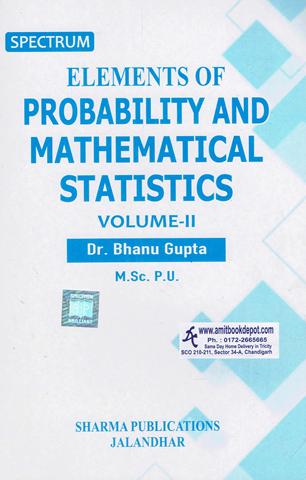
Spectrum Elements of Probability and Mathematical Statistics Vol 2 for MSc Panjab University Chandigarh

by Madhurima
₹210 ₹210.00(-/ off)

Rating & Reviews

23 Customer Review

Spectrum Elements of Probability and Mathematical Statistics Vol 2 for MSc Panjab University Chandigarh (English Medium) by Dr. Bhanu Gupta, published by Sharma Publications Jalandhar, is a comprehensive guide tailored for M.SC 2nd-year students. This book delves into advanced topics such as Sampling Theory, Estimation Theory, Hypothesis Testing, Analysis of Variance, and Non-Parametric Tests. With clear explanations, practical examples, and detailed coverage of statistical methods, it serves as an essential resource for mastering probability and mathematical statistics. 

Have Doubts Regarding This Product ? Ask Your Question

  • Q1
    Is this book specifically written for the M.SC 2nd-year syllabus?
    A1

    Yes, this book, "Spectrum Elements of Probability and Mathematical Statistics Volume-II," is meticulously tailored to cover the entire syllabus for M.SC 2nd PU, as prescribed by various universities, including topics like Estimation Theory, Hypothesis Testing, and ANOVA.

  • Q2
    Does the book cover both Parametric and Non-Parametric tests?
    A2

    Absolutely. The book provides dedicated chapters on both. It covers exact sample tests (t-test, F-test, Chi-square test) and includes a separate chapter on Non-Parametric tests like the Sign Test, Wilcoxon Signed Rank Test, and Mann-Whitney Test.

  • Q3
    Are the statistical tables needed for hypothesis testing included in the book?
    A3

    Yes, the book contains a comprehensive section of statistical tables (Tables I-VIII) at the end, which include critical values for Chi-square, t, and F-distributions, essential for performing and interpreting hypothesis tests.

  • Q4
    I struggle with understanding theoretical concepts like the Rao-Blackwell Theorem. Is it explained clearly?
    A4

    Yes, the book is known for breaking down complex theoretical concepts. The Rao-Blackwell Theorem, along with other advanced topics like the Cramer-Rao Inequality and the Neyman-Pearson Lemma, is explained with a focus on clarity and logical progression.

  • Q5
    Is the Analysis of Variance (ANOVA) technique explained in a simple manner?
    A5

    The book dedicates a full chapter to ANOVA, explaining the fundamental concepts and procedures for both one-way and two-way analysis in a structured and understandable way, suitable for M.SC 2nd-year students.

  • Q6
    Is this book useful for competitive exams like NET or SET in Statistics?
    A6

    While its primary focus is the M.SC 2nd PU university syllabus, the strong theoretical foundation it provides in probability and mathematical statistics makes it a valuable resource for preparing for the core statistics portion of exams like NET and SET.

  • Q7
    Is the method of Maximum Likelihood Estimation covered?
    A7

    Yes, the Method of Maximum Likelihood Estimation is covered in detail under the "Methods of Estimation" section in the Point Estimation chapter.

  • Q8
    How does this book help with university exam preparation?
    A8

    The content is structured to match the typical question paper pattern, with clear topic demarcation as per university units. The theoretical explanations and practical examples directly aid in answering both long and short-type questions.

  • Q9
    Are there any prerequisites for studying from this Volume-II?
    A9

    It is assumed that the student has a solid understanding of the topics covered in the first volume, which typically includes basic probability, random variables, and standard distributions. A strong foundation in calculus is also beneficial.

  • Q10
    Is the concept of Likelihood Ratio Tests included in the syllabus coverage?
    A10

    Yes, Likelihood Ratio Tests, a key part of the advanced hypothesis testing syllabus for M.SC 2nd PU, are covered in a dedicated section within the book.

0.00

0 Overall Rating
  • 5
    0
  • 4
    0
  • 3
    0
  • 2
    0
  • 1
    0

Try this product & share your review & thoughts

1. Sample Theory
1.1 Introduction
1.2 Population and Sample
1.3 Sampling
1.4 Parameter and Statistic
1.5 Tests of Significance
1.6 Formation of a Hypothesis 
1.7 Two-Tailed and Single Tailed Tests
1.8 Level of Significance
1.9 Critical Region
1.10 General Procedure for Hypothesis Testing
1.11 P-Value
1.12 Alternate Approach of Testing Hypothesis
1.13 Errors in Testing of Hypothesis
1.14 Power of a Hypothesis Test
1.15 Normal Test (Large Sample Significance Test)

2. Sampling Distributions 
2.1 Introduction 
2.2 Chi-square (x²) Distribution
2.3 The t-Distribution
2.4 F-Distribution

3. Estimation Theory-I: Point Estimation
3.1 Introduction
3.2 Point Estimation
3.3 Unbiasedness
3.4 Consistency
3.5 Efficiency
3.6 Sufficiency
3.7 Completeness
3.8 Rao-Blackwell Theorem
3.9 Cramer-Rao Inequality 
3.10 Methods of Estimation 

4. Estimation Theory-II: Interval Estimation 
4.1 Introduction
4.2 Interval Estimation
4.3 Confidence Interval for Means 
4.4 Confidence Interval for Difference of Means
4.5 Confidence Interval for Variance

5. Testing Hypothesis-I: Exact Sample Tests
5.1 Introduction
5.2 x2- test
5.3 t-test
5.4 F-test

6. Analysis of Variance
6.1 Introduction
6.2 Analysis of Variance (ANOVA)

7. Testing Hypothesis-II
7.1 Introduction 
7.2 Fundamental Concepts 
7.3 Classical Theory of Testing Hypothesis
7.4 The Neyman-Pearson Lemma
7.5 Likelihood Ratio Tests

8. Non-Parametric Tests
8.1 Introduction
8.2 Difference Between Parametric and Non-parametric Tests
8.3 The Sign Test
8.4 Wilcoxon Signed Rank Test 
8.5 Mann-Whitney Test

Appendix (I-IV)
Table (I-VIII)
Bibliograph

Latest Syllabus Of Elements of Probability and Mathematical Statistics Vol 2 for MSc Panjab University Chandigarh


MATH 681S: Probability and Mathematical Statistics-II
Total Marks : 100
Theory : 80 Marks
Internal Assessment : 20 Marks
Time : 3 hrs.

Note: 1. The question paper will consist of 9 questions. Candidates will attempt total five questions.
2. Question No.1 is compulsory and will consist of short answer type questions covering the whole syllabus.
3. There will be four questions from each Unit and the candidates will be required to attempt two questions from each Unit.
4. All questions carry equal marks.

UNIT-I
Point and Interval Estimation: General concept of Point estimation, unbiasedness, consistency, efficiency and Sufficiency. Factorization theorem, completeness, Rao-Blackwell theorem, Cramer-Rao inequality.Maximum likelihood method of estimation and method of moments. Interval estimation, confidence intervals for means, difference of means and variances.

UNIT–II
Hypothesis Testing: The basic idea of significance test. Null and alternative hypothesis, Type-I and TypeII errors. Uniformly most powerful tests, Likelihood Ratio tests. t, Chi-square and F-distributions. Tests of significance based on t, Chi-square and F. One way and two way Analysis of Variance (ANOVA).
Non-Parametric Tests: Sign test, Wilcoxon signed rank test, Mann-whitney test. 

Spectrum Elements of Probability and Mathematical Statistics Volume-II for M.SC 2nd Panjab University Chandigarh (English Medium) is an authoritative book authored by Dr. Bhanu Gupta and published by Sharma Publications Jalandhar. Designed specifically for M.SC 2nd-year students, this book provides an in-depth exploration of advanced statistical concepts and methodologies, making it an indispensable resource for mastering probability and mathematical statistics.
Comprehensive Coverage of Advanced Topics
The book is structured to cover a wide range of topics essential for M.SC 2nd Panjab University Chandigarh students. It begins with Sampling Theory, introducing fundamental concepts such as population, sample, parameter, and statistic. It further elaborates on hypothesis testing, including the formation of hypotheses, types of tests (two-tailed and single-tailed), levels of significance, and critical regions. The chapter also discusses errors in hypothesis testing, the power of a test, and the normal test for large samples, providing a solid foundation for understanding statistical inference.

The second chapter focuses on Sampling Distributions, detailing key distributions such as the Chi-square (x²) distribution, t-distribution, and F-distribution. These distributions are crucial for various statistical tests and analyses, and the book explains their properties and applications with clarity.

Estimation Theory: Point and Interval Estimation
The book dedicates two chapters to Estimation Theory, dividing it into Point Estimation and Interval Estimation. In Point Estimation, students will learn about unbiasedness, consistency, efficiency, sufficiency, and completeness of estimators. The chapter also covers advanced topics like the Rao-Blackwell Theorem and the Cramer-Rao Inequality, along with various methods of estimation. Interval Estimation, on the other hand, provides a detailed understanding of confidence intervals for means, differences of means, and variances, equipping students with the tools to estimate population parameters with precision.

Hypothesis Testing: Exact Sample Tests and Advanced Concepts
The book extensively covers Hypothesis Testing across two chapters. The first chapter on hypothesis testing focuses on exact sample tests, including the x²-test, t-test, and F-test, which are fundamental for analyzing sample data. The second chapter delves into advanced concepts such as the classical theory of hypothesis testing, the Neyman-Pearson Lemma, and likelihood ratio tests. These topics are essential for students aiming to develop a deeper understanding of statistical decision-making.

Analysis of Variance (ANOVA)
A dedicated chapter on Analysis of Variance (ANOVA) introduces students to the techniques used to analyze the differences among group means. This chapter is particularly useful for students involved in research or experimental studies, as it provides a systematic approach to understanding variance and its implications.

Non-Parametric Tests
The book also includes a chapter on Non-Parametric Tests, which are used when the assumptions of parametric tests are not met. It covers the differences between parametric and non-parametric tests, along with specific tests such as the Sign Test, Wilcoxon Signed Rank Test, and Mann-Whitney Test. These tests are invaluable for analyzing data that do not follow a normal distribution.

Appendices and Tables
To aid in practical applications, the book features an Appendix with supplementary materials and Tables (I-VIII) that provide critical values for various statistical tests. These resources are designed to assist students in performing statistical analyses and interpreting results accurately.

Key Features
1. Tailored for M.SC 2nd PU Students: The content is specifically designed to meet the academic requirements of M.SC 2nd-year students.
2. Clear and Concise Explanations: Complex statistical concepts are explained in a straightforward manner, making them accessible to students.
3. Practical Examples: The book includes numerous examples to illustrate the application of statistical methods.
4. Comprehensive Coverage: From basic sampling theory to advanced hypothesis testing, the book covers all essential topics in probability and mathematical statistics.
5. Useful Appendices and Tables: The inclusion of appendix tables enhances the book's utility for both students and educators.

Why Choose This Book?
Spectrum Elements of Probability and Mathematical Statistics Volume-II for M.SC 2nd PU (English Medium) is an ideal choice for students seeking a thorough understanding of advanced statistical concepts. Its structured approach, detailed explanations, and practical examples make it a valuable resource for academic success. Whether you are preparing for exams or conducting research, this book will serve as a reliable guide throughout your M.SC 2nd PU journey.

1. Sample Theory
1.1 Introduction
1.2 Population and Sample
1.3 Sampling
1.4 Parameter and Statistic
1.5 Tests of Significance
1.6 Formation of a Hypothesis 
1.7 Two-Tailed and Single Tailed Tests
1.8 Level of Significance
1.9 Critical Region
1.10 General Procedure for Hypothesis Testing
1.11 P-Value
1.12 Alternate Approach of Testing Hypothesis
1.13 Errors in Testing of Hypothesis
1.14 Power of a Hypothesis Test
1.15 Normal Test (Large Sample Significance Test)

2. Sampling Distributions 
2.1 Introduction 
2.2 Chi-square (x²) Distribution
2.3 The t-Distribution
2.4 F-Distribution

3. Estimation Theory-I: Point Estimation
3.1 Introduction
3.2 Point Estimation
3.3 Unbiasedness
3.4 Consistency
3.5 Efficiency
3.6 Sufficiency
3.7 Completeness
3.8 Rao-Blackwell Theorem
3.9 Cramer-Rao Inequality 
3.10 Methods of Estimation 

4. Estimation Theory-II: Interval Estimation 
4.1 Introduction
4.2 Interval Estimation
4.3 Confidence Interval for Means 
4.4 Confidence Interval for Difference of Means
4.5 Confidence Interval for Variance

5. Testing Hypothesis-I: Exact Sample Tests
5.1 Introduction
5.2 x2- test
5.3 t-test
5.4 F-test

6. Analysis of Variance
6.1 Introduction
6.2 Analysis of Variance (ANOVA)

7. Testing Hypothesis-II
7.1 Introduction 
7.2 Fundamental Concepts 
7.3 Classical Theory of Testing Hypothesis
7.4 The Neyman-Pearson Lemma
7.5 Likelihood Ratio Tests

8. Non-Parametric Tests
8.1 Introduction
8.2 Difference Between Parametric and Non-parametric Tests
8.3 The Sign Test
8.4 Wilcoxon Signed Rank Test 
8.5 Mann-Whitney Test

Appendix (I-IV)
Table (I-VIII)
Bibliograph

Have Doubts Regarding This Product ? Ask Your Question

  • Q1
    Is this book specifically written for the M.SC 2nd-year syllabus?
    A1

    Yes, this book, "Spectrum Elements of Probability and Mathematical Statistics Volume-II," is meticulously tailored to cover the entire syllabus for M.SC 2nd PU, as prescribed by various universities, including topics like Estimation Theory, Hypothesis Testing, and ANOVA.

  • Q2
    Does the book cover both Parametric and Non-Parametric tests?
    A2

    Absolutely. The book provides dedicated chapters on both. It covers exact sample tests (t-test, F-test, Chi-square test) and includes a separate chapter on Non-Parametric tests like the Sign Test, Wilcoxon Signed Rank Test, and Mann-Whitney Test.

  • Q3
    Are the statistical tables needed for hypothesis testing included in the book?
    A3

    Yes, the book contains a comprehensive section of statistical tables (Tables I-VIII) at the end, which include critical values for Chi-square, t, and F-distributions, essential for performing and interpreting hypothesis tests.

  • Q4
    I struggle with understanding theoretical concepts like the Rao-Blackwell Theorem. Is it explained clearly?
    A4

    Yes, the book is known for breaking down complex theoretical concepts. The Rao-Blackwell Theorem, along with other advanced topics like the Cramer-Rao Inequality and the Neyman-Pearson Lemma, is explained with a focus on clarity and logical progression.

  • Q5
    Is the Analysis of Variance (ANOVA) technique explained in a simple manner?
    A5

    The book dedicates a full chapter to ANOVA, explaining the fundamental concepts and procedures for both one-way and two-way analysis in a structured and understandable way, suitable for M.SC 2nd-year students.

  • Q6
    Is this book useful for competitive exams like NET or SET in Statistics?
    A6

    While its primary focus is the M.SC 2nd PU university syllabus, the strong theoretical foundation it provides in probability and mathematical statistics makes it a valuable resource for preparing for the core statistics portion of exams like NET and SET.

  • Q7
    Is the method of Maximum Likelihood Estimation covered?
    A7

    Yes, the Method of Maximum Likelihood Estimation is covered in detail under the "Methods of Estimation" section in the Point Estimation chapter.

  • Q8
    How does this book help with university exam preparation?
    A8

    The content is structured to match the typical question paper pattern, with clear topic demarcation as per university units. The theoretical explanations and practical examples directly aid in answering both long and short-type questions.

  • Q9
    Are there any prerequisites for studying from this Volume-II?
    A9

    It is assumed that the student has a solid understanding of the topics covered in the first volume, which typically includes basic probability, random variables, and standard distributions. A strong foundation in calculus is also beneficial.

  • Q10
    Is the concept of Likelihood Ratio Tests included in the syllabus coverage?
    A10

    Yes, Likelihood Ratio Tests, a key part of the advanced hypothesis testing syllabus for M.SC 2nd PU, are covered in a dedicated section within the book.


Latest Syllabus Of Elements of Probability and Mathematical Statistics Vol 2 for MSc Panjab University Chandigarh


MATH 681S: Probability and Mathematical Statistics-II
Total Marks : 100
Theory : 80 Marks
Internal Assessment : 20 Marks
Time : 3 hrs.

Note: 1. The question paper will consist of 9 questions. Candidates will attempt total five questions.
2. Question No.1 is compulsory and will consist of short answer type questions covering the whole syllabus.
3. There will be four questions from each Unit and the candidates will be required to attempt two questions from each Unit.
4. All questions carry equal marks.

UNIT-I
Point and Interval Estimation: General concept of Point estimation, unbiasedness, consistency, efficiency and Sufficiency. Factorization theorem, completeness, Rao-Blackwell theorem, Cramer-Rao inequality.Maximum likelihood method of estimation and method of moments. Interval estimation, confidence intervals for means, difference of means and variances.

UNIT–II
Hypothesis Testing: The basic idea of significance test. Null and alternative hypothesis, Type-I and TypeII errors. Uniformly most powerful tests, Likelihood Ratio tests. t, Chi-square and F-distributions. Tests of significance based on t, Chi-square and F. One way and two way Analysis of Variance (ANOVA).
Non-Parametric Tests: Sign test, Wilcoxon signed rank test, Mann-whitney test. 

0.00

0 Overall Rating
  • 5
    0
  • 4
    0
  • 3
    0
  • 2
    0
  • 1
    0

Try this product & share your review & thoughts

Top Trending Product

Related Product

Related Product

Related Blog Posts

Latest Blogs

Latest Blogs

blog-img
Classic Literature Reimagined: Discuss modern twists on classic novels.
Lorem ipsum dolor sit amet, consectetur adipiscing elit, sed do eiusmod tempor incididunt ut labore et dolore magna aliqua. Ut enim ad minim veniam, quis nostrud exercitation ullamco Lorem ipsum dolor sit amet, consectetur adipiscing elit, sed do eiusmod tempor incididunt ut labore et dolore magna aliqua. Utenim ad minim veniam, quis nostrud exercitation ullamco Lorem ipsum dolor sit amet, consecte...
Read more
Author name | 10 jan, 2025
blog-img
Classic Literature Reimagined: Discuss modern twists on classic novels.
Lorem ipsum dolor sit amet, consectetur adipiscing elit, sed do eiusmod tempor incididunt ut labore et dolore magna aliqua. Ut enim ad minim veniam, quis nostrud exercitation ullamco Lorem ipsum dolor sit amet, consectetur adipiscing elit, sed do eiusmod tempor incididunt ut labore et dolore magna aliqua. Utenim ad minim veniam, quis nostrud exercitation ullamco Lorem ipsum dolor sit amet, consecte...
Read more
Author name | 10 jan, 2025
blog-img
Classic Literature Reimagined: Discuss modern twists on classic novels.
Lorem ipsum dolor sit amet, consectetur adipiscing elit, sed do eiusmod tempor incididunt ut labore et dolore magna aliqua. Ut enim ad minim veniam, quis nostrud exercitation ullamco Lorem ipsum dolor sit amet, consectetur adipiscing elit, sed do eiusmod tempor incididunt ut labore et dolore magna aliqua. Utenim ad minim veniam, quis nostrud exercitation ullamco Lorem ipsum dolor sit amet, consecte...
Read more
Author name | 10 jan, 2025
blog-img
Classic Literature Reimagined: Discuss modern twists on classic novels.
Lorem ipsum dolor sit amet, consectetur adipiscing elit...
Read more
Author Name | 10 Jan, 2025
blog-img
Classic Literature Reimagined: Discuss modern twists on classic novels.
Lorem ipsum dolor sit amet, consectetur adipiscing elit...
Read more
Author Name | 10 Jan, 2025
blog-img
Classic Literature Reimagined: Discuss modern twists on classic novels.
Lorem ipsum dolor sit amet, consectetur adipiscing elit...
Read more
Author Name | 10 Jan, 2025
blog-img
Classic Literature Reimagined: Discuss modern twists on classic novels.
Lorem ipsum dolor sit amet, consectetur adipiscing elit...
Read more
Author Name | 10 Jan, 2025
blog-img
Classic Literature Reimagined: Discuss modern twists on classic novels.
Lorem ipsum dolor sit amet, consectetur adipiscing elit...
Read more
Author Name | 10 Jan, 2025
blog-img
Classic Literature Reimagined: Discuss modern twists on classic novels.
Lorem ipsum dolor sit amet, consectetur adipiscing elit...
Read more
Author Name | 10 Jan, 2025
blog-img
Classic Literature Reimagined: Discuss modern twists on classic novels.
Lorem ipsum dolor sit amet, consectetur adipiscing elit...
Read more
Author Name | 10 Jan, 2025
blog-img
Classic Literature Reimagined: Discuss modern twists on classic novels.
Lorem ipsum dolor sit amet, consectetur adipiscing elit...
Read more
Author Name | 10 Jan, 2025
blog-img
Classic Literature Reimagined: Discuss modern twists on classic novels.
Lorem ipsum dolor sit amet, consectetur adipiscing elit...
Read more
Author Name | 10 Jan, 2025