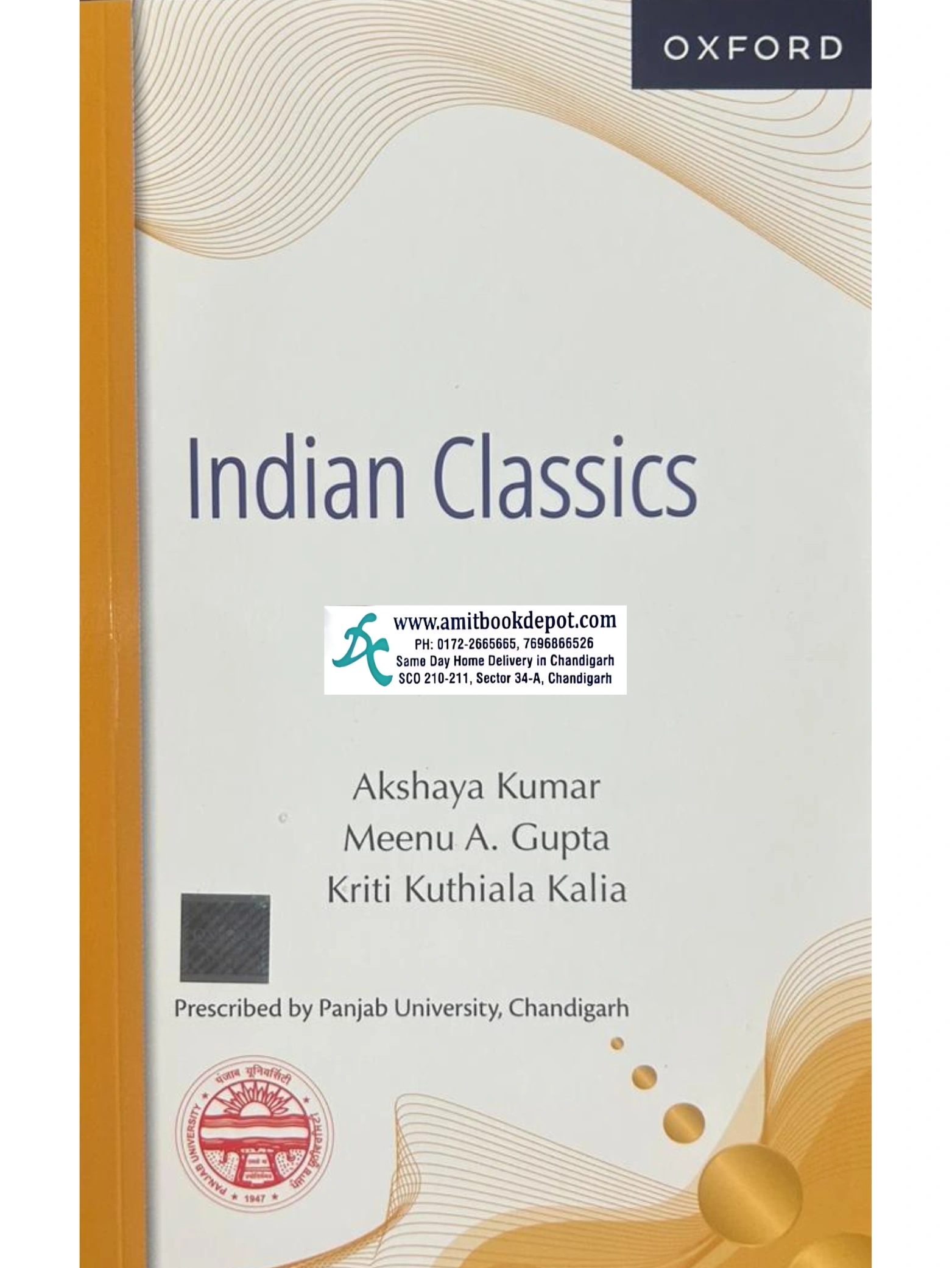
The textbook deliberately structures Unit I to present Bharat Muni's ancient Rasa theory from the Natyashastra alongside Rabindranath Tagore's modern essay "What is art?". This side-by-side analysis allows students to trace the evolution and dialogue between foundational aesthetic principles and contemporary perspectives within a single academic resource.
Yes. The treatment of the Rig Veda hymns goes beyond mere translation. The commentary includes essential context regarding Vedic cosmology, ritual practices, and philosophical inquiries, helping students understand these hymns as literary, theological, and historical documents central to Indian thought.
Absolutely. The analysis of Kalidasa's "Spring" focuses on his use of alamkaras (poetic figures), sensory imagery, and the embodiment of the shringara rasa (erotic sentiment), demonstrating his mastery as a poet and providing a model for appreciating classical Sanskrit kavya.
At this level, the focus shifts from simple morals to analyzing narrative structure, character archetypes, and the use of the fable form for didactic and political instruction. The book examines these tales as sophisticated prose models that employ allegory to convey complex social and ethical teachings.
Yes. The textbook breaks down the Upanishad's core teachings on the Atman (Philosophy of Spirit) and Sabda-Brahman using clear explanations, analogies, and a structured presentation, making its profound metaphysical concepts accessible to students encountering them for the first time.
While each unit is dedicated to a specific form, the introduction and editorial commentary throughout the book encourage comparative thinking. Students are guided to observe how similar themes—duty, nature, spirituality—are explored differently across genres, from Vedic poetry to philosophical prose and classical drama.
The syllabus consciously incorporates diversity by including the Tamil Manimekhalai alongside the Sanskrit canon. This reflects a broader, more inclusive view of Indian classics, introducing students to the rich literary heritage of different linguistic and cultural traditions within the subcontinent.
Yes. All essential technical terminology from Indian poetics and philosophy is italicized, clearly defined upon first use, and often reiterated in context. This builds a student's critical vocabulary essential for engaging with the subject matter at an academic level.
Certainly. While structured for the BA syllabus, the book serves as an excellent curated introduction for any reader seeking a foundational understanding of India's seminal literary and philosophical texts, from the Vedas and Upanishads to classical poetry and drama.
The book is designed to be a core self-contained resource. With its clear introductions, contextual notes, and progressive explanations, a motivated student can effectively use it for self-study. However, classroom discussion would naturally enrich the understanding of complex themes.
No Description Added
The textbook deliberately structures Unit I to present Bharat Muni's ancient Rasa theory from the Natyashastra alongside Rabindranath Tagore's modern essay "What is art?". This side-by-side analysis allows students to trace the evolution and dialogue between foundational aesthetic principles and contemporary perspectives within a single academic resource.
Yes. The treatment of the Rig Veda hymns goes beyond mere translation. The commentary includes essential context regarding Vedic cosmology, ritual practices, and philosophical inquiries, helping students understand these hymns as literary, theological, and historical documents central to Indian thought.
Absolutely. The analysis of Kalidasa's "Spring" focuses on his use of alamkaras (poetic figures), sensory imagery, and the embodiment of the shringara rasa (erotic sentiment), demonstrating his mastery as a poet and providing a model for appreciating classical Sanskrit kavya.
At this level, the focus shifts from simple morals to analyzing narrative structure, character archetypes, and the use of the fable form for didactic and political instruction. The book examines these tales as sophisticated prose models that employ allegory to convey complex social and ethical teachings.
Yes. The textbook breaks down the Upanishad's core teachings on the Atman (Philosophy of Spirit) and Sabda-Brahman using clear explanations, analogies, and a structured presentation, making its profound metaphysical concepts accessible to students encountering them for the first time.
While each unit is dedicated to a specific form, the introduction and editorial commentary throughout the book encourage comparative thinking. Students are guided to observe how similar themes—duty, nature, spirituality—are explored differently across genres, from Vedic poetry to philosophical prose and classical drama.
The syllabus consciously incorporates diversity by including the Tamil Manimekhalai alongside the Sanskrit canon. This reflects a broader, more inclusive view of Indian classics, introducing students to the rich literary heritage of different linguistic and cultural traditions within the subcontinent.
Yes. All essential technical terminology from Indian poetics and philosophy is italicized, clearly defined upon first use, and often reiterated in context. This builds a student's critical vocabulary essential for engaging with the subject matter at an academic level.
Certainly. While structured for the BA syllabus, the book serves as an excellent curated introduction for any reader seeking a foundational understanding of India's seminal literary and philosophical texts, from the Vedas and Upanishads to classical poetry and drama.
The book is designed to be a core self-contained resource. With its clear introductions, contextual notes, and progressive explanations, a motivated student can effectively use it for self-study. However, classroom discussion would naturally enrich the understanding of complex themes.