-
Mon-Fri: 10AM to 8PM 01722665665
-
My Account
-
-
0
Total :
₹ 0.00

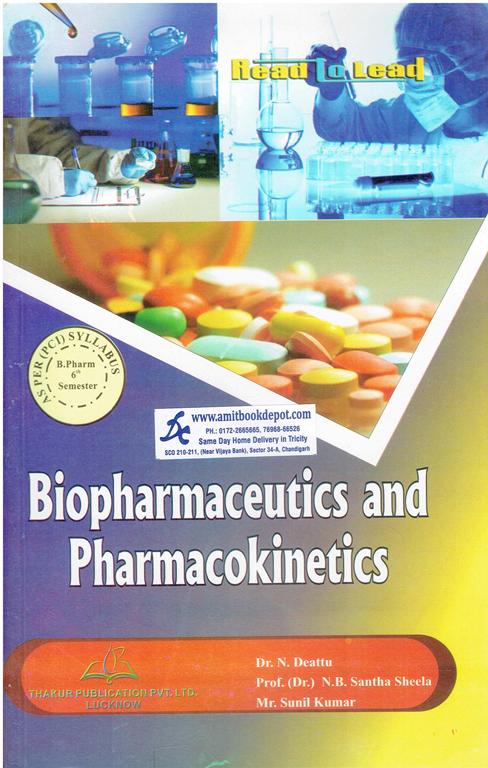

Yes, this textbook is meticulously crafted to cover 100% of the prescribed syllabus for the subject Biopharmaceutics and Pharmacokinetics (BP 604 T) for B. Pharmacy Semester VI under PTU. The chapters and units correspond directly to the official curriculum.
Absolutely. The book is structured in two integrated parts. The first half provides a comprehensive foundation in biopharmaceutics (absorption, distribution, elimination), while the second half delves deeply into pharmacokinetics, including compartment models, parameter calculations, and non-linear kinetics, as per the syllabus.
Yes, Chapter 4 is entirely dedicated to Bioavailability and Bioequivalence. It covers definitions, measurement methods, IVIVC (In Vitro-In Vivo Correlation), and the significance of bioequivalence studies, which are crucial for generic drug development and regulatory science.
While the book focuses on conceptual clarity and theory as per the PTU syllabus, it outlines the methods and principles for determining pharmacokinetic parameters from plasma and urinary data following different routes of administration (IV bolus, infusion, extravascular).
Yes, Chapter 1 provides a detailed breakdown of all mechanisms of drug absorption through the GIT, including passive diffusion, active transport, facilitated diffusion, pore transport, and endocytosis, along with factors affecting each.
Chapter 2 offers an in-depth analysis of protein binding of drugs, covering plasma protein binding, tissue binding, factors affecting it, kinetics of protein binding, and, most importantly, its clinical significance in drug therapy.
Yes, a dedicated section (4.2) covers various methods to enhance dissolution rates and bioavailability. It includes both traditional methods like salt formation and particle size reduction and modern approaches like nanotechnology and co-crystallization.
Certainly. Chapter 6 is dedicated to Multicompartment Models, specifically the two-compartment open model, and includes the kinetics of multiple dosing, steady-state levels, and the calculation of loading and maintenance doses.
Yes, Section 1.4 extensively covers extra-absorption of drugs from non-peroral routes, including intravenous, intramuscular, transdermal, inhalational, rectal, and ocular routes, explaining their absorption characteristics.
Yes, the final chapter (Chapter 7) provides an introduction to non-linear pharmacokinetics, discusses factors causing non-linearity, and explains the Michaelis-Menten method for estimating parameters.
No Description Added
Yes, this textbook is meticulously crafted to cover 100% of the prescribed syllabus for the subject Biopharmaceutics and Pharmacokinetics (BP 604 T) for B. Pharmacy Semester VI under PTU. The chapters and units correspond directly to the official curriculum.
Absolutely. The book is structured in two integrated parts. The first half provides a comprehensive foundation in biopharmaceutics (absorption, distribution, elimination), while the second half delves deeply into pharmacokinetics, including compartment models, parameter calculations, and non-linear kinetics, as per the syllabus.
Yes, Chapter 4 is entirely dedicated to Bioavailability and Bioequivalence. It covers definitions, measurement methods, IVIVC (In Vitro-In Vivo Correlation), and the significance of bioequivalence studies, which are crucial for generic drug development and regulatory science.
While the book focuses on conceptual clarity and theory as per the PTU syllabus, it outlines the methods and principles for determining pharmacokinetic parameters from plasma and urinary data following different routes of administration (IV bolus, infusion, extravascular).
Yes, Chapter 1 provides a detailed breakdown of all mechanisms of drug absorption through the GIT, including passive diffusion, active transport, facilitated diffusion, pore transport, and endocytosis, along with factors affecting each.
Chapter 2 offers an in-depth analysis of protein binding of drugs, covering plasma protein binding, tissue binding, factors affecting it, kinetics of protein binding, and, most importantly, its clinical significance in drug therapy.
Yes, a dedicated section (4.2) covers various methods to enhance dissolution rates and bioavailability. It includes both traditional methods like salt formation and particle size reduction and modern approaches like nanotechnology and co-crystallization.
Certainly. Chapter 6 is dedicated to Multicompartment Models, specifically the two-compartment open model, and includes the kinetics of multiple dosing, steady-state levels, and the calculation of loading and maintenance doses.
Yes, Section 1.4 extensively covers extra-absorption of drugs from non-peroral routes, including intravenous, intramuscular, transdermal, inhalational, rectal, and ocular routes, explaining their absorption characteristics.
Yes, the final chapter (Chapter 7) provides an introduction to non-linear pharmacokinetics, discusses factors causing non-linearity, and explains the Michaelis-Menten method for estimating parameters.