-
Mon-Fri: 10AM to 8PM 01722665665
-
My Account
-
-
0
Total :
₹ 0.00

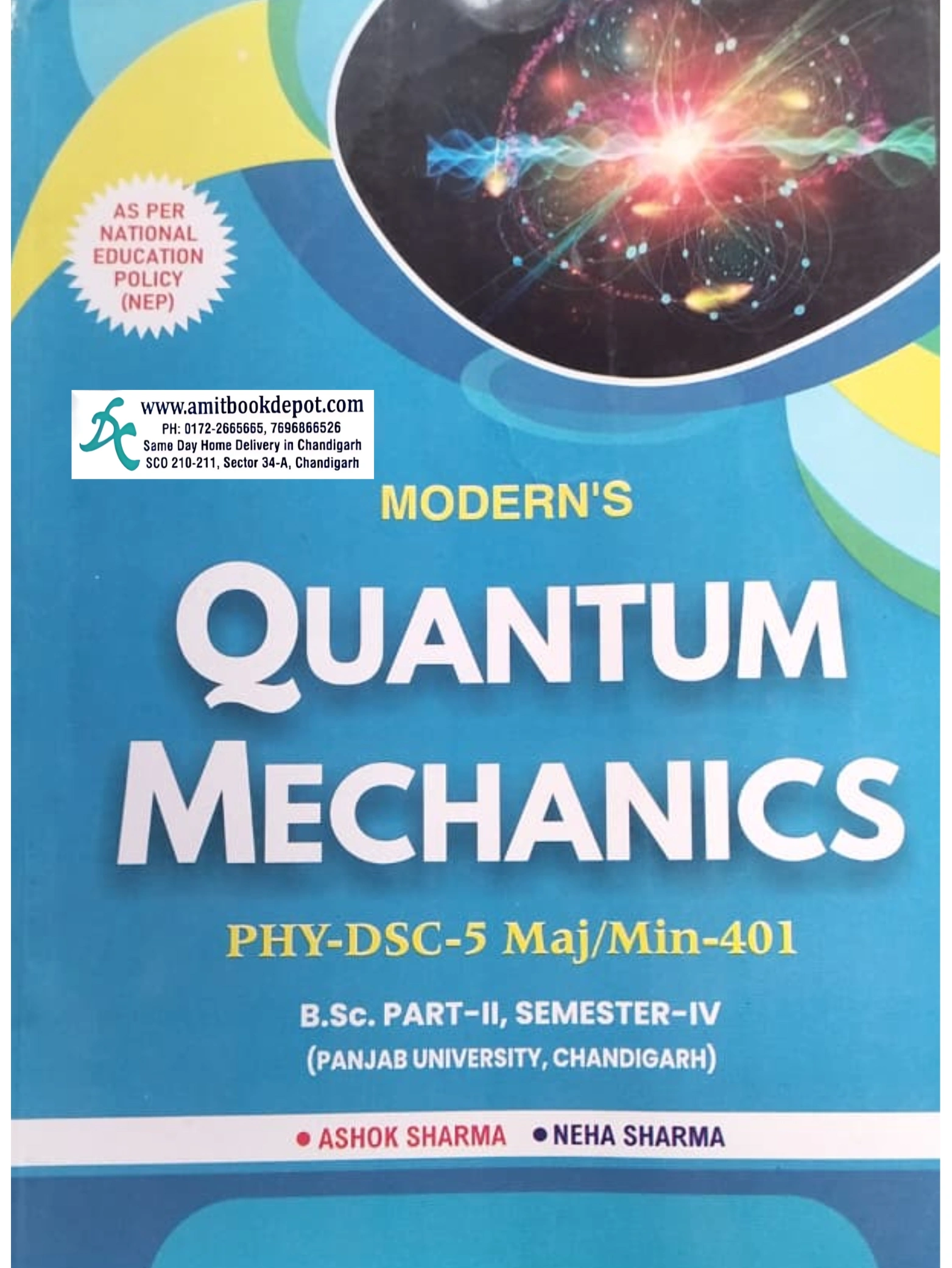



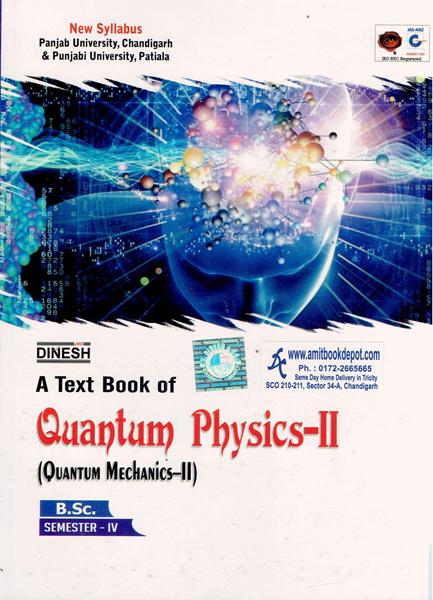
Yes, it is meticulously crafted to cover the entire latest syllabus for PHY-DSC-5 (Quantum Mechanics) for BSc Semester 4 at Panjab University, including the unit-wise breakdown and marking scheme.
The book provides the complete theory syllabus and outlines the practical exam structure and internal assessment weightage as per university guidelines, though the primary focus is on theory content.
It clearly explains the exam pattern, including that Unit III contains a compulsory short-answer question. The content is structured to facilitate quick revisions for such questions.
Absolutely. The book places strong emphasis on problem-solving, with dedicated sections on solving the Schrödinger equation for various potentials and other numerical applications as per the syllabus.
Yes, it provides detailed explanations of both the Normal Zeeman effect and the Anomalous Zeeman effect, including its application to the sodium D-lines as specified in the syllabus.
Yes, Chapter 7 on Many Electron Atoms comprehensively covers symmetric/antisymmetric wave functions, Hund’s rule, L-S coupling, J-J coupling, and term symbols.
Yes, Chapter 3 on Quantum Mechanics details the operator formalism, Hermitian operators, expectation values, and the Ehrenfest theorem with necessary mathematical rigor.
Yes, it is written in a clear, structured, and student-friendly manner with a logical progression from basic concepts to advanced applications, making it suitable for self-study.
Yes, the concepts of probability current density and the probability conservation equation are explained in the context of the Born interpretation of the wave function.
Yes, it includes relevant diagrams, figures, and schematics (like for experimental setups and potential curves) to enhance conceptual understanding of phenomena like the photoelectric effect and tunnel effect.
No Description Added
Yes, it is meticulously crafted to cover the entire latest syllabus for PHY-DSC-5 (Quantum Mechanics) for BSc Semester 4 at Panjab University, including the unit-wise breakdown and marking scheme.
The book provides the complete theory syllabus and outlines the practical exam structure and internal assessment weightage as per university guidelines, though the primary focus is on theory content.
It clearly explains the exam pattern, including that Unit III contains a compulsory short-answer question. The content is structured to facilitate quick revisions for such questions.
Absolutely. The book places strong emphasis on problem-solving, with dedicated sections on solving the Schrödinger equation for various potentials and other numerical applications as per the syllabus.
Yes, it provides detailed explanations of both the Normal Zeeman effect and the Anomalous Zeeman effect, including its application to the sodium D-lines as specified in the syllabus.
Yes, Chapter 7 on Many Electron Atoms comprehensively covers symmetric/antisymmetric wave functions, Hund’s rule, L-S coupling, J-J coupling, and term symbols.
Yes, Chapter 3 on Quantum Mechanics details the operator formalism, Hermitian operators, expectation values, and the Ehrenfest theorem with necessary mathematical rigor.
Yes, it is written in a clear, structured, and student-friendly manner with a logical progression from basic concepts to advanced applications, making it suitable for self-study.
Yes, the concepts of probability current density and the probability conservation equation are explained in the context of the Born interpretation of the wave function.
Yes, it includes relevant diagrams, figures, and schematics (like for experimental setups and potential curves) to enhance conceptual understanding of phenomena like the photoelectric effect and tunnel effect.