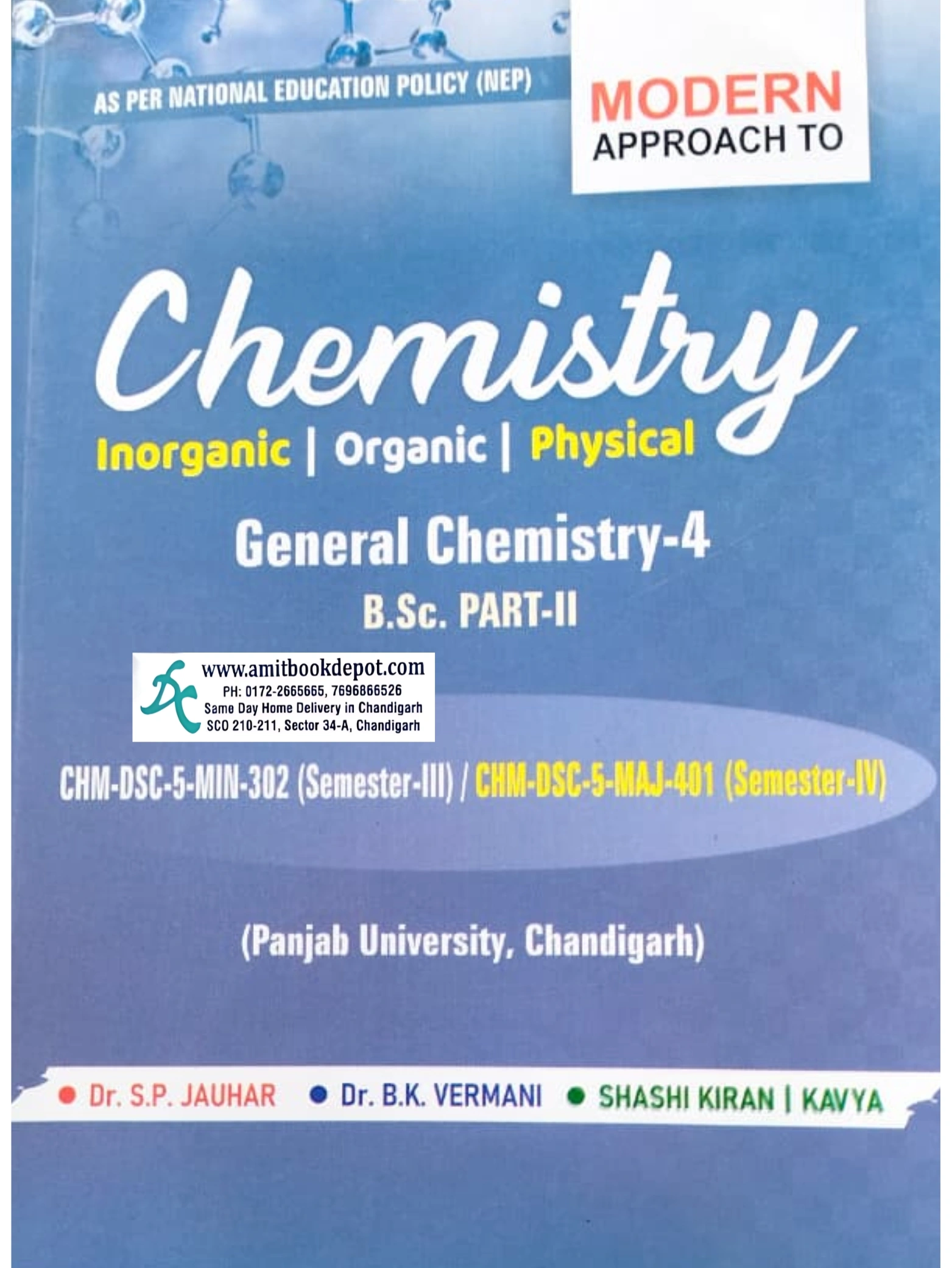
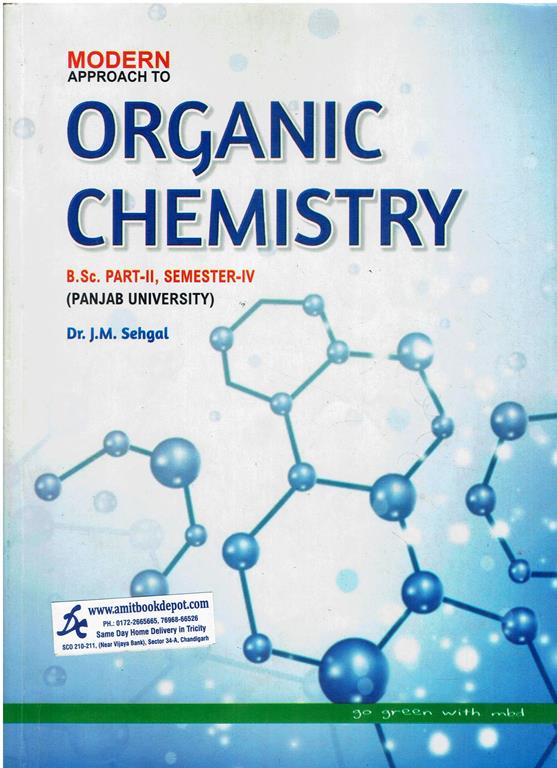
Yes, this textbook has been exclusively compiled and updated to adhere 100% to the latest prescribed syllabus for CHM-DSC-5-MAJ-401/MIN-302 (General Chemistry-4) under NEP for Panjab University's 3rd and 4th Semester B.Sc. students.
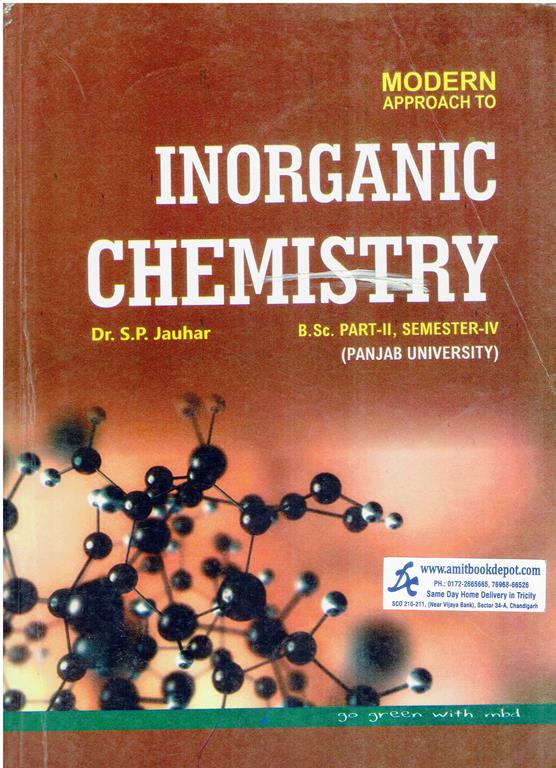
This book is designed specifically for the theory paper "General Chemistry-4" (CHM-DSC-5-MAJ-401/MIN-302) taught in the 3rd and 4th Semesters of the B.Sc. program at Panjab University, Chandigarh.
Yes, it is a comprehensive single volume that covers all three core units—Inorganic Chemistry (Group 13 & 14), Organic Chemistry (Aromaticity, Arenes, Alkyl/Aryl Halides), and Physical Chemistry (Thermodynamics-III, Chemical Equilibrium) as per the syllabus.
Absolutely. The book provides step-by-step mechanistic explanations for aromatic electrophilic substitution (nitration, halogenation, etc.) and nucleophilic substitution (SN1, SN2), complete with energy profile diagrams as required by the syllabus.
Yes, Unit I includes detailed sections on fullerenes, carbides, fluorocarbons, as well as the preparation, structure, and bonding of boron hydrides like diborane, as mandated in the Group 13 and 14 elements syllabus.
Yes, Chapter 1 of Unit III (Thermodynamics-III) covers the Third Law, Nernst heat theorem, residual entropy, and the evaluation of absolute entropy in a clear, detailed manner.
While it provides a strong foundational understanding of core topics that are part of these exams, its primary focus and structure are tailored to the specific Panjab University semester syllabus. It is an excellent base, but dedicated competitive exam materials would also be needed.
These are presented as dedicated, comparative discussions at the beginning of each group study (Group 13 and Group 14), highlighting trends, anomalies, and diagonal relationships in a structured, easy-to-compare format.
Yes, the book is written in a clear, explanatory style with logical flow and breakdown of complex concepts, making it highly suitable for self-study and revision outside the classroom.
Yes, Chapter 2 of Unit II on Alkyl and Aryl Halides distinctly covers both the addition-elimination (SNAr) and the elimination-addition (benzyne) mechanisms for nucleophilic aromatic substitution reactions.
No Description Added
Yes, this textbook has been exclusively compiled and updated to adhere 100% to the latest prescribed syllabus for CHM-DSC-5-MAJ-401/MIN-302 (General Chemistry-4) under NEP for Panjab University's 3rd and 4th Semester B.Sc. students.
This book is designed specifically for the theory paper "General Chemistry-4" (CHM-DSC-5-MAJ-401/MIN-302) taught in the 3rd and 4th Semesters of the B.Sc. program at Panjab University, Chandigarh.
Yes, it is a comprehensive single volume that covers all three core units—Inorganic Chemistry (Group 13 & 14), Organic Chemistry (Aromaticity, Arenes, Alkyl/Aryl Halides), and Physical Chemistry (Thermodynamics-III, Chemical Equilibrium) as per the syllabus.
Absolutely. The book provides step-by-step mechanistic explanations for aromatic electrophilic substitution (nitration, halogenation, etc.) and nucleophilic substitution (SN1, SN2), complete with energy profile diagrams as required by the syllabus.
Yes, Unit I includes detailed sections on fullerenes, carbides, fluorocarbons, as well as the preparation, structure, and bonding of boron hydrides like diborane, as mandated in the Group 13 and 14 elements syllabus.
Yes, Chapter 1 of Unit III (Thermodynamics-III) covers the Third Law, Nernst heat theorem, residual entropy, and the evaluation of absolute entropy in a clear, detailed manner.
While it provides a strong foundational understanding of core topics that are part of these exams, its primary focus and structure are tailored to the specific Panjab University semester syllabus. It is an excellent base, but dedicated competitive exam materials would also be needed.
These are presented as dedicated, comparative discussions at the beginning of each group study (Group 13 and Group 14), highlighting trends, anomalies, and diagonal relationships in a structured, easy-to-compare format.
Yes, the book is written in a clear, explanatory style with logical flow and breakdown of complex concepts, making it highly suitable for self-study and revision outside the classroom.
Yes, Chapter 2 of Unit II on Alkyl and Aryl Halides distinctly covers both the addition-elimination (SNAr) and the elimination-addition (benzyne) mechanisms for nucleophilic aromatic substitution reactions.