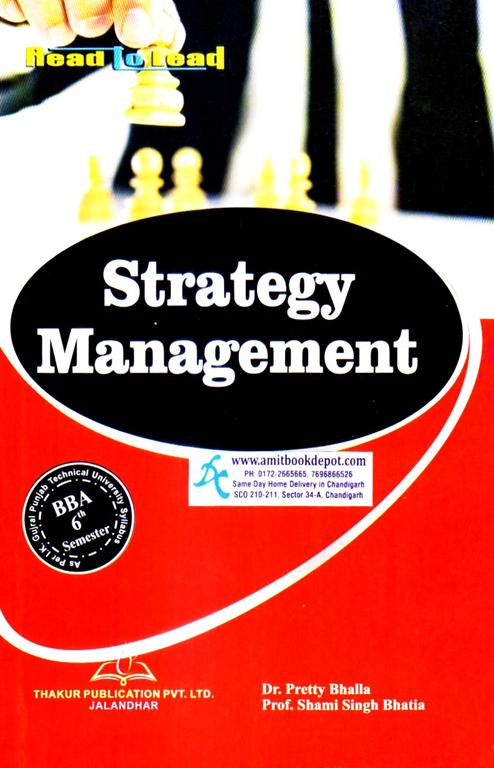
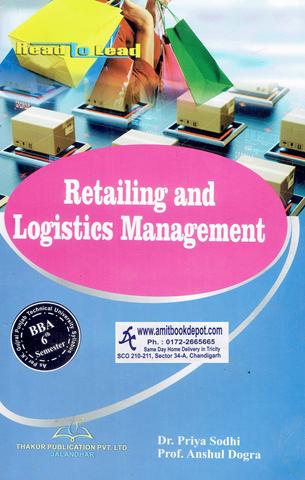
Thakur Strategy Management for BBA 6th Semester by Dr. Pretty Bhalla and Prof. Shami Singh Bhatia is a comprehensive book tailored to the BBA curriculum. Published by Thakur Publishers, it covers essential topics like strategic planning, external environment analysis (PEST, Porter's Analysis), corporate and business-level strategies, strategic choice (BCG Matrix, GE Matrix), and strategy implementation, evaluation, and control. Designed for clarity and exam-focused learning, it includes keywords such as "competitive advantage," "strategic management process," and "environmental scanning." This book is an indispensable resource for students seeking to master the principles of strategic management and excel in their academic pursuits.
Thakur Strategy Management for BBA 6th Semester by Dr. Pretty Bhalla and Prof. Shami Singh Bhatia is the definitive academic book designed to provide a comprehensive and structured understanding of strategic management principles. Published by Thakur Publishers, this book is meticulously crafted to align with the specific curriculum requirements of Bachelor of Business Administration (BBA) programs, serving as an indispensable resource for sixth-semester students, educators, and aspiring managers.
The book is structured into four detailed units, each systematically unpacking a critical phase of the strategic management process. Unit 1: Strategy and Strategic Management establishes a strong foundation by introducing the core concepts of strategy, its role, and the basic frameworks that guide modern businesses. It delves into the strategic planning process, strategic analysis, and the development of strategic ideas, providing a clear overview of strategic management. This unit distinguishes between business and corporate strategies, explores the levels of strategy, and clarifies the scope and importance of strategic management, setting the stage for more advanced topics.
Unit 2: External Business Environment equips students with the analytical tools necessary to assess the macro and micro forces shaping an organization's future. This section provides an in-depth exploration of external analysis and appraisal, including PEST analysis and Porter's frameworks for industry and competitor analysis. Key concepts such as competitive advantage, the resource-based view of the firm, and environmental scanning through tools like the Environmental Threat and Opportunity Profile (ETOP) are thoroughly explained. The unit also covers dynamic competition, segmentation, strategic groups, and life stage analysis, enabling students to diagnose the opportunities and threats in any business landscape.
Unit 3: Strategy Types and Strategic Choice transitions from analysis to action, presenting the portfolio of strategies available to organizations. It comprehensively covers corporate-level strategies, including expansion/growth, stability, retrenchment, and combination strategies. The unit further breaks down business-level strategies for achieving competitive advantage through cost leadership and differentiation. A dedicated focus on innovation underscores its strategic importance. The critical process of strategic choice is elucidated using renowned portfolio analysis tools like the BCG Matrix, GE Nine Cell Matrix, Hofer’s Product-Market Evolution Matrix, and the Directional Policy Matrix, guiding students in evaluating and selecting the most viable strategic options.
Unit 4: Strategic Implementation, Evaluation, and Control addresses the practical challenges of translating strategy into results. It details the process of strategy implementation, emphasizing the crucial links between strategy and organizational structure, resource allocation, and supportive culture. The book covers implementation across key functional areas and delves into behavioral implementation to manage human elements. The final component focuses on the evaluation of strategy and the strategic control process, outlining how to measure performance and manage strategic change effectively, ensuring that strategic goals are met in a dynamic environment.
Each unit concludes with a practical exercise section, allowing students to apply theoretical knowledge, test their understanding, and prepare effectively for examinations. With its clear, student-friendly language, logical flow from concept to application, and strict syllabus alignment, Thakur Strategy Management is more than just a book—it is a vital tool for building a robust foundation in strategic management and achieving academic excellence in BBA studies.
Is this book strictly aligned with the official BBA 6th-semester syllabus for Strategic Management?
A1
Yes, the book "Thakur Strategy Management" is specifically written and structured to cover every topic outlined in the standard BBA 6th-semester syllabus for Strategic Management, as evidenced by its unit-wise breakdown.
Q2
Are practical tools like BCG Matrix and GE Nine Cell Matrix explained with examples?
A2
Absolutely. Unit 3 of the book provides dedicated sections on these portfolio analysis tools, explaining their concepts, components, and application processes to aid in strategic choice, often supported by illustrative examples.
Q3
Does the book cover both the formulation and implementation aspects of strategy?
A3
Yes, the book provides a balanced approach. Units 1-3 focus on strategy formulation, analysis, and choice, while Unit 4 is entirely dedicated to the challenges and processes of strategy implementation, evaluation, and control.
Q4
How does this book address the topic of "Competitive Advantage"?
A4
The book explores competitive advantage from multiple angles, including Porter's generic strategies (cost and differentiation) in Unit 3 and the Resource-Based View (RBV) of the firm in Unit 2, providing a holistic understanding.
Q5
Is the concept of "Innovation" treated as a strategic function in this textbook?
A5
Yes, Innovation is presented as a critical component of business strategy in Unit 3, highlighting its role in achieving and sustaining a competitive edge in the market.
Q6
What analytical frameworks for external environment analysis are included?
A6
The book covers key external analysis frameworks in Unit 2, including PEST Analysis, Porter's Five Forces model for Industry Analysis, and Environmental Threat and Opportunity Profile (ETOP).
Q7
Are there exercises or practice questions included for self-study and exam preparation?
A7
Each of the four units concludes with an "Exercise" section, which contains questions and problems to help students test their understanding and prepare for university examinations.
Q8
Does the content explain the difference between corporate-level and business-level strategies?
A8
Yes, Unit 1 provides an overview and defines the levels of strategy, and Unit 3 offers detailed chapters separately explaining Corporate-Level Strategies (like growth and retrenchment) and Business-Level Strategies (focused on competitive advantage).
Q9
Are combination strategies covered under corporate-level strategies?
A9
Yes, Unit 3 has a dedicated section on Combination Strategies, which discusses how large organizations often employ a mix of growth, stability, and retrenchment strategies simultaneously across different business units.
Q10
Does the book provide guidance on the process of "Strategic Choice"?
A10
Unit 3 details the concept and process of strategic choice, outlining how managers can evaluate alternative strategies and make a final selection using various analytical matrices.
0.00
0 Overall Rating
5
0
4
0
3
0
2
0
1
0
Try this product & share your review &
thoughts
UNIT - 1: STRATEGY AND STRATEGIC MANAGEMENT
1. Strategy
2. Strategic Management
3. Strategic Planning
4. Strategic Analysis
5. Development of Strategic Ideas
6. Strategic Decision Making
7. Exercise
UNIT - 2: EXTERNAL BUSINESS ENVIRONMENT
1. Business Environment
2. External Analysis/External Appraisal
3. Environmental Scanning
4. Industry Analysis
5. Life Stage Analysis/Organizational Life Cycle
6. Competitor Analysis
7. Competitive Advantage
8. Segmentation and Strategic Groups
9. Exercise
UNIT - 3: STRATEGY TYPES AND STRATEGIC CHOICE
1. Corporate-Level Strategies
2. Expansion/Growth Strategies
3. Stability Strategy
4. Retrenchment Strategy
5. Combination Strategies
6. Business Strategies: Types of Competitive Advantage
7. Innovation
8. Strategic Choice
9. Exercise
UNIT - 4: STRATEGIC IMPLEMENTATION, EVALUATION, AND CONTROL
1. Strategy Implementation
2. Strategy Implementation through Structure
3. Resource Allocation
4. Implementation Strategies in Functional Areas/Functional Implementation
5. Behavioral Implementation
6. Evaluation of Strategy and Strategic Control
7. Managing Strategic Change
8. Exercise
UNIT - I
Strategy: Concept, Role, and Basic Framework: Strategic Planning Process of Strategy and Decision Making, Business and Corporate Strategies, Development of Strategic Ideas, Overview of Strategic Management, Traditional Approaches of Strategy, Levels of Strategy, Scope and Importance of Strategic Management, Framework of Strategic Analysis.
UNIT - II
Business Environment: External Analysis, Competitive Dynamics, Dynamic Competition: Hyper Competition, and Competitor Analysis Resource-Based View, Competitive Advantages, Segmentation, and Strategic Groups, PEST Analysis, Porter Analysis, Life Stage Analysis,
Environmental Scanning: Environmental Threat and Opportunity Profile.
Strategic Choice: Concept, Process of Strategic Choice, BCG Matrix, GE Nine Cell Matrix, Hofer’s Product-Market Evolution Matrix, Directional Policy Matrix.
UNIT - IV
Strategic Implementation: The Process of Strategy Implementation, Resource Allocation—Strategy and Structure—Supportive Culture—Implementing Strategies in Functional Areas.
Strategic Evaluation and Control: Evaluation of Strategy and Strategic Control, Evaluation Process, Strategic Control Process, Types of External Controls, Managing Strategic Change, Strategic
Thakur Strategy Management for BBA 6th Semester by Dr. Pretty Bhalla and Prof. Shami Singh Bhatia is the definitive academic book designed to provide a comprehensive and structured understanding of strategic management principles. Published by Thakur Publishers, this book is meticulously crafted to align with the specific curriculum requirements of Bachelor of Business Administration (BBA) programs, serving as an indispensable resource for sixth-semester students, educators, and aspiring managers.
The book is structured into four detailed units, each systematically unpacking a critical phase of the strategic management process. Unit 1: Strategy and Strategic Management establishes a strong foundation by introducing the core concepts of strategy, its role, and the basic frameworks that guide modern businesses. It delves into the strategic planning process, strategic analysis, and the development of strategic ideas, providing a clear overview of strategic management. This unit distinguishes between business and corporate strategies, explores the levels of strategy, and clarifies the scope and importance of strategic management, setting the stage for more advanced topics.
Unit 2: External Business Environment equips students with the analytical tools necessary to assess the macro and micro forces shaping an organization's future. This section provides an in-depth exploration of external analysis and appraisal, including PEST analysis and Porter's frameworks for industry and competitor analysis. Key concepts such as competitive advantage, the resource-based view of the firm, and environmental scanning through tools like the Environmental Threat and Opportunity Profile (ETOP) are thoroughly explained. The unit also covers dynamic competition, segmentation, strategic groups, and life stage analysis, enabling students to diagnose the opportunities and threats in any business landscape.
Unit 3: Strategy Types and Strategic Choice transitions from analysis to action, presenting the portfolio of strategies available to organizations. It comprehensively covers corporate-level strategies, including expansion/growth, stability, retrenchment, and combination strategies. The unit further breaks down business-level strategies for achieving competitive advantage through cost leadership and differentiation. A dedicated focus on innovation underscores its strategic importance. The critical process of strategic choice is elucidated using renowned portfolio analysis tools like the BCG Matrix, GE Nine Cell Matrix, Hofer’s Product-Market Evolution Matrix, and the Directional Policy Matrix, guiding students in evaluating and selecting the most viable strategic options.
Unit 4: Strategic Implementation, Evaluation, and Control addresses the practical challenges of translating strategy into results. It details the process of strategy implementation, emphasizing the crucial links between strategy and organizational structure, resource allocation, and supportive culture. The book covers implementation across key functional areas and delves into behavioral implementation to manage human elements. The final component focuses on the evaluation of strategy and the strategic control process, outlining how to measure performance and manage strategic change effectively, ensuring that strategic goals are met in a dynamic environment.
Each unit concludes with a practical exercise section, allowing students to apply theoretical knowledge, test their understanding, and prepare effectively for examinations. With its clear, student-friendly language, logical flow from concept to application, and strict syllabus alignment, Thakur Strategy Management is more than just a book—it is a vital tool for building a robust foundation in strategic management and achieving academic excellence in BBA studies.
UNIT - 1: STRATEGY AND STRATEGIC MANAGEMENT
1. Strategy
2. Strategic Management
3. Strategic Planning
4. Strategic Analysis
5. Development of Strategic Ideas
6. Strategic Decision Making
7. Exercise
UNIT - 2: EXTERNAL BUSINESS ENVIRONMENT
1. Business Environment
2. External Analysis/External Appraisal
3. Environmental Scanning
4. Industry Analysis
5. Life Stage Analysis/Organizational Life Cycle
6. Competitor Analysis
7. Competitive Advantage
8. Segmentation and Strategic Groups
9. Exercise
UNIT - 3: STRATEGY TYPES AND STRATEGIC CHOICE
1. Corporate-Level Strategies
2. Expansion/Growth Strategies
3. Stability Strategy
4. Retrenchment Strategy
5. Combination Strategies
6. Business Strategies: Types of Competitive Advantage
7. Innovation
8. Strategic Choice
9. Exercise
UNIT - 4: STRATEGIC IMPLEMENTATION, EVALUATION, AND CONTROL
1. Strategy Implementation
2. Strategy Implementation through Structure
3. Resource Allocation
4. Implementation Strategies in Functional Areas/Functional Implementation
Is this book strictly aligned with the official BBA 6th-semester syllabus for Strategic Management?
A1
Yes, the book "Thakur Strategy Management" is specifically written and structured to cover every topic outlined in the standard BBA 6th-semester syllabus for Strategic Management, as evidenced by its unit-wise breakdown.
Q2
Are practical tools like BCG Matrix and GE Nine Cell Matrix explained with examples?
A2
Absolutely. Unit 3 of the book provides dedicated sections on these portfolio analysis tools, explaining their concepts, components, and application processes to aid in strategic choice, often supported by illustrative examples.
Q3
Does the book cover both the formulation and implementation aspects of strategy?
A3
Yes, the book provides a balanced approach. Units 1-3 focus on strategy formulation, analysis, and choice, while Unit 4 is entirely dedicated to the challenges and processes of strategy implementation, evaluation, and control.
Q4
How does this book address the topic of "Competitive Advantage"?
A4
The book explores competitive advantage from multiple angles, including Porter's generic strategies (cost and differentiation) in Unit 3 and the Resource-Based View (RBV) of the firm in Unit 2, providing a holistic understanding.
Q5
Is the concept of "Innovation" treated as a strategic function in this textbook?
A5
Yes, Innovation is presented as a critical component of business strategy in Unit 3, highlighting its role in achieving and sustaining a competitive edge in the market.
Q6
What analytical frameworks for external environment analysis are included?
A6
The book covers key external analysis frameworks in Unit 2, including PEST Analysis, Porter's Five Forces model for Industry Analysis, and Environmental Threat and Opportunity Profile (ETOP).
Q7
Are there exercises or practice questions included for self-study and exam preparation?
A7
Each of the four units concludes with an "Exercise" section, which contains questions and problems to help students test their understanding and prepare for university examinations.
Q8
Does the content explain the difference between corporate-level and business-level strategies?
A8
Yes, Unit 1 provides an overview and defines the levels of strategy, and Unit 3 offers detailed chapters separately explaining Corporate-Level Strategies (like growth and retrenchment) and Business-Level Strategies (focused on competitive advantage).
Q9
Are combination strategies covered under corporate-level strategies?
A9
Yes, Unit 3 has a dedicated section on Combination Strategies, which discusses how large organizations often employ a mix of growth, stability, and retrenchment strategies simultaneously across different business units.
Q10
Does the book provide guidance on the process of "Strategic Choice"?
A10
Unit 3 details the concept and process of strategic choice, outlining how managers can evaluate alternative strategies and make a final selection using various analytical matrices.
UNIT - I
Strategy: Concept, Role, and Basic Framework: Strategic Planning Process of Strategy and Decision Making, Business and Corporate Strategies, Development of Strategic Ideas, Overview of Strategic Management, Traditional Approaches of Strategy, Levels of Strategy, Scope and Importance of Strategic Management, Framework of Strategic Analysis.
UNIT - II
Business Environment: External Analysis, Competitive Dynamics, Dynamic Competition: Hyper Competition, and Competitor Analysis Resource-Based View, Competitive Advantages, Segmentation, and Strategic Groups, PEST Analysis, Porter Analysis, Life Stage Analysis,
Environmental Scanning: Environmental Threat and Opportunity Profile.
Strategic Choice: Concept, Process of Strategic Choice, BCG Matrix, GE Nine Cell Matrix, Hofer’s Product-Market Evolution Matrix, Directional Policy Matrix.
UNIT - IV
Strategic Implementation: The Process of Strategy Implementation, Resource Allocation—Strategy and Structure—Supportive Culture—Implementing Strategies in Functional Areas.
Strategic Evaluation and Control: Evaluation of Strategy and Strategic Control, Evaluation Process, Strategic Control Process, Types of External Controls, Managing Strategic Change, Strategic
Classic Literature Reimagined: Discuss modern twists on classic novels.
Lorem ipsum dolor sit amet, consectetur adipiscing elit, sed
do
eiusmod tempor incididunt ut labore et dolore magna aliqua. Ut enim ad minim
veniam, quis nostrud exercitation ullamco Lorem ipsum dolor sit amet,
consectetur adipiscing elit, sed do eiusmod tempor incididunt ut labore et
dolore magna aliqua. Utenim ad minim veniam, quis nostrud exercitation
ullamco
Lorem ipsum dolor sit amet, consecte...
Classic Literature Reimagined: Discuss modern twists on classic novels.
Lorem ipsum dolor sit amet, consectetur adipiscing elit, sed
do
eiusmod tempor incididunt ut labore et dolore magna aliqua. Ut enim ad minim
veniam, quis nostrud exercitation ullamco Lorem ipsum dolor sit amet,
consectetur adipiscing elit, sed do eiusmod tempor incididunt ut labore et
dolore magna aliqua. Utenim ad minim veniam, quis nostrud exercitation
ullamco
Lorem ipsum dolor sit amet, consecte...
Classic Literature Reimagined: Discuss modern twists on classic novels.
Lorem ipsum dolor sit amet, consectetur adipiscing elit, sed
do
eiusmod tempor incididunt ut labore et dolore magna aliqua. Ut enim ad minim
veniam, quis nostrud exercitation ullamco Lorem ipsum dolor sit amet,
consectetur adipiscing elit, sed do eiusmod tempor incididunt ut labore et
dolore magna aliqua. Utenim ad minim veniam, quis nostrud exercitation
ullamco
Lorem ipsum dolor sit amet, consecte...








.jpg)