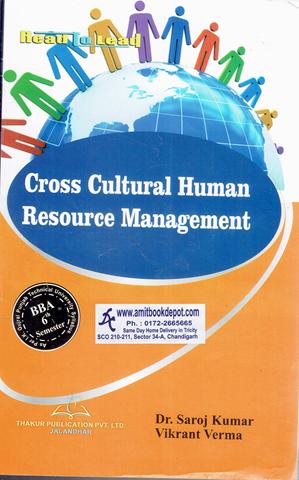
Cross Cultural Human Resource Management for BBA 6th Sem (PTU) by Dr. Saroj Kumar & Vikrant Verma | Thakur Publishers
Master the Art of Managing a Global Workforce
In today's interconnected world, the ability to navigate cultural complexities is not just an advantage—it's a necessity for any aspiring business leader. "Cross Cultural Human Resource Management" for BBA 6th Semester of Punjab Technical University (PTU) is a comprehensive academic resource meticulously designed to equip students with the critical knowledge and skills required to excel in the global business arena. This book serves as an essential guide to understanding and implementing effective cross-cultural HRM strategies, making it an indispensable tool for mastering the PTU syllabus.
Authored by the esteemed Dr. Saroj Kumar and Vikrant Verma and published by Thakur Publishers, this book delves deep into the challenges and opportunities presented by a multicultural work environment. It systematically addresses the course objectives of preparing future managers to interact with, manage, and lead people from diverse cultural backgrounds, fostering respect for cross-cultural differences and enhancing global business competency.
A Structured Approach to Global Management
The book is logically organized into four detailed units, each building upon the last to provide a holistic understanding of the subject.
1. Unit I: Introduction to Cross-Cultural Management lays the foundation by defining culture and exploring its profound significance and impact on organizations. It examines key cultural dimensions and analyzes the influence of national culture on organizational culture. This unit also investigates the dynamics of a shift in culture, including the effects of economic factors and foreign intervention on local cultures.
2. Unit II: Comparing Culture provides the tools for practical cultural analysis. It explores cultural and behavioral differences across various countries and introduces seminal models for comparing culture, including the renowned Hofstede's cultural dimensions, the Edward T. Hall study, the GLOBE project, and the Kluckhohn & Strodtbeck framework. This section is crucial for developing the cultural sensitivity needed for effective cultural adaptation and for understanding the broader international business environment.
3. Unit III: Cross-Cultural HRM is the core of the book, translating theory into practice. It covers the vital functions of staffing for global operations, debating the choice between expatriates and local managers, and the design of training & development for global operations. It further explores the dynamics of cross-cultural leadership, strategies for managing multicultural teams, and the intricacies of cross-cultural negotiation and decision-making. This unit is vital for resolving cross-cultural conflict and building harmonious, productive international teams.
4. Unit IV: Knowledge Transfer and Strategic Management elevates the discussion to a strategic level. It covers the critical process of knowledge transfer within a multinational company and delves into emerging models of strategic management in a global context. Students will learn about achieving and sustaining international competitive advantage, forming successful international strategic alliances, and navigating the complex terrain of cross-cultural ethics and values.
Key Features and Learning Outcomes
This book is designed to ensure students not only pass their exams but also gain practical insights. It includes chapter-end exercises to test comprehension and apply concepts. By engaging with this material, students will achieve the defined Course Outcomes (COs), enabling them to:
1. Understand the issues, opportunities, and challenges in Cross-Cultural Human Resource Management (IHRM).
2. Develop real-world competency in dealing with cross-cultural situations.
3. Identify the pivotal role of cross-cultural leadership in motivating and managing multicultural teams.
4. Comprehend the external forces like globalization and socio-economic changes that shape global HRM.
5. Respect and understand different cultures by analyzing cross-cultural differences.
"Cross Cultural Human Resource Management" is more than a book; it is a passport to a successful career in international business. It is the definitive resource for PTU BBA students aiming to become adept, culturally intelligent managers ready to thrive in the global village.




.jpg)