Yes. While it targets competitive exams, its deep conceptual explanations and varied problem sets can greatly benefit any student seeking a stronger understanding and appreciation of advanced high school mathematics, potentially leading to higher achievement in board exams.
This book focuses more on building fundamental mathematical reasoning and problem-solving intuition from the ground up. While it covers JEE topics, it does so with a depth and rigor often found in Olympiad training, emphasizing proof-based learning and a wider range of challenging problems beyond typical JEE patterns.
The method of inversion is not part of the standard JEE syllabus. However, it is a powerful geometric tool often covered in advanced Olympiad training. Its inclusion highlights the book's value for students aiming for the highest levels of mathematical contests.
The problems are graded. Each chapter typically begins with foundational problems that reinforce concepts before progressing to moderately difficult and finally to very challenging "thrill" problems, making it accessible for gradual learning.
Yes, the core mathematical topics covered (Algebra, Calculus, Coordinate Geometry, Trigonometry, Vectors) are foundational and perennially relevant to the JEE syllabus. The book's strength is in building timeless conceptual strength.
Functional equations, while not heavily emphasized in JEE, are a staple in the International Mathematical Olympiad (IMO) and INMO. This chapter trains students in logical reasoning and finding functions satisfying given conditions, sharply improving analytical skills.
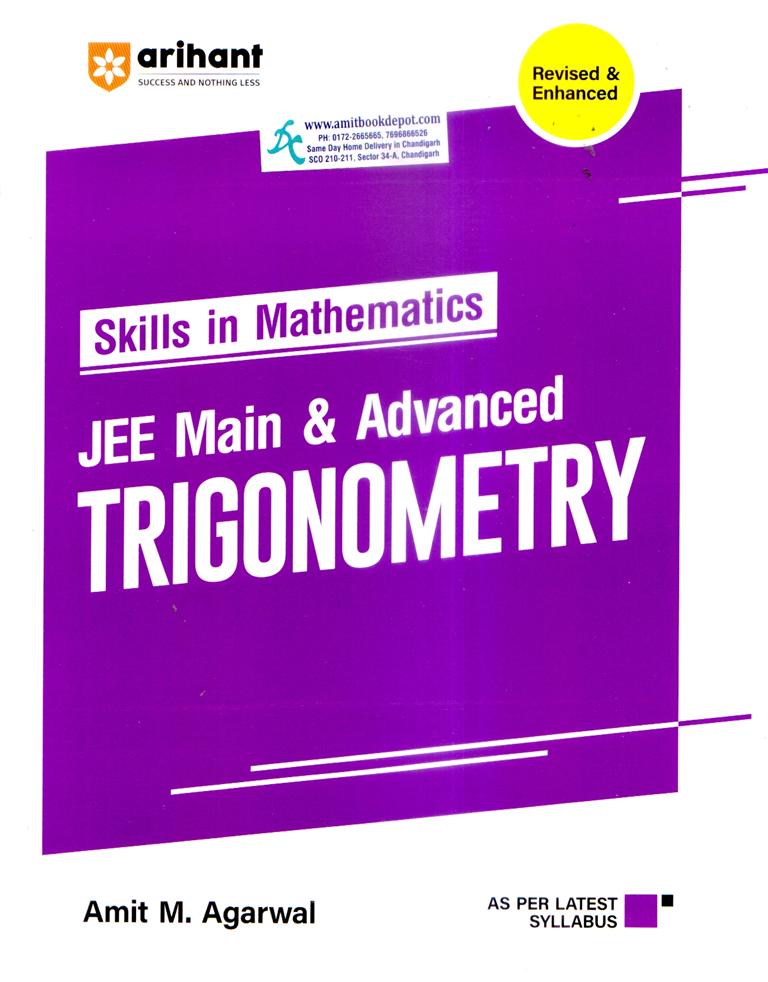
The trigonometry section is exceptionally detailed, covering identities, equations, inverse functions, and properties of triangles. It provides a formidable foundation. For JEE Advanced, combining this conceptual base with extensive practice from JEE-specific problem books is recommended.
The table of contents for this edition shows a focus on pre-calculus topics (algebra, geometry, trigonometry). Core calculus (limits, derivatives, integrals) is typically not the focus, as the book's "pre-college" scope aligns with foundational mathematics needed before delving into calculus.
A motivated student in Class 9 or 10 can certainly begin with the early chapters on Number Systems, Basic Geometry, and Arithmetic. They can progress gradually, using it as an enrichment tool alongside their school curriculum to develop advanced skills early.
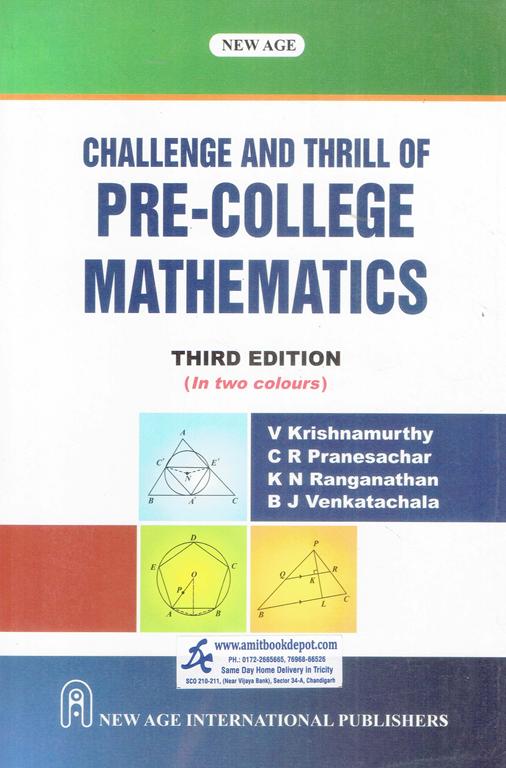
"Challenge and Thrill" is often considered more comprehensive and textbook-like, offering detailed theory before problems. Books like "Problem Primer" are often strictly problem collections with minimal theory. They can be used complementarily—"Challenge and Thrill" for learning concepts and the others for additional problem practice.
No Description Added
Yes. While it targets competitive exams, its deep conceptual explanations and varied problem sets can greatly benefit any student seeking a stronger understanding and appreciation of advanced high school mathematics, potentially leading to higher achievement in board exams.
This book focuses more on building fundamental mathematical reasoning and problem-solving intuition from the ground up. While it covers JEE topics, it does so with a depth and rigor often found in Olympiad training, emphasizing proof-based learning and a wider range of challenging problems beyond typical JEE patterns.
The method of inversion is not part of the standard JEE syllabus. However, it is a powerful geometric tool often covered in advanced Olympiad training. Its inclusion highlights the book's value for students aiming for the highest levels of mathematical contests.
The problems are graded. Each chapter typically begins with foundational problems that reinforce concepts before progressing to moderately difficult and finally to very challenging "thrill" problems, making it accessible for gradual learning.
Yes, the core mathematical topics covered (Algebra, Calculus, Coordinate Geometry, Trigonometry, Vectors) are foundational and perennially relevant to the JEE syllabus. The book's strength is in building timeless conceptual strength.
Functional equations, while not heavily emphasized in JEE, are a staple in the International Mathematical Olympiad (IMO) and INMO. This chapter trains students in logical reasoning and finding functions satisfying given conditions, sharply improving analytical skills.
The trigonometry section is exceptionally detailed, covering identities, equations, inverse functions, and properties of triangles. It provides a formidable foundation. For JEE Advanced, combining this conceptual base with extensive practice from JEE-specific problem books is recommended.
The table of contents for this edition shows a focus on pre-calculus topics (algebra, geometry, trigonometry). Core calculus (limits, derivatives, integrals) is typically not the focus, as the book's "pre-college" scope aligns with foundational mathematics needed before delving into calculus.
A motivated student in Class 9 or 10 can certainly begin with the early chapters on Number Systems, Basic Geometry, and Arithmetic. They can progress gradually, using it as an enrichment tool alongside their school curriculum to develop advanced skills early.
"Challenge and Thrill" is often considered more comprehensive and textbook-like, offering detailed theory before problems. Books like "Problem Primer" are often strictly problem collections with minimal theory. They can be used complementarily—"Challenge and Thrill" for learning concepts and the others for additional problem practice.