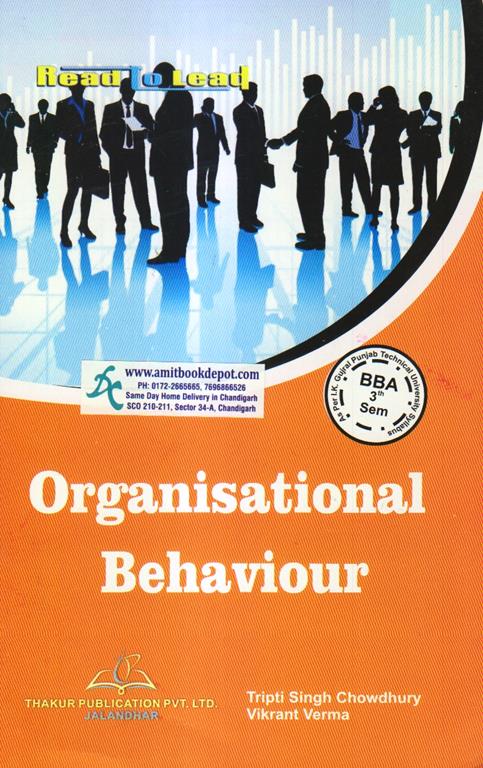
Thakur organisational behaviour BBA 3rd sem Punjab Technical University
Thakur organisational behaviour BBA 3rd sem Punjab Technical University
by Madhurima
₹220₹220.00(-/
off)
Rating & Reviews
23 Customer Review
Thakur Organizational Behavior for BBA 3rd Sem by Vikrant Verma & Tripti Singh Chowdhury is the essential guide for I.K.G. Punjab Technical University students. This comprehensive book covers the entire BBA 301 syllabus, exploring individual behavior, perception, attitude, personality, and motivation theories. It further examines group dynamics, work teams, leadership styles, conflict management, stress management, and organizational culture. Structured with clear units and practical exercises, it is designed to help students achieve all course outcomes. Keywords: Organizational Behavior, OB, Motivation, Leadership, Personality, Perception, Group Dynamics, Conflict Management, Organizational Culture, BBA Book, PTU Syllabus.
Thakur Organizational Behavior for BBA 3rd Semester by Vikrant Verma & Tripti Singh Chowdhury | Strictly as per the Latest Syllabus of I.K.G. Punjab Technical University
Master the dynamics of human behavior in the modern workplace with "Thakur Organizational Behavior," the definitive book meticulously crafted for BBA students at the third-semester level. Authored by Vikrant Verma and Tripti Singh Chowdhury and published by Thakur Publishers, this comprehensive guide is specifically aligned with the prescribed syllabus of I.K.G. Punjab Technical University for BBA Batch 2018 (Course Code: BBA 301). It serves as an indispensable resource for building a strong foundation in organizational behavior (OB) and understanding the critical role of human capital in achieving organizational excellence.
The book is strategically structured into four detailed units, each designed to systematically address the course objectives and lead students toward a clear understanding of the course outcomes. It begins by establishing a solid foundation in organizational behavior and learning (Unit I), explaining the meaning, relevance, and contributing disciplines of OB. It delves into the foundations of individual behavior and explores key learning theories, including classical conditioning, operant conditioning, and social learning theory, with practical insights into organizational behavior modification (OB MOD).
Progressing to the core of individual psychology, Unit II: Perception, Attitude, Personality, Motivation provides an in-depth analysis of the factors that shape an employee's actions and performance. Students will gain clarity on the perceptual process and its errors, the components of work-related attitudes, the determinants of personality, and the powerful forces of motivation. This unit thoroughly covers seminal motivation theories by thought leaders like Maslow, Herzberg, McGregor, Vroom, and Porter-Lawler, providing the theoretical backbone necessary for understanding what drives people at work.
The scope then expands to interpersonal and collective dynamics in Unit III: Group Behavior, Work Teams, and Leadership. This section moves beyond the individual to explore group dynamics, the stages of group development, and the critical distinction between groups and effective work teams. A significant focus is placed on leadership, examining various leadership styles and foundational leadership theories, including trait theory and behavioral theories, equipping future managers with the knowledge to guide and inspire others.
Finally, Unit IV: Managing Conflict, Stress, and Organizational Culture addresses the challenges and contextual factors present in every organization. It provides practical frameworks for understanding the sources and types of conflict, the process of conflict management, and effective resolution approaches. The book also tackles modern workplace issues like stress management, identifying its sources and outlining strategies for mitigation. It concludes by exploring the powerful concept of organizational culture, its types, and its key dimensions, helping students understand the invisible force that shapes organizational behavior.
Key Features of This Book:
1. Syllabus-Centric Approach: Uniquely tailored to cover 100% of the I.K.G. PTU BBA 301 syllabus, ensuring no topic is left unaddressed.
2. Clear Learning Objectives: Each unit is mapped to specific Course Outcomes (COs), enabling focused learning and self-assessment.
3. Structured Content: Complex topics are broken down into logically sequenced chapters for easy comprehension and retention.
4. Practical Exercises: Each unit concludes with a dedicated exercise section to help students apply theoretical concepts, test their understanding, and prepare for examinations.
5. Examination-Oriented: The content is presented in a manner that directly aids in answering university exam questions effectively.
"Thakur Organizational Behavior" is more than just a book; it is a vital tool for aspiring business professionals. It bridges the gap between theoretical OB concepts and their practical application in real-world business scenarios. By mastering the content within, students will be well-prepared not only for their semester examinations but also for their future roles as effective and empathetic managers and leaders.
Is this book strictly based on the latest I.K.G. Punjab Technical University syllabus for BBA 3rd Semester?
A1
Yes, this book is meticulously crafted to align 100% with the prescribed syllabus for BBA 301 - Organizational Behavior for BBA Batch 2018.
Q2
Does the book cover all the motivation theories mentioned in the PTU syllabus, like Vroom and Porter-Lawler?
A2
Absolutely. Unit II provides dedicated coverage of motivation theories by Maslow, Herzberg, McGregor, Vroom, and Porter-Lawler as required by the syllabus.
Q3
Are there any practical exercises or questions included for self-study and exam preparation?
A3
Yes, each of the four units concludes with a dedicated "Exercise" section to help you test your understanding and apply the concepts you have learned.
Q4
I am struggling with the difference between 'Group' and 'Work Teams.' Does this book explain it clearly?
A4
Yes, Unit III has separate chapters on "Group" and "Work Teams," which clearly distinguish their characteristics and discuss the process of creating effective teams.
Q5
Does the book explain the concept of Organizational Behavior Modification (OB MOD)?
A5
Yes, Chapter 4 in Unit I is specifically dedicated to "Organizational Behavior Modification (OB MOD)," linking learning theories to practical application in organizations.
Q6
Are the leadership theories limited to just Trait Theory?
A6
No, the book covers both Trait Theory and Behavioral Theories of leadership, as outlined in the university syllabus for Unit III.
Q7
How is the topic of 'Organizational Culture' handled in the book?
A7
Unit IV provides a comprehensive look at organizational culture, covering its meaning, concept, types, and dimensions, which is crucial for meeting Course Outcome CO4.
Q8
Can this book help me understand how to manage conflict in an organization?
A8
Yes, Unit IV covers Conflict Management in detail, including the types and sources of conflict, as well as the process and approaches to manage it effectively.
Q9
Are the 'Course Outcomes' (COs) mentioned in the syllabus integrated into the book's content?
A9
Yes, the book's structure and chapter content are designed to directly help students achieve the five stated Course Outcomes (CO1 to CO5).
Q10
Is group cohesiveness and its impact on performance covered?
A10
Yes, the chapter on Group Dynamics in Unit III discusses key group properties, including group cohesiveness and its effects.
0.00
0 Overall Rating
5
0
4
0
3
0
2
0
1
0
Try this product & share your review &
thoughts
UNIT - 1: ORGANIZATIONAL BEHAVIOR AND LEARNING
1. Organizational Behavior (OB)
2. Individual Behavior in Organization
3. Learning
4. Organizational Behavior Modification (OB MOD)
5. Exercise
UNIT - 2: PERCEPTION, ATTITUDE, PERSONALITY, MOTIVATION
1. Perception
2. Attitude
3. Personality
4. Motivation
5. Exercise
UNIT - 3: GROUP BEHAVIOR, WORK TEAMS, LEADERSHIP
1. Group
2. Group Dynamics
3. Work Teams
4. Leadership
5. Leadership Theories
6. Exercise
UNIT - 4: MANAGING CONFLICT, STRESS, AND ORGANIZATIONAL CULTURE
1. Conflict
2. Stress
3. Organizational Culture
4. Exercise
I.K.G. Punjab Technical University
BBA Batch 2018
BBA 301- Organizational Behavior
Course Objective: This course emphasizes the importance of human capital in the organizations of today. It gives an insight to the students regarding individual and group behavior in any organization.
Course Outcomes (COs): After completion of the course, the students shall be able to:
CO1—To explain the basics of organizational behavior and various challenges for OB.
CO2—To illustrate the foundations of individual behavior and various factors influencing individual behavior, viz., learning, personality, perception, attitude, and motivation.
CO3: To examine the dynamics of group development and group properties.
CO4: To understand various dimensions of organizational culture.
CO5: To analyze the process of conflict management and approaches to stress management.
Unit I
Introduction: Meaning of organizational behavior and its relevance in today’s business environment, contributing disciplines to organizational behavior, and challenges and opportunities for OB.
Individual behavior in organizations: Foundations of individual behavior and factors influencing individual behavior.
Learning: Meaning, characteristics, and theories: Classical conditioning theory, operant conditioning theory, social learning theory, and behavior modification.
Attitude: Meaning, importance, components, and types of work-related attitude.
Personality: Meaning, determinants of personality, and personality traits.
Motivation: Meaning, types of motivation, and theories of work motivation given by Maslow, Herzberg, McGregor, Vroom, and Porter–Lawler.
Unit III
Group behavior in organizations: group dynamics, types of groups, group development, theories of group development, group norms and roles, group cohesiveness,
Work Teams: Meaning, characteristics, types of teams, and creating effective teams.
Leadership: nature, leadership styles, and leadership theories: trait theory and behavioral theories.
Unit IV
Conflict Management: Meaning, types, and sources of conflict; process of conflict management; approaches to conflict management.
Stress management: sources of stress, approaches for stress management.
Organizational culture: meaning, concept, types of culture, and dimensions of organizational culture.
Thakur Organizational Behavior for BBA 3rd Semester by Vikrant Verma & Tripti Singh Chowdhury | Strictly as per the Latest Syllabus of I.K.G. Punjab Technical University
Master the dynamics of human behavior in the modern workplace with "Thakur Organizational Behavior," the definitive book meticulously crafted for BBA students at the third-semester level. Authored by Vikrant Verma and Tripti Singh Chowdhury and published by Thakur Publishers, this comprehensive guide is specifically aligned with the prescribed syllabus of I.K.G. Punjab Technical University for BBA Batch 2018 (Course Code: BBA 301). It serves as an indispensable resource for building a strong foundation in organizational behavior (OB) and understanding the critical role of human capital in achieving organizational excellence.
The book is strategically structured into four detailed units, each designed to systematically address the course objectives and lead students toward a clear understanding of the course outcomes. It begins by establishing a solid foundation in organizational behavior and learning (Unit I), explaining the meaning, relevance, and contributing disciplines of OB. It delves into the foundations of individual behavior and explores key learning theories, including classical conditioning, operant conditioning, and social learning theory, with practical insights into organizational behavior modification (OB MOD).
Progressing to the core of individual psychology, Unit II: Perception, Attitude, Personality, Motivation provides an in-depth analysis of the factors that shape an employee's actions and performance. Students will gain clarity on the perceptual process and its errors, the components of work-related attitudes, the determinants of personality, and the powerful forces of motivation. This unit thoroughly covers seminal motivation theories by thought leaders like Maslow, Herzberg, McGregor, Vroom, and Porter-Lawler, providing the theoretical backbone necessary for understanding what drives people at work.
The scope then expands to interpersonal and collective dynamics in Unit III: Group Behavior, Work Teams, and Leadership. This section moves beyond the individual to explore group dynamics, the stages of group development, and the critical distinction between groups and effective work teams. A significant focus is placed on leadership, examining various leadership styles and foundational leadership theories, including trait theory and behavioral theories, equipping future managers with the knowledge to guide and inspire others.
Finally, Unit IV: Managing Conflict, Stress, and Organizational Culture addresses the challenges and contextual factors present in every organization. It provides practical frameworks for understanding the sources and types of conflict, the process of conflict management, and effective resolution approaches. The book also tackles modern workplace issues like stress management, identifying its sources and outlining strategies for mitigation. It concludes by exploring the powerful concept of organizational culture, its types, and its key dimensions, helping students understand the invisible force that shapes organizational behavior.
Key Features of This Book:
1. Syllabus-Centric Approach: Uniquely tailored to cover 100% of the I.K.G. PTU BBA 301 syllabus, ensuring no topic is left unaddressed.
2. Clear Learning Objectives: Each unit is mapped to specific Course Outcomes (COs), enabling focused learning and self-assessment.
3. Structured Content: Complex topics are broken down into logically sequenced chapters for easy comprehension and retention.
4. Practical Exercises: Each unit concludes with a dedicated exercise section to help students apply theoretical concepts, test their understanding, and prepare for examinations.
5. Examination-Oriented: The content is presented in a manner that directly aids in answering university exam questions effectively.
"Thakur Organizational Behavior" is more than just a book; it is a vital tool for aspiring business professionals. It bridges the gap between theoretical OB concepts and their practical application in real-world business scenarios. By mastering the content within, students will be well-prepared not only for their semester examinations but also for their future roles as effective and empathetic managers and leaders.
UNIT - 1: ORGANIZATIONAL BEHAVIOR AND LEARNING
1. Organizational Behavior (OB)
2. Individual Behavior in Organization
3. Learning
4. Organizational Behavior Modification (OB MOD)
5. Exercise
UNIT - 2: PERCEPTION, ATTITUDE, PERSONALITY, MOTIVATION
1. Perception
2. Attitude
3. Personality
4. Motivation
5. Exercise
UNIT - 3: GROUP BEHAVIOR, WORK TEAMS, LEADERSHIP
1. Group
2. Group Dynamics
3. Work Teams
4. Leadership
5. Leadership Theories
6. Exercise
UNIT - 4: MANAGING CONFLICT, STRESS, AND ORGANIZATIONAL CULTURE
Is this book strictly based on the latest I.K.G. Punjab Technical University syllabus for BBA 3rd Semester?
A1
Yes, this book is meticulously crafted to align 100% with the prescribed syllabus for BBA 301 - Organizational Behavior for BBA Batch 2018.
Q2
Does the book cover all the motivation theories mentioned in the PTU syllabus, like Vroom and Porter-Lawler?
A2
Absolutely. Unit II provides dedicated coverage of motivation theories by Maslow, Herzberg, McGregor, Vroom, and Porter-Lawler as required by the syllabus.
Q3
Are there any practical exercises or questions included for self-study and exam preparation?
A3
Yes, each of the four units concludes with a dedicated "Exercise" section to help you test your understanding and apply the concepts you have learned.
Q4
I am struggling with the difference between 'Group' and 'Work Teams.' Does this book explain it clearly?
A4
Yes, Unit III has separate chapters on "Group" and "Work Teams," which clearly distinguish their characteristics and discuss the process of creating effective teams.
Q5
Does the book explain the concept of Organizational Behavior Modification (OB MOD)?
A5
Yes, Chapter 4 in Unit I is specifically dedicated to "Organizational Behavior Modification (OB MOD)," linking learning theories to practical application in organizations.
Q6
Are the leadership theories limited to just Trait Theory?
A6
No, the book covers both Trait Theory and Behavioral Theories of leadership, as outlined in the university syllabus for Unit III.
Q7
How is the topic of 'Organizational Culture' handled in the book?
A7
Unit IV provides a comprehensive look at organizational culture, covering its meaning, concept, types, and dimensions, which is crucial for meeting Course Outcome CO4.
Q8
Can this book help me understand how to manage conflict in an organization?
A8
Yes, Unit IV covers Conflict Management in detail, including the types and sources of conflict, as well as the process and approaches to manage it effectively.
Q9
Are the 'Course Outcomes' (COs) mentioned in the syllabus integrated into the book's content?
A9
Yes, the book's structure and chapter content are designed to directly help students achieve the five stated Course Outcomes (CO1 to CO5).
Q10
Is group cohesiveness and its impact on performance covered?
A10
Yes, the chapter on Group Dynamics in Unit III discusses key group properties, including group cohesiveness and its effects.
I.K.G. Punjab Technical University
BBA Batch 2018
BBA 301- Organizational Behavior
Course Objective: This course emphasizes the importance of human capital in the organizations of today. It gives an insight to the students regarding individual and group behavior in any organization.
Course Outcomes (COs): After completion of the course, the students shall be able to:
CO1—To explain the basics of organizational behavior and various challenges for OB.
CO2—To illustrate the foundations of individual behavior and various factors influencing individual behavior, viz., learning, personality, perception, attitude, and motivation.
CO3: To examine the dynamics of group development and group properties.
CO4: To understand various dimensions of organizational culture.
CO5: To analyze the process of conflict management and approaches to stress management.
Unit I
Introduction: Meaning of organizational behavior and its relevance in today’s business environment, contributing disciplines to organizational behavior, and challenges and opportunities for OB.
Individual behavior in organizations: Foundations of individual behavior and factors influencing individual behavior.
Learning: Meaning, characteristics, and theories: Classical conditioning theory, operant conditioning theory, social learning theory, and behavior modification.
Attitude: Meaning, importance, components, and types of work-related attitude.
Personality: Meaning, determinants of personality, and personality traits.
Motivation: Meaning, types of motivation, and theories of work motivation given by Maslow, Herzberg, McGregor, Vroom, and Porter–Lawler.
Unit III
Group behavior in organizations: group dynamics, types of groups, group development, theories of group development, group norms and roles, group cohesiveness,
Work Teams: Meaning, characteristics, types of teams, and creating effective teams.
Leadership: nature, leadership styles, and leadership theories: trait theory and behavioral theories.
Unit IV
Conflict Management: Meaning, types, and sources of conflict; process of conflict management; approaches to conflict management.
Stress management: sources of stress, approaches for stress management.
Organizational culture: meaning, concept, types of culture, and dimensions of organizational culture.
Classic Literature Reimagined: Discuss modern twists on classic novels.
Lorem ipsum dolor sit amet, consectetur adipiscing elit, sed
do
eiusmod tempor incididunt ut labore et dolore magna aliqua. Ut enim ad minim
veniam, quis nostrud exercitation ullamco Lorem ipsum dolor sit amet,
consectetur adipiscing elit, sed do eiusmod tempor incididunt ut labore et
dolore magna aliqua. Utenim ad minim veniam, quis nostrud exercitation
ullamco
Lorem ipsum dolor sit amet, consecte...
Classic Literature Reimagined: Discuss modern twists on classic novels.
Lorem ipsum dolor sit amet, consectetur adipiscing elit, sed
do
eiusmod tempor incididunt ut labore et dolore magna aliqua. Ut enim ad minim
veniam, quis nostrud exercitation ullamco Lorem ipsum dolor sit amet,
consectetur adipiscing elit, sed do eiusmod tempor incididunt ut labore et
dolore magna aliqua. Utenim ad minim veniam, quis nostrud exercitation
ullamco
Lorem ipsum dolor sit amet, consecte...
Classic Literature Reimagined: Discuss modern twists on classic novels.
Lorem ipsum dolor sit amet, consectetur adipiscing elit, sed
do
eiusmod tempor incididunt ut labore et dolore magna aliqua. Ut enim ad minim
veniam, quis nostrud exercitation ullamco Lorem ipsum dolor sit amet,
consectetur adipiscing elit, sed do eiusmod tempor incididunt ut labore et
dolore magna aliqua. Utenim ad minim veniam, quis nostrud exercitation
ullamco
Lorem ipsum dolor sit amet, consecte...







.jpg)