Categories
College Bookssss >
BA PU Chandigarh
BSC PU Chandigarh
MSC PU Chandigarh
BBA PU Chandigarh
MA PU Chandigarh
Medical Books
Engineering Books
Management Books
PGDCA Books
BCOM PU Chandigarh
MCOM PU Chandigarh
BCA PU Chandigarh
MCA PU Chandigarh
animate-books

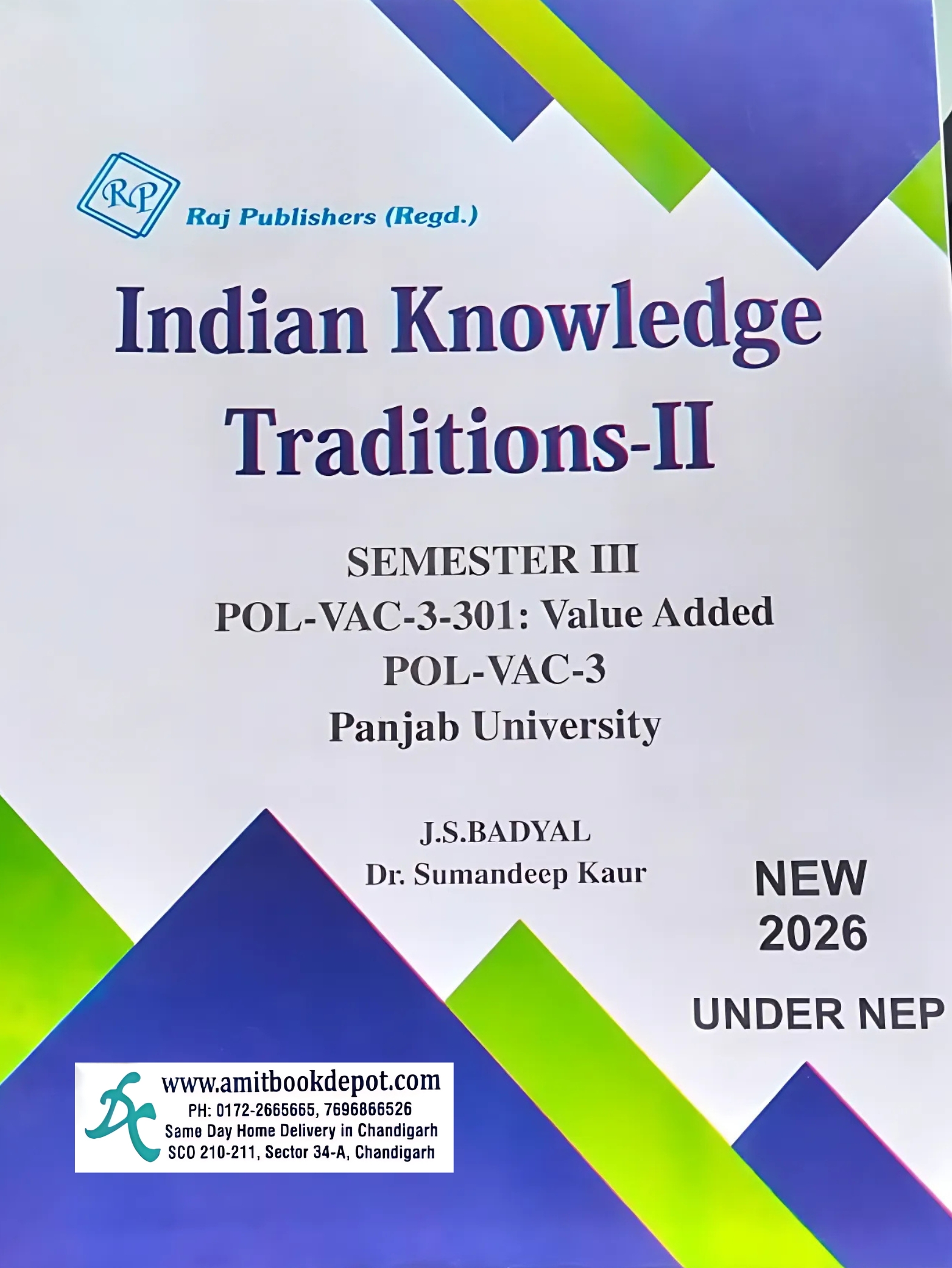
Raj Indian Knowledge Traditions - II BA 3rd Sem PU Chandigarh

by Madhurima
₹0 ₹0.00(-/ off)

Rating & Reviews

23 Customer Review

Purchase Type

Have Doubts Regarding This Product ? Ask Your Question

  • Q1
    Is this book strictly based on the latest syllabus for Panjab University's BA 3rd Semester (POL-VAC-3-301)?
    A1

    Yes, this book by Raj Publishers is meticulously crafted to cover the entire prescribed syllabus for the Value Added Course "Indian Knowledge Traditions-II" for Semester III, ensuring complete alignment with the university's requirements.

  • Q2
    Which authors' philosophies are covered in this book?
    A2

    The book provides detailed analysis of the core ideas of four key thinkers: Sri Aurobindo, Rabindranath Tagore, Mahatma Gandhi, and Dr. B.R. Ambedkar.

  • Q3
    Does the book include material for exam preparation, like practice questions?
    A3

    Yes, it includes a dedicated section for Short Answer Type Questions, which is crucial for preparing for the first compulsory question in the university exam paper.

  • Q4
    I am a student from a non-Political Science background. Will I understand the content?
    A4

    Absolutely. The book is designed as a Value Added Course for students from other disciplines. The concepts are explained in clear, accessible language to facilitate easy understanding.

  • Q5
    How many units are there in the book, and what are the topics?
    A5

    The book is divided into two units. Unit I covers Aurobindo's Spiritual Nationalism and Tagore's Nationalism & Internationalism. Unit II covers Gandhi's Ahimsa & Satya and Ambedkar's Nyaya (Social Justice).

  • Q6
    Is this book useful for internal assessment projects and class assignments?
    A6

    Yes, the comprehensive coverage of the syllabus provides the necessary content and conceptual clarity required for excelling in internal assessments, class assignments, and unit tests.

  • Q7
    What is the marking scheme for the university exam based on this syllabus?
    A7

    The theory exam is for 45 marks, with an additional 5 marks for internal assessment, making the total 50 marks. The question paper pattern is also explained in the book's preface/syllabus section.

  • Q8
    Is the language of the book complex or student-friendly?
    A8

    The language is deliberately kept student-friendly, concise, and focused on explaining complex philosophical ideas in an easy-to-grasp manner.

  • Q9
    Can this book be used as a primary study material for scoring well in exams?
    A9

    Yes, this book is designed to be a self-contained, primary resource. Covering the content thoroughly, along with the practice questions, will sufficiently prepare you for the university examinations.

  • Q10
    Does the book provide context for how these Indian knowledge traditions are relevant today?
    A10

    Yes, by explaining the core principles of these thinkers, the book inherently highlights their contemporary relevance to modern Indian society, politics, and social issues, fulfilling the course objective.
0.00

0 Overall Rating
  • 5
    0
  • 4
    0
  • 3
    0
  • 2
    0
  • 1
    0

Try this product & share your review & thoughts

No Description Added

No Table Content Added

Have Doubts Regarding This Product ? Ask Your Question

  • Q1
    Is this book strictly based on the latest syllabus for Panjab University's BA 3rd Semester (POL-VAC-3-301)?
    A1

    Yes, this book by Raj Publishers is meticulously crafted to cover the entire prescribed syllabus for the Value Added Course "Indian Knowledge Traditions-II" for Semester III, ensuring complete alignment with the university's requirements.

  • Q2
    Which authors' philosophies are covered in this book?
    A2

    The book provides detailed analysis of the core ideas of four key thinkers: Sri Aurobindo, Rabindranath Tagore, Mahatma Gandhi, and Dr. B.R. Ambedkar.

  • Q3
    Does the book include material for exam preparation, like practice questions?
    A3

    Yes, it includes a dedicated section for Short Answer Type Questions, which is crucial for preparing for the first compulsory question in the university exam paper.

  • Q4
    I am a student from a non-Political Science background. Will I understand the content?
    A4

    Absolutely. The book is designed as a Value Added Course for students from other disciplines. The concepts are explained in clear, accessible language to facilitate easy understanding.

  • Q5
    How many units are there in the book, and what are the topics?
    A5

    The book is divided into two units. Unit I covers Aurobindo's Spiritual Nationalism and Tagore's Nationalism & Internationalism. Unit II covers Gandhi's Ahimsa & Satya and Ambedkar's Nyaya (Social Justice).

  • Q6
    Is this book useful for internal assessment projects and class assignments?
    A6

    Yes, the comprehensive coverage of the syllabus provides the necessary content and conceptual clarity required for excelling in internal assessments, class assignments, and unit tests.

  • Q7
    What is the marking scheme for the university exam based on this syllabus?
    A7

    The theory exam is for 45 marks, with an additional 5 marks for internal assessment, making the total 50 marks. The question paper pattern is also explained in the book's preface/syllabus section.

  • Q8
    Is the language of the book complex or student-friendly?
    A8

    The language is deliberately kept student-friendly, concise, and focused on explaining complex philosophical ideas in an easy-to-grasp manner.

  • Q9
    Can this book be used as a primary study material for scoring well in exams?
    A9

    Yes, this book is designed to be a self-contained, primary resource. Covering the content thoroughly, along with the practice questions, will sufficiently prepare you for the university examinations.

  • Q10
    Does the book provide context for how these Indian knowledge traditions are relevant today?
    A10

    Yes, by explaining the core principles of these thinkers, the book inherently highlights their contemporary relevance to modern Indian society, politics, and social issues, fulfilling the course objective.
No Syllabus Added

0.00

0 Overall Rating
  • 5
    0
  • 4
    0
  • 3
    0
  • 2
    0
  • 1
    0

Try this product & share your review & thoughts

Top Trending Product

Related Product

Related Product

Related Blog Posts

Latest Blogs

Latest Blogs

blog-img
Classic Literature Reimagined: Discuss modern twists on classic novels.
Lorem ipsum dolor sit amet, consectetur adipiscing elit, sed do eiusmod tempor incididunt ut labore et dolore magna aliqua. Ut enim ad minim veniam, quis nostrud exercitation ullamco Lorem ipsum dolor sit amet, consectetur adipiscing elit, sed do eiusmod tempor incididunt ut labore et dolore magna aliqua. Utenim ad minim veniam, quis nostrud exercitation ullamco Lorem ipsum dolor sit amet, consecte...
Read more
Author name | 10 jan, 2025
blog-img
Classic Literature Reimagined: Discuss modern twists on classic novels.
Lorem ipsum dolor sit amet, consectetur adipiscing elit, sed do eiusmod tempor incididunt ut labore et dolore magna aliqua. Ut enim ad minim veniam, quis nostrud exercitation ullamco Lorem ipsum dolor sit amet, consectetur adipiscing elit, sed do eiusmod tempor incididunt ut labore et dolore magna aliqua. Utenim ad minim veniam, quis nostrud exercitation ullamco Lorem ipsum dolor sit amet, consecte...
Read more
Author name | 10 jan, 2025
blog-img
Classic Literature Reimagined: Discuss modern twists on classic novels.
Lorem ipsum dolor sit amet, consectetur adipiscing elit, sed do eiusmod tempor incididunt ut labore et dolore magna aliqua. Ut enim ad minim veniam, quis nostrud exercitation ullamco Lorem ipsum dolor sit amet, consectetur adipiscing elit, sed do eiusmod tempor incididunt ut labore et dolore magna aliqua. Utenim ad minim veniam, quis nostrud exercitation ullamco Lorem ipsum dolor sit amet, consecte...
Read more
Author name | 10 jan, 2025
blog-img
Classic Literature Reimagined: Discuss modern twists on classic novels.
Lorem ipsum dolor sit amet, consectetur adipiscing elit...
Read more
Author Name | 10 Jan, 2025
blog-img
Classic Literature Reimagined: Discuss modern twists on classic novels.
Lorem ipsum dolor sit amet, consectetur adipiscing elit...
Read more
Author Name | 10 Jan, 2025
blog-img
Classic Literature Reimagined: Discuss modern twists on classic novels.
Lorem ipsum dolor sit amet, consectetur adipiscing elit...
Read more
Author Name | 10 Jan, 2025
blog-img
Classic Literature Reimagined: Discuss modern twists on classic novels.
Lorem ipsum dolor sit amet, consectetur adipiscing elit...
Read more
Author Name | 10 Jan, 2025
blog-img
Classic Literature Reimagined: Discuss modern twists on classic novels.
Lorem ipsum dolor sit amet, consectetur adipiscing elit...
Read more
Author Name | 10 Jan, 2025
blog-img
Classic Literature Reimagined: Discuss modern twists on classic novels.
Lorem ipsum dolor sit amet, consectetur adipiscing elit...
Read more
Author Name | 10 Jan, 2025
blog-img
Classic Literature Reimagined: Discuss modern twists on classic novels.
Lorem ipsum dolor sit amet, consectetur adipiscing elit...
Read more
Author Name | 10 Jan, 2025
blog-img
Classic Literature Reimagined: Discuss modern twists on classic novels.
Lorem ipsum dolor sit amet, consectetur adipiscing elit...
Read more
Author Name | 10 Jan, 2025
blog-img
Classic Literature Reimagined: Discuss modern twists on classic novels.
Lorem ipsum dolor sit amet, consectetur adipiscing elit...
Read more
Author Name | 10 Jan, 2025