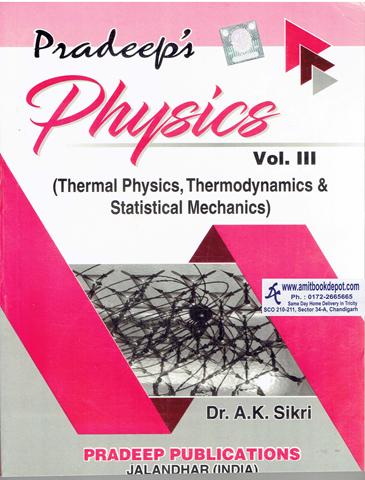

Yes, this book by Dr. A. K. Sikri is meticulously crafted to cover the latest prescribed syllabus for Thermal Physics, Thermodynamics, and Statistical Mechanics for BSc 3rd and 4th Semesters at Panjab University, Chandigarh.
Absolutely. The content is specifically designed to meet the syllabus requirements of Himachal Pradesh University (HPU) alongside other major universities, making it a versatile text for students under HPU.
Yes, the book contains numerous solved examples and a wide range of practice problems, including numericals, at the end of each chapter to aid in problem-solving skills and exam preparation.
The book breaks down complex concepts like Entropy and Thermodynamic Potentials (Gibbs, Helmholtz) into step-by-step explanations with illustrative diagrams and practical examples, making them easier to grasp.
The book is designed to be comprehensive for the collective syllabi of the mentioned universities. It is advisable to cross-check with your specific university's syllabus document, but the book covers all core topics extensively.
Yes, the book is written in clear, concise English with a logical flow of topics, making it highly suitable for self-study alongside regular classroom lectures.
Yes, it provides a comprehensive foundation, starting from Basic Probability to detailed discussions on Maxwell-Boltzmann, Bose-Einstein, and Fermi-Dirac Statistics, fully covering the typical BSc-level syllabus.
While primarily designed for BSc semester exams, the clear conceptual foundation it lays in Thermal Physics and Statistical Mechanics can be highly beneficial for initial preparation for competitive exams like MSc entrance tests.
This book is specifically tailored to the syllabus of North Indian universities (PU, HPU, GNDU, Punjab Uni.), making it more directly relevant for semester exams than general international texts. It distills key concepts in a concise, exam-oriented manner.
Yes, the chapter on Carnot’s Engine thoroughly covers reversible and irreversible cycles, efficiency, and the principles that form the basis for understanding refrigerators and heat pumps.
No Description Added
Yes, this book by Dr. A. K. Sikri is meticulously crafted to cover the latest prescribed syllabus for Thermal Physics, Thermodynamics, and Statistical Mechanics for BSc 3rd and 4th Semesters at Panjab University, Chandigarh.
Absolutely. The content is specifically designed to meet the syllabus requirements of Himachal Pradesh University (HPU) alongside other major universities, making it a versatile text for students under HPU.
Yes, the book contains numerous solved examples and a wide range of practice problems, including numericals, at the end of each chapter to aid in problem-solving skills and exam preparation.
The book breaks down complex concepts like Entropy and Thermodynamic Potentials (Gibbs, Helmholtz) into step-by-step explanations with illustrative diagrams and practical examples, making them easier to grasp.
The book is designed to be comprehensive for the collective syllabi of the mentioned universities. It is advisable to cross-check with your specific university's syllabus document, but the book covers all core topics extensively.
Yes, the book is written in clear, concise English with a logical flow of topics, making it highly suitable for self-study alongside regular classroom lectures.
Yes, it provides a comprehensive foundation, starting from Basic Probability to detailed discussions on Maxwell-Boltzmann, Bose-Einstein, and Fermi-Dirac Statistics, fully covering the typical BSc-level syllabus.
While primarily designed for BSc semester exams, the clear conceptual foundation it lays in Thermal Physics and Statistical Mechanics can be highly beneficial for initial preparation for competitive exams like MSc entrance tests.
This book is specifically tailored to the syllabus of North Indian universities (PU, HPU, GNDU, Punjab Uni.), making it more directly relevant for semester exams than general international texts. It distills key concepts in a concise, exam-oriented manner.
Yes, the chapter on Carnot’s Engine thoroughly covers reversible and irreversible cycles, efficiency, and the principles that form the basis for understanding refrigerators and heat pumps.