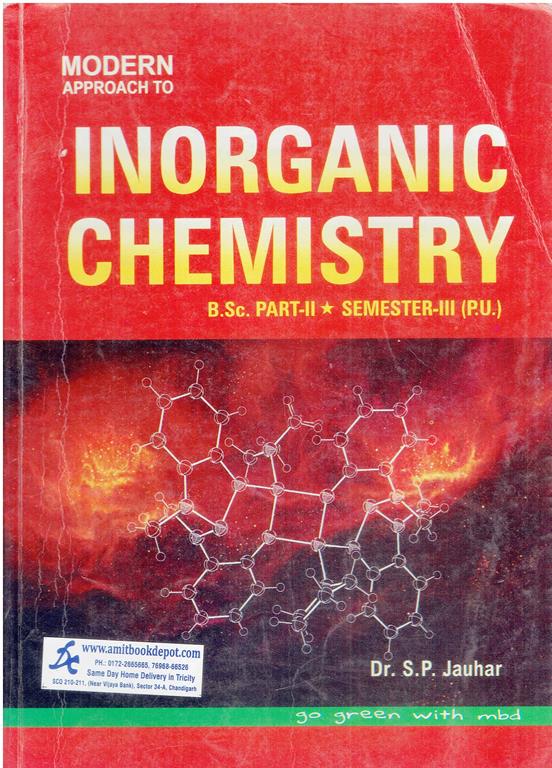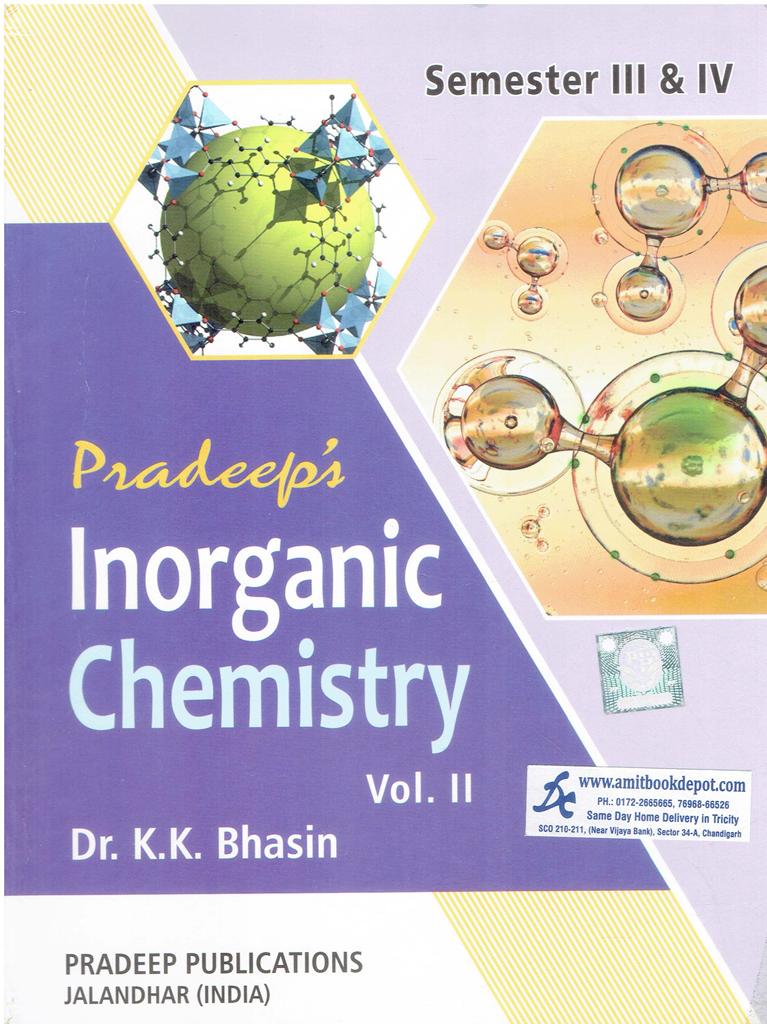
Yes, this book is meticulously crafted to cover the latest prescribed syllabus for Inorganic Chemistry Papers IX (Sem 3) and XIII (Sem 4) of Panjab University, as detailed in the content.
Absolutely. The content specifically includes topics for G.N.D.U. 4th Semester, such as Bioinorganic Chemistry, making it a suitable resource for their curriculum.
Yes, Chapter 11 is dedicated to Bioinorganic Chemistry, covering essential elements, hemoglobin, myoglobin, and nitrogen fixation.
It is covered in great depth across two extensive chapters, including Werner’s theory, isomerism, Valence Bond Theory, bonding, and applications, as required by all mentioned university syllabi.
Yes, Chapter 6 on Oxidation-Reduction provides a detailed explanation and uses of Latimer diagrams, Frost diagrams, and Pourbaix diagrams for analyzing redox stability.
Yes, Chapter 10 provides the Theory of Qualitative and Quantitative Inorganic Analysis, which is crucial for practical understanding and is part of syllabi like M.D.U. and Kurukshetra University.
Yes, the table of contents and syllabus mapping show comprehensive coverage of topics for both M.D.U. 3rd and 4th Semester Inorganic Chemistry papers.
Yes, Chapter 9, "Compounds," separately details the preparation, properties, and uses of important compounds like Potassium Permanganate (KMnO4), Ziegler-Natta Catalyst, and Prussian Blue.
Given its comprehensive coverage, structured pedagogy, and alignment with multiple university syllabi, it is designed to be a self-sufficient primary textbook for exam preparation.
Yes, separate chapters for the first series and the second/third series, along with a dedicated section on comparative study, provide a clear analysis of their properties.
No Description Added
Yes, this book is meticulously crafted to cover the latest prescribed syllabus for Inorganic Chemistry Papers IX (Sem 3) and XIII (Sem 4) of Panjab University, as detailed in the content.
Absolutely. The content specifically includes topics for G.N.D.U. 4th Semester, such as Bioinorganic Chemistry, making it a suitable resource for their curriculum.
Yes, Chapter 11 is dedicated to Bioinorganic Chemistry, covering essential elements, hemoglobin, myoglobin, and nitrogen fixation.
It is covered in great depth across two extensive chapters, including Werner’s theory, isomerism, Valence Bond Theory, bonding, and applications, as required by all mentioned university syllabi.
Yes, Chapter 6 on Oxidation-Reduction provides a detailed explanation and uses of Latimer diagrams, Frost diagrams, and Pourbaix diagrams for analyzing redox stability.
Yes, Chapter 10 provides the Theory of Qualitative and Quantitative Inorganic Analysis, which is crucial for practical understanding and is part of syllabi like M.D.U. and Kurukshetra University.
Yes, the table of contents and syllabus mapping show comprehensive coverage of topics for both M.D.U. 3rd and 4th Semester Inorganic Chemistry papers.
Yes, Chapter 9, "Compounds," separately details the preparation, properties, and uses of important compounds like Potassium Permanganate (KMnO4), Ziegler-Natta Catalyst, and Prussian Blue.
Given its comprehensive coverage, structured pedagogy, and alignment with multiple university syllabi, it is designed to be a self-sufficient primary textbook for exam preparation.
Yes, separate chapters for the first series and the second/third series, along with a dedicated section on comparative study, provide a clear analysis of their properties.