No, this is a critical guide and analysis. It provides summaries, explanations, and critical insights, but students must read the complete primary texts as prescribed by the university.
The guide includes dedicated sections on the Dalit literary movement, providing socio-historical context and critical frameworks to help you analyze "The Weave of My Life" beyond the narrative.
Yes, the guide extensively covers the allegorical nature of 'Tughlaq', drawing clear parallels between the play's events and the post-independence political landscape of India, which is crucial for answering essay-length questions.
Yes, it touches upon key translation challenges, discussing how translators like Agha Shahid Ali and David Rubin have approached rhythm, metaphor, and cultural nuance, aiding your appreciation of the poetry in its translated form.
The guide provides an introduction to Spivak's role as a translator and theorist, explaining how her feminist and postcolonial perspectives shape the reading of "Draupadi" and "The Breast Giver."
Absolutely. It offers comparative analysis, highlighting Premchand's realism, Devi's activist literature, and Basheer's minimalist and often humorous style, helping you distinguish between them in exams.
The guide provides comprehensive character analyses for major and minor characters, exploring their motivations, socio-economic backgrounds, and symbolic significance within the novel's themes.
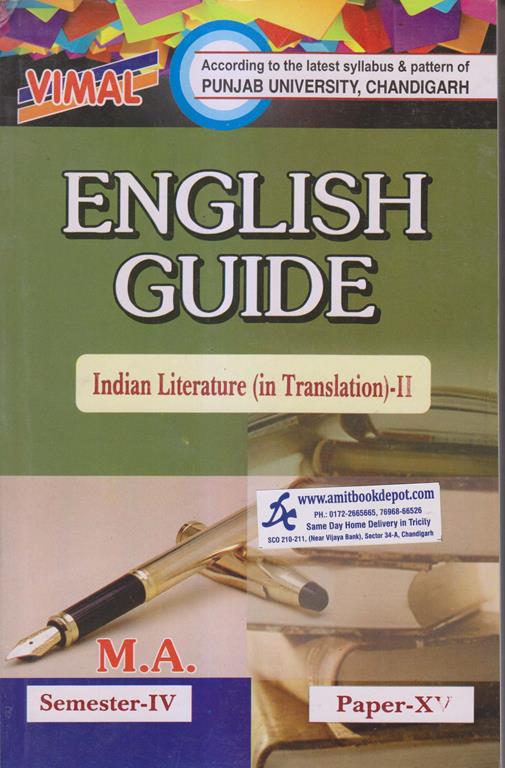
While it is specifically tailored for Panjab University's syllabus, students from other universities with overlapping curricula for Indian Literature in Translation may find the critical analyses highly beneficial.
Yes, each unit begins with a biographical note on the author, situating them within their specific literary tradition (e.g., Progressive Writers' Movement, Dalit Panthers, Navodaya).
The guide offers a stanza-by-stanza or line-by-line explanation where necessary, focusing on literary devices, imagery, and thematic significance to ensure a thorough understanding.
No Description Added
No, this is a critical guide and analysis. It provides summaries, explanations, and critical insights, but students must read the complete primary texts as prescribed by the university.
The guide includes dedicated sections on the Dalit literary movement, providing socio-historical context and critical frameworks to help you analyze "The Weave of My Life" beyond the narrative.
Yes, the guide extensively covers the allegorical nature of 'Tughlaq', drawing clear parallels between the play's events and the post-independence political landscape of India, which is crucial for answering essay-length questions.
Yes, it touches upon key translation challenges, discussing how translators like Agha Shahid Ali and David Rubin have approached rhythm, metaphor, and cultural nuance, aiding your appreciation of the poetry in its translated form.
The guide provides an introduction to Spivak's role as a translator and theorist, explaining how her feminist and postcolonial perspectives shape the reading of "Draupadi" and "The Breast Giver."
Absolutely. It offers comparative analysis, highlighting Premchand's realism, Devi's activist literature, and Basheer's minimalist and often humorous style, helping you distinguish between them in exams.
The guide provides comprehensive character analyses for major and minor characters, exploring their motivations, socio-economic backgrounds, and symbolic significance within the novel's themes.
While it is specifically tailored for Panjab University's syllabus, students from other universities with overlapping curricula for Indian Literature in Translation may find the critical analyses highly beneficial.
Yes, each unit begins with a biographical note on the author, situating them within their specific literary tradition (e.g., Progressive Writers' Movement, Dalit Panthers, Navodaya).
The guide offers a stanza-by-stanza or line-by-line explanation where necessary, focusing on literary devices, imagery, and thematic significance to ensure a thorough understanding.