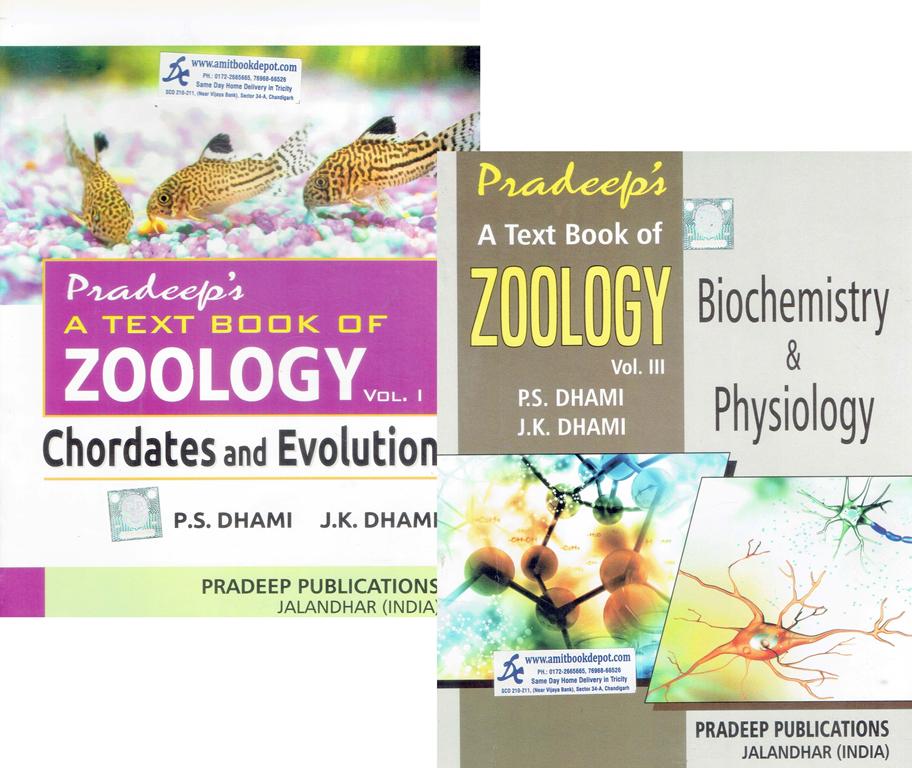
Yes, this textbook is meticulously crafted to align perfectly with the BSc 2nd Year (3rd and 4th Semester) Zoology syllabus of Panjab University, Chandigarh, as well as GNDU Amritsar and several other Indian universities.

Absolutely. Volume I includes dedicated sections and chapters on comparative morphology, such as "Lancelet vs. Lamprey," "Shark vs. Frog," and "Sand Lizard vs. Pigeon vs. Rabbit," which are essential for understanding evolutionary adaptations.
Yes, Volume II begins with a detailed Biochemistry section that thoroughly covers Carbohydrates, Lipids, Proteins, their Metabolism, Enzymes, and Nucleic Acids (DNA and RNA).
Yes, Volume II has an extensive Physiology section with dedicated chapters on the Nerve Impulse, Muscle Contraction, Hormones, Circulation, Excretion, Respiration, and more, providing a complete overview of animal function.
Yes, Section IV of Volume I is entirely devoted to the "Skeletons of Representative Vertebrates," including Scoliodon, Frog, Varanus, Pigeon (Gallus), Rabbit, and Rat, complemented with explanatory diagrams.
Yes, a key feature of this textbook is the consistent inclusion of the "Economic Importance" of each major animal group, such as fishes, amphibians, reptiles, birds, and mammals, adding applied context to the study.
While primarily designed for university exams, its clear conceptual foundation and comprehensive coverage of core zoology topics make it a good starting resource for competitive exams like NET, SET, and entrance tests for postgraduate courses.
Yes, Pradeep Publications is known for incorporating clear, well-labeled, and precise diagrams and illustrations throughout the text to aid in visualizing anatomical and physiological concepts.
Yes, the content flows logically from Protochordates (Hemichordata, Urochordata, Cephalochordata) to all classes of Vertebrates, ensuring a complete understanding of the Phylum Chordata.
Yes, the authors are known for their straightforward, lucid, and student-friendly explanatory style, making complex topics accessible to all undergraduate students.
No Description Added
Yes, this textbook is meticulously crafted to align perfectly with the BSc 2nd Year (3rd and 4th Semester) Zoology syllabus of Panjab University, Chandigarh, as well as GNDU Amritsar and several other Indian universities.
Absolutely. Volume I includes dedicated sections and chapters on comparative morphology, such as "Lancelet vs. Lamprey," "Shark vs. Frog," and "Sand Lizard vs. Pigeon vs. Rabbit," which are essential for understanding evolutionary adaptations.
Yes, Volume II begins with a detailed Biochemistry section that thoroughly covers Carbohydrates, Lipids, Proteins, their Metabolism, Enzymes, and Nucleic Acids (DNA and RNA).
Yes, Volume II has an extensive Physiology section with dedicated chapters on the Nerve Impulse, Muscle Contraction, Hormones, Circulation, Excretion, Respiration, and more, providing a complete overview of animal function.
Yes, Section IV of Volume I is entirely devoted to the "Skeletons of Representative Vertebrates," including Scoliodon, Frog, Varanus, Pigeon (Gallus), Rabbit, and Rat, complemented with explanatory diagrams.
Yes, a key feature of this textbook is the consistent inclusion of the "Economic Importance" of each major animal group, such as fishes, amphibians, reptiles, birds, and mammals, adding applied context to the study.
While primarily designed for university exams, its clear conceptual foundation and comprehensive coverage of core zoology topics make it a good starting resource for competitive exams like NET, SET, and entrance tests for postgraduate courses.
Yes, Pradeep Publications is known for incorporating clear, well-labeled, and precise diagrams and illustrations throughout the text to aid in visualizing anatomical and physiological concepts.
Yes, the content flows logically from Protochordates (Hemichordata, Urochordata, Cephalochordata) to all classes of Vertebrates, ensuring a complete understanding of the Phylum Chordata.
Yes, the authors are known for their straightforward, lucid, and student-friendly explanatory style, making complex topics accessible to all undergraduate students.