Categories
College Bookssss >
BA PU Chandigarh
BSC PU Chandigarh
MSC PU Chandigarh
BBA PU Chandigarh
MA PU Chandigarh
Medical Books
Engineering Books
Management Books
PGDCA Books
BCOM PU Chandigarh
MCOM PU Chandigarh
BCA PU Chandigarh
MCA PU Chandigarh
animate-books

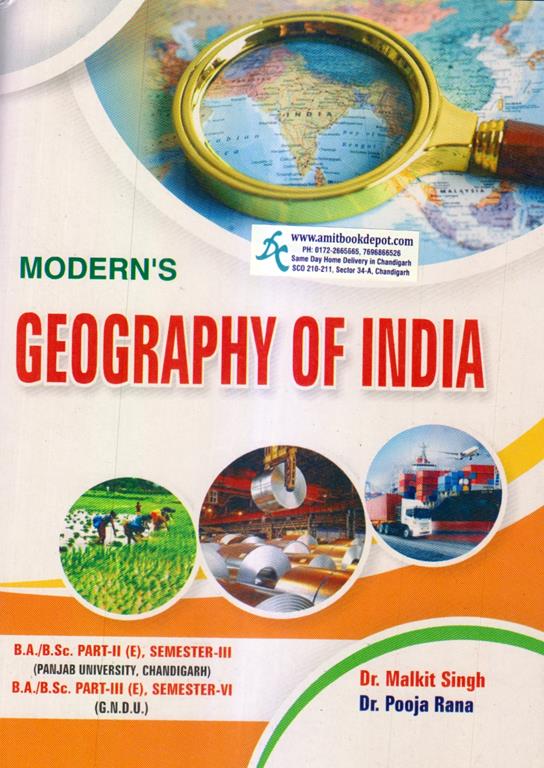
Moderns Geography of india BA/B.Sc part II semester III Panjab University Chandigarh

by Madhurima
₹450 ₹450.00(-/ off)

Rating & Reviews

23 Customer Review

Discover the essence of India's geographical diversity with Geography of India by Dr. Malkit Singh, an essential revision book for BA/BSc second-year semester 3 students at Punjab University, Chandigarh. This comprehensive guide delves into key aspects such as physiography, climate, drainage systems, and natural resources, providing a holistic understanding of the country's geography. With engaging insights and real-world applications, this book emphasizes the interplay between physical landscapes and human activities, making it a crucial resource for third-semester Geography students.
Have Doubts Regarding This Product ? Ask Your Question

  • Q1
    What is the primary focus of the "Geography of India" book?
    A1

    The primary focus of the book is to provide a comprehensive understanding of India's geographical diversity, covering aspects such as physiography, climate, drainage systems, and natural resources.

  • Q2
    Who is the author of the book?
    A2

    The author of the book is Dr. Malkit Singh, a distinguished expert in the field of geography.

  • Q3
    Who is the book tailored for?
    A3

    The book is tailored specifically for students of BA/BSc in their second year at Punjab University, Chandigarh.

  • Q4
    What are the key topics covered in the book?
    A4

    The book covers topics such as introduction to geography, relief and physiography, drainage system, climate, soils and natural vegetation, mineral resources, power resources, population, agriculture, industries, transport system, and international trade.

  • Q5
    What is the syllabus for the course?
    A5

    The syllabus for the course includes four units: introduction to geography, agriculture and natural hazards, population and mineral and power resources, and industries and trade and transport.

  • Q6
    Is the book essential for aspiring geographers and professionals alike?
    A6

    Yes, the book is essential for aspiring geographers and professionals alike due to its comprehensive analysis of geographical concepts and real-world applications.

  • Q7
    : What is the basis for internal assessment for CDOE reappear/improvement candidates?
    A7

    The internal assessment for CDOE reappear/improvement candidates will be based on the maximum marks allotted to the paper(s) concerned.

  • Q8
    How does "Geography of India" connect geography with human activities?
    A8

    The book explicitly explores the interplay between physical landscapes and human activities, showing how geography influences urbanization, settlement patterns, and economic development across the country.

  • Q9
    : What methodologies are used in the book to teach geographical concepts?
    A9

    The book uses a combination of descriptive text, diagrams, maps, and real-life examples to engage students and facilitate a deeper understanding of geographical concepts.

  • Q10
    Can educators use this book for teaching purposes beyond Punjab University?
    A10

    While tailored for Punjab University students, the comprehensive content of the book makes it a valuable resource for geography courses in other institutions as well.
0.00

0 Overall Rating
  • 5
    0
  • 4
    0
  • 3
    0
  • 2
    0
  • 1
    0

Try this product & share your review & thoughts

1.An Introduction 

2.Relief or Physiography 

3.Drainage System 

4.Climate 

5.Soils and natural vegetation 

6.Mineral resources

7.Power resources 

8.Population 

9.Agriculture 

10.Industries 

11.Transport system of India 

12.International Trade 

Latest Syllabus Of Geography of india BA/B.Sc part II Semester III Panjab University (PU) Chandigarh, As Per New Education Policy (NEP)


Max. Marks : 70
Theory : 60 marks
Internal Assessment : 10 marks
Time : 3 Hours

Objectives:
To foster an understanding of the physical and cultural landscape of India and its spatial diversity
Course Content

Unit-I
Introduction: India in the context of South Asia, Asia and the World. 
Physiography: Relief, drainage, climate, vegetation, soils. 

Unit-II
Agriculture: Characteristics and problems of Indian agriculture; irrigation, major crops (rice, wheat, maize,
sugarcane, cotton, jute and tea), Food security with special reference to India.
Natural hazards in India: Flood, Drought and Earthquake.

Unit III
Population: Distribution and density, Growth, Migration, Urbanization 
Mineral and Power Resources: Iron ore, manganese, mica, copper and gold; Coal, Petroleum, Hydroelectricity
and Non- conventional Power resources. 

Unit IV
Industries: Distribution and localization factors of major industries (Iron and Steel, Cotton Textiles, Sugar,
Fertilizers, Automobile).
Trade &Transport: Rail, Road, Airways and Waterways; International Trade

Note : 1. A compulsory question containing 15 short answer type questions shall be set
covering the whole syllabus. The students shall attempt any 10 parts. The answer of each
part should be in about 25 words. Each part will carry 2 marks (Total 20 marks).
 2. The whole syllabus will be divided into 4 Units. Eight questions will be set out of the
whole syllabus, two from each Unit. The students will be required to attempt one question
from each Unit. Each question will carry 10 marks (Total 40 marks). These will be in
addition to the compulsory question.
 3. Special credit will be given to suitable use of maps and diagrams. Use of unmarked map
stencils and colour pens/pencils are allowed.
 4. Six hours Theory Classes in a week are compulsory.
 5. Internal assessment will be based on (i) class tests,(5%) (ii) academic activities, Seminar,
Project, Assignment (3%) and (iii) attendance(2%).
 6. For CDOE, reappear/improvement candidate(s) who have not been assessed earlier for
Internal Assessment, the question paper(s) in their case shall be of Maximum Marks
allotted to the paper(s) concerned. The paper-setter must put note (6) in the question
paper.

Embark on an enlightening journey with Geography of India, authored by Dr. Malkit Singh, a distinguished expert in the field of geography, tailored specifically for students of BA/BSc in their second year at Punjab University, Chandigarh. As learners dive into this text, they will find that it not only serves as an academic resource for their third-semester studies but also as a gateway to understanding the geographical marvels that shape Indian society and culture.

This groundbreaking book is a comprehensive exploration of India's diverse physical landscape, providing a holistic perspective that encompasses various facets such as physiography, climate, drainage, soils, vegetation, and resource management. Dr. Singh meticulously crafts each chapter to engage students, encouraging them to critically analyze and appreciate the multifaceted nature of India's geography.

The initial chapters lay a profound foundation, introducing students to the notion of geographical significance. Readers will explore how India’s physical geography serves as the bedrock upon which its rich tapestry of cultures, economies, and ecosystems are built. The author effectively illustrates the intricate linkage between natural features and human activities, emphasizing how geography influences everything from settlement patterns to economic development.

One of the focal points of Geography of India is its in-depth examination of the country's Relief and Physiography. Students will learn about the varying landforms, from the towering Himalayan ranges in the north to the coastal plains in the south. This section crucially highlights the geographical zones of India and their unique characteristics an understanding that is vital for any aspiring geographer.

The discussions around the Drainage System reveal the significance of rivers not just as water sources, but as lifelines that support agriculture, transportation, and industry. Dr. Malkit Singh provides a thorough exploration of major rivers like the Ganges, Brahmaputra, and Yamuna, elucidating their cultural significance and the challenges they face due to human intervention and climate change.

The text’s investigation into Climate offers nuanced insights into how varying climates across different regions influence agriculture, flora, and fauna. With India’s diverse climatic zones—from the arid deserts of Rajasthan to the lush green hills of the Western Ghats—students are equipped to understand the wide-ranging impact of climatic conditions on the socio-economic framework.

1.An Introduction 

2.Relief or Physiography 

3.Drainage System 

4.Climate 

5.Soils and natural vegetation 

6.Mineral resources

7.Power resources 

8.Population 

9.Agriculture 

10.Industries 

11.Transport system of India 

12.International Trade 

Have Doubts Regarding This Product ? Ask Your Question

  • Q1
    What is the primary focus of the "Geography of India" book?
    A1

    The primary focus of the book is to provide a comprehensive understanding of India's geographical diversity, covering aspects such as physiography, climate, drainage systems, and natural resources.

  • Q2
    Who is the author of the book?
    A2

    The author of the book is Dr. Malkit Singh, a distinguished expert in the field of geography.

  • Q3
    Who is the book tailored for?
    A3

    The book is tailored specifically for students of BA/BSc in their second year at Punjab University, Chandigarh.

  • Q4
    What are the key topics covered in the book?
    A4

    The book covers topics such as introduction to geography, relief and physiography, drainage system, climate, soils and natural vegetation, mineral resources, power resources, population, agriculture, industries, transport system, and international trade.

  • Q5
    What is the syllabus for the course?
    A5

    The syllabus for the course includes four units: introduction to geography, agriculture and natural hazards, population and mineral and power resources, and industries and trade and transport.

  • Q6
    Is the book essential for aspiring geographers and professionals alike?
    A6

    Yes, the book is essential for aspiring geographers and professionals alike due to its comprehensive analysis of geographical concepts and real-world applications.

  • Q7
    : What is the basis for internal assessment for CDOE reappear/improvement candidates?
    A7

    The internal assessment for CDOE reappear/improvement candidates will be based on the maximum marks allotted to the paper(s) concerned.

  • Q8
    How does "Geography of India" connect geography with human activities?
    A8

    The book explicitly explores the interplay between physical landscapes and human activities, showing how geography influences urbanization, settlement patterns, and economic development across the country.

  • Q9
    : What methodologies are used in the book to teach geographical concepts?
    A9

    The book uses a combination of descriptive text, diagrams, maps, and real-life examples to engage students and facilitate a deeper understanding of geographical concepts.

  • Q10
    Can educators use this book for teaching purposes beyond Punjab University?
    A10

    While tailored for Punjab University students, the comprehensive content of the book makes it a valuable resource for geography courses in other institutions as well.

Latest Syllabus Of Geography of india BA/B.Sc part II Semester III Panjab University (PU) Chandigarh, As Per New Education Policy (NEP)


Max. Marks : 70
Theory : 60 marks
Internal Assessment : 10 marks
Time : 3 Hours

Objectives:
To foster an understanding of the physical and cultural landscape of India and its spatial diversity
Course Content

Unit-I
Introduction: India in the context of South Asia, Asia and the World. 
Physiography: Relief, drainage, climate, vegetation, soils. 

Unit-II
Agriculture: Characteristics and problems of Indian agriculture; irrigation, major crops (rice, wheat, maize,
sugarcane, cotton, jute and tea), Food security with special reference to India.
Natural hazards in India: Flood, Drought and Earthquake.

Unit III
Population: Distribution and density, Growth, Migration, Urbanization 
Mineral and Power Resources: Iron ore, manganese, mica, copper and gold; Coal, Petroleum, Hydroelectricity
and Non- conventional Power resources. 

Unit IV
Industries: Distribution and localization factors of major industries (Iron and Steel, Cotton Textiles, Sugar,
Fertilizers, Automobile).
Trade &Transport: Rail, Road, Airways and Waterways; International Trade

Note : 1. A compulsory question containing 15 short answer type questions shall be set
covering the whole syllabus. The students shall attempt any 10 parts. The answer of each
part should be in about 25 words. Each part will carry 2 marks (Total 20 marks).
 2. The whole syllabus will be divided into 4 Units. Eight questions will be set out of the
whole syllabus, two from each Unit. The students will be required to attempt one question
from each Unit. Each question will carry 10 marks (Total 40 marks). These will be in
addition to the compulsory question.
 3. Special credit will be given to suitable use of maps and diagrams. Use of unmarked map
stencils and colour pens/pencils are allowed.
 4. Six hours Theory Classes in a week are compulsory.
 5. Internal assessment will be based on (i) class tests,(5%) (ii) academic activities, Seminar,
Project, Assignment (3%) and (iii) attendance(2%).
 6. For CDOE, reappear/improvement candidate(s) who have not been assessed earlier for
Internal Assessment, the question paper(s) in their case shall be of Maximum Marks
allotted to the paper(s) concerned. The paper-setter must put note (6) in the question
paper.

0.00

0 Overall Rating
  • 5
    0
  • 4
    0
  • 3
    0
  • 2
    0
  • 1
    0

Try this product & share your review & thoughts

Top Trending Product

Related Product

Related Product

Related Blog Posts

Latest Blogs

Latest Blogs

blog-img
Classic Literature Reimagined: Discuss modern twists on classic novels.
Lorem ipsum dolor sit amet, consectetur adipiscing elit, sed do eiusmod tempor incididunt ut labore et dolore magna aliqua. Ut enim ad minim veniam, quis nostrud exercitation ullamco Lorem ipsum dolor sit amet, consectetur adipiscing elit, sed do eiusmod tempor incididunt ut labore et dolore magna aliqua. Utenim ad minim veniam, quis nostrud exercitation ullamco Lorem ipsum dolor sit amet, consecte...
Read more
Author name | 10 jan, 2025
blog-img
Classic Literature Reimagined: Discuss modern twists on classic novels.
Lorem ipsum dolor sit amet, consectetur adipiscing elit, sed do eiusmod tempor incididunt ut labore et dolore magna aliqua. Ut enim ad minim veniam, quis nostrud exercitation ullamco Lorem ipsum dolor sit amet, consectetur adipiscing elit, sed do eiusmod tempor incididunt ut labore et dolore magna aliqua. Utenim ad minim veniam, quis nostrud exercitation ullamco Lorem ipsum dolor sit amet, consecte...
Read more
Author name | 10 jan, 2025
blog-img
Classic Literature Reimagined: Discuss modern twists on classic novels.
Lorem ipsum dolor sit amet, consectetur adipiscing elit, sed do eiusmod tempor incididunt ut labore et dolore magna aliqua. Ut enim ad minim veniam, quis nostrud exercitation ullamco Lorem ipsum dolor sit amet, consectetur adipiscing elit, sed do eiusmod tempor incididunt ut labore et dolore magna aliqua. Utenim ad minim veniam, quis nostrud exercitation ullamco Lorem ipsum dolor sit amet, consecte...
Read more
Author name | 10 jan, 2025
blog-img
Classic Literature Reimagined: Discuss modern twists on classic novels.
Lorem ipsum dolor sit amet, consectetur adipiscing elit...
Read more
Author Name | 10 Jan, 2025
blog-img
Classic Literature Reimagined: Discuss modern twists on classic novels.
Lorem ipsum dolor sit amet, consectetur adipiscing elit...
Read more
Author Name | 10 Jan, 2025
blog-img
Classic Literature Reimagined: Discuss modern twists on classic novels.
Lorem ipsum dolor sit amet, consectetur adipiscing elit...
Read more
Author Name | 10 Jan, 2025
blog-img
Classic Literature Reimagined: Discuss modern twists on classic novels.
Lorem ipsum dolor sit amet, consectetur adipiscing elit...
Read more
Author Name | 10 Jan, 2025
blog-img
Classic Literature Reimagined: Discuss modern twists on classic novels.
Lorem ipsum dolor sit amet, consectetur adipiscing elit...
Read more
Author Name | 10 Jan, 2025
blog-img
Classic Literature Reimagined: Discuss modern twists on classic novels.
Lorem ipsum dolor sit amet, consectetur adipiscing elit...
Read more
Author Name | 10 Jan, 2025
blog-img
Classic Literature Reimagined: Discuss modern twists on classic novels.
Lorem ipsum dolor sit amet, consectetur adipiscing elit...
Read more
Author Name | 10 Jan, 2025
blog-img
Classic Literature Reimagined: Discuss modern twists on classic novels.
Lorem ipsum dolor sit amet, consectetur adipiscing elit...
Read more
Author Name | 10 Jan, 2025
blog-img
Classic Literature Reimagined: Discuss modern twists on classic novels.
Lorem ipsum dolor sit amet, consectetur adipiscing elit...
Read more
Author Name | 10 Jan, 2025