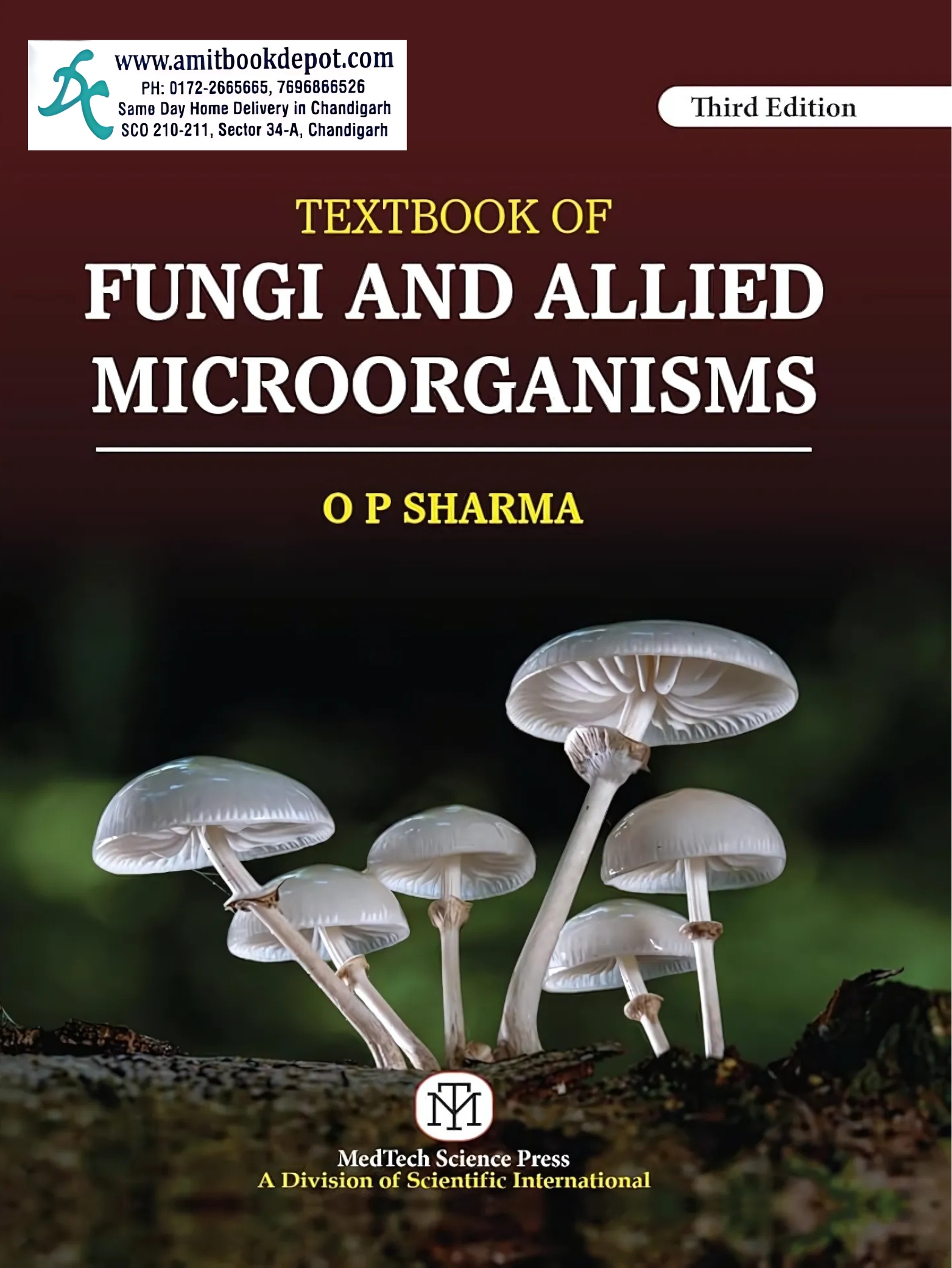
While the primary and most detailed focus is on the fungal kingdom, the book's scope explicitly includes "allied microorganisms." It contains dedicated chapters on Bacteria (Ch. 32) and Viruses (Ch. 33), and integrates them in the final chapter on Selected Diseases Caused by Fungi, Bacteria, and Viruses (Ch. 35), providing a broader microbiological context.
The book follows a well-established morphological and traditional taxonomic framework (e.g., using divisions like Mastigomycotina, Zygomycotina). It is an excellent resource for understanding the classical classification that forms the basis of mycology. For the very latest molecular phylogenetic groupings, students would need to supplement with current research papers, as the textbook provides the essential foundational taxonomy.
The book has strong applied sections. Key chapters include Economic Importance of Fungi (Ch. 24), Fungi and Biotechnology (Ch. 25), Mushroom Cultivation (Ch. 26), and Single-Cell Protein (Ch. 27). The chapter on Mycorrhizae (Ch. 30) also covers critical agricultural and ecological applications.
Highly relevant. Beyond the extensive coverage of fungal plant pathogens across taxonomic groups, the final section is crucial for you. It includes Plant Diseases and Their Control (General Account) (Ch. 34) and Selected Diseases Caused by Fungi, Bacteria, and Viruses (Ch. 35), making it a direct resource for understanding disease causation and management.
Absolutely. There are entire chapters dedicated to two major symbiotic associations: Mycorrhizae (Ch. 30), the relationship between fungi and plant roots, and Lichens (Ch. 31), the symbiotic partnership between fungi and algae/cyanobacteria.
It is presented as a "Chronology of Major Events," providing a structured timeline of key discoveries and figures. This offers a valuable historical framework for understanding the development of mycological science.
Yes. The book provides specific chapters on both Trichomycetes (Ch. 11), which are often commensals in arthropod guts, and Laboulbeniomycetes (Ch. 16), which are specialized parasitic ascomycetes on insects. This makes it a comprehensive reference for less commonly taught groups.
The foundation is laid in the chapter Fungal Cell: Structure and Composition (Ch. 3), which details the ultrastructure, cell wall composition (chitin, glucans), and other cellular components essential for understanding fungal physiology.
The book's primary emphasis is on general, systematic, and applied mycology with a strong bent towards plant sciences and biotechnology. While human pathogenic fungi may be mentioned within taxonomic descriptions (e.g., in Ascomycetes), it is not a dedicated textbook of medical mycology.
The chapter on Mushroom Cultivation (Ch. 26) provides a conceptual and methodological overview of the process. For detailed, step-by-step lab protocols for fungal culturing or staining, students would typically need a separate laboratory manual, as this is primarily a theory textbook.
No Description Added
While the primary and most detailed focus is on the fungal kingdom, the book's scope explicitly includes "allied microorganisms." It contains dedicated chapters on Bacteria (Ch. 32) and Viruses (Ch. 33), and integrates them in the final chapter on Selected Diseases Caused by Fungi, Bacteria, and Viruses (Ch. 35), providing a broader microbiological context.
The book follows a well-established morphological and traditional taxonomic framework (e.g., using divisions like Mastigomycotina, Zygomycotina). It is an excellent resource for understanding the classical classification that forms the basis of mycology. For the very latest molecular phylogenetic groupings, students would need to supplement with current research papers, as the textbook provides the essential foundational taxonomy.
The book has strong applied sections. Key chapters include Economic Importance of Fungi (Ch. 24), Fungi and Biotechnology (Ch. 25), Mushroom Cultivation (Ch. 26), and Single-Cell Protein (Ch. 27). The chapter on Mycorrhizae (Ch. 30) also covers critical agricultural and ecological applications.
Highly relevant. Beyond the extensive coverage of fungal plant pathogens across taxonomic groups, the final section is crucial for you. It includes Plant Diseases and Their Control (General Account) (Ch. 34) and Selected Diseases Caused by Fungi, Bacteria, and Viruses (Ch. 35), making it a direct resource for understanding disease causation and management.
Absolutely. There are entire chapters dedicated to two major symbiotic associations: Mycorrhizae (Ch. 30), the relationship between fungi and plant roots, and Lichens (Ch. 31), the symbiotic partnership between fungi and algae/cyanobacteria.
It is presented as a "Chronology of Major Events," providing a structured timeline of key discoveries and figures. This offers a valuable historical framework for understanding the development of mycological science.
Yes. The book provides specific chapters on both Trichomycetes (Ch. 11), which are often commensals in arthropod guts, and Laboulbeniomycetes (Ch. 16), which are specialized parasitic ascomycetes on insects. This makes it a comprehensive reference for less commonly taught groups.
The foundation is laid in the chapter Fungal Cell: Structure and Composition (Ch. 3), which details the ultrastructure, cell wall composition (chitin, glucans), and other cellular components essential for understanding fungal physiology.
The book's primary emphasis is on general, systematic, and applied mycology with a strong bent towards plant sciences and biotechnology. While human pathogenic fungi may be mentioned within taxonomic descriptions (e.g., in Ascomycetes), it is not a dedicated textbook of medical mycology.
The chapter on Mushroom Cultivation (Ch. 26) provides a conceptual and methodological overview of the process. For detailed, step-by-step lab protocols for fungal culturing or staining, students would typically need a separate laboratory manual, as this is primarily a theory textbook.