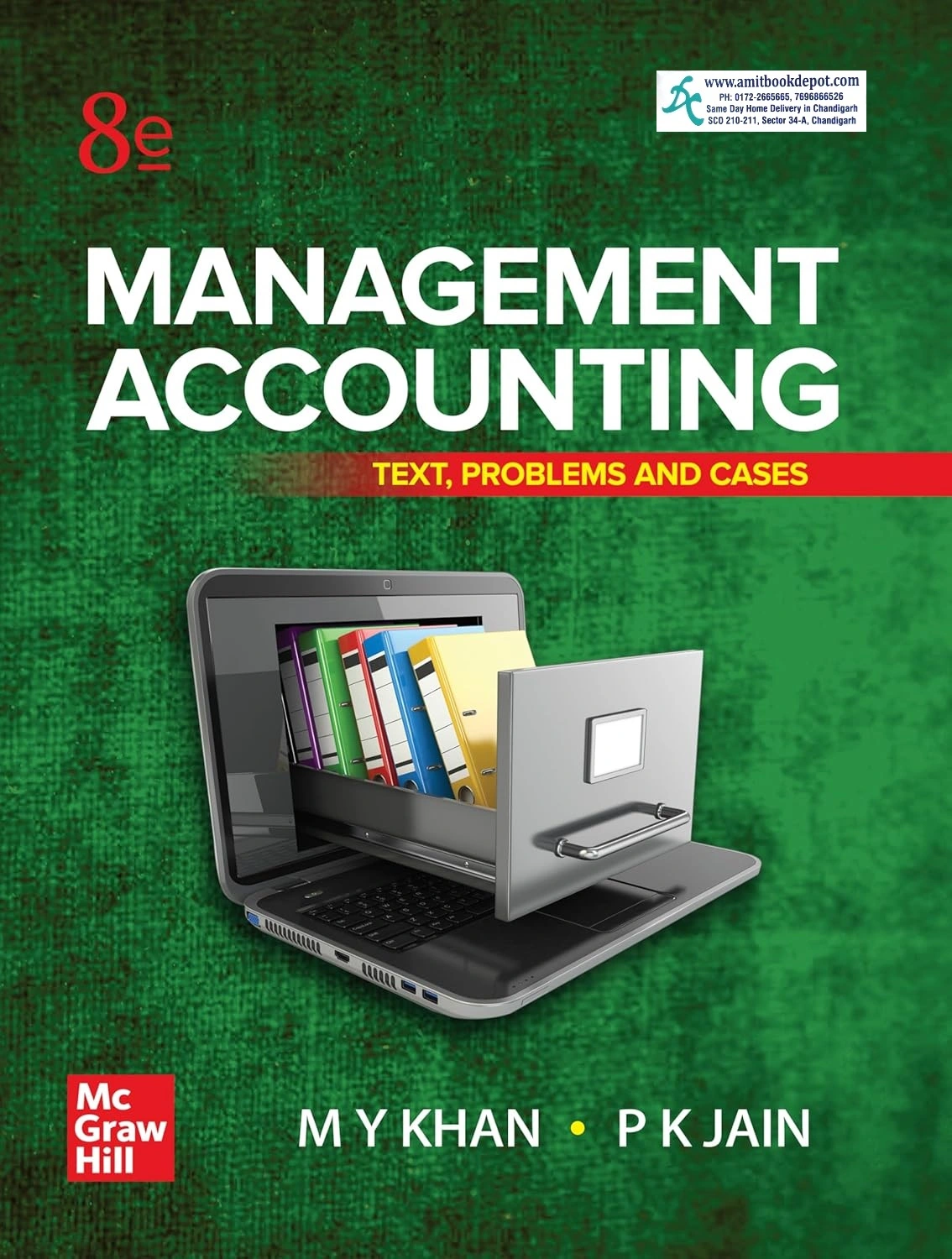
McGraw-Hill’s ‘Management Accounting: Text, Problems and Cases’ (8th Edition) by M Y Khan and P K Jain offers a complete toolkit for financial decision-making. This edition covers GAAP, cash flow analysis, activity-based costing, CVP analysis, budgeting, variance analysis, the balanced scorecard, and capital budgeting. With over 100 cases and graded problems, it bridges cost accounting theory with strategic management practice. Ideal for MBA, CMA, CA, and B.Com students, the book integrates contemporary topics like responsibility accounting and short-run decision analysis. Enhance your ability to interpret corporate financial statements and drive organisational performance.




Chapter 15 explains variable costing treats fixed overheads as period costs, while absorption costing includes them in product costs, affecting inventory valuation and profit reporting.
Yes, Chapter 12 is dedicated to ABC systems, illustrating how to allocate overheads more accurately than traditional methods for better cost control.
Chapter 6 provides corporate financial statements and ratio analysis cases, enabling learners to assess liquidity, leverage, and profitability using real-world data.
Chapter 5 delivers a step-by-step approach to operating, investing, and financing activities, aligning with AS-3 (revised) standards.
Chapters 18-19 cover material, labour, and overhead variances with numerical problems, plus Chapter 20 extends into revenue and profit variance analysis.
Chapter 22 details Kaplan and Norton’s balanced scorecard, linking financial, customer, internal process, and learning metrics to strategy execution.
Chapter 23 includes make-or-buy, sell-or-process-further, and product-mix decisions under capacity constraints using contribution margin analysis.
Chapter 24 introduces payback, NPV, IRR, and profitability index with solved examples, emphasizing risk evaluation in long-term investments.
Chapter 13 details job-order costing for manufacturing, batch costing for batches, and service costing for hospitals, transport, and IT firms.
Chapter 16 covers break-even charts, margin of safety, and sales mix decisions, with cases on profit planning under uncertainty.
Chapter 15 explains variable costing treats fixed overheads as period costs, while absorption costing includes them in product costs, affecting inventory valuation and profit reporting.
Yes, Chapter 12 is dedicated to ABC systems, illustrating how to allocate overheads more accurately than traditional methods for better cost control.
Chapter 6 provides corporate financial statements and ratio analysis cases, enabling learners to assess liquidity, leverage, and profitability using real-world data.
Chapter 5 delivers a step-by-step approach to operating, investing, and financing activities, aligning with AS-3 (revised) standards.
Chapters 18-19 cover material, labour, and overhead variances with numerical problems, plus Chapter 20 extends into revenue and profit variance analysis.
Chapter 22 details Kaplan and Norton’s balanced scorecard, linking financial, customer, internal process, and learning metrics to strategy execution.
Chapter 23 includes make-or-buy, sell-or-process-further, and product-mix decisions under capacity constraints using contribution margin analysis.
Chapter 24 introduces payback, NPV, IRR, and profitability index with solved examples, emphasizing risk evaluation in long-term investments.
Chapter 13 details job-order costing for manufacturing, batch costing for batches, and service costing for hospitals, transport, and IT firms.
Chapter 16 covers break-even charts, margin of safety, and sales mix decisions, with cases on profit planning under uncertainty.