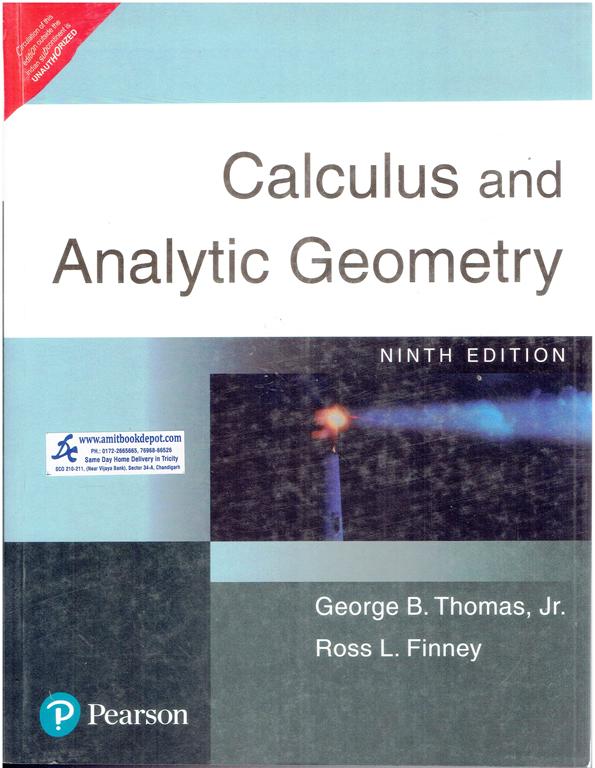
Yes. Chapters 1-8 focus on single-variable calculus, while Chapters 9-14 introduce multivariable functions, partial derivatives, multiple integrals, and vector fields.
Yes. Chapter 8 covers convergence tests, power series, Taylor and Maclaurin series with remainders – essential for advanced calculus and differential equations.
Chapter 9 is dedicated to conic sections, parametrised curves, and polar coordinates, including calculus applications like area and arc length.
Chapter 10 introduces vectors, dot and cross products, lines, planes, and quadric surfaces in three-dimensional analytic geometry.
Chapter 14 covers Green’s Theorem, Stokes’ Theorem, and the Divergence Theorem for integration in vector fields.
Yes, Chapter 3 features optimization, curve sketching, related rates, and linear approximations with real-world engineering problems.
Chapter 6 integrates logarithmic, exponential, inverse trigonometric, and hyperbolic functions into differentiation and integration methods.
Chapter 7 details integration by parts, trigonometric substitution, partial fractions, and numerical methods like Simpson’s Rule.
Yes, Chapter 13 explains double and triple integrals in Cartesian, cylindrical, and spherical coordinates with Jacobian transformations.
Yes, both parts are rigorously proven in Chapter 4, connecting antiderivatives to definite integrals via Riemann sums.
No Description Added
Yes. Chapters 1-8 focus on single-variable calculus, while Chapters 9-14 introduce multivariable functions, partial derivatives, multiple integrals, and vector fields.
Yes. Chapter 8 covers convergence tests, power series, Taylor and Maclaurin series with remainders – essential for advanced calculus and differential equations.
Chapter 9 is dedicated to conic sections, parametrised curves, and polar coordinates, including calculus applications like area and arc length.
Chapter 10 introduces vectors, dot and cross products, lines, planes, and quadric surfaces in three-dimensional analytic geometry.
Chapter 14 covers Green’s Theorem, Stokes’ Theorem, and the Divergence Theorem for integration in vector fields.
Yes, Chapter 3 features optimization, curve sketching, related rates, and linear approximations with real-world engineering problems.
Chapter 6 integrates logarithmic, exponential, inverse trigonometric, and hyperbolic functions into differentiation and integration methods.
Chapter 7 details integration by parts, trigonometric substitution, partial fractions, and numerical methods like Simpson’s Rule.
Yes, Chapter 13 explains double and triple integrals in Cartesian, cylindrical, and spherical coordinates with Jacobian transformations.
Yes, both parts are rigorously proven in Chapter 4, connecting antiderivatives to definite integrals via Riemann sums.