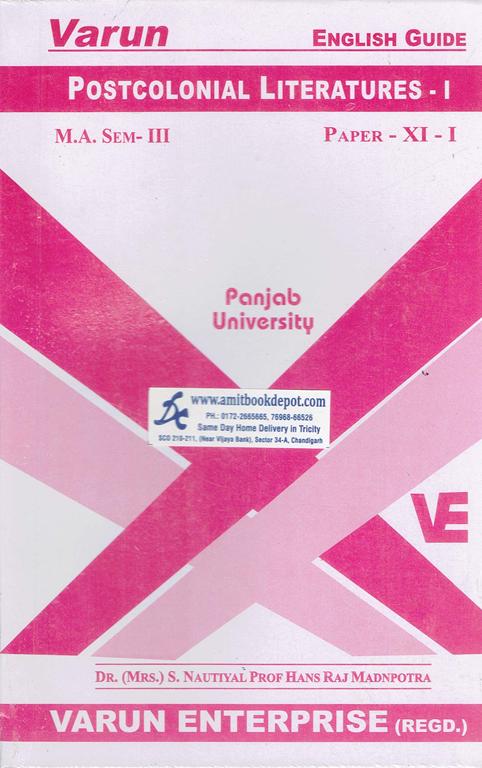
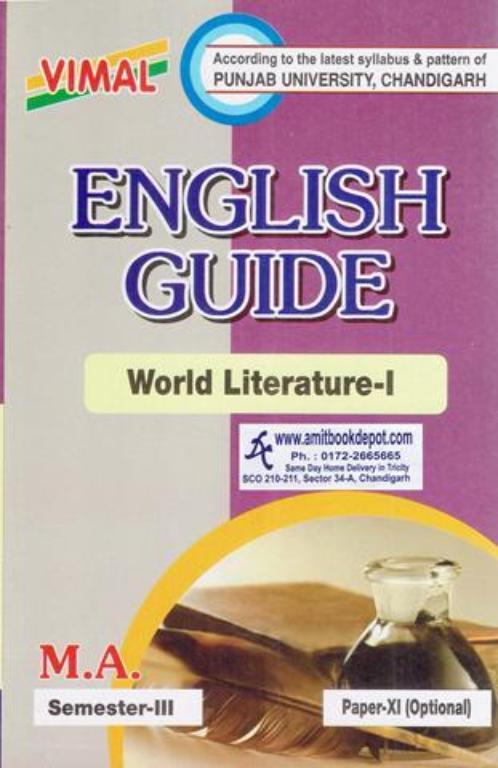
Varun English Guide Postcolonial Literatures 1 For MA 3rd Semester Paper 11 (1) Panjab University Chandigarh
by Madhurima
₹350₹350.00(-/
off)
Rating & Reviews
23 Customer Review
The Varun English Guide: Postcolonial Literatures—I by Dr. S. Nautiyal is the prescribed study companion for M.A. 3rd Semester, Paper 11 (1) at Panjab University, Chandigarh. Published by Varun Enterprises, this guide provides a comprehensive analysis of the syllabus, integrating key theoretical essays by thinkers like Edward Said and Frantz Fanon with core literary texts by Shakespeare, Achebe, and Coetzee. It is designed to foster a critical dialogue between theory and text, ensuring students are well-prepared for exams. This book is an essential resource for mastering concepts of colonialism, postcolonial resistance, national consciousness, and discursive power.

Varun English Guide: Postcolonial Literatures—I for M.A. 3rd Semester (Paper 11, Panjab University) is an authoritative and comprehensive academic resource meticulously crafted for students pursuing their Master of Arts in English. Authored by the esteemed Dr. S. Nautiyal and published by Varun Enterprises, this guide is specifically aligned with the syllabus of Panjab University, Chandigarh, for MA 3rd Semester, Paper 11 (Option 1). It serves as an indispensable companion for navigating the complex terrain of postcolonial studies, offering a structured and insightful exploration of key theoretical frameworks and seminal literary texts.
This guide is engineered to facilitate a deep understanding of the introductory course on postcolonial literatures. It systematically examines the key concepts, debates, and historical contexts that define postcolonial writing, theory, and criticism. The content is strategically organized into five thematic units, each pairing a foundational theoretical essay with a corresponding literary masterpiece. This unique theory-text integration is a core strength of the guide, encouraging students to see theoretical insights as emerging directly from literary analysis, thereby fostering a more engaged and critical understanding.
Unit I: The British Raj initiates the journey with Edward Said’s groundbreaking critique in Orientalism, paired with William Shakespeare’s The Tempest, analyzed through a postcolonial lens to understand the construction of the "Other." Unit II: Language and Discourse explores the role of language in colonial power structures via Alastair Pennycook’s work, alongside Daniel Defoe’s Robinson Crusoe, a classic narrative of colonization. Unit III: Resistance: Linguistic, Cultural, and Ideological delves into modes of defiance with Frantz Fanon’s analysis of national consciousness and Chinua Achebe’s iconic novel Things Fall Apart, a powerful representation of cultural collision and resilience.
Unit IV: New Nations and Nationalisms focuses on the formative ideologies of decolonization, presenting M.K. Gandhi’s Hind Swaraj alongside Raja Rao’s Kanthapura, a novel that fictionalizes the Gandhian struggle for independence. Finally, Unit V: Rewriting History engages with Benedict Anderson’s concept of "imagined communities" and J.M. Coetzee’s Foe, a postmodern rewriting of Robinson Crusoe that interrogates silenced histories and narrative authority.
This Varun English Guide is more than a summary; it is a critical apparatus designed for academic success. It provides detailed explanations, contextual backgrounds, thematic analyses, and potential discussion points for each text and theory. The guide emphasizes the dialogue between theory and text, a methodology recommended by the university syllabus to prepare students for examinations where questions often demand an integrated approach. Each unit is structured to help students grasp the effect of imperialism, the dynamics of colonial discourse, and the various forms of postcolonial resistance and national identity formation.
Produced with the Indian postgraduate student in mind, this book addresses the specific requirements of the Panjab University MA English syllabus. It is an essential tool for achieving high marks, offering clarity on complex topics like colonialism and postcolonialism, subaltern voices, cultural hegemony, and narrative appropriation. For any student enrolled in MA 3rd Semester Paper 11 at Panjab University, this guide by Dr. S. Nautiyal is a vital investment, ensuring a thorough, exam-focused, and conceptually robust preparation in the field of postcolonial literatures.
Is this Varun English Guide for Postcolonial Literatures updated for the current academic year's syllabus of Panjab University?
A1
Yes, this guide is meticulously crafted to align with the latest prescribed syllabus for MA 3rd Semester, Paper 11 (Option 1) at Panjab University, Chandigarh.
Q2
How does this guide help in answering integrated questions that combine theory and text, as suggested in the syllabus?
A2
Each unit in the guide is structured as a theory-text pair (e.g., Said with The Tempest). It provides dedicated analysis showing how the theoretical concepts illuminate the literary work and vice-versa, training students to formulate integrated answers.
Q3
Are the primary texts like Orientalism or Things Fall Apart included in full within this guide?
A3
No, this is a critical guide and analysis book. It provides detailed summaries, contextual backgrounds, thematic explorations, and critical commentary on the prescribed chapters and texts. Students must refer to the original texts for complete reading.
Q4
Does Dr. Nautiyal's guide include previous years' question papers or model answers?
A4
While the primary focus is on conceptual clarity and unit-wise analysis, the guide often includes important exam-oriented questions and discussion points that help in formulating model answers. For previous years' papers, you may need a separate supplement.
Q5
Is the guide useful for understanding complex theorists like Frantz Fanon and Benedict Anderson?
A5
Absolutely. One of the key features of this guide is to break down complex theoretical essays from the syllabus (like Fanon's "Pitfalls of National Consciousness" or Anderson's chapter) into more digestible explanations with relevant examples.
Q6
Can this book be used by students from universities other than Panjab University?
A6
While it is specifically tailored for Panjab University, students of postcolonial literature from other Indian or foreign universities will find the detailed analyses of these canonical texts and theories highly beneficial for their study.
Q7
What is the unique value of pairing Alastair Pennycook's discourse analysis with Robinson Crusoe?
A7
This pairing helps students practically see how the English language and narrative forms were tools of colonial discourse. The guide shows how Robinson Crusoe is not just an adventure story but a narrative enacting colonial ideology.
Q8
Does the guide cover the historical context necessary for understanding Hind Swaraj and Kanthapura?
A8
Yes, for Unit IV (New Nations and Nationalisms), it provides crucial historical background on the Indian Independence movement and the Gandhian philosophy, which is essential for analyzing both Gandhi's treatise and Raja Rao's novel.
Q9
Is the language of the guide academic and complex, or is it student-friendly?
A9
The language is academic yet clear and explanatory, aimed at bridging the gap between advanced theory and student comprehension. It simplifies complex ideas without diluting their intellectual rigor.
Q10
Does this product cover both options of Paper 11, or only Postcolonial Literatures-I?
A10
This specific guide is dedicated solely to Option 1: Postcolonial Literatures – I. Please check the title carefully if your syllabus requires a different option.
0.00
0 Overall Rating
5
0
4
0
3
0
2
0
1
0
Try this product & share your review &
thoughts
UNIT I: THE BRITISH RAJ
1. Edward Said: Introduction to Orientalism
2. William Shakespeare: The Tempest
UNIT II: LANGUAGE AND DISCOURSE
1. Alastair Pennycook: English and the Cultural Constructs of Colonialism. “ English and the Discourses of Colonialism
2. Daniel Defoe: Robinson Crusoe
UNIT III: RESISTANCE: LINGUISTIC, CULTURAL, IDEOLOGICAL
1. Frantz Fanon: “The Pitfalls of National Consciousness,” The Wretched of the Earth
2. Chinua Achebe: Things Fall Apart
UNIT IV: NEW NATIONS AND NATIONALISMS
1. Gandhi, M. K.: Hind Swaraj
2. Raja Rao: Kanthapura
UNIT - V: REWRITING HISTORY
1. Benedict Anderson: The Origins of National Consciousness”, Imagined Communities.
2. J. M. Coetzee: Foe. New York: Viking
Latest Syllabus of English Guide Postcolonial Literatures 1 For MA 3rd Semester Paper 11 (1) Panjab University (PU) Chandigarh
Paper XI
(Choose any one option.)
1. Postcolonial Literatures – I
Time: 3 Hrs.
M.M.: 80
This introductory course will examine some key concepts and debates in postcolonial writing, theory, and criticism. It begins with the British Raj and its accompanying literature, leading to an understanding of some conceptual categories of postcolonial studies—its assumptions, contexts, and pitfalls. In Units I and II, the course will explore the origins and meaning of the history of colonialism and postcolonialism to understand the effect of imperialism on the colonized world. In Units III, IV, and V, focus will shift to self-representation and resistance, to postcolonial activism, and to theories of language and nationalism in the formerly colonized societies. The emphasis in this semester will be on texts rather than simply on theories. Literary texts will be primary to the discussions so that all theoretical insights will be seen as emerging from these significant texts. We shall try and place theory and texts in a dialogue so that theory will act as an accompanying method for understanding the writing of the texts. Each unit has a list of reference books students are advised to consult. The course has five units. Each unit is so designed that it contains one critical introductory essay on the history or politics of colonialism/postcolonialism along with a corresponding novel, play, or prose essay. The paper will have five compulsory questions—one from each unit, and each question shall have an internal choice. It is recommended (though not necessary) that questions be based on the integration between theory and the corresponding text in each unit in order to encourage theory-based preparation of the text. The paper carries 80 marks.
Unit I: The British Raj
1. Edward Said, Introduction to Orientalism. London: Routledge, 1978: 1-28.
2. William Shakespeare, The Tempest, ed. Frank Kermode (Arden). London and New York: Methuen, 1984.
Unit II: Language and Discourse
1. Alastair Pennycook, “English and the Cultural Constructs of Colonialism.” English and the Discourses of Colonialism. London and New York: Routledge, 1998: 132.
2. Daniel Defoe, Robinson Crusoe. Harmondsworth: Penguin Classics, 2003.
Unit III Resistance: Linguistic, Cultural, and Ideological
1. Frantz Fanon, “The Pitfalls of National Consciousness.” The Wretched of the Earth. Harmondsworth: Penguin, 1967: 119-65.
2. Chinua Achebe: Things Fall Apart. Oxford: Heinemann, 1958.
Unit IV: New Nations and Nationalisms
1. Gandhi, M. K. Hind Swaraj [Indian Home Rule] (1908; 1968), in Narayan, Shriman (ed.), The Selected Works of Mahatma Gandhi, vol. 4. Ahmedabad: Navajivan.
2. Raja Rao: Kanthapura. Delhi: Orient Paperbacks, 1938.
Unit V: Rewriting History
1. Benedict Anderson, “The Origins of National Consciousness.” Imagined Communities. London: Verso, 1983: 37-46.
Varun English Guide: Postcolonial Literatures—I for M.A. 3rd Semester (Paper 11, Panjab University) is an authoritative and comprehensive academic resource meticulously crafted for students pursuing their Master of Arts in English. Authored by the esteemed Dr. S. Nautiyal and published by Varun Enterprises, this guide is specifically aligned with the syllabus of Panjab University, Chandigarh, for MA 3rd Semester, Paper 11 (Option 1). It serves as an indispensable companion for navigating the complex terrain of postcolonial studies, offering a structured and insightful exploration of key theoretical frameworks and seminal literary texts.
This guide is engineered to facilitate a deep understanding of the introductory course on postcolonial literatures. It systematically examines the key concepts, debates, and historical contexts that define postcolonial writing, theory, and criticism. The content is strategically organized into five thematic units, each pairing a foundational theoretical essay with a corresponding literary masterpiece. This unique theory-text integration is a core strength of the guide, encouraging students to see theoretical insights as emerging directly from literary analysis, thereby fostering a more engaged and critical understanding.
Unit I: The British Raj initiates the journey with Edward Said’s groundbreaking critique in Orientalism, paired with William Shakespeare’s The Tempest, analyzed through a postcolonial lens to understand the construction of the "Other." Unit II: Language and Discourse explores the role of language in colonial power structures via Alastair Pennycook’s work, alongside Daniel Defoe’s Robinson Crusoe, a classic narrative of colonization. Unit III: Resistance: Linguistic, Cultural, and Ideological delves into modes of defiance with Frantz Fanon’s analysis of national consciousness and Chinua Achebe’s iconic novel Things Fall Apart, a powerful representation of cultural collision and resilience.
Unit IV: New Nations and Nationalisms focuses on the formative ideologies of decolonization, presenting M.K. Gandhi’s Hind Swaraj alongside Raja Rao’s Kanthapura, a novel that fictionalizes the Gandhian struggle for independence. Finally, Unit V: Rewriting History engages with Benedict Anderson’s concept of "imagined communities" and J.M. Coetzee’s Foe, a postmodern rewriting of Robinson Crusoe that interrogates silenced histories and narrative authority.
This Varun English Guide is more than a summary; it is a critical apparatus designed for academic success. It provides detailed explanations, contextual backgrounds, thematic analyses, and potential discussion points for each text and theory. The guide emphasizes the dialogue between theory and text, a methodology recommended by the university syllabus to prepare students for examinations where questions often demand an integrated approach. Each unit is structured to help students grasp the effect of imperialism, the dynamics of colonial discourse, and the various forms of postcolonial resistance and national identity formation.
Produced with the Indian postgraduate student in mind, this book addresses the specific requirements of the Panjab University MA English syllabus. It is an essential tool for achieving high marks, offering clarity on complex topics like colonialism and postcolonialism, subaltern voices, cultural hegemony, and narrative appropriation. For any student enrolled in MA 3rd Semester Paper 11 at Panjab University, this guide by Dr. S. Nautiyal is a vital investment, ensuring a thorough, exam-focused, and conceptually robust preparation in the field of postcolonial literatures.
UNIT I: THE BRITISH RAJ
1. Edward Said: Introduction to Orientalism
2. William Shakespeare: The Tempest
UNIT II: LANGUAGE AND DISCOURSE
1. Alastair Pennycook: English and the Cultural Constructs of Colonialism. “ English and the Discourses of Colonialism
2. Daniel Defoe: Robinson Crusoe
UNIT III: RESISTANCE: LINGUISTIC, CULTURAL, IDEOLOGICAL
1. Frantz Fanon: “The Pitfalls of National Consciousness,” The Wretched of the Earth
2. Chinua Achebe: Things Fall Apart
UNIT IV: NEW NATIONS AND NATIONALISMS
1. Gandhi, M. K.: Hind Swaraj
2. Raja Rao: Kanthapura
UNIT - V: REWRITING HISTORY
1. Benedict Anderson: The Origins of National Consciousness”, Imagined Communities.
Is this Varun English Guide for Postcolonial Literatures updated for the current academic year's syllabus of Panjab University?
A1
Yes, this guide is meticulously crafted to align with the latest prescribed syllabus for MA 3rd Semester, Paper 11 (Option 1) at Panjab University, Chandigarh.
Q2
How does this guide help in answering integrated questions that combine theory and text, as suggested in the syllabus?
A2
Each unit in the guide is structured as a theory-text pair (e.g., Said with The Tempest). It provides dedicated analysis showing how the theoretical concepts illuminate the literary work and vice-versa, training students to formulate integrated answers.
Q3
Are the primary texts like Orientalism or Things Fall Apart included in full within this guide?
A3
No, this is a critical guide and analysis book. It provides detailed summaries, contextual backgrounds, thematic explorations, and critical commentary on the prescribed chapters and texts. Students must refer to the original texts for complete reading.
Q4
Does Dr. Nautiyal's guide include previous years' question papers or model answers?
A4
While the primary focus is on conceptual clarity and unit-wise analysis, the guide often includes important exam-oriented questions and discussion points that help in formulating model answers. For previous years' papers, you may need a separate supplement.
Q5
Is the guide useful for understanding complex theorists like Frantz Fanon and Benedict Anderson?
A5
Absolutely. One of the key features of this guide is to break down complex theoretical essays from the syllabus (like Fanon's "Pitfalls of National Consciousness" or Anderson's chapter) into more digestible explanations with relevant examples.
Q6
Can this book be used by students from universities other than Panjab University?
A6
While it is specifically tailored for Panjab University, students of postcolonial literature from other Indian or foreign universities will find the detailed analyses of these canonical texts and theories highly beneficial for their study.
Q7
What is the unique value of pairing Alastair Pennycook's discourse analysis with Robinson Crusoe?
A7
This pairing helps students practically see how the English language and narrative forms were tools of colonial discourse. The guide shows how Robinson Crusoe is not just an adventure story but a narrative enacting colonial ideology.
Q8
Does the guide cover the historical context necessary for understanding Hind Swaraj and Kanthapura?
A8
Yes, for Unit IV (New Nations and Nationalisms), it provides crucial historical background on the Indian Independence movement and the Gandhian philosophy, which is essential for analyzing both Gandhi's treatise and Raja Rao's novel.
Q9
Is the language of the guide academic and complex, or is it student-friendly?
A9
The language is academic yet clear and explanatory, aimed at bridging the gap between advanced theory and student comprehension. It simplifies complex ideas without diluting their intellectual rigor.
Q10
Does this product cover both options of Paper 11, or only Postcolonial Literatures-I?
A10
This specific guide is dedicated solely to Option 1: Postcolonial Literatures – I. Please check the title carefully if your syllabus requires a different option.
Latest Syllabus of English Guide Postcolonial Literatures 1 For MA 3rd Semester Paper 11 (1) Panjab University (PU) Chandigarh
Paper XI
(Choose any one option.)
1. Postcolonial Literatures – I
Time: 3 Hrs.
M.M.: 80
This introductory course will examine some key concepts and debates in postcolonial writing, theory, and criticism. It begins with the British Raj and its accompanying literature, leading to an understanding of some conceptual categories of postcolonial studies—its assumptions, contexts, and pitfalls. In Units I and II, the course will explore the origins and meaning of the history of colonialism and postcolonialism to understand the effect of imperialism on the colonized world. In Units III, IV, and V, focus will shift to self-representation and resistance, to postcolonial activism, and to theories of language and nationalism in the formerly colonized societies. The emphasis in this semester will be on texts rather than simply on theories. Literary texts will be primary to the discussions so that all theoretical insights will be seen as emerging from these significant texts. We shall try and place theory and texts in a dialogue so that theory will act as an accompanying method for understanding the writing of the texts. Each unit has a list of reference books students are advised to consult. The course has five units. Each unit is so designed that it contains one critical introductory essay on the history or politics of colonialism/postcolonialism along with a corresponding novel, play, or prose essay. The paper will have five compulsory questions—one from each unit, and each question shall have an internal choice. It is recommended (though not necessary) that questions be based on the integration between theory and the corresponding text in each unit in order to encourage theory-based preparation of the text. The paper carries 80 marks.
Unit I: The British Raj
1. Edward Said, Introduction to Orientalism. London: Routledge, 1978: 1-28.
2. William Shakespeare, The Tempest, ed. Frank Kermode (Arden). London and New York: Methuen, 1984.
Unit II: Language and Discourse
1. Alastair Pennycook, “English and the Cultural Constructs of Colonialism.” English and the Discourses of Colonialism. London and New York: Routledge, 1998: 132.
2. Daniel Defoe, Robinson Crusoe. Harmondsworth: Penguin Classics, 2003.
Unit III Resistance: Linguistic, Cultural, and Ideological
1. Frantz Fanon, “The Pitfalls of National Consciousness.” The Wretched of the Earth. Harmondsworth: Penguin, 1967: 119-65.
2. Chinua Achebe: Things Fall Apart. Oxford: Heinemann, 1958.
Unit IV: New Nations and Nationalisms
1. Gandhi, M. K. Hind Swaraj [Indian Home Rule] (1908; 1968), in Narayan, Shriman (ed.), The Selected Works of Mahatma Gandhi, vol. 4. Ahmedabad: Navajivan.
2. Raja Rao: Kanthapura. Delhi: Orient Paperbacks, 1938.
Unit V: Rewriting History
1. Benedict Anderson, “The Origins of National Consciousness.” Imagined Communities. London: Verso, 1983: 37-46.
2. J. M. Coetzee, Foe. New York: Viking, 1986.
0.00
0 Overall Rating
5
0
4
0
3
0
2
0
1
0
Try this product & share your review &
thoughts
Top Trending Product
Related
Product
Related Product
Related Blog Posts
Latest Blogs
Latest Blogs
Classic Literature Reimagined: Discuss modern twists on classic novels.
Lorem ipsum dolor sit amet, consectetur adipiscing elit, sed
do
eiusmod tempor incididunt ut labore et dolore magna aliqua. Ut enim ad minim
veniam, quis nostrud exercitation ullamco Lorem ipsum dolor sit amet,
consectetur adipiscing elit, sed do eiusmod tempor incididunt ut labore et
dolore magna aliqua. Utenim ad minim veniam, quis nostrud exercitation
ullamco
Lorem ipsum dolor sit amet, consecte...
Classic Literature Reimagined: Discuss modern twists on classic novels.
Lorem ipsum dolor sit amet, consectetur adipiscing elit, sed
do
eiusmod tempor incididunt ut labore et dolore magna aliqua. Ut enim ad minim
veniam, quis nostrud exercitation ullamco Lorem ipsum dolor sit amet,
consectetur adipiscing elit, sed do eiusmod tempor incididunt ut labore et
dolore magna aliqua. Utenim ad minim veniam, quis nostrud exercitation
ullamco
Lorem ipsum dolor sit amet, consecte...
Classic Literature Reimagined: Discuss modern twists on classic novels.
Lorem ipsum dolor sit amet, consectetur adipiscing elit, sed
do
eiusmod tempor incididunt ut labore et dolore magna aliqua. Ut enim ad minim
veniam, quis nostrud exercitation ullamco Lorem ipsum dolor sit amet,
consectetur adipiscing elit, sed do eiusmod tempor incididunt ut labore et
dolore magna aliqua. Utenim ad minim veniam, quis nostrud exercitation
ullamco
Lorem ipsum dolor sit amet, consecte...