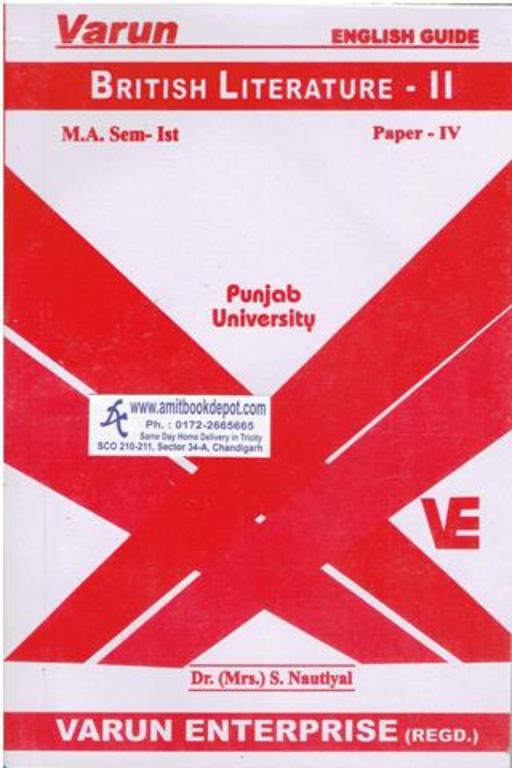
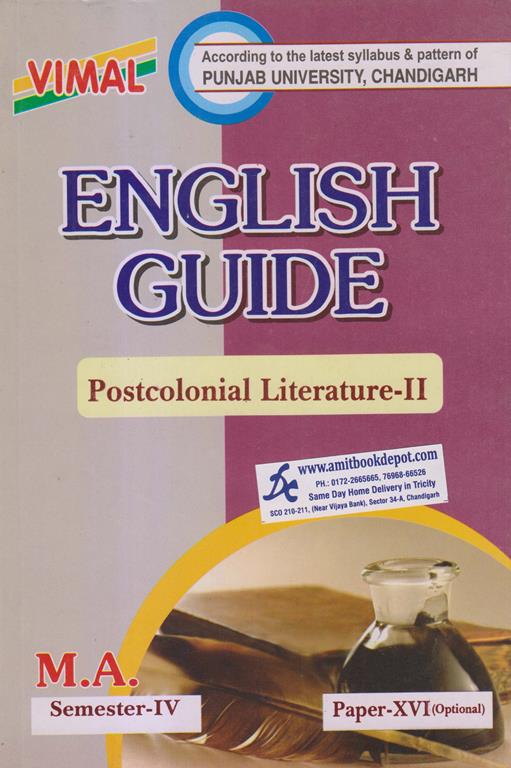
Varun English Guide Postcolonial Literature -II For MA 4rd Paper 16 (I) Panjab University Chandigarh
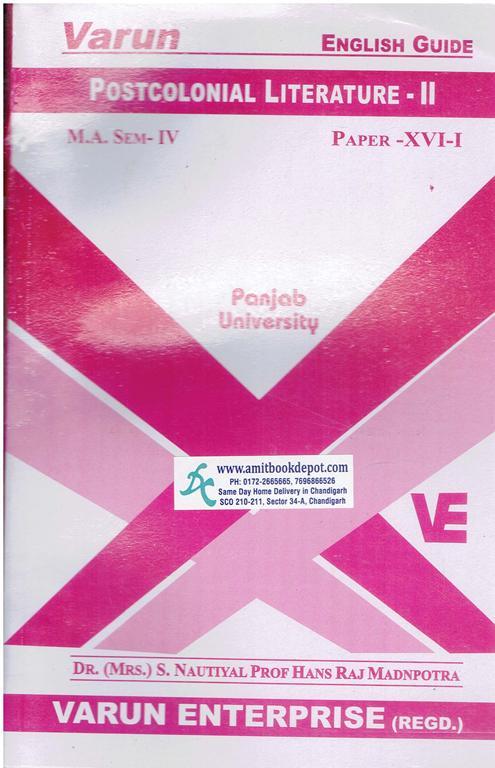
Varun English Guide Postcolonial Literature -II For MA 4rd Paper 16 (I) Panjab University Chandigarh
by Madhurima
₹350₹350.00(-/
off)
Rating & Reviews
23 Customer Review
The Varun English Guide for Postcolonial Literature—II is the essential study resource for Panjab University's M.A. English 4th Semester, Paper 16 (I). Authored by Dr. S. Nautiyal, this guide provides comprehensive coverage of the entire syllabus, including critical theories by Young, Gilroy, and Galeano, and literary masterpieces by Jean Rhys, Toni Morrison, and Mohsin Hamid. It features detailed chapter summaries, critical analyses, and integrated question-answer sets designed for exam success. Perfect for mastering complex themes like hybridity, diaspora, subalternity, and post-9/11 writing, this guide is your key to academic excellence in advanced postcolonial studies.
Varun English Guide: Postcolonial Literature - II for M.A. 4th Semester (Paper 16-I) - Panjab University, Chandigarh
Master the complex and evolving field of contemporary postcolonial studies with the definitive academic companion: the Varun English Guide for Postcolonial Literature—II. Authored by the esteemed Dr. S. Nautiyal and published by Varun Enterprises, this guide is meticulously crafted to align perfectly with the syllabus prescribed for Panjab University's M.A. English 4th Semester, Paper 16 (I). This comprehensive resource is engineered to provide students with an in-depth understanding of sophisticated theoretical frameworks and their intricate connections to seminal literary texts.
This guide is strategically structured to navigate the advanced themes that define modern postcolonial discourse. Moving beyond foundational concepts, Paper 16 (I) challenges students to engage with issues of hybridity, diaspora, subalternity, race, globalization, and post-9/11 geopolitical tensions. Our guide serves as an essential roadmap through this intellectual terrain, ensuring students are not only prepared for examinations but also develop a critical, analytical perspective on global literatures of resistance and identity.
Key Features and Thematic Coverage:
The guide is systematically divided into five units, each pairing a critical theoretical essay with a corresponding literary work to foster an integrated learning approach.
- Unit I: Hybridity and Diaspora: This section provides a clear analysis of Robert J.C. Young's foundational concepts from "Colonial Desire," demystifying the complexities of cultural mixing and migrant identities. It is perfectly complemented by a detailed exploration of Jean Rhys's Wide Sargasso Sea, offering critical insights into the prehistory of Jane Eyre and the voice of the Creole subject, Antoinette Cosway.
- Unit II: Gender, Subalternity, and Marginality: This unit bridges critical theory with powerful lived experience. It breaks down Sharmila Rege's pivotal work on Dalit women's testimonies, explaining the significance of caste and gender intersectionality. The guide then offers a comprehensive summary and analysis of Bama's Karukku, a groundbreaking Dalit autobiography that gives voice to struggles against caste-based oppression and celebrates resilience.
- Unit III: Race and Counterculture: Navigate the influential theories of Paul Gilroy's The Black Atlantic, which redefines the understanding of modernity through the lens of the Black diaspora. The guide then delves into a chapter-wise critical commentary on Toni Morrison's masterpiece, Beloved, exploring its profound treatment of history, memory, trauma, and the enduring legacy of slavery.
- Unit IV: Globalization: This section elucidates Eduardo Galeano's powerful critique of economic exploitation in Latin America from Open Veins of Latin America. It further provides an in-depth analysis of Margaret Atwood's Surfacing, interpreting the novel as a response to cultural and environmental imperialism and a quest for authentic identity in a homogenizing world.
- Unit V: Post-9/11 Writing: The guide offers a balanced and critical summary of Samuel P. Huntington's controversial "Clash of Civilizations" thesis. It then presents a thorough examination of Mohsin Hamid's The Reluctant Fundamentalist, analyzing the novel's nuanced portrayal of identity, ambivalence, and the global tensions in the aftermath of 9/11.
Designed for Academic Excellence:
This guide is specifically tailored to meet the testing methodology outlined by Panjab University. It includes:
1. Chapter-wise Summaries and Critical Analyses for all texts and essays.
2. Thematically integrated questions and answers that encourage students to connect theoretical concepts with their literary applications, as recommended by the syllabus.
3. Important explanations of key concepts, terms, and theorists to build a strong foundational vocabulary.
4. Context-based Short notes covering a wide range of topics to thoroughly prepare for the compulsory 20-mark question.
Does this guide include solved questions and answers as per the Panjab University exam pattern?
A1
Yes, it features a wide range of thematically integrated questions and answers with internal choice, perfectly aligned with the university's testing methodology.
Q2
How does the guide help in understanding the connection between the theoretical essays and the literary texts in each unit?
A2
Each unit's content is structured to explicitly link the theoretical concepts (e.g., Hybridity from Young) with their manifestations in the corresponding novel (e.g., Wide Sargasso Sea), providing a cohesive and analytical understanding.
Q3
Is the context-based question for 20 marks covered in this guide?
A3
Absolutely. The guide includes a dedicated section with numerous short notes (approx. 200 words each) on key concepts, terms, authors, and texts to thoroughly prepare for this compulsory part of the exam.
Q4
Are the summaries for complex texts like Toni Morrison's Beloved easy to understand?
A4
Yes, the guide provides clear, chapter-wise summaries and critical commentaries that break down the narrative complexity, themes of trauma, and historical context of Beloved in a student-friendly manner.
Q5
Does the guide explain critical concepts like Dalit testimonies and the subaltern from Unit II?
A5
Yes, it offers detailed explanations of Sharmila Rege's work on Dalit feminism and provides a comprehensive analysis of Bama's Karukku, making the concepts of caste and marginality accessible.
Q6
Is Paul Gilroy's "The Black Atlantic" theory explained in simple terms?
A6
The guide simplifies Gilroy's complex ideas about the Black Atlantic as a counterculture of modernity, connecting them clearly to the themes in Toni Morrison's Beloved.
Q7
Does this guide provide a balanced view of both Huntington's "Clash of Civilizations" and Hamid's The Reluctant Fundamentalist?
A7
Yes, it presents a critical summary of Huntington's thesis and a nuanced analysis of Hamid's novel, allowing students to understand and contrast both perspectives on post-9/11 world dynamics.
Q8
Are there any references to additional critical resources or books beyond the syllabus?
A8
The guide is strictly focused on the prescribed syllabus to avoid confusion. It distills the essential knowledge needed to excel in the Panjab University examination.
Q9
Is the language used in the guide academic or more conversational?
A9
The language maintains a formal, academic tone appropriate for a Master's level course while ensuring clarity and ease of understanding for effective learning.
Q10
Is the translation of Bama's Karukku by Lakshmi Holmstrom discussed in the guide?
A10
Yes, the analysis of Karukku is based on the prescribed Lakshmi Holmstrom translation, and the guide acknowledges the role of translation in bringing Dalit literature to a wider audience.
0.00
0 Overall Rating
5
0
4
0
3
0
2
0
1
0
Try this product & share your review &
thoughts
UNIT - I: Hybridity and Diaspora
1. Robert J. C. Young: “Hybridity and Diaspora,” Colonial Desire
2. Jean Rhys: Wide Sargasso Sea
UNIT - II: Gender, Subalternity, and Marginality
1. Sharmila Rege: The Significance of Dalit Testimonies
2. Bama: Karukku
UNIT - III: Race and Counterculture
1. Paul Gilroy: “The Black Atlantic as a Counterculture of Modernity”: The Black Atlantic
2. Toni Morrison: Beloved
UNIT - IV: Globalization
1. Eduardo Galeano: “Introduction: 120 Million Children in the Eye of the Hurricane”: Open Veins of Latin America
2. Margaret Atwood: Surfacing
UNIT - V: Post 9/11 Writing
1. Samuel P. Huntington: The Clash of Civilizations?
2. Mohsin Hamid: The Reluctant Fundamentalist
Latest Syllabus of English Guide Postcolonial Literature -II For MA 4rd Paper 16 (I) Panjab University (PU) Chandigarh
Paper XVI (Choose any one)
(1) Postcolonial Literatures – II
Time : 3 Hrs.
M.M. : 80
Scope: In this semester, students will move on to examining more contemporary essays and texts, ranging from issues of history-writing to hybridity, from decolonization to rapidly globalizing third-world economies, and finally to blackness, terror, and migration. It will consider how postcolonialism has changed its agendas, having migrated to the United States by transcending national boundaries.
Aims: This course attempts to move beyond an introductory study of colonialism/postcolonialism to focus on the enormous minefield Postcolonial Studies
has become. It will probe whether the discipline maintains links with the literature of dissent and resistance examined in Semester I. This course will endeavor to both analyze the meanings and implications of postcolonialism today and critique the discipline and interrogate its wide-ranging scope. Each unit has a list of reference books students are advised to study.
Method of Testing: The course has five units. Each unit is so designed that it contains one critical introductory essay on the history or politics of colonialism/postcolonialism along with a corresponding novel, play, collection of poems, or prose essay. The paper will have five compulsory questions—one from each unit, and each question shall have an internal choice. It is recommended (though not necessary) that questions be based on the integration between theory and the corresponding text in each unit in order to encourage theory-based preparation of the text. The paper carries 80 marks.
There shall be one context-based question of 20 marks in which the candidate shall have to attempt four out of six short notes, to be answered in 200 words each. The notes are likely to cover a range of terms/concepts/trends/movements specific to the course and may be author- or text-based.
Unit I: Hybridity and Diaspora
1. Robert J. C. Young, “Hybridity and Diaspora,” Colonial Desire: Hybridity in Theory, Culture, and Race. London and New York: Routledge, 1995: 1-28.
2. Jean Rhys: Wide Sargasso Sea. London: Penguin, 1968.
Unit II: Gender, Subalternity, and Marginality
1. Sharmila Rege, “The Significance of Dalit Testimonies,” Writing Caste/Writing Gender: Narrating Dalit Women’s Testimonies. New Delhi: Zubaan, 2006.
2. Bama, Karukku. Trans. Lakshmi Holmstrom. New Delhi: Oxford India Paperbacks, 1992.
Unit III: Race and Counterculture
1. Paul Gilroy, “The Black Atlantic as a Counterculture of Modernity.” The Black Atlantic, Cambridge, Mass.: Harvard University Press, 1994: 1-40.
2. Toni Morrison, Beloved. New York: Knopf, 1987.
Unit IV: Globalization
1. Eduardo Galeano, “Introduction: 120 Million Children in the Eye of the Hurricane,” Open Veins of Latin America: Five Centuries of the Pillage of a Continent, trans. Cedric Belfrage. New York: Monthly Review Press, 1977: 1-8.
2. Margaret Atwood, Surfacing. Canada: McClelland and Stewart, 1972.
Unit V Post-9/11 Writing
1. Samuel P. Huntington, “The Clash of Civilizations?” Foreign Affairs, Vol. 72, No. 3 (Summer 1993): 22-49.
2. Mohsin Hamid, The Reluctant Fundamentalist. Harmondsworth: Penguin, 2008.
Varun English Guide: Postcolonial Literature - II for M.A. 4th Semester (Paper 16-I) - Panjab University, Chandigarh
Master the complex and evolving field of contemporary postcolonial studies with the definitive academic companion: the Varun English Guide for Postcolonial Literature—II. Authored by the esteemed Dr. S. Nautiyal and published by Varun Enterprises, this guide is meticulously crafted to align perfectly with the syllabus prescribed for Panjab University's M.A. English 4th Semester, Paper 16 (I). This comprehensive resource is engineered to provide students with an in-depth understanding of sophisticated theoretical frameworks and their intricate connections to seminal literary texts.
This guide is strategically structured to navigate the advanced themes that define modern postcolonial discourse. Moving beyond foundational concepts, Paper 16 (I) challenges students to engage with issues of hybridity, diaspora, subalternity, race, globalization, and post-9/11 geopolitical tensions. Our guide serves as an essential roadmap through this intellectual terrain, ensuring students are not only prepared for examinations but also develop a critical, analytical perspective on global literatures of resistance and identity.
Key Features and Thematic Coverage:
The guide is systematically divided into five units, each pairing a critical theoretical essay with a corresponding literary work to foster an integrated learning approach.
- Unit I: Hybridity and Diaspora: This section provides a clear analysis of Robert J.C. Young's foundational concepts from "Colonial Desire," demystifying the complexities of cultural mixing and migrant identities. It is perfectly complemented by a detailed exploration of Jean Rhys's Wide Sargasso Sea, offering critical insights into the prehistory of Jane Eyre and the voice of the Creole subject, Antoinette Cosway.
- Unit II: Gender, Subalternity, and Marginality: This unit bridges critical theory with powerful lived experience. It breaks down Sharmila Rege's pivotal work on Dalit women's testimonies, explaining the significance of caste and gender intersectionality. The guide then offers a comprehensive summary and analysis of Bama's Karukku, a groundbreaking Dalit autobiography that gives voice to struggles against caste-based oppression and celebrates resilience.
- Unit III: Race and Counterculture: Navigate the influential theories of Paul Gilroy's The Black Atlantic, which redefines the understanding of modernity through the lens of the Black diaspora. The guide then delves into a chapter-wise critical commentary on Toni Morrison's masterpiece, Beloved, exploring its profound treatment of history, memory, trauma, and the enduring legacy of slavery.
- Unit IV: Globalization: This section elucidates Eduardo Galeano's powerful critique of economic exploitation in Latin America from Open Veins of Latin America. It further provides an in-depth analysis of Margaret Atwood's Surfacing, interpreting the novel as a response to cultural and environmental imperialism and a quest for authentic identity in a homogenizing world.
- Unit V: Post-9/11 Writing: The guide offers a balanced and critical summary of Samuel P. Huntington's controversial "Clash of Civilizations" thesis. It then presents a thorough examination of Mohsin Hamid's The Reluctant Fundamentalist, analyzing the novel's nuanced portrayal of identity, ambivalence, and the global tensions in the aftermath of 9/11.
Designed for Academic Excellence:
This guide is specifically tailored to meet the testing methodology outlined by Panjab University. It includes:
1. Chapter-wise Summaries and Critical Analyses for all texts and essays.
2. Thematically integrated questions and answers that encourage students to connect theoretical concepts with their literary applications, as recommended by the syllabus.
3. Important explanations of key concepts, terms, and theorists to build a strong foundational vocabulary.
4. Context-based Short notes covering a wide range of topics to thoroughly prepare for the compulsory 20-mark question.
UNIT - I: Hybridity and Diaspora
1. Robert J. C. Young: “Hybridity and Diaspora,” Colonial Desire
2. Jean Rhys: Wide Sargasso Sea
UNIT - II: Gender, Subalternity, and Marginality
1. Sharmila Rege: The Significance of Dalit Testimonies
2. Bama: Karukku
UNIT - III: Race and Counterculture
1. Paul Gilroy: “The Black Atlantic as a Counterculture of Modernity”: The Black Atlantic
2. Toni Morrison: Beloved
UNIT - IV: Globalization
1. Eduardo Galeano: “Introduction: 120 Million Children in the Eye of the Hurricane”: Open Veins of Latin America
2. Margaret Atwood: Surfacing
UNIT - V: Post 9/11 Writing
1. Samuel P. Huntington: The Clash of Civilizations?
Does this guide include solved questions and answers as per the Panjab University exam pattern?
A1
Yes, it features a wide range of thematically integrated questions and answers with internal choice, perfectly aligned with the university's testing methodology.
Q2
How does the guide help in understanding the connection between the theoretical essays and the literary texts in each unit?
A2
Each unit's content is structured to explicitly link the theoretical concepts (e.g., Hybridity from Young) with their manifestations in the corresponding novel (e.g., Wide Sargasso Sea), providing a cohesive and analytical understanding.
Q3
Is the context-based question for 20 marks covered in this guide?
A3
Absolutely. The guide includes a dedicated section with numerous short notes (approx. 200 words each) on key concepts, terms, authors, and texts to thoroughly prepare for this compulsory part of the exam.
Q4
Are the summaries for complex texts like Toni Morrison's Beloved easy to understand?
A4
Yes, the guide provides clear, chapter-wise summaries and critical commentaries that break down the narrative complexity, themes of trauma, and historical context of Beloved in a student-friendly manner.
Q5
Does the guide explain critical concepts like Dalit testimonies and the subaltern from Unit II?
A5
Yes, it offers detailed explanations of Sharmila Rege's work on Dalit feminism and provides a comprehensive analysis of Bama's Karukku, making the concepts of caste and marginality accessible.
Q6
Is Paul Gilroy's "The Black Atlantic" theory explained in simple terms?
A6
The guide simplifies Gilroy's complex ideas about the Black Atlantic as a counterculture of modernity, connecting them clearly to the themes in Toni Morrison's Beloved.
Q7
Does this guide provide a balanced view of both Huntington's "Clash of Civilizations" and Hamid's The Reluctant Fundamentalist?
A7
Yes, it presents a critical summary of Huntington's thesis and a nuanced analysis of Hamid's novel, allowing students to understand and contrast both perspectives on post-9/11 world dynamics.
Q8
Are there any references to additional critical resources or books beyond the syllabus?
A8
The guide is strictly focused on the prescribed syllabus to avoid confusion. It distills the essential knowledge needed to excel in the Panjab University examination.
Q9
Is the language used in the guide academic or more conversational?
A9
The language maintains a formal, academic tone appropriate for a Master's level course while ensuring clarity and ease of understanding for effective learning.
Q10
Is the translation of Bama's Karukku by Lakshmi Holmstrom discussed in the guide?
A10
Yes, the analysis of Karukku is based on the prescribed Lakshmi Holmstrom translation, and the guide acknowledges the role of translation in bringing Dalit literature to a wider audience.
Latest Syllabus of English Guide Postcolonial Literature -II For MA 4rd Paper 16 (I) Panjab University (PU) Chandigarh
Paper XVI (Choose any one)
(1) Postcolonial Literatures – II
Time : 3 Hrs.
M.M. : 80
Scope: In this semester, students will move on to examining more contemporary essays and texts, ranging from issues of history-writing to hybridity, from decolonization to rapidly globalizing third-world economies, and finally to blackness, terror, and migration. It will consider how postcolonialism has changed its agendas, having migrated to the United States by transcending national boundaries.
Aims: This course attempts to move beyond an introductory study of colonialism/postcolonialism to focus on the enormous minefield Postcolonial Studies
has become. It will probe whether the discipline maintains links with the literature of dissent and resistance examined in Semester I. This course will endeavor to both analyze the meanings and implications of postcolonialism today and critique the discipline and interrogate its wide-ranging scope. Each unit has a list of reference books students are advised to study.
Method of Testing: The course has five units. Each unit is so designed that it contains one critical introductory essay on the history or politics of colonialism/postcolonialism along with a corresponding novel, play, collection of poems, or prose essay. The paper will have five compulsory questions—one from each unit, and each question shall have an internal choice. It is recommended (though not necessary) that questions be based on the integration between theory and the corresponding text in each unit in order to encourage theory-based preparation of the text. The paper carries 80 marks.
There shall be one context-based question of 20 marks in which the candidate shall have to attempt four out of six short notes, to be answered in 200 words each. The notes are likely to cover a range of terms/concepts/trends/movements specific to the course and may be author- or text-based.
Unit I: Hybridity and Diaspora
1. Robert J. C. Young, “Hybridity and Diaspora,” Colonial Desire: Hybridity in Theory, Culture, and Race. London and New York: Routledge, 1995: 1-28.
2. Jean Rhys: Wide Sargasso Sea. London: Penguin, 1968.
Unit II: Gender, Subalternity, and Marginality
1. Sharmila Rege, “The Significance of Dalit Testimonies,” Writing Caste/Writing Gender: Narrating Dalit Women’s Testimonies. New Delhi: Zubaan, 2006.
2. Bama, Karukku. Trans. Lakshmi Holmstrom. New Delhi: Oxford India Paperbacks, 1992.
Unit III: Race and Counterculture
1. Paul Gilroy, “The Black Atlantic as a Counterculture of Modernity.” The Black Atlantic, Cambridge, Mass.: Harvard University Press, 1994: 1-40.
2. Toni Morrison, Beloved. New York: Knopf, 1987.
Unit IV: Globalization
1. Eduardo Galeano, “Introduction: 120 Million Children in the Eye of the Hurricane,” Open Veins of Latin America: Five Centuries of the Pillage of a Continent, trans. Cedric Belfrage. New York: Monthly Review Press, 1977: 1-8.
2. Margaret Atwood, Surfacing. Canada: McClelland and Stewart, 1972.
Unit V Post-9/11 Writing
1. Samuel P. Huntington, “The Clash of Civilizations?” Foreign Affairs, Vol. 72, No. 3 (Summer 1993): 22-49.
2. Mohsin Hamid, The Reluctant Fundamentalist. Harmondsworth: Penguin, 2008.
0.00
0 Overall Rating
5
0
4
0
3
0
2
0
1
0
Try this product & share your review &
thoughts
Top Trending Product
Related
Product
Related Product
Related Blog Posts
Latest Blogs
Latest Blogs
Classic Literature Reimagined: Discuss modern twists on classic novels.
Lorem ipsum dolor sit amet, consectetur adipiscing elit, sed
do
eiusmod tempor incididunt ut labore et dolore magna aliqua. Ut enim ad minim
veniam, quis nostrud exercitation ullamco Lorem ipsum dolor sit amet,
consectetur adipiscing elit, sed do eiusmod tempor incididunt ut labore et
dolore magna aliqua. Utenim ad minim veniam, quis nostrud exercitation
ullamco
Lorem ipsum dolor sit amet, consecte...
Classic Literature Reimagined: Discuss modern twists on classic novels.
Lorem ipsum dolor sit amet, consectetur adipiscing elit, sed
do
eiusmod tempor incididunt ut labore et dolore magna aliqua. Ut enim ad minim
veniam, quis nostrud exercitation ullamco Lorem ipsum dolor sit amet,
consectetur adipiscing elit, sed do eiusmod tempor incididunt ut labore et
dolore magna aliqua. Utenim ad minim veniam, quis nostrud exercitation
ullamco
Lorem ipsum dolor sit amet, consecte...
Classic Literature Reimagined: Discuss modern twists on classic novels.
Lorem ipsum dolor sit amet, consectetur adipiscing elit, sed
do
eiusmod tempor incididunt ut labore et dolore magna aliqua. Ut enim ad minim
veniam, quis nostrud exercitation ullamco Lorem ipsum dolor sit amet,
consectetur adipiscing elit, sed do eiusmod tempor incididunt ut labore et
dolore magna aliqua. Utenim ad minim veniam, quis nostrud exercitation
ullamco
Lorem ipsum dolor sit amet, consecte...


.jpg)