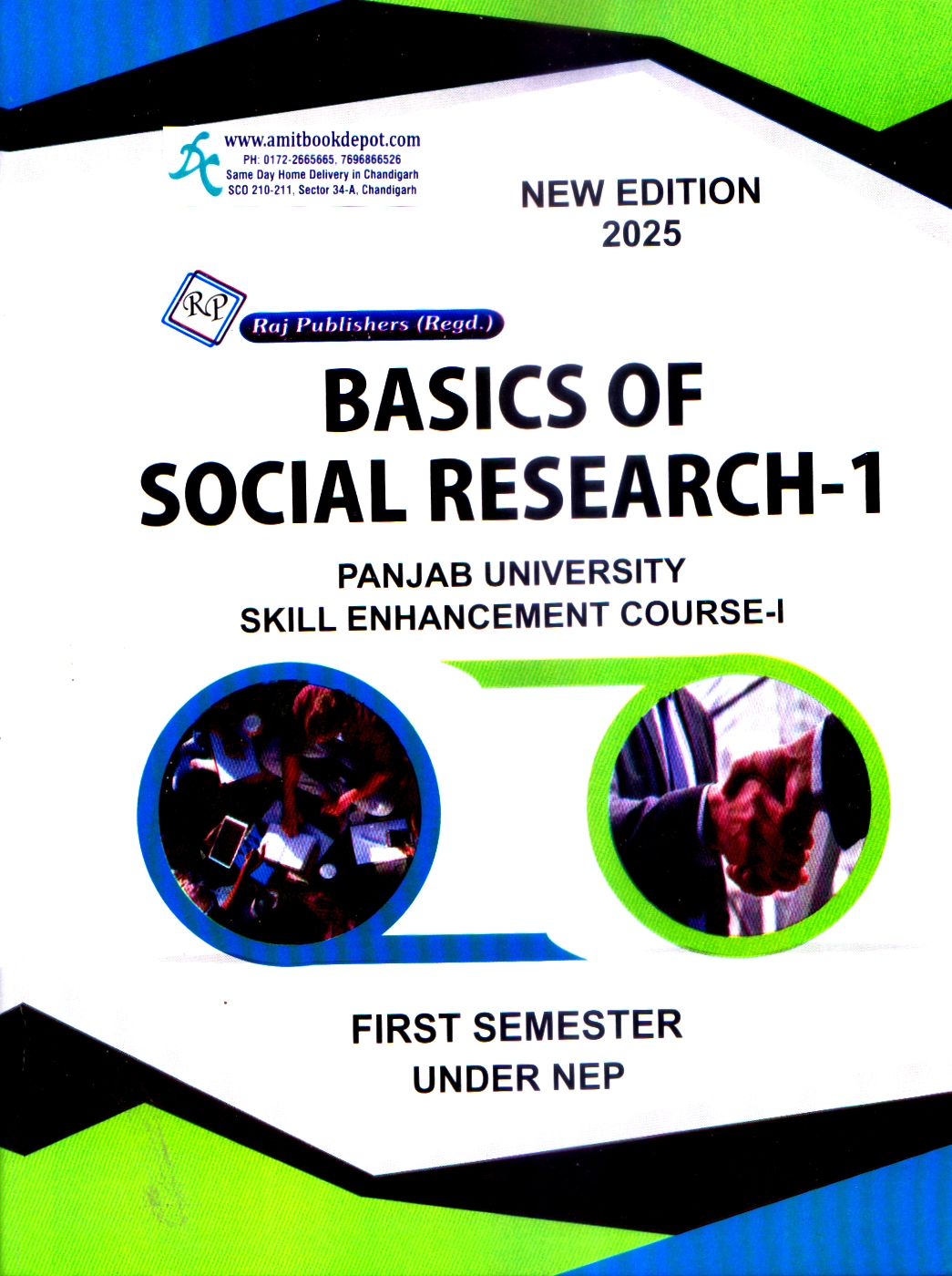
Yes, this book is meticulously crafted to cover the entire prescribed syllabus for the SEC - I paper "Basics of Social Research - I" for BA 1st Semester at PU Chandigarh.
Absolutely. The book covers the entire theoretical syllabus which constitutes the majority of your marks. Private candidates are evaluated solely on the theory paper, for which this book is a comprehensive resource.
Unit I of the book provides a dedicated section comparing and contrasting Qualitative and Quantitative research, explaining their methodologies, applications, and key differences in a clear, beginner-friendly manner.
Yes, the book covers the concept of a hypothesis in Unit II, explaining its characteristics and providing guidance on how to formulate a testable and clear hypothesis for a research problem.
Yes, the section on Sampling in Unit II provides a detailed explanation of various sampling techniques, categorizing them into probability (like simple random, systematic) and non-probability (like purposive, snowball) methods.

Definitely. The book is written with beginners in mind, using clear and straightforward language to explain complex research terminology and concepts.
Unit III on Data Collection is designed to be practical. It provides step-by-step insights into techniques like interviews and questionnaire administration, moving beyond pure theory to application.
Yes, the content is structured to cover the entire syllabus in detail, making it easier to grasp key points essential for answering the 10 short-answer-type questions in the compulsory section of the paper.
While it is tailor-made for PU Chandigarh, the core topics of social research are universal. Students from other universities with similar introductory courses in research methodology may find it beneficial, but should cross-check their specific syllabus.
Unit II has a dedicated chapter on "Objectivity in Social Sciences" which discusses the meaning, importance, and challenges of achieving objectivity, providing students with a critical perspective on research ethics.
No Description Added
Yes, this book is meticulously crafted to cover the entire prescribed syllabus for the SEC - I paper "Basics of Social Research - I" for BA 1st Semester at PU Chandigarh.
Absolutely. The book covers the entire theoretical syllabus which constitutes the majority of your marks. Private candidates are evaluated solely on the theory paper, for which this book is a comprehensive resource.
Unit I of the book provides a dedicated section comparing and contrasting Qualitative and Quantitative research, explaining their methodologies, applications, and key differences in a clear, beginner-friendly manner.
Yes, the book covers the concept of a hypothesis in Unit II, explaining its characteristics and providing guidance on how to formulate a testable and clear hypothesis for a research problem.
Yes, the section on Sampling in Unit II provides a detailed explanation of various sampling techniques, categorizing them into probability (like simple random, systematic) and non-probability (like purposive, snowball) methods.
Definitely. The book is written with beginners in mind, using clear and straightforward language to explain complex research terminology and concepts.
Unit III on Data Collection is designed to be practical. It provides step-by-step insights into techniques like interviews and questionnaire administration, moving beyond pure theory to application.
Yes, the content is structured to cover the entire syllabus in detail, making it easier to grasp key points essential for answering the 10 short-answer-type questions in the compulsory section of the paper.
While it is tailor-made for PU Chandigarh, the core topics of social research are universal. Students from other universities with similar introductory courses in research methodology may find it beneficial, but should cross-check their specific syllabus.
Unit II has a dedicated chapter on "Objectivity in Social Sciences" which discusses the meaning, importance, and challenges of achieving objectivity, providing students with a critical perspective on research ethics.