-
Mon-Fri: 10AM to 8PM 01722665665
-
My Account
-
-
0
Total :
₹ 0.00

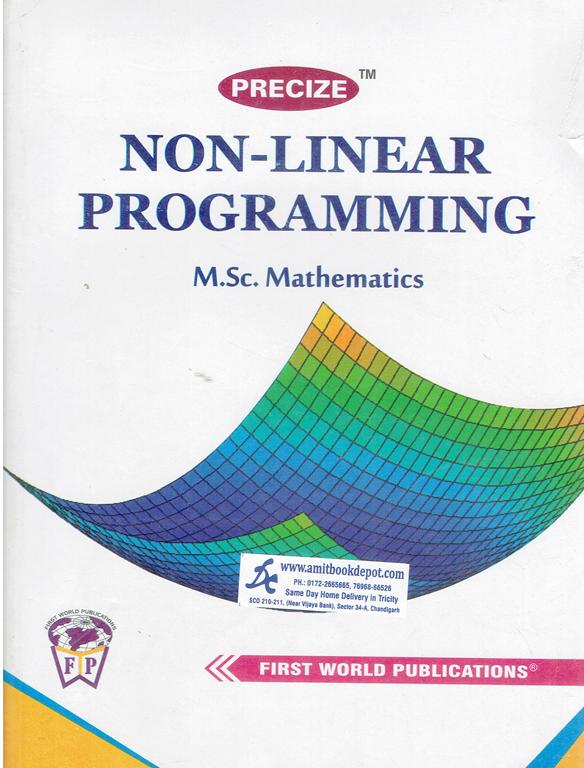



Yes, this book is specifically written to cover the entire syllabus for the paper MATH 698S: Non-Linear Programming as prescribed by Panjab University, Chandigarh.
While the primary focus is on delivering rigorous theoretical concepts and proofs, the explanations of methods like Wolfe's and Beale's for Quadratic Programming are detailed and algorithmic, effectively guiding you through problem-solving.
Yes, the book dedicates a full chapter to the Fritz John and KKT optimality conditions, comprehensively covering problems with inequality constraints as well as a combination of inequality and equality constraints.
Yes, the deep theoretical foundation provided in this book on topics like Convex Functions, Duality, and Optimality Conditions is highly beneficial for competitive exams like CSIR-NET/JRF in Mathematical Sciences.
Yes, the Game Theory chapter specifically includes the solution of two-person, zero-sum games using Linear Programming methods, as outlined in the syllabus.
Absolutely. The book covers Linear Fractional Programming via the Charnes and Cooper method and Nonlinear Fractional Programming using Dinkelbach's approach.
Yes, the book includes detailed discussions on key duality theorems, including Dorn's duality theorem, the strict converse duality theorem, and Wolfe's duality theorem.
Yes, the section on Game Theory explicitly covers solutions using mixed strategies, including graphical solutions for applicable cases.
Yes, it systematically progresses from the optimality criteria for unconstrained problems to the more complex Fritz John and KKT conditions for constrained problems.
The "Precise Nonlinear Programming" textbook consolidates all the material from the various reference books mentioned in the syllabus (like Hadley, Mangasarian, etc.) into a single, coherent, and syllabus-focused resource, saving you the trouble of consulting multiple texts.
No Description Added
Yes, this book is specifically written to cover the entire syllabus for the paper MATH 698S: Non-Linear Programming as prescribed by Panjab University, Chandigarh.
While the primary focus is on delivering rigorous theoretical concepts and proofs, the explanations of methods like Wolfe's and Beale's for Quadratic Programming are detailed and algorithmic, effectively guiding you through problem-solving.
Yes, the book dedicates a full chapter to the Fritz John and KKT optimality conditions, comprehensively covering problems with inequality constraints as well as a combination of inequality and equality constraints.
Yes, the deep theoretical foundation provided in this book on topics like Convex Functions, Duality, and Optimality Conditions is highly beneficial for competitive exams like CSIR-NET/JRF in Mathematical Sciences.
Yes, the Game Theory chapter specifically includes the solution of two-person, zero-sum games using Linear Programming methods, as outlined in the syllabus.
Absolutely. The book covers Linear Fractional Programming via the Charnes and Cooper method and Nonlinear Fractional Programming using Dinkelbach's approach.
Yes, the book includes detailed discussions on key duality theorems, including Dorn's duality theorem, the strict converse duality theorem, and Wolfe's duality theorem.
Yes, the section on Game Theory explicitly covers solutions using mixed strategies, including graphical solutions for applicable cases.
Yes, it systematically progresses from the optimality criteria for unconstrained problems to the more complex Fritz John and KKT conditions for constrained problems.
The "Precise Nonlinear Programming" textbook consolidates all the material from the various reference books mentioned in the syllabus (like Hadley, Mangasarian, etc.) into a single, coherent, and syllabus-focused resource, saving you the trouble of consulting multiple texts.