-
Mon-Fri: 10AM to 8PM 01722665665
-
My Account
-
-
0
Total :
₹ 0.00

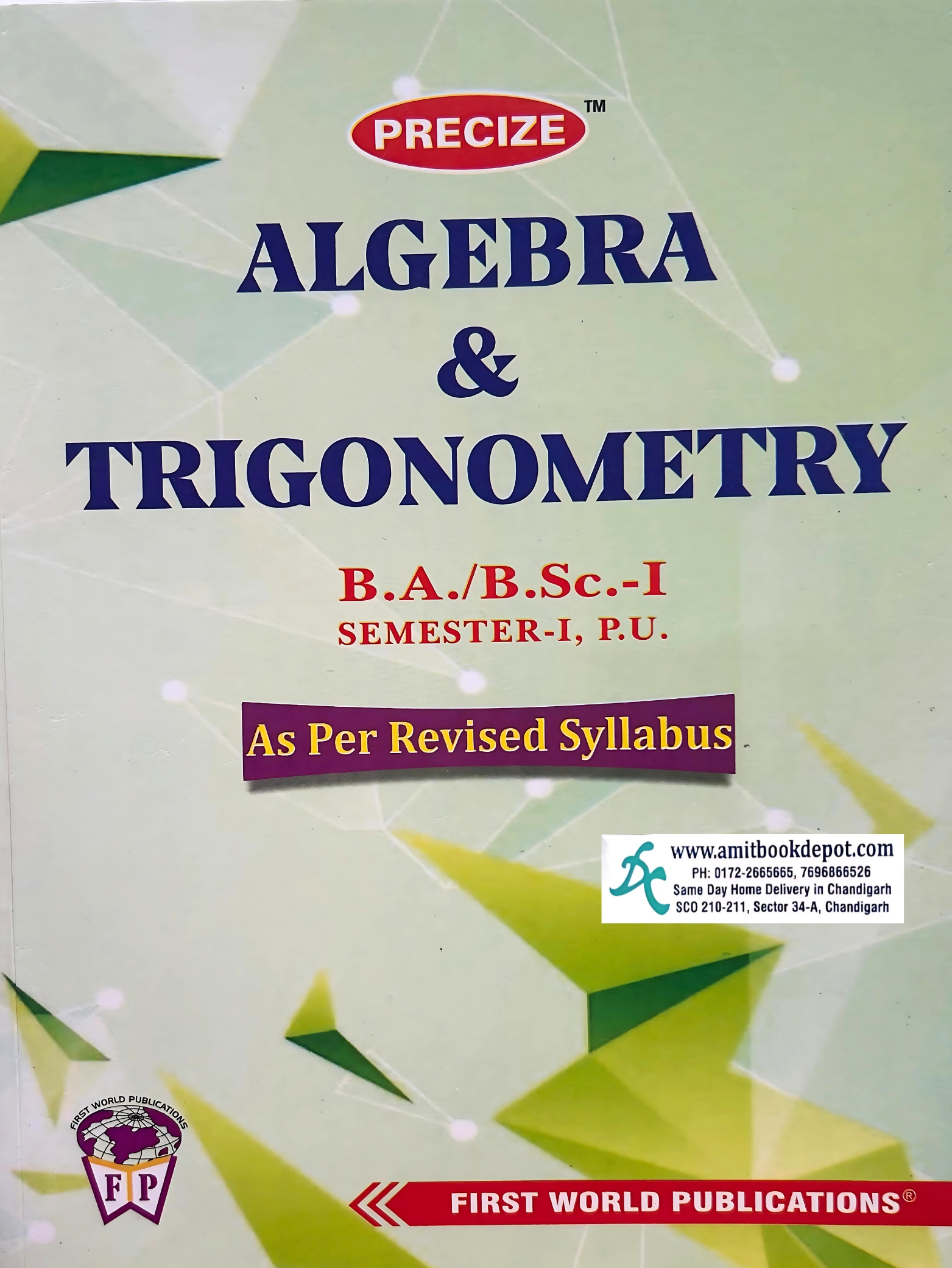
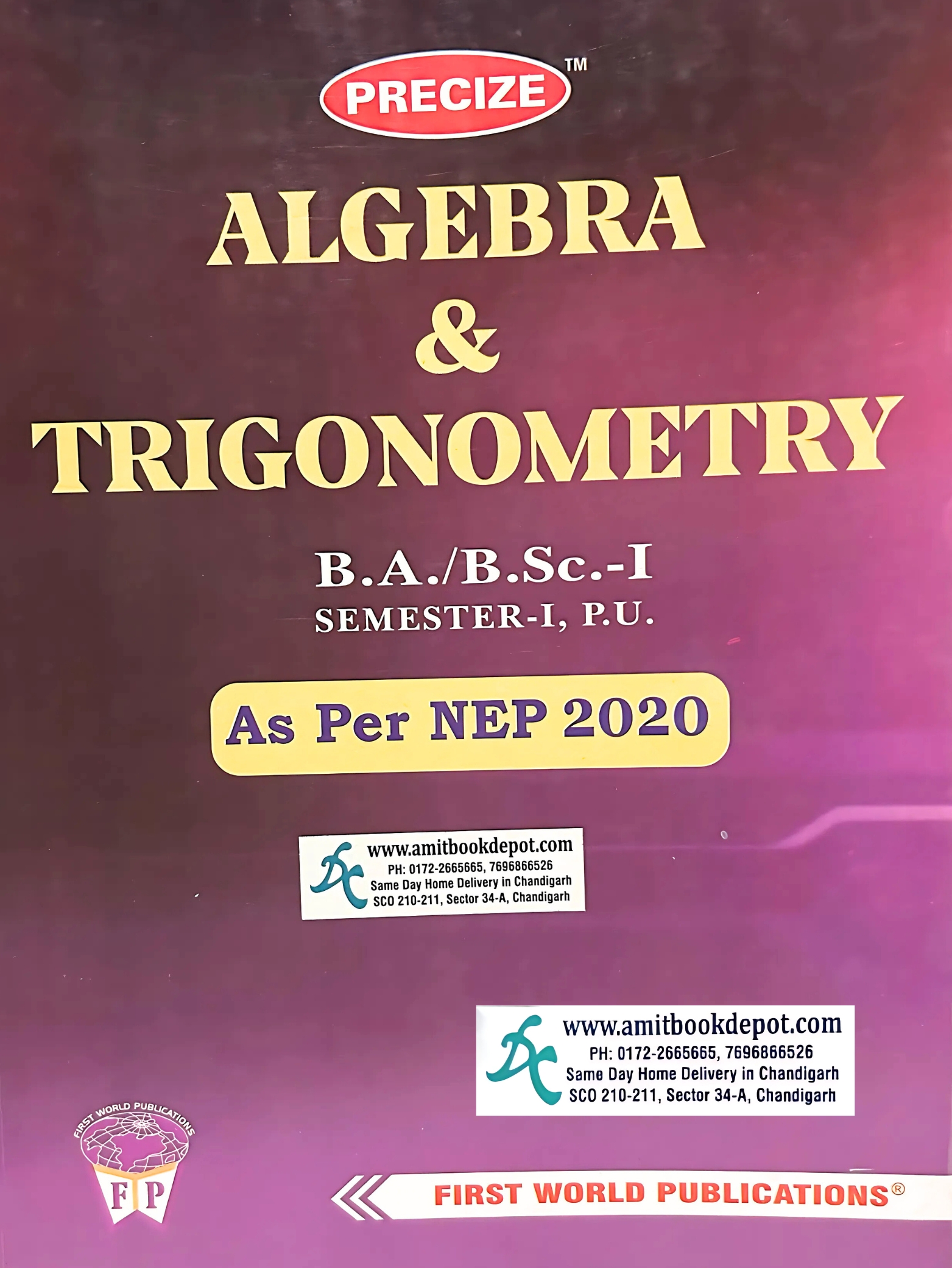


Yes, absolutely. This book is meticulously tailored to align with the Punjab University algebra & Trigonometry BA and BSc 1st Semester PU Chandigarh BA/BSc 1st Year Semester 1 syllabus and the NEP 2020 curriculum. It covers all four units, including Mathematical Induction, Binomial Theorem, Trigonometry, Complex Numbers, and Matrices, making it a comprehensive, standalone resource.
The book is designed with the NEP 2020's emphasis on critical thinking and application in mind. Its clear explanations, practical examples, and problem-solving focus not only prepare you for the 80-mark external exam but also help you build a strong conceptual foundation to excel in internal assessments, projects, and viva voce.
The book dedicates separate chapters to "De Moivre's Theorem" and "Applications of De Moivre's Theorem." It goes beyond theory to show how it's used to find roots of unity, expand trigonometric functions like sin nθ and cos nθ, and understand the link between complex numbers and trigonometry, providing step-by-step solved problems for clarity.
Yes, Unit I explicitly covers the "Principle of Mathematical Induction (both strong and weak forms)" with dedicated applications, ensuring you are well-prepared for questions from this fundamental topic.
The book breaks down complex topics like Eigenvalues and Eigenvectors, and the Cayley-Hamilton theorem into manageable steps. It starts with the basics of determinants, builds up to matrix properties, and uses clear explanations to demystify how these concepts are used for diagonalization and finding inverses.
Yes, Unit IV is entirely dedicated to this. It provides the necessary theorems and methods to check the consistency of both homogeneous and non-homogeneous systems of linear equations, a key area from which exam questions are frequently set.
The book covers "Row rank, Column rank and rank of a matrix" in detail. It explains the concepts of linear dependence/independence for vectors and includes a discussion on the equivalence of row and column rank, which is a crucial theoretical point in linear algebra.
Unit I covers the Binomial Theorem for a positive index and then extends it to "Binomial Theorem for any index." It explains how this allows for the summation of infinite binomial series, a common topic in university-level algebra.
The book adheres strictly to the syllabus, which specifies the "Determinant of an n x n matrix." It covers properties and calculations relevant to higher-order determinants, preparing you for the scope of university exams.
Yes, the syllabus for Unit I specifically includes "its combinatorial interpretation," and the book provides an explanation of how the binomial coefficients relate to combinations, offering a deeper understanding beyond mere formula application.
No Description Added
Yes, absolutely. This book is meticulously tailored to align with the Punjab University algebra & Trigonometry BA and BSc 1st Semester PU Chandigarh BA/BSc 1st Year Semester 1 syllabus and the NEP 2020 curriculum. It covers all four units, including Mathematical Induction, Binomial Theorem, Trigonometry, Complex Numbers, and Matrices, making it a comprehensive, standalone resource.
The book is designed with the NEP 2020's emphasis on critical thinking and application in mind. Its clear explanations, practical examples, and problem-solving focus not only prepare you for the 80-mark external exam but also help you build a strong conceptual foundation to excel in internal assessments, projects, and viva voce.
The book dedicates separate chapters to "De Moivre's Theorem" and "Applications of De Moivre's Theorem." It goes beyond theory to show how it's used to find roots of unity, expand trigonometric functions like sin nθ and cos nθ, and understand the link between complex numbers and trigonometry, providing step-by-step solved problems for clarity.
Yes, Unit I explicitly covers the "Principle of Mathematical Induction (both strong and weak forms)" with dedicated applications, ensuring you are well-prepared for questions from this fundamental topic.
The book breaks down complex topics like Eigenvalues and Eigenvectors, and the Cayley-Hamilton theorem into manageable steps. It starts with the basics of determinants, builds up to matrix properties, and uses clear explanations to demystify how these concepts are used for diagonalization and finding inverses.
Yes, Unit IV is entirely dedicated to this. It provides the necessary theorems and methods to check the consistency of both homogeneous and non-homogeneous systems of linear equations, a key area from which exam questions are frequently set.
The book covers "Row rank, Column rank and rank of a matrix" in detail. It explains the concepts of linear dependence/independence for vectors and includes a discussion on the equivalence of row and column rank, which is a crucial theoretical point in linear algebra.
Unit I covers the Binomial Theorem for a positive index and then extends it to "Binomial Theorem for any index." It explains how this allows for the summation of infinite binomial series, a common topic in university-level algebra.
The book adheres strictly to the syllabus, which specifies the "Determinant of an n x n matrix." It covers properties and calculations relevant to higher-order determinants, preparing you for the scope of university exams.
Yes, the syllabus for Unit I specifically includes "its combinatorial interpretation," and the book provides an explanation of how the binomial coefficients relate to combinations, offering a deeper understanding beyond mere formula application.