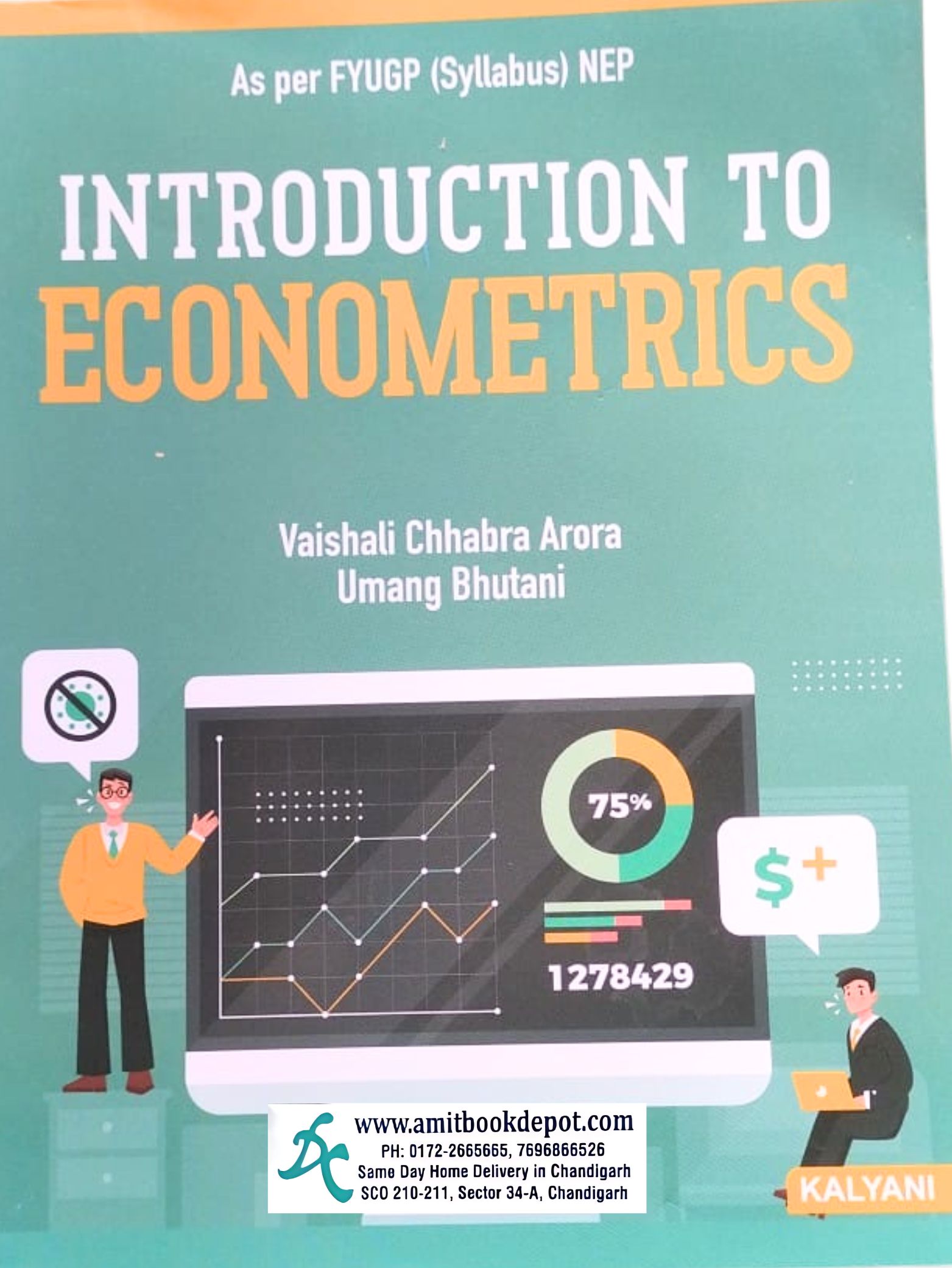
Yes, this book is meticulously crafted to cover 100% of the prescribed syllabus for the "Introduction to Econometrics" paper for BA and BA (Hons.) at Panjab University, Chandigarh.
The book provides detailed theoretical explanations and methodologies for regression analysis. For a comprehensive set of solved numerical problems, you may want to check with the publisher or author for a companion workbook, as the primary focus is on theory and application as per the syllabus.
Absolutely. The authors have dedicated entire chapters to these topics, breaking down their nature, consequences, detection methods, and remedial measures in a student-friendly manner suitable for undergraduate-level understanding.
The book's unit-wise division corresponds directly to the structure of the question paper, which requires students to attempt questions from each unit. This organization helps in focused study and revision.
Yes, the book is written with clarity and structured logically, making it an excellent resource for self-study for both regular and distance education students enrolled in the PU Chandigarh program.
Yes, the Gauss-Markov Theorem and the properties of least squares estimators are covered in detail in Unit-I, which is a core part of the syllabus.
Yes, Unit-II of the book comprehensively covers interval estimation and hypothesis testing, which are essential for determining the statistical significance of regression coefficients.
Yes, the book is titled "Introduction to Econometrics" and is designed for BA-level students, assuming no prior knowledge. The language is academic yet accessible for beginners.
Chapter 10 is entirely devoted to Errors of Measurement, discussing the consequences and remedial measures for errors in both dependent and independent variables.
Based on the provided table of contents and syllabus, the book focuses on the theoretical foundations of econometrics as required for the PU Chandigarh paper. Practical software application is typically not part of the core theory syllabus for this course.
No Description Added
Yes, this book is meticulously crafted to cover 100% of the prescribed syllabus for the "Introduction to Econometrics" paper for BA and BA (Hons.) at Panjab University, Chandigarh.
The book provides detailed theoretical explanations and methodologies for regression analysis. For a comprehensive set of solved numerical problems, you may want to check with the publisher or author for a companion workbook, as the primary focus is on theory and application as per the syllabus.
Absolutely. The authors have dedicated entire chapters to these topics, breaking down their nature, consequences, detection methods, and remedial measures in a student-friendly manner suitable for undergraduate-level understanding.
The book's unit-wise division corresponds directly to the structure of the question paper, which requires students to attempt questions from each unit. This organization helps in focused study and revision.
Yes, the book is written with clarity and structured logically, making it an excellent resource for self-study for both regular and distance education students enrolled in the PU Chandigarh program.
Yes, the Gauss-Markov Theorem and the properties of least squares estimators are covered in detail in Unit-I, which is a core part of the syllabus.
Yes, Unit-II of the book comprehensively covers interval estimation and hypothesis testing, which are essential for determining the statistical significance of regression coefficients.
Yes, the book is titled "Introduction to Econometrics" and is designed for BA-level students, assuming no prior knowledge. The language is academic yet accessible for beginners.
Chapter 10 is entirely devoted to Errors of Measurement, discussing the consequences and remedial measures for errors in both dependent and independent variables.
Based on the provided table of contents and syllabus, the book focuses on the theoretical foundations of econometrics as required for the PU Chandigarh paper. Practical software application is typically not part of the core theory syllabus for this course.