Categories
College Bookssss >
BA PU Chandigarh
BSC PU Chandigarh
MSC PU Chandigarh
BBA PU Chandigarh
MA PU Chandigarh
Medical Books
Engineering Books
Management Books
PGDCA Books
BCOM PU Chandigarh
MCOM PU Chandigarh
BCA PU Chandigarh
MCA PU Chandigarh
animate-books

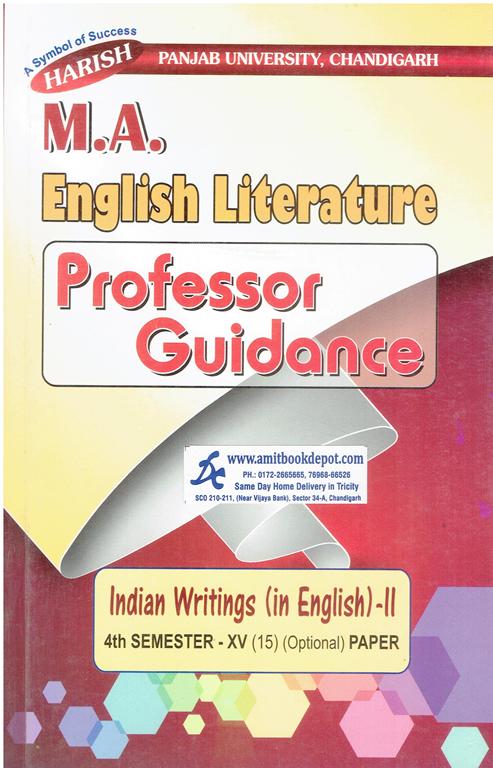
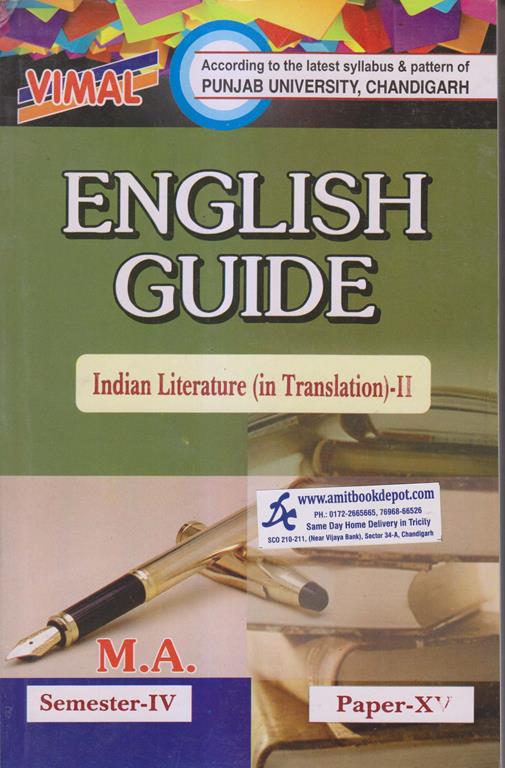
Harish Professor Guidance Indian Writings in English 2 For MA 4th Semester XV (15) Optional Paper Panjab University Chandigarh

by Madhurima
β‚Ή360 β‚Ή360.00(-/ off)

Rating & Reviews

23 Customer Review

Harish Professor Guidance: Indian Writings in English 2 is the essential study guide for Panjab University MA 4th Semester (Paper XV) students. Authored by Dr. Chakreshwari Dixit & Dr. Mohd Mazhar, this book provides a complete, unit-wise analysis of the prescribed syllabus. It covers key texts like The Last Flicker, The Weave of My Life, short stories by Prem Chand and Mahasweta Devi, poetry by Nirala, Faiz, and Dhasal, and the play Tughlaq. With detailed summaries, thematic explorations, and exam-focused content, this guide is indispensable for mastering Indian Writings in Translation and achieving academic excellence. Published by Harish Prakashan Mandir.

Have Doubts Regarding This Product ? Ask Your Question

  • Q1
    Is this book an exact match for the new MA 4th Semester syllabus (2024-25) of Panjab University, Chandigarh?
    A1

    Yes, this "Professor Guidance" book is meticulously compiled to align 100% with the latest prescribed syllabus and text list for Paper XV (Indian Writings in Translation-II) for the MA 4th Semester at Panjab University.

  • Q2
    Does the guide include the complete texts of the novels, stories, and poems, or is it only a commentary?
    A2

    This is a critical guide and study companion. It does not contain the full primary texts. It provides detailed summaries, character analyses, thematic explanations, critical perspectives, and important questions tailored to the syllabus to help you understand and analyze the prescribed books, which you need to purchase separately.

  • Q3
    Does the section on short stories cover all the authors mentioned in the syllabusβ€”Prem Chand, Mahasweta Devi, and Vaikom Muhammad Basheer?
    A3

    Yes, Unit III comprehensively covers the selected short stories from all three prescribed authors as per the syllabus, providing individual story analysis and comparative insights.

  • Q4
    Is the translation and context of the poems by Nirala, Faiz, and Namdeo Dhasal explained?
    A4

    Absolutely. Unit IV on Poetry not only analyzes the poems but also discusses the significance of their translation, the poet's background, and the socio-cultural context crucial for understanding these works.

  • Q5
    Is this book useful for NET/JRF preparation in English?
    A5

    While its primary focus is the Panjab University MA exam, the in-depth analysis of major Indian writers and texts in translation makes it a valuable supplementary resource for the Indian Literature section of the NET/JRF exam in English.

  • Q6
    How is the guide for "The Weave of My Life" helpful in understanding Dalit feminist literature?
    A6

    The guide provides a critical framework for Urmila Pawar's memoir, explaining key concepts of Dalit feminism, autoethnography, and the politics of caste and gender, which are central to scoring well on this unit.

  • Q7
    Is the language of the guide complex or easy for students to understand?
    A7

    The language is academic yet clear and student-friendly. It is designed to simplify complex literary theories and texts, making them accessible for effective learning and exam writing.

  • Q8
    Does the analysis of "Tughlaq" connect the play to contemporary political scenarios?
    A8

    Yes, the analysis of Girish Karnad's Tughlaq often draws connections between the play's themes of power, governance, and idealism and their relevance to modern political discourse, a common question in exams.

  • Q9
    Can this book be used by students from other universities with a similar syllabus?
    A9

    Students from other universities studying Indian Writings in Translation with overlapping texts (like Tughlaq, works by Prem Chand, Faiz, etc.) will find the critical analyses highly beneficial, though the exam patterns may differ.

  • Q10
    Does the book address the "translation studies" aspect mentioned in the course objectives?
    A10

    Yes, the introduction and various unit analyses engage with key issues in translation studies, such as authenticity, cultural transference, and the role of the translator, which are part of the paper's critical focus.

0.00

0 Overall Rating
  • 5
    0
  • 4
    0
  • 3
    0
  • 2
    0
  • 1
    0

Try this product & share your review & thoughts

UNIT-I FICTION

1. THE LAST FLICKER (MARHI DA DEEVA) -Gurdial Singh

Gurdial Singh
- Introduction to Gurdial Singh

The Last Flicker
Summary of 'The Last Flicker
1. Focus on Neglected Class
2. Evaluation as a Novelist
3. Complexity of Human Relationship
4. An Anti-orient Equation

UNIT-II LIFE WRITING

2. THE WEAVE OF MY LIFE -Urmila Pawar

Urmila Pawar
- Introduction to Author

The Weave of My Life
Summary of "The Weave of My Life'
1. Writer to Break Caste and Patriarchy
2. Journey of Urmila Pawar
3. Portrayal of Women
4. Women Characters of the Weave of My Life
5. Childhood of Urmila Pawar
6. Distinctive Features of Dalit

UNIT-III
SHORT STORY/SHORT FICTION

3. SELECTED SHORT STORIES -Premchand

Munshi Premchand
- Introduction to the Author
1. Reflection of Society's Picture
2. Discussion of Human Feelings

The Thakur's Well-A Story
Summary of The Thakur's Well
1. Discussion of Thakur's Well

Kafan-A Story
Summary of 'Kafan'
Characteristics of Ghisu in Kafan
1. Evaluation of Various Languages
2. Critical Evaluation of Irony
3. Various Symbols Employed in the 'Kafan'
4. New Turn of Realism

4. SELECTED STORIES -Mahasweta Devi

Mahasweta Devi
- Introduction to the Author

Draupadi
- Introduction of 'Draupadi'
- Summary of 'Draupadi'
1. Contextualing 'Draupadi'
2. Voice of Torture and Atrocity
3. A Symbol of Subaltern Defiance
4. Patriarchal Structure of Draupadi

- Breast Giver
Summary of 'Breast Giver'
1. Victimisation and Exploitation of Motherhood
2. The Position of Women
3. Breast Giver: Feminist Study
4. Critical Analysis of Motherhood
5. Discussion of the Statement

5. SELECTED STORIES -Vaikom Muhammad Basheer

- Vaikom Muhammad Basheer
Introduction to the Author
1. Brevity becomes the Soul of Wit
2. The Art of Basheer's Story Telling
3. The Art of Story Telling

- Walls
Summary of the 'Walls'
1. The Elements of the 'Walls'

- The Card Sharper's Daughter
Summary of "The Card Sharper's Daughter'

1. Critical Analysis of Story

UNIT-IV : POETRY
SELECTED POEMS -Suryakant Tripathi Nirala

- Suryakant Tripathi 'Nirala'
Introduction to the Author

1. Discussion of Nirala's Hate
2. Discussion of Hindi Poetry's Freedom

- Breaking Stones
Text-Breaking Stones
Summary of 'Breaking Stones'
1. Critical Appreciation of the Poem

Beggar
Text-Beggar
Summary of 'Beggar'
1. Theme of the Poem 'Beggar'

7. SELECTED POEMS -Faiz Ahmed Faiz

- Faiz Ahmed Faiz
Introduction to the Author

1. A Revolutionary Poet
2. Faiz's Poetry reflect Resistance, Protest and Voice
3. Faiz's Poetic growth during Imprisonment
4. Poetic Skills of Faiz

- A Letter from Prison
Text A Letter from Prison'
Summary of 'A Letter from Prison'

1. Critical Evaluation of Poem
'A Letter from Prison'

- Don't Ask Me for that Love Again
Text-Don't Ask me for that Love Again
Summary of 'Don't Ask me for that Love Again'
1. Critical Appreciation of the Poem

- A Prison Day Break
Text-A Prison Day Break
Summary of 'A Prison Day Break'
1. The Poet's thought and feelings for the Poem

8. HUNGER - Namdev Dhasal

-Namdev Dhasal
Introduction to the Author
1. A voice of Pain and Protest
2. Critical Analysis of Dhasal and Rajkumar
3. Evaluation of Namdeo Dhasal
4. A Language of Heterogeneity: The Poetry of Namdeo Dhasal
5. Difference from Dalit Writers

- Hunger
Text-Hunger
Summary of 'Hunger'
1. Personification of Hunger

UNIT-V : PLAY
9. TUGHLAQ - Girish Karnad

-Girish Karnad
Introduction to the Author

Tughlaq
Introduction to the Play Tughlaq
Summary of the Play

Scene One
Scene Two
Scene Three
Scene Four
Scene Five
Scene Six
Scene Seven
Scene Eight
Scene Nine
Scene Ten
Scene Eleven
Scene Twelve
Scene Thirteen

Brief Summary of the Play, Tughlaq
Major Characters
1. Muhammad bin Tughlaq
2. Rain
3. Aziz

1. Historical Background of the Play
2. Wrong Policy of Tughlaq
3. Satire and Nature of the Sultan Shown in Tughlaq
4. A Critique of Indian Policies
5. Tughlaq-A Classic in Literature
6. Tughlaq-A Relevant Political Allegory
7. Use of Symbolism, Irony and Humour

Latest Syllabus of Professor Guidance Indian Writings in English 2 For MA 4th Semester XV (15) Optional Paper Panjab University (PU) Chandigarh


(Semester IV)
Paper XV (choose any one)
(1) Indian Writings (in Translation) – II

One of the most fascinating aspects of Indian life is its bewildering array of languages and subcultures. This diversity has been flowering for millennia and has led to a profusion of writing in multiple languages. From epics like the Mahabharata, Ramayana, Bhagavad-Gita, and Panchatantra to contemporary prose, fiction, poetry, and drama, Indian languages offer a magnificent canvas of the multi-lingual, multi-cultural, and multi-dimensional body of Indian literature. However, most readers are limited to experiencing literature only from their respective regions. In the present course, an attempt is made to bridge the gap by offering an array of linguistically diverse texts in translation. A representative selection of texts from multiple genres, translated from Indian languages, is curated for the postgraduate students. Through the extra textual and critical readings, the course aims to provide a context for the contentious issues of identity and authenticity as they are presented in translated texts. This course is an opportunity for students to acquire a deeper understanding of the varied influences on the terrain of Indian writing in a tangible way. The paper consists of 5 units. There will be one question from each section with internal choice.

Unit 1 Fiction

1. Gurdial Singh. Marhi da Deeva (The Last Flicker). New Delhi: National Book Trust, 2017.

Unit 2: Life Writing

1. Urmila Pawar, The Weave of My Life: A Dalit Woman’s Memoirs. Trans., Maya Pandit. New York: Columbia University Press. 2009.

Unit 3: Short Story/Short Fiction

1. Prem Chand: β€œKafan,” β€œThe Thakur’s Well,” trans. David Rubin in The World of Prem Chand: Selected Short Stories, Delhi, Oxford University Press, 2001.
2. Mahashweta Devi: β€œDraupadi” and β€œThe Breast Giver,” trans. Gayatri Chakarvarty Spivak. Breast Stories. Calcutta: Seagull, 1997.
3. Vaikom Muhammad Basheer, β€œWalls” (47) and β€œThe Card Sharper’s Daughter” (27), both stories from Basheer Katha Classics. New Delhi: Katha, 1997.

Unit 4 Poetry

1. Surya Kant Tripathi Nirala: β€œBeggar,” β€œBreaking Stones,” from A Season on the Earth. Trans. David Rubin, New Delhi, Oxford University Press, 2003.
2. Faiz Ahmed Faiz: β€œA Letter from Prison” β€œDon’t Ask Me for that Love Again” and β€œA Prison Daybreak,” available in The Rebel’s Silhouette Trans. Agha Shahid Ali. New Delhi: OUP, 2005.
3. Namdeo Dhasal. β€œHunger” from Poet of the Underworld. Delhi: Narayana, 2007.

Unit 5 Play

1. Girish Karnad: Tughlaq. New Delhi: Oxford University Press, 2005.

Harish Professor Guidance: Indian Writings in English 2 (MA 4th Semester, Paper XV, Panjab University) is an indispensable academic resource meticulously crafted for postgraduate students pursuing their Master of Arts at Panjab University, Chandigarh. This comprehensive guide is specifically designed for the MA 4th Semester Optional Paper XV, focusing on Indian Writings (in Translation)β€”II. Authored by the esteemed scholars Dr. Chakreshwari Dixit and Dr. Mohd Mazhar and published by Harish Prakashan Mandir, this book serves as the definitive study companion for navigating the rich and diverse landscape of translated Indian literature prescribed by the university syllabus.

This guide is structured to provide an in-depth, unit-wise analysis of the seminal texts that form the core of the curriculum. It bridges the gap between regional linguistic diversity and the academic needs of the student by offering critical insights, summaries, thematic explorations, and contextual frameworks for each work. The book is engineered to facilitate a deeper understanding of the socio-cultural, political, and historical nuances embedded within these celebrated translations, enabling students to engage critically with the content for both examinations and scholarly appreciation.

The content is meticulously aligned with the official Panjab University MA English syllabus. Unit I: Fiction offers a profound exploration of Gurdial Singh's iconic Punjabi novel, The Last Flicker (Marhi Da Deeva), delving into its portrayal of rural Punjab, caste oppression, and existential struggle. Unit II: Life Writing provides a critical framework for Urmila Pawar's powerful Dalit feminist memoir, The Weave of My Life, analyzing narratives of caste, gender, and identity. Unit III: Short Story/Short Fiction covers the selected works of literary giantsβ€”Prem Chand's social realism in "Kafan" and "The Thakur’s Well," Mahasweta Devi's subaltern activism in "Draupadi" and "The Breast Giver," and Vaikom Muhammad Basheer's poignant storytelling in "Walls" and "The Card Sharper's Daughter."

Unit IV: Poetry is dedicated to a detailed examination of the prescribed poetic works. It includes an analysis of Suryakant Tripathi 'Nirala's modernist Hindi poetry ("Beggar," "Breaking Stones"), Faiz Ahmed Faiz's revolutionary Urdu verses ("A Letter from Prison," "Don’t Ask Me for that Love Again," "A Prison Daybreak"), and Namdeo Dhasal's stark Dalit Marathi poem "Hunger." Unit V: Play concludes with a comprehensive study of Girish Karnad's classic historical play Tughlaq, exploring its themes of power, idealism, and political ambiguity.

Key features of this Professor Guidance book include detailed chapter summaries, character sketches, critical commentaries, thematic discussions, and potential examination-oriented questions and answers. It addresses the core objectives of the paper by helping students grapple with issues of translation studies, cultural identity, authenticity, and the multilingual fabric of Indian literature. This volume is not merely a summary but an analytical tool that empowers MA English students to develop sophisticated arguments and excel in their Panjab University MA 4th Semester exams.

For any student enrolled in the MA English Literature program at Panjab University Chandigarh, this book is an essential purchase. It is the most reliable and syllabus-specific guide available, ensuring thorough preparation, conceptual clarity, and academic success in Optional Paper XV.

UNIT-I FICTION

1. THE LAST FLICKER (MARHI DA DEEVA) -Gurdial Singh

Gurdial Singh
- Introduction to Gurdial Singh

The Last Flicker
Summary of 'The Last Flicker
1. Focus on Neglected Class
2. Evaluation as a Novelist
3. Complexity of Human Relationship
4. An Anti-orient Equation

UNIT-II LIFE WRITING

2. THE WEAVE OF MY LIFE -Urmila Pawar

Urmila Pawar
- Introduction to Author

The Weave of My Life
Summary of "The Weave of My Life'
1. Writer to Break Caste and Patriarchy
2. Journey of Urmila Pawar
3. Portrayal of Women
4. Women Characters of the Weave of My Life
5. Childhood of Urmila Pawar
6. Distinctive Features of Dalit

UNIT-III
SHORT STORY/SHORT FICTION

3. SELECTED SHORT STORIES -Premchand

Munshi Premchand
- Introduction to the Author
1. Reflection of Society's Picture
2. Discussion of Human Feelings

The Thakur's Well-A Story
Summary of The Thakur's Well
1. Discussion of Thakur's Well

Kafan-A Story
Summary of 'Kafan'
Characteristics of Ghisu in Kafan
1. Evaluation of Various Languages
2. Critical Evaluation of Irony
3. Various Symbols Employed in the 'Kafan'
4. New Turn of Realism

4. SELECTED STORIES -Mahasweta Devi

Mahasweta Devi
- Introduction to the Author

Draupadi
- Introduction of 'Draupadi'
- Summary of 'Draupadi'
1. Contextualing 'Draupadi'
2. Voice of Torture and Atrocity
3. A Symbol of Subaltern Defiance
4. Patriarchal Structure of Draupadi

- Breast Giver
Summary of 'Breast Giver'
1. Victimisation and Exploitation of Motherhood
2. The Position of Women
3. Breast Giver: Feminist Study
4. Critical Analysis of Motherhood
5. Discussion of the Statement

5. SELECTED STORIES -Vaikom Muhammad Basheer

- Vaikom Muhammad Basheer
Introduction to the Author
1. Brevity becomes the Soul of Wit
2. The Art of Basheer's Story Telling
3. The Art of Story Telling

- Walls
Summary of the 'Walls'
1. The Elements of the 'Walls'

- The Card Sharper's Daughter
Summary of "The Card Sharper's Daughter'

1. Critical Analysis of Story

UNIT-IV : POETRY
SELECTED POEMS -Suryakant Tripathi Nirala

- Suryakant Tripathi 'Nirala'
Introduction to the Author

1. Discussion of Nirala's Hate
2. Discussion of Hindi Poetry's Freedom

- Breaking Stones
Text-Breaking Stones
Summary of 'Breaking Stones'
1. Critical Appreciation of the Poem

Beggar
Text-Beggar
Summary of 'Beggar'
1. Theme of the Poem 'Beggar'

7. SELECTED POEMS -Faiz Ahmed Faiz

- Faiz Ahmed Faiz
Introduction to the Author

1. A Revolutionary Poet
2. Faiz's Poetry reflect Resistance, Protest and Voice
3. Faiz's Poetic growth during Imprisonment
4. Poetic Skills of Faiz

- A Letter from Prison
Text A Letter from Prison'
Summary of 'A Letter from Prison'

1. Critical Evaluation of Poem
'A Letter from Prison'

- Don't Ask Me for that Love Again
Text-Don't Ask me for that Love Again
Summary of 'Don't Ask me for that Love Again'
1. Critical Appreciation of the Poem

- A Prison Day Break
Text-A Prison Day Break
Summary of 'A Prison Day Break'
1. The Poet's thought and feelings for the Poem

8. HUNGER - Namdev Dhasal

-Namdev Dhasal
Introduction to the Author
1. A voice of Pain and Protest
2. Critical Analysis of Dhasal and Rajkumar
3. Evaluation of Namdeo Dhasal
4. A Language of Heterogeneity: The Poetry of Namdeo Dhasal
5. Difference from Dalit Writers

- Hunger
Text-Hunger
Summary of 'Hunger'
1. Personification of Hunger

UNIT-V : PLAY
9. TUGHLAQ - Girish Karnad

-Girish Karnad
Introduction to the Author

Tughlaq
Introduction to the Play Tughlaq
Summary of the Play

Scene One
Scene Two
Scene Three
Scene Four
Scene Five
Scene Six
Scene Seven
Scene Eight
Scene Nine
Scene Ten
Scene Eleven
Scene Twelve
Scene Thirteen

Brief Summary of the Play, Tughlaq
Major Characters
1. Muhammad bin Tughlaq
2. Rain
3. Aziz

1. Historical Background of the Play
2. Wrong Policy of Tughlaq
3. Satire and Nature of the Sultan Shown in Tughlaq
4. A Critique of Indian Policies
5. Tughlaq-A Classic in Literature
6. Tughlaq-A Relevant Political Allegory
7. Use of Symbolism, Irony and Humour

Have Doubts Regarding This Product ? Ask Your Question

  • Q1
    Is this book an exact match for the new MA 4th Semester syllabus (2024-25) of Panjab University, Chandigarh?
    A1

    Yes, this "Professor Guidance" book is meticulously compiled to align 100% with the latest prescribed syllabus and text list for Paper XV (Indian Writings in Translation-II) for the MA 4th Semester at Panjab University.

  • Q2
    Does the guide include the complete texts of the novels, stories, and poems, or is it only a commentary?
    A2

    This is a critical guide and study companion. It does not contain the full primary texts. It provides detailed summaries, character analyses, thematic explanations, critical perspectives, and important questions tailored to the syllabus to help you understand and analyze the prescribed books, which you need to purchase separately.

  • Q3
    Does the section on short stories cover all the authors mentioned in the syllabusβ€”Prem Chand, Mahasweta Devi, and Vaikom Muhammad Basheer?
    A3

    Yes, Unit III comprehensively covers the selected short stories from all three prescribed authors as per the syllabus, providing individual story analysis and comparative insights.

  • Q4
    Is the translation and context of the poems by Nirala, Faiz, and Namdeo Dhasal explained?
    A4

    Absolutely. Unit IV on Poetry not only analyzes the poems but also discusses the significance of their translation, the poet's background, and the socio-cultural context crucial for understanding these works.

  • Q5
    Is this book useful for NET/JRF preparation in English?
    A5

    While its primary focus is the Panjab University MA exam, the in-depth analysis of major Indian writers and texts in translation makes it a valuable supplementary resource for the Indian Literature section of the NET/JRF exam in English.

  • Q6
    How is the guide for "The Weave of My Life" helpful in understanding Dalit feminist literature?
    A6

    The guide provides a critical framework for Urmila Pawar's memoir, explaining key concepts of Dalit feminism, autoethnography, and the politics of caste and gender, which are central to scoring well on this unit.

  • Q7
    Is the language of the guide complex or easy for students to understand?
    A7

    The language is academic yet clear and student-friendly. It is designed to simplify complex literary theories and texts, making them accessible for effective learning and exam writing.

  • Q8
    Does the analysis of "Tughlaq" connect the play to contemporary political scenarios?
    A8

    Yes, the analysis of Girish Karnad's Tughlaq often draws connections between the play's themes of power, governance, and idealism and their relevance to modern political discourse, a common question in exams.

  • Q9
    Can this book be used by students from other universities with a similar syllabus?
    A9

    Students from other universities studying Indian Writings in Translation with overlapping texts (like Tughlaq, works by Prem Chand, Faiz, etc.) will find the critical analyses highly beneficial, though the exam patterns may differ.

  • Q10
    Does the book address the "translation studies" aspect mentioned in the course objectives?
    A10

    Yes, the introduction and various unit analyses engage with key issues in translation studies, such as authenticity, cultural transference, and the role of the translator, which are part of the paper's critical focus.

Latest Syllabus of Professor Guidance Indian Writings in English 2 For MA 4th Semester XV (15) Optional Paper Panjab University (PU) Chandigarh


(Semester IV)
Paper XV (choose any one)
(1) Indian Writings (in Translation) – II

One of the most fascinating aspects of Indian life is its bewildering array of languages and subcultures. This diversity has been flowering for millennia and has led to a profusion of writing in multiple languages. From epics like the Mahabharata, Ramayana, Bhagavad-Gita, and Panchatantra to contemporary prose, fiction, poetry, and drama, Indian languages offer a magnificent canvas of the multi-lingual, multi-cultural, and multi-dimensional body of Indian literature. However, most readers are limited to experiencing literature only from their respective regions. In the present course, an attempt is made to bridge the gap by offering an array of linguistically diverse texts in translation. A representative selection of texts from multiple genres, translated from Indian languages, is curated for the postgraduate students. Through the extra textual and critical readings, the course aims to provide a context for the contentious issues of identity and authenticity as they are presented in translated texts. This course is an opportunity for students to acquire a deeper understanding of the varied influences on the terrain of Indian writing in a tangible way. The paper consists of 5 units. There will be one question from each section with internal choice.

Unit 1 Fiction

1. Gurdial Singh. Marhi da Deeva (The Last Flicker). New Delhi: National Book Trust, 2017.

Unit 2: Life Writing

1. Urmila Pawar, The Weave of My Life: A Dalit Woman’s Memoirs. Trans., Maya Pandit. New York: Columbia University Press. 2009.

Unit 3: Short Story/Short Fiction

1. Prem Chand: β€œKafan,” β€œThe Thakur’s Well,” trans. David Rubin in The World of Prem Chand: Selected Short Stories, Delhi, Oxford University Press, 2001.
2. Mahashweta Devi: β€œDraupadi” and β€œThe Breast Giver,” trans. Gayatri Chakarvarty Spivak. Breast Stories. Calcutta: Seagull, 1997.
3. Vaikom Muhammad Basheer, β€œWalls” (47) and β€œThe Card Sharper’s Daughter” (27), both stories from Basheer Katha Classics. New Delhi: Katha, 1997.

Unit 4 Poetry

1. Surya Kant Tripathi Nirala: β€œBeggar,” β€œBreaking Stones,” from A Season on the Earth. Trans. David Rubin, New Delhi, Oxford University Press, 2003.
2. Faiz Ahmed Faiz: β€œA Letter from Prison” β€œDon’t Ask Me for that Love Again” and β€œA Prison Daybreak,” available in The Rebel’s Silhouette Trans. Agha Shahid Ali. New Delhi: OUP, 2005.
3. Namdeo Dhasal. β€œHunger” from Poet of the Underworld. Delhi: Narayana, 2007.

Unit 5 Play

1. Girish Karnad: Tughlaq. New Delhi: Oxford University Press, 2005.

0.00

0 Overall Rating
  • 5
    0
  • 4
    0
  • 3
    0
  • 2
    0
  • 1
    0

Try this product & share your review & thoughts

Top Trending Product

Related Product

Related Product

Related Blog Posts

Latest Blogs

Latest Blogs

blog-img
Classic Literature Reimagined: Discuss modern twists on classic novels.
Lorem ipsum dolor sit amet, consectetur adipiscing elit, sed do eiusmod tempor incididunt ut labore et dolore magna aliqua. Ut enim ad minim veniam, quis nostrud exercitation ullamco Lorem ipsum dolor sit amet, consectetur adipiscing elit, sed do eiusmod tempor incididunt ut labore et dolore magna aliqua. Utenim ad minim veniam, quis nostrud exercitation ullamco Lorem ipsum dolor sit amet, consecte...
Read more
Author name | 10 jan, 2025
blog-img
Classic Literature Reimagined: Discuss modern twists on classic novels.
Lorem ipsum dolor sit amet, consectetur adipiscing elit, sed do eiusmod tempor incididunt ut labore et dolore magna aliqua. Ut enim ad minim veniam, quis nostrud exercitation ullamco Lorem ipsum dolor sit amet, consectetur adipiscing elit, sed do eiusmod tempor incididunt ut labore et dolore magna aliqua. Utenim ad minim veniam, quis nostrud exercitation ullamco Lorem ipsum dolor sit amet, consecte...
Read more
Author name | 10 jan, 2025
blog-img
Classic Literature Reimagined: Discuss modern twists on classic novels.
Lorem ipsum dolor sit amet, consectetur adipiscing elit, sed do eiusmod tempor incididunt ut labore et dolore magna aliqua. Ut enim ad minim veniam, quis nostrud exercitation ullamco Lorem ipsum dolor sit amet, consectetur adipiscing elit, sed do eiusmod tempor incididunt ut labore et dolore magna aliqua. Utenim ad minim veniam, quis nostrud exercitation ullamco Lorem ipsum dolor sit amet, consecte...
Read more
Author name | 10 jan, 2025
blog-img
Classic Literature Reimagined: Discuss modern twists on classic novels.
Lorem ipsum dolor sit amet, consectetur adipiscing elit...
Read more
Author Name | 10 Jan, 2025
blog-img
Classic Literature Reimagined: Discuss modern twists on classic novels.
Lorem ipsum dolor sit amet, consectetur adipiscing elit...
Read more
Author Name | 10 Jan, 2025
blog-img
Classic Literature Reimagined: Discuss modern twists on classic novels.
Lorem ipsum dolor sit amet, consectetur adipiscing elit...
Read more
Author Name | 10 Jan, 2025
blog-img
Classic Literature Reimagined: Discuss modern twists on classic novels.
Lorem ipsum dolor sit amet, consectetur adipiscing elit...
Read more
Author Name | 10 Jan, 2025
blog-img
Classic Literature Reimagined: Discuss modern twists on classic novels.
Lorem ipsum dolor sit amet, consectetur adipiscing elit...
Read more
Author Name | 10 Jan, 2025
blog-img
Classic Literature Reimagined: Discuss modern twists on classic novels.
Lorem ipsum dolor sit amet, consectetur adipiscing elit...
Read more
Author Name | 10 Jan, 2025
blog-img
Classic Literature Reimagined: Discuss modern twists on classic novels.
Lorem ipsum dolor sit amet, consectetur adipiscing elit...
Read more
Author Name | 10 Jan, 2025
blog-img
Classic Literature Reimagined: Discuss modern twists on classic novels.
Lorem ipsum dolor sit amet, consectetur adipiscing elit...
Read more
Author Name | 10 Jan, 2025
blog-img
Classic Literature Reimagined: Discuss modern twists on classic novels.
Lorem ipsum dolor sit amet, consectetur adipiscing elit...
Read more
Author Name | 10 Jan, 2025