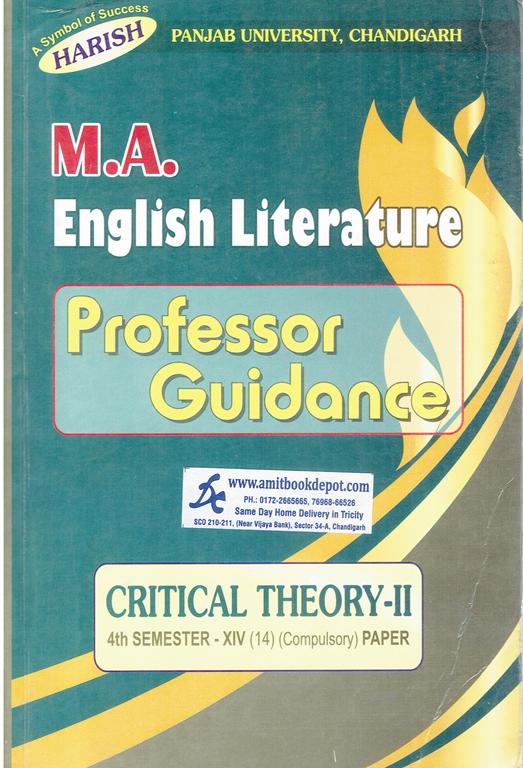
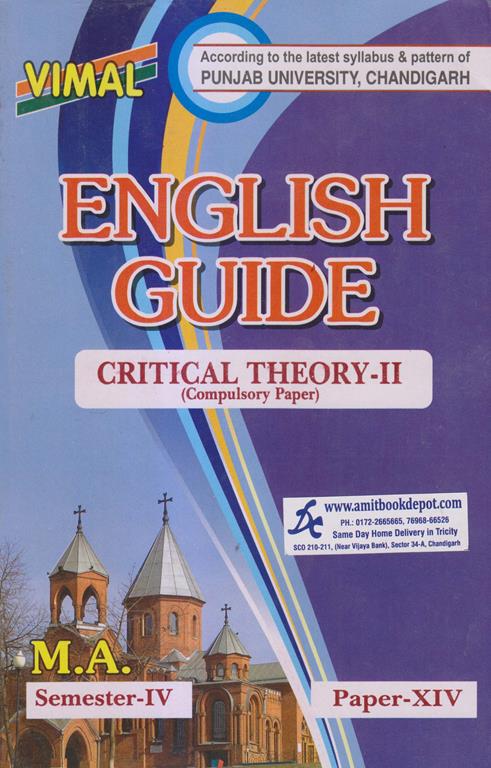
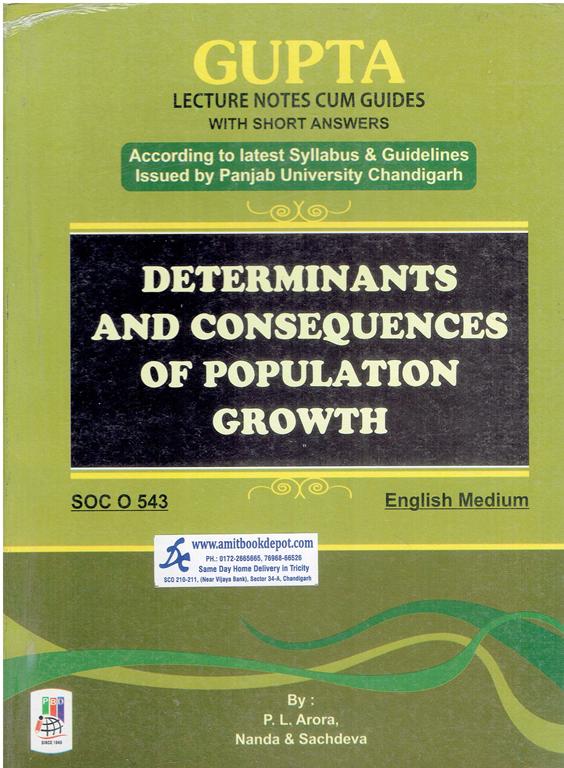
Harish Professor Guidance Critical Theory 2 For MA 4th Semester Paper XIV (14) Compulsory Panjab University Chandigarh
Harish Professor Guidance Critical Theory 2 For MA 4th Semester Paper XIV (14) Compulsory Panjab University Chandigarh
by Madhurima
₹360₹360.00(-/
off)
Rating & Reviews
23 Customer Review
This essential guide, "Professor Guidance Critical Theory 2," is the prescribed study resource for Panjab University's MA 4th Semester, Compulsory Paper XIV. Authored by Dr. Sangeeta Rani and Dr. Chakreshwari Dixit and published by Harish Prakashan Mandir, it provides a detailed, unit-wise analysis of the syllabus. Covering key theorists like Hayden White, Raymond Williams, Judith Butler, Homi Bhabha, and Aijaz Ahmad, it delves into advanced literary theory, cultural studies, historiography, gender performativity, postcolonial discourse, and Marxist critique. Designed specifically for PU Chandigarh students, it simplifies complex concepts and serves as indispensable exam preparation material for mastering contemporary critical theory.
Product Name: Harish Professor Guidance Critical Theory 2 For MA 4th Semester Paper XIV (14) Compulsory Panjab University Chandigarh
Authors: Dr. Sangeeta Rani and Dr. Chakreshwari Dixit
Publisher: Harish Prakashan Mandir
This comprehensive guidebook, "Professor Guidance Critical Theory 2," is an indispensable academic resource meticulously crafted for Master of Arts students at Panjab University, Chandigarh, specifically enrolled in the fourth semester of the MA II program. Authored by the esteemed scholars Dr. Sangeeta Rani and Dr. Chakreshwari Dixit, this volume serves as the definitive study aid for Compulsory Paper XIV (14): Critical Theory – II. Published by Harish Prakashan Mandir, a trusted name in academic publishing, this book is engineered to align perfectly with the university's prescribed syllabus, providing students with a structured, clear, and in-depth exploration of complex theoretical paradigms that have emerged post-1980.
The central objective of this MA English book is to bridge the gap between advanced literary theory and contemporary cultural theory. As the syllabus outlines, modern theory no longer operates in isolation but fundamentally reshapes our understanding of broader discourses such as history, colonialism, gender, and ideology. This guide systematically navigates this expanded ambit, presenting critical essays that represent pivotal later developments in the field. It is designed to be studied in conjunction with Literary Theory—I, offering a complete framework for students specializing in English literature, cultural studies, and critical theory.
The content is organized into five detailed units, each dedicated to a foundational theorist and their seminal work. The book begins with Hayden White's revolutionary essay, "Historical Text as Literary Artifact," which deconstructs the traditional boundaries between historical narrative and literary creation, introducing students to the concepts of tropology and narratology. Unit II delves into the work of Raymond Williams, explicating his crucial concepts of "From Reflection to Mediation" and the dynamic model of "Dominant, Residual, and Emergent" cultural forces, essential for understanding the materialist analysis of literature and culture within Marxist literary theory.
Unit III is dedicated to Judith Butler's groundbreaking work on gender performativity, through her essay "Performative Acts and Gender Constitution." This section is vital for students of feminist theory, queer theory, and gender studies, breaking down the construction of gender identity as a reiterated social performance. Unit IV explores Homi Bhabha's influential postcolonial critique in "Of Mimicry and Man," unpacking the ambivalence and hybridity inherent in colonial discourse, key concepts for analyzing power dynamics in postcolonial literature.
The final unit engages with Aijaz Ahmad's provocative critique in "Literary Theory and Third World Literature," offering a crucial perspective on the politics of categorizing Third World literature and interrogating Western theoretical models from a Marxist standpoint. This encourages critical thinking about nationalism, class, and the institutionalization of theory.
Beyond mere summarization, this Panjab University guidebook provides detailed explanatory notes, critical commentary, and contextual analysis for each essay. It clarifies complex terminology, traces theoretical arguments, and draws connections between different schools of thought. As a PU Chandigarh study material, it includes potential examination questions, thematic discussions, and guidance on essay writing, making it an essential tool for both semester examinations and developing a sophisticated scholarly approach. For any MA English student aiming to master the challenging terrain of contemporary critical theory as mandated by Panjab University's syllabus, this Professor Guidance book from Harish Prakashan Mandir is an authoritative, syllabus-specific, and invaluable academic companion.
Does this guidebook include the full original text of the critical essays by Hayden White, Judith Butler, etc.?
A1
No, this is a guidebook and critical commentary. It provides detailed analysis, explanations, and summaries of the prescribed essays. Students must refer to the original source texts or anthologies for the complete essays as per the university syllabus.
Q2
How does this book help in understanding Judith Butler's concept of gender performativity, which is often considered challenging?
A2
The guide breaks down Butler's complex phenomenological and feminist arguments into clear, structured explanations with contemporary examples, helping students grasp the core idea that gender is an act constituted through repeated performative acts, rather than a fixed identity.
Q3
Is the section on Aijaz Ahmad's critique aligned with his debate with Fredric Jameson on "Third-World Literature"?
A3
Yes, the unit on Aijaz Ahmad contextualizes his essay within that seminal debate, explaining his Marxist critique of Jameson's model and his arguments about nationalism, class, and the reductive categorization of non-Western literatures.
Q4
Are Raymond Williams' concepts of "Dominant, Residual, and Emergent" explained with literary or cultural examples?
A4
Absolutely. The guide illustrates these key concepts from Marxism and Literature with relevant examples from cultural processes and literary history to show how these forces interact at any given point in time.
Q5
Does this book cover the application of Homi Bhabha's ideas of mimicry and ambivalence to specific postcolonial novels or texts?
A5
While the primary focus is on explicating Bhabha's theoretical framework from "Of Mimicry and Man," it does suggest potential avenues for application and provides analytical tools that students can directly use to interpret colonial and postcolonial texts for their exams and studies.
Q6
Is the material updated to the latest syllabus of Panjab University's MA English (Semester IV, Paper XIV)?
A6
Yes, this book is specifically compiled and published for the current/academic year's syllabus of Panjab University, Chandigarh, for MA II, Semester IV, Compulsory Paper XIV (Critical Theory – II). Always check the publication year for the most recent edition.
Q7
How is Hayden White's idea of the "historical text as a literary artifact" different from traditional historiography?
A7
The guide clearly contrasts White's postmodern perspective—which emphasizes the use of literary tropes (metaphor, metonymy, etc.) and employment in historical narratives—with traditional, positivist historiography that claims objective truth, highlighting his contribution to the theory of history.
Q8
Can this book be used by students from other universities studying similar critical theories?
A8
While it is meticulously tailored for Panjab University's specific syllabus and exam pattern, students from other universities with courses on contemporary critical theory, postcolonialism, or feminist theory will find the in-depth explanations of key theorists extremely beneficial for their conceptual understanding.
Q9
Does the unit on Raymond Williams connect his ideas to his broader cultural materialism?
A9
Yes, it situates the selected excerpts ("From Reflection to Mediation" and "Dominant, Residual, and Emergent") within Williams' overarching project of cultural materialism, explaining how they reformulate traditional Marxist base-superstructure models.
Q10
Is there a comparative analysis provided between the theorists covered in the five units?
A10
The introduction and conclusion of the guide often draw comparative insights, highlighting how these post-1980 theories intersect and diverge, particularly on issues of power, discourse, and representation. Individual units also occasionally reference related ideas from other theorists.
0.00
0 Overall Rating
5
0
4
0
3
0
2
0
1
0
Try this product & share your review &
thoughts
UNIT - I
1. Historical Text as Literary Artifact: Tropics of Discourse—Essay in Cultural Criticism: Hayden White
Text - Hyden White
- Introduction to the Author
Historical Text as Literary Artifact
Summary
1. A Manifesto of New Historicism
2. A Pause in a Lingual Utterance
3. Tropical Elements of Literary Artifact
4. Explanation of Revisiting History
5. Relation of History with Literary Texts
UNIT - II
2. ‘From Reflection to Mediation’ & Dominant, Residual, and Emergent - Raymond Williams
Text—From Reflection to Mediation
[Marxism and Literature Chapter - 4]
Introduction to the Author
Summary of ‘From Reflection of Mediation.’
Introduction to Marxism and Literature
1. Marxism and Marxist Criticism in Literature
2. Base and Superstructure in Relation to Reflection and Mediation
Dominant, Residual, and Emergent
Text—Dominant, Residual, and Emergent
[Marxism and Literature Chapter - 8]
Summary of Dominant Residual and Emergent’
1. Main Points of Raymond Williams’s Essay
2. Artistic Components of Williams
3. William’s Marxian Cultural Theory
4. Dominant, Residual, and Emergent Structure
UNIT - III
3. Performative Act and Gender Constitution: An Essay in Phenomenology and Feminist Theory - Judith Butler
Text—Judith Butler
- Introduction of Judith Butler
Performative Acts and Gender Constitution
A Succinct Summary
1. Concept of Performativity
2. Views on Gender Construction
3. Gender Identity Is Problematic
4. Conception of Female Gender and Sexual Identity
5. Critical Evaluation of Judith Butler’s Essay
6. Metaphysical Perspective of Gender Realism
UNIT - IV
4. Of Mimicry and Man: The Ambivalence of Colonial Discourse: Homi Bhabha
Text—Homi Bhabha
- Introduction to Homi Bhabha
Of Mimicry and Mind
Of Mimicry and Man and Commentary Mimicry and Hybridity in Simple English
1. Concept of Mimicry and Ambivalence
2. Homi Bhabha as the Chief Postcolonial Cultural Critic
3. Irony, Mimicry, and Repetition
4. Effect of Mimicry and Hybridity
UNIT - V
5. Literary Theory and Third World Literature—In Theory: Classes, Nations, Literatures—Aijaz Ahmad
Text—Aijaz Ahmad
- Introduction to the Author
Literary Theory and Third World Literature
Summary
1. Third World Literary Theory
2. Transforming Effect of Colonialism and Postcolonialism
3. Three World Theory and World Literature
4. Third World Theory
5. Evaluate Ahmad’s Third World Literature
6. Ahmad’s Views on Colonization
Latest Syllabus of Professor Guidance Critical Theory 2 For MA 4th Semester Paper XIV (14) Compulsory Panjab University (PU) Chandigarh
M.A. II
Semester IV
Compulsory Paper
Paper XIV
Critical Theory – II
Post-1980, the gap between literary theory and cultural theory has narrowed down. Literary theory is no longer contained to our thinking about the production or
reception of literary works alone; rather, it has brought about changes in the ways in which we conceptualize larger discourses of history, colonialism, gender, and
ideology. The ambit of theory has further widened due to a strident inner questioning. This paper, to be seen in conjunction with Literary Theory—I, maps the subsequent development and new interrogations in the field. The collation of texts is with the intent of exposing students to later developments in the field of literary theory. The paper focuses on essays that deal with theoretical understanding of history, ideology, gender, and colonialism.
Unit I
Hayden White: “Historical Text as Literary Artifact,” Tropics of Discourse: Essays in Cultural Criticism (The John Hopkins University Press, 1986), 81-100.
Unit II
Raymond Williams, “From Reflection to Mediation” (95-100), “Dominant, Residual and Emergent” (121-127), Marxism and Literature (Oxford and New York: OUP, 1977)
Unit III
Judith Butler, “Performative Acts and Gender Constitution: An Essay in Phenomenology and Feminist Theory,” Theatre Journal, Vol. 40, No. 4 (Dec., 1988), 519-531.
Unit IV
Homi Bhabha, “Of Mimicry and Man: The Ambivalence of Colonial Discourse,” October, Vol. 28, Discipleship: A Special Issue on Psychoanalysis (Spring, 1984),
125-133
Unit V
Aijaz Ahmad, “Literary Theory and Third World Literature,” In Theory: Classes, Nations, Literatures (London & New York: Verso, 1992) 2000 rpt. 43-71 & 327-330.
Product Name: Harish Professor Guidance Critical Theory 2 For MA 4th Semester Paper XIV (14) Compulsory Panjab University Chandigarh
Authors: Dr. Sangeeta Rani and Dr. Chakreshwari Dixit
Publisher: Harish Prakashan Mandir
This comprehensive guidebook, "Professor Guidance Critical Theory 2," is an indispensable academic resource meticulously crafted for Master of Arts students at Panjab University, Chandigarh, specifically enrolled in the fourth semester of the MA II program. Authored by the esteemed scholars Dr. Sangeeta Rani and Dr. Chakreshwari Dixit, this volume serves as the definitive study aid for Compulsory Paper XIV (14): Critical Theory – II. Published by Harish Prakashan Mandir, a trusted name in academic publishing, this book is engineered to align perfectly with the university's prescribed syllabus, providing students with a structured, clear, and in-depth exploration of complex theoretical paradigms that have emerged post-1980.
The central objective of this MA English book is to bridge the gap between advanced literary theory and contemporary cultural theory. As the syllabus outlines, modern theory no longer operates in isolation but fundamentally reshapes our understanding of broader discourses such as history, colonialism, gender, and ideology. This guide systematically navigates this expanded ambit, presenting critical essays that represent pivotal later developments in the field. It is designed to be studied in conjunction with Literary Theory—I, offering a complete framework for students specializing in English literature, cultural studies, and critical theory.
The content is organized into five detailed units, each dedicated to a foundational theorist and their seminal work. The book begins with Hayden White's revolutionary essay, "Historical Text as Literary Artifact," which deconstructs the traditional boundaries between historical narrative and literary creation, introducing students to the concepts of tropology and narratology. Unit II delves into the work of Raymond Williams, explicating his crucial concepts of "From Reflection to Mediation" and the dynamic model of "Dominant, Residual, and Emergent" cultural forces, essential for understanding the materialist analysis of literature and culture within Marxist literary theory.
Unit III is dedicated to Judith Butler's groundbreaking work on gender performativity, through her essay "Performative Acts and Gender Constitution." This section is vital for students of feminist theory, queer theory, and gender studies, breaking down the construction of gender identity as a reiterated social performance. Unit IV explores Homi Bhabha's influential postcolonial critique in "Of Mimicry and Man," unpacking the ambivalence and hybridity inherent in colonial discourse, key concepts for analyzing power dynamics in postcolonial literature.
The final unit engages with Aijaz Ahmad's provocative critique in "Literary Theory and Third World Literature," offering a crucial perspective on the politics of categorizing Third World literature and interrogating Western theoretical models from a Marxist standpoint. This encourages critical thinking about nationalism, class, and the institutionalization of theory.
Beyond mere summarization, this Panjab University guidebook provides detailed explanatory notes, critical commentary, and contextual analysis for each essay. It clarifies complex terminology, traces theoretical arguments, and draws connections between different schools of thought. As a PU Chandigarh study material, it includes potential examination questions, thematic discussions, and guidance on essay writing, making it an essential tool for both semester examinations and developing a sophisticated scholarly approach. For any MA English student aiming to master the challenging terrain of contemporary critical theory as mandated by Panjab University's syllabus, this Professor Guidance book from Harish Prakashan Mandir is an authoritative, syllabus-specific, and invaluable academic companion.
UNIT - I
1. Historical Text as Literary Artifact: Tropics of Discourse—Essay in Cultural Criticism: Hayden White
Text - Hyden White
- Introduction to the Author
Historical Text as Literary Artifact
Summary
1. A Manifesto of New Historicism
2. A Pause in a Lingual Utterance
3. Tropical Elements of Literary Artifact
4. Explanation of Revisiting History
5. Relation of History with Literary Texts
UNIT - II
2. ‘From Reflection to Mediation’ & Dominant, Residual, and Emergent - Raymond Williams
Text—From Reflection to Mediation
[Marxism and Literature Chapter - 4]
Introduction to the Author
Summary of ‘From Reflection of Mediation.’
Introduction to Marxism and Literature
1. Marxism and Marxist Criticism in Literature
2. Base and Superstructure in Relation to Reflection and Mediation
Dominant, Residual, and Emergent
Text—Dominant, Residual, and Emergent
[Marxism and Literature Chapter - 8]
Summary of Dominant Residual and Emergent’
1. Main Points of Raymond Williams’s Essay
2. Artistic Components of Williams
3. William’s Marxian Cultural Theory
4. Dominant, Residual, and Emergent Structure
UNIT - III
3. Performative Act and Gender Constitution: An Essay in Phenomenology and Feminist Theory - Judith Butler
Text—Judith Butler
- Introduction of Judith Butler
Performative Acts and Gender Constitution
A Succinct Summary
1. Concept of Performativity
2. Views on Gender Construction
3. Gender Identity Is Problematic
4. Conception of Female Gender and Sexual Identity
5. Critical Evaluation of Judith Butler’s Essay
6. Metaphysical Perspective of Gender Realism
UNIT - IV
4. Of Mimicry and Man: The Ambivalence of Colonial Discourse: Homi Bhabha
Text—Homi Bhabha
- Introduction to Homi Bhabha
Of Mimicry and Mind
Of Mimicry and Man and Commentary Mimicry and Hybridity in Simple English
1. Concept of Mimicry and Ambivalence
2. Homi Bhabha as the Chief Postcolonial Cultural Critic
3. Irony, Mimicry, and Repetition
4. Effect of Mimicry and Hybridity
UNIT - V
5. Literary Theory and Third World Literature—In Theory: Classes, Nations, Literatures—Aijaz Ahmad
Text—Aijaz Ahmad
- Introduction to the Author
Literary Theory and Third World Literature
Summary
1. Third World Literary Theory
2. Transforming Effect of Colonialism and Postcolonialism
Does this guidebook include the full original text of the critical essays by Hayden White, Judith Butler, etc.?
A1
No, this is a guidebook and critical commentary. It provides detailed analysis, explanations, and summaries of the prescribed essays. Students must refer to the original source texts or anthologies for the complete essays as per the university syllabus.
Q2
How does this book help in understanding Judith Butler's concept of gender performativity, which is often considered challenging?
A2
The guide breaks down Butler's complex phenomenological and feminist arguments into clear, structured explanations with contemporary examples, helping students grasp the core idea that gender is an act constituted through repeated performative acts, rather than a fixed identity.
Q3
Is the section on Aijaz Ahmad's critique aligned with his debate with Fredric Jameson on "Third-World Literature"?
A3
Yes, the unit on Aijaz Ahmad contextualizes his essay within that seminal debate, explaining his Marxist critique of Jameson's model and his arguments about nationalism, class, and the reductive categorization of non-Western literatures.
Q4
Are Raymond Williams' concepts of "Dominant, Residual, and Emergent" explained with literary or cultural examples?
A4
Absolutely. The guide illustrates these key concepts from Marxism and Literature with relevant examples from cultural processes and literary history to show how these forces interact at any given point in time.
Q5
Does this book cover the application of Homi Bhabha's ideas of mimicry and ambivalence to specific postcolonial novels or texts?
A5
While the primary focus is on explicating Bhabha's theoretical framework from "Of Mimicry and Man," it does suggest potential avenues for application and provides analytical tools that students can directly use to interpret colonial and postcolonial texts for their exams and studies.
Q6
Is the material updated to the latest syllabus of Panjab University's MA English (Semester IV, Paper XIV)?
A6
Yes, this book is specifically compiled and published for the current/academic year's syllabus of Panjab University, Chandigarh, for MA II, Semester IV, Compulsory Paper XIV (Critical Theory – II). Always check the publication year for the most recent edition.
Q7
How is Hayden White's idea of the "historical text as a literary artifact" different from traditional historiography?
A7
The guide clearly contrasts White's postmodern perspective—which emphasizes the use of literary tropes (metaphor, metonymy, etc.) and employment in historical narratives—with traditional, positivist historiography that claims objective truth, highlighting his contribution to the theory of history.
Q8
Can this book be used by students from other universities studying similar critical theories?
A8
While it is meticulously tailored for Panjab University's specific syllabus and exam pattern, students from other universities with courses on contemporary critical theory, postcolonialism, or feminist theory will find the in-depth explanations of key theorists extremely beneficial for their conceptual understanding.
Q9
Does the unit on Raymond Williams connect his ideas to his broader cultural materialism?
A9
Yes, it situates the selected excerpts ("From Reflection to Mediation" and "Dominant, Residual, and Emergent") within Williams' overarching project of cultural materialism, explaining how they reformulate traditional Marxist base-superstructure models.
Q10
Is there a comparative analysis provided between the theorists covered in the five units?
A10
The introduction and conclusion of the guide often draw comparative insights, highlighting how these post-1980 theories intersect and diverge, particularly on issues of power, discourse, and representation. Individual units also occasionally reference related ideas from other theorists.
Latest Syllabus of Professor Guidance Critical Theory 2 For MA 4th Semester Paper XIV (14) Compulsory Panjab University (PU) Chandigarh
M.A. II
Semester IV
Compulsory Paper
Paper XIV
Critical Theory – II
Post-1980, the gap between literary theory and cultural theory has narrowed down. Literary theory is no longer contained to our thinking about the production or
reception of literary works alone; rather, it has brought about changes in the ways in which we conceptualize larger discourses of history, colonialism, gender, and
ideology. The ambit of theory has further widened due to a strident inner questioning. This paper, to be seen in conjunction with Literary Theory—I, maps the subsequent development and new interrogations in the field. The collation of texts is with the intent of exposing students to later developments in the field of literary theory. The paper focuses on essays that deal with theoretical understanding of history, ideology, gender, and colonialism.
Unit I
Hayden White: “Historical Text as Literary Artifact,” Tropics of Discourse: Essays in Cultural Criticism (The John Hopkins University Press, 1986), 81-100.
Unit II
Raymond Williams, “From Reflection to Mediation” (95-100), “Dominant, Residual and Emergent” (121-127), Marxism and Literature (Oxford and New York: OUP, 1977)
Unit III
Judith Butler, “Performative Acts and Gender Constitution: An Essay in Phenomenology and Feminist Theory,” Theatre Journal, Vol. 40, No. 4 (Dec., 1988), 519-531.
Unit IV
Homi Bhabha, “Of Mimicry and Man: The Ambivalence of Colonial Discourse,” October, Vol. 28, Discipleship: A Special Issue on Psychoanalysis (Spring, 1984),
125-133
Unit V
Aijaz Ahmad, “Literary Theory and Third World Literature,” In Theory: Classes, Nations, Literatures (London & New York: Verso, 1992) 2000 rpt. 43-71 & 327-330.
0.00
0 Overall Rating
5
0
4
0
3
0
2
0
1
0
Try this product & share your review &
thoughts
Top Trending Product
Related
Product
Related Product
Related Blog Posts
Latest Blogs
Latest Blogs
Classic Literature Reimagined: Discuss modern twists on classic novels.
Lorem ipsum dolor sit amet, consectetur adipiscing elit, sed
do
eiusmod tempor incididunt ut labore et dolore magna aliqua. Ut enim ad minim
veniam, quis nostrud exercitation ullamco Lorem ipsum dolor sit amet,
consectetur adipiscing elit, sed do eiusmod tempor incididunt ut labore et
dolore magna aliqua. Utenim ad minim veniam, quis nostrud exercitation
ullamco
Lorem ipsum dolor sit amet, consecte...
Classic Literature Reimagined: Discuss modern twists on classic novels.
Lorem ipsum dolor sit amet, consectetur adipiscing elit, sed
do
eiusmod tempor incididunt ut labore et dolore magna aliqua. Ut enim ad minim
veniam, quis nostrud exercitation ullamco Lorem ipsum dolor sit amet,
consectetur adipiscing elit, sed do eiusmod tempor incididunt ut labore et
dolore magna aliqua. Utenim ad minim veniam, quis nostrud exercitation
ullamco
Lorem ipsum dolor sit amet, consecte...
Classic Literature Reimagined: Discuss modern twists on classic novels.
Lorem ipsum dolor sit amet, consectetur adipiscing elit, sed
do
eiusmod tempor incididunt ut labore et dolore magna aliqua. Ut enim ad minim
veniam, quis nostrud exercitation ullamco Lorem ipsum dolor sit amet,
consectetur adipiscing elit, sed do eiusmod tempor incididunt ut labore et
dolore magna aliqua. Utenim ad minim veniam, quis nostrud exercitation
ullamco
Lorem ipsum dolor sit amet, consecte...


.jpg)