Categories
College Bookssss >
BA PU Chandigarh
BSC PU Chandigarh
MSC PU Chandigarh
BBA PU Chandigarh
MA PU Chandigarh
Medical Books
Engineering Books
Management Books
PGDCA Books
BCOM PU Chandigarh
MCOM PU Chandigarh
BCA PU Chandigarh
MCA PU Chandigarh
animate-books

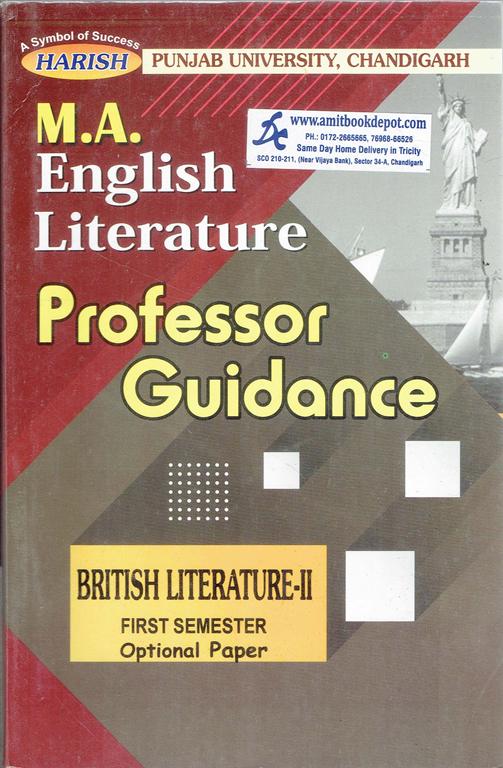
Harish Professor Guidance British Literature 2 For MA 1st Semester 4th Optional Paper Panjab University Chandigarh

by Madhurima
₹360 ₹360.00(-/ off)

Rating & Reviews

23 Customer Review

Harish Professor Guidance British Literature 2 is the definitive study guide for Panjab University, Chandigarh MA 1st Semester students opting for the 4th Optional Paper. Authored by Dr. Mohd Mazhar and Dauji Agarwal, this book provides complete coverage of the Romantic Period syllabus. It includes detailed analyses of major works by Mary Shelley, William Wordsworth, William Blake, John Keats, S.T. Coleridge, Charles Lamb, and William Hazlitt. Designed as an essential exam preparation tool, it offers critical insights, summaries, and potential question-answer frameworks to ensure thorough understanding and academic success in British Literature.

Have Doubts Regarding This Product ? Ask Your Question

  • Q1
    Is this book aligned with the latest syllabus of Panjab University, Chandigarh for MA 1st Semester (British Literature – II)?
    A1

    Yes, this Harish Professor Guidance book is meticulously compiled based on the latest prescribed syllabus for the 4th Optional Paper at Panjab University.

  • Q2
    Does the guide include the complete text of "Frankenstein" and the poems, or is it only analysis?
    A2

    This is a critical guide and study aid. It provides detailed summary, analysis, themes, and critical perspectives on the prescribed texts. The original full texts of the novel and poems are not reprinted but are referenced as per standard editions listed in the syllabus.

  • Q3
    Are both "The Chimney Sweeper" poems from Songs of Innocence and Experience covered?
    A3

    Yes, Unit III provides a dedicated comparative analysis of both "The Chimney Sweeper" poems by William Blake, a crucial part of the syllabus.

  • Q4
    Does it cover all three odes by John Keats mentioned in the syllabus?
    A4

    Absolutely. Unit IV contains detailed analysis of "Ode to a Nightingale," "Ode to Autumn," and "Ode on a Grecian Urn."

  • Q5
    Is the "Preface to Lyrical Ballads" explained in a student-friendly manner?
    A5

    Yes, Unit II breaks down Wordsworth's complex "Preface," explaining its historical importance, key concepts like the language of common men, poetic subject, and the definition of poetry, making it accessible for students.

  • Q6
    Can this book be used as a sole resource for preparing this paper?
    A6

    While this guide is a comprehensive and primary resource that covers the syllabus thoroughly, it is always recommended to read the original literary texts alongside for the best understanding and to supplement your answers.

  • Q7
    Does the book provide historical context for the Romantic Age?
    A7

    Yes, the introduction and various units integrate the historical, cultural, and philosophical milieu of the Romantic period, explaining it as a reaction to the Enlightenment and Neoclassicism.

  • Q8
    Is "The Rime of the Ancient Mariner" analyzed with a focus on its supernatural elements?
    A8

    Yes, the analysis covers the poem's narrative, symbolism, themes of crime and punishment, and its quintessential Romantic features, including the treatment of the supernatural and nature.

  • Q9
    Are there any notes on the shift from Neoclassicism to Romanticism highlighted in the book?
    A9

    Yes, the book's framework and unit introductions consistently highlight this shift, contrasting the emphasis on reason, order, and objectivity with Romanticism's focus on emotion, imagination, and subjectivity.

  • Q10
    Does it include definitions and explanations of key literary terms used in Romantic criticism (e.g., Gusto, Negative Capability, Sublime)?
    A10

    Yes, key terms like "Gusto" (from Hazlitt's essay), "Negative Capability" (associated with Keats), the "Sublime," and others are explained within the context of the relevant chapters.

0.00

0 Overall Rating
  • 5
    0
  • 4
    0
  • 3
    0
  • 2
    0
  • 1
    0

Try this product & share your review & thoughts

BRITISH LITERATURE-II
First Semester - IVth (Optional) Paper

Unit-I Frankenstein—Mary Shelley
Mary Shelley—His Life and Works

Frankenstein
1. An Introduction
2. A Note on the Text
3. A Short Summary of Frankenstein
4. Detailed Summary with Critical Comments
Letter-1 to Letter-4
Volume I: Chapters I to VII
Volume II: Chapters I to IX
Volume III: Chapters I to VII
5. Some Major Themes and the Narrative
Technique in Frankenstein

- Long Question with Their Answers
1. Meetings of Victor and the Monster
2. Narrative Technique in the Novel
3. Female Characters in the Novel
4. Allusions in the Novel
5. Parallels in the Novel
6. Gothic Tradition in the Novel

Unit-II
- Preface to Lyrical Ballads—William Wordsworth

William Wordsworth—His Life and Works
A Summary of 'Preface to Lyrical Ballads'
Hindi summary of 'Preface to Lyrical Ballads'

- Descriptive Questions and Answers
1. The Preface is a Landmark in the History of Criticism.
2. Wordsworth's definition of poetry as the spontaneous overflow of powerful feelings
3. Wordsworth's concept of poetic language
4. Wordsworth's views on themes proper to poetry 2
5. Wordsworth's View on Meter and Its Function 2
6. Wordsworth's view on (a) the nature of poetic truth and (b) poetic pleasure
7. Poetry is the breath and finer spirit of all knowledge.
8. Wordsworth as a Critic
9. Wordsworth's theory of poetic diction reflects the Romantic Revolt.
10. Relationship between poetry and science
11. Wordsworth's theory of poetic language
12. Wordsworth's theory of poetry as enunciated in the Preface to Lyrical Ballads
13. Wordsworth's theory of poetic diction
14. Wordsworth's View on Meter
15. The Themes of Poetry
16. Wordsworth's view on imagination as represented in the Preface to Lyrical Ballads
17. Wordsworth's greatness as a critic and its achievement

Unit III
- Selected Poems—William Blake
Introduction of William Blake
1. Songs of Innocence—A Brief Survey
2. Note on Blake's vision of childhood as depicted in the "Songs of Innocence" and "Songs of Experience"
3. Trace the growth of Blake's thought from the "Songs of Innocence" to the "Songs of Experience""
4. Lamb versus Tyger: Two Contrary States
5. William Blake: Songs of Innocence

- 1. The Chimney Sweeper (Songs of Experience)
1. Text
2. Introduction to the Poem
3. Substance of the Poem

- Questions and Answers
Critical Appreciation of the Poem

- 2. The Chimney Sweeper (Songs of Innocence)
1. Text
2. Introduction to the Poem
3. Substance of the Poem

- Questions and Answers
1. Critical Appreciation of the Poem
2. Parents' indifference towards children


- 3. The Tiger
1. Text
2. Introduction to the Poem
3. Substance of the Poem

- Questions and Answers
Critical Appreciation of the Poem

- Selected Poems—William Wordsworth
1. A Brief Biographical Sketch
2. His Poetical Works
3. Wordsworth as a Romantic Poet
4. Wordsworth as a Poet of Nature
5. Wordsworth as a Poet of Man
6. Wordsworth as a Mystic Poet
7. Wordsworth's Theory of Poetic Diction

- Questions and Answers
1. Wordsworth as a Teacher
2. Process of Wordsworth's Poetic Composition

- 1. Ode on Intimations of Immortality from Recollections of Early Childhood
1. Text
2. Introduction to the Poem
3. Summary of the Poem

- Questions and Answers
Critical Appreciation of the Poem
Metaphysical Implications of Platonism
Wordsworth's Concept of Childhood

- 2. Lines Written in Early Spring
1. Text
2. Introduction to the Poem
3. Summary of the Poem

- Questions and Answers
Estimate of Poem
Relationship between Man and Nature

- 3. London, 1802 (The Milton)
1. Text
2. Introduction to the Poem
3. Substance of the Poem

- Questions and Answers
Critical Estimate of the Poem

Unit IV
- Selected Poems—John Keats
1. Life and Works of Keats
2. Keats as a Poet
3. Keats's Hellenism
4. Keats as a Poet of Beauty
5. Romantic Qualities of Keats' Poetry

- Critical Opinions on Keats' Poetry
1. As a Poet of Beauty
2. Keats's Sensuousness
3. His Odes
4. Keats as a Poet of Nature

- Questions and Answers
The Ode in English Literature

- 1. Ode to the Nightingale
1. Introduction to the Ode
2. Substance of the Ode
3. Text, Paraphrase in English

- Questions and Answers
Critical Appreciation of the Ode

- 2. Ode to Autumn
1. Introduction to the Ode
2. Substance of the Ode
3. Text, Paraphrase in English

- Questions and Answers
Critical Appreciation of the Ode

- 3. Ode on a Grecian Urn
1. Introduction to the Ode
2. Substance of the Ode
3. Text, Paraphrase in English

- Questions and Answers
Critical Appreciation of the Ode
Main Idea of the Ode

- The Rime of the Ancient Mariner—S. T. Coleridge
Medievalism in Coleridge's Poetry
Date and Sources of the Ancient Mariner
The Form of the Ancient Mariner
Meter and Versification of the Ancient Mariner
Style and Atmosphere in the Ancient Mariner
Mediaeval Element in the Ancient Mariner: The Moral of the Ancient Mariner
Supernaturalism in the Ancient Mariner
The Significance of the Wedding Guest
The Synopsis of the Ancient Mariner
Outline of the Story of the Ancient Mariner
Detailed Summary of the Ancient Mariner
Part I to Part VII
Critical Commentary on the Ancient Mariner
Part I to Part VII
Hindi translation (critical discussion on ancient mariners)
Paraphrase of Text in English & Hindi
Part I to Part VII

- Questions and Answers
1. Source of the Poem "The Ancient Mariner'
2. Form of the Poem "The Ancient Mariner'
3. Coleridge as a Lover of Nature
4. Importance of the Supernatural Element in the Poem
5. Coleridge's Poetic Diction
6. The Ancient Mariner is a story of sin and punishment.

Unit-V
- Selected Essays—Charles Lamb

Introduction of Charles Lamb
Important Dates and Events in the Life of
Charles Lamb
Personality of Charles Lamb
Works of Charles Lamb
The Essays of Elia

- 1. The Praise of Chimney Sweepers
1. Text
2. Introduction to the Essay
3. Summary of the Essay

- Questions and Answers
Critical Appreciation of the Essay
Silent Features of the Essay

- 2. Dream Children: A Reverie
1. Text
2. Introduction to the Essay
3. Summary of the Essay

- Questions and Answers
Critical Appreciation of the Essay
Humor and Pathos in the Essay:
Dream Children: A Reverie

- Selected Essays—William Hazlitt
1. His Life and Personality
2. Hazlitt's Works
3. William Hazlitt—The Man
4. The Essay: Its Definition and Characteristics
5. Hazlitt's Philosophy of Life
6. Hazlitt as a (Literary) Critic
7. Hazlitt as an Essayist: A General Estimate
8. Autobiographical Element in Hazlitt's Essays
9. Wit, Humor, Irony, and Satire in the Essays of Hazlitt
10. Hazlitt's Observations on Style
11. Hazlitt's Style

- 1. On Reading Old Books
1. Text
2. Introduction to the Essay
3. Summary of the Essay

- Questions and Answers
Comment on the essay, On Reading Old Books.
The Main Qualities of Hazlitt's Prose Style

- 2. On Gusto
1. Text
2. Introduction to the Essay
3. Summary of the Essay

- Questions and Answers
Hazlitt's Concept of Gusto

Latest Syllabus of Professor Guidance British Literature 2 for MA 1st Semester 4th Optional Paper, Panjab University (PU), Chandigarh


British Literature – II

The end of the eighteenth century and early nineteenth century saw a momentous shift in philosophical, artistic, and literary movements in Europe—Romanticism. It
flourished until the mid-nineteenth century. Romanticism celebrated imagination and intuition in the enduring search for individual rights and liberty. It marks a shift from objectivism to subjectivism, from reason to the power of imagination and emotive response. The objective of the paper is to introduce students to these tenets of Romanticism in general and English Romanticism in particular. During the course they will be introduced to major English poets and prose writers of the period. Through the reading, the students will be familiarized with the English Romantic imagination, its stress on nature, poetic inspiration, freedom, individualism, and spontaneity, and the role language plays in it. Gothic fiction is also explored in the paper. At the end of the course the students will be familiar with major themes, ideas, and concepts of Romanticism and English literature. They will be cognizant of the historical, cultural, political, and aesthetic milieu of the time. Students will study Romanticism as a reaction against the philosophical rationalism and neoclassicism of the Enlightenment. At the end of the course, they would have in-depth knowledge of a movement that not only captured the imagination of people with their ideas of liberty and freedom but also fuelled the avant-garde movements well into the twentieth century.

Unit I

1. Mary Shelley, Frankenstein. Foreword by Ruskin Bond (Collins Classics, 2018).

Unit II

1. William Wordsworth, Preface to Lyrical Ballads (Create Space Pub, 2016).

Unit III

1. William Blake, “The Chimney Sweeper” & “The Tyger,” Songs of Innocence and of Experience (Oxford UP, 1967).
2. William Wordsworth, “Lines Written in Early Spring,” “Ode: Intimations of Immortality,” & “London 1802,” Selected Poems (Penguin Classics, 2004).

Unit IV

1. John Keats, “Ode on a Grecian Urn,” “Ode to a Nightingale,” & “Ode to Autumn,” Selected Poems (Penguin Classics, 2007).
2. Samuel Taylor Coleridge, “Rime of the Ancient Mariner,” Rime of the Ancient Mariner and the Other Poems (Collin Classics, 2016).

Unit V

1. Charles Lamb, “Dream Children: A Reverie” & “The Praise of Chimney Sweepers,” The Essays of Elia and Eliana (G. Bell & Sons, Ltd.).
2. William Hazlitt:
• ‘On Reading Old Books,’ from The Spirit of the Age (Vintage, 2009).
• ‘On Gusto,’ The Fight and Other Writings (Penguin Classics, 2000).

Harish, Professor, Guidance British Literature 2 for MA 1st Semester (4th Optional Paper)—Panjab University, Chandigarh

The Harish Professor Guidance British Literature 2 is an authoritative and meticulously crafted academic resource designed exclusively for Master of Arts (MA) first-semester students at Panjab University, Chandigarh, pursuing the 4th Optional Paper in British Literature. Authored by the esteemed Dr. Mohd Mazhar and Dauji Agarwal and published by Harish Prakashan Mandir, this book serves as an indispensable companion for mastering the Romantic Period of English literature as prescribed in the latest Panjab University syllabus.

This comprehensive guide is structured to provide an in-depth exploration of English Romanticism, a revolutionary literary movement that spanned the late 18th to mid-19th centuries. The book’s primary objective is to elucidate the core tenets of Romanticism—its celebration of imagination, emotion, individualism, and nature, and its rebellion against Enlightenment rationalism and Neoclassical conventions. It is meticulously aligned with the PU Chandigarh MA syllabus, ensuring complete coverage of all prescribed texts, poets, and prose writers, thereby forming a complete study guide and exam preparation tool.

The content is organized into five detailed units, each focusing on seminal works and authors. Unit I delves into Mary Shelley’s groundbreaking Gothic novel, Frankenstein, analyzing its themes of creation, ambition, and the sublime, and its place within the Romantic imagination. Unit II is dedicated to William Wordsworth’s Preface to Lyrical Ballads, the manifesto of the Romantic movement, providing critical insights into its revolutionary ideas on poetic language and subject matter.

Unit III offers a comparative study of two literary giants. It explores the visionary poetry of William Blake through “The Chimney Sweeper” (from both Songs of Innocence and Songs of Experience) and “The Tyger,” alongside the nature-centric and reflective works of William Wordsworth, including the “Ode on Intimations of Immortality,” “Lines Written in Early Spring,” and “London, 1802.” This unit facilitates a deep understanding of the diversity within Romantic thought.

Unit IV focuses on the sublime odes of John Keats—“Ode to a Nightingale,” “Ode to Autumn,” and “Ode on a Grecian Urn”—and the supernatural narrative mastery of Samuel Taylor Coleridge in “The Rime of the Ancient Mariner.” This section helps students grasp the concepts of negative capability, beauty, melancholy, and the interplay of the natural and supernatural.

Unit V shifts to the rich prose of the period, featuring the personal and poignant essays of Charles Lamb (“Dream Children: A Reverie” and “The Praise of Chimney Sweepers”) and the critical, energetic prose of William Hazlitt (“On Reading Old Books” and “On Gusto”). This unit completes the panorama of Romantic expression beyond poetry.

Key features of this Professor Guidance book include a clear, student-friendly explanation of complex literary concepts; detailed analysis of poems, prose, and novels; likely university exam questions and answer frameworks; and contextual notes on the historical, cultural, and aesthetic milieu of the Romantic era. It empowers students to develop critical perspectives, articulate well-argued answers, and excel in their MA 1st Semester exams.

For any student of Panjab University MA English Literature, this book is not just a guide but a strategic resource for achieving academic excellence. It bridges the gap between the university syllabus and the student’s need for concise, reliable, and exam-focused content. Secure your understanding of British Romantic Literature with this essential volume from Harish Prakashan Mandir.

BRITISH LITERATURE-II
First Semester - IVth (Optional) Paper

Unit-I Frankenstein—Mary Shelley
Mary Shelley—His Life and Works

Frankenstein
1. An Introduction
2. A Note on the Text
3. A Short Summary of Frankenstein
4. Detailed Summary with Critical Comments
Letter-1 to Letter-4
Volume I: Chapters I to VII
Volume II: Chapters I to IX
Volume III: Chapters I to VII
5. Some Major Themes and the Narrative
Technique in Frankenstein

- Long Question with Their Answers
1. Meetings of Victor and the Monster
2. Narrative Technique in the Novel
3. Female Characters in the Novel
4. Allusions in the Novel
5. Parallels in the Novel
6. Gothic Tradition in the Novel

Unit-II
- Preface to Lyrical Ballads—William Wordsworth

William Wordsworth—His Life and Works
A Summary of 'Preface to Lyrical Ballads'
Hindi summary of 'Preface to Lyrical Ballads'

- Descriptive Questions and Answers
1. The Preface is a Landmark in the History of Criticism.
2. Wordsworth's definition of poetry as the spontaneous overflow of powerful feelings
3. Wordsworth's concept of poetic language
4. Wordsworth's views on themes proper to poetry 2
5. Wordsworth's View on Meter and Its Function 2
6. Wordsworth's view on (a) the nature of poetic truth and (b) poetic pleasure
7. Poetry is the breath and finer spirit of all knowledge.
8. Wordsworth as a Critic
9. Wordsworth's theory of poetic diction reflects the Romantic Revolt.
10. Relationship between poetry and science
11. Wordsworth's theory of poetic language
12. Wordsworth's theory of poetry as enunciated in the Preface to Lyrical Ballads
13. Wordsworth's theory of poetic diction
14. Wordsworth's View on Meter
15. The Themes of Poetry
16. Wordsworth's view on imagination as represented in the Preface to Lyrical Ballads
17. Wordsworth's greatness as a critic and its achievement

Unit III
- Selected Poems—William Blake
Introduction of William Blake
1. Songs of Innocence—A Brief Survey
2. Note on Blake's vision of childhood as depicted in the "Songs of Innocence" and "Songs of Experience"
3. Trace the growth of Blake's thought from the "Songs of Innocence" to the "Songs of Experience""
4. Lamb versus Tyger: Two Contrary States
5. William Blake: Songs of Innocence

- 1. The Chimney Sweeper (Songs of Experience)
1. Text
2. Introduction to the Poem
3. Substance of the Poem

- Questions and Answers
Critical Appreciation of the Poem

- 2. The Chimney Sweeper (Songs of Innocence)
1. Text
2. Introduction to the Poem
3. Substance of the Poem

- Questions and Answers
1. Critical Appreciation of the Poem
2. Parents' indifference towards children


- 3. The Tiger
1. Text
2. Introduction to the Poem
3. Substance of the Poem

- Questions and Answers
Critical Appreciation of the Poem

- Selected Poems—William Wordsworth
1. A Brief Biographical Sketch
2. His Poetical Works
3. Wordsworth as a Romantic Poet
4. Wordsworth as a Poet of Nature
5. Wordsworth as a Poet of Man
6. Wordsworth as a Mystic Poet
7. Wordsworth's Theory of Poetic Diction

- Questions and Answers
1. Wordsworth as a Teacher
2. Process of Wordsworth's Poetic Composition

- 1. Ode on Intimations of Immortality from Recollections of Early Childhood
1. Text
2. Introduction to the Poem
3. Summary of the Poem

- Questions and Answers
Critical Appreciation of the Poem
Metaphysical Implications of Platonism
Wordsworth's Concept of Childhood

- 2. Lines Written in Early Spring
1. Text
2. Introduction to the Poem
3. Summary of the Poem

- Questions and Answers
Estimate of Poem
Relationship between Man and Nature

- 3. London, 1802 (The Milton)
1. Text
2. Introduction to the Poem
3. Substance of the Poem

- Questions and Answers
Critical Estimate of the Poem

Unit IV
- Selected Poems—John Keats
1. Life and Works of Keats
2. Keats as a Poet
3. Keats's Hellenism
4. Keats as a Poet of Beauty
5. Romantic Qualities of Keats' Poetry

- Critical Opinions on Keats' Poetry
1. As a Poet of Beauty
2. Keats's Sensuousness
3. His Odes
4. Keats as a Poet of Nature

- Questions and Answers
The Ode in English Literature

- 1. Ode to the Nightingale
1. Introduction to the Ode
2. Substance of the Ode
3. Text, Paraphrase in English

- Questions and Answers
Critical Appreciation of the Ode

- 2. Ode to Autumn
1. Introduction to the Ode
2. Substance of the Ode
3. Text, Paraphrase in English

- Questions and Answers
Critical Appreciation of the Ode

- 3. Ode on a Grecian Urn
1. Introduction to the Ode
2. Substance of the Ode
3. Text, Paraphrase in English

- Questions and Answers
Critical Appreciation of the Ode
Main Idea of the Ode

- The Rime of the Ancient Mariner—S. T. Coleridge
Medievalism in Coleridge's Poetry
Date and Sources of the Ancient Mariner
The Form of the Ancient Mariner
Meter and Versification of the Ancient Mariner
Style and Atmosphere in the Ancient Mariner
Mediaeval Element in the Ancient Mariner: The Moral of the Ancient Mariner
Supernaturalism in the Ancient Mariner
The Significance of the Wedding Guest
The Synopsis of the Ancient Mariner
Outline of the Story of the Ancient Mariner
Detailed Summary of the Ancient Mariner
Part I to Part VII
Critical Commentary on the Ancient Mariner
Part I to Part VII
Hindi translation (critical discussion on ancient mariners)
Paraphrase of Text in English & Hindi
Part I to Part VII

- Questions and Answers
1. Source of the Poem "The Ancient Mariner'
2. Form of the Poem "The Ancient Mariner'
3. Coleridge as a Lover of Nature
4. Importance of the Supernatural Element in the Poem
5. Coleridge's Poetic Diction
6. The Ancient Mariner is a story of sin and punishment.

Unit-V
- Selected Essays—Charles Lamb

Introduction of Charles Lamb
Important Dates and Events in the Life of
Charles Lamb
Personality of Charles Lamb
Works of Charles Lamb
The Essays of Elia

- 1. The Praise of Chimney Sweepers
1. Text
2. Introduction to the Essay
3. Summary of the Essay

- Questions and Answers
Critical Appreciation of the Essay
Silent Features of the Essay

- 2. Dream Children: A Reverie
1. Text
2. Introduction to the Essay
3. Summary of the Essay

- Questions and Answers
Critical Appreciation of the Essay
Humor and Pathos in the Essay:
Dream Children: A Reverie

- Selected Essays—William Hazlitt
1. His Life and Personality
2. Hazlitt's Works
3. William Hazlitt—The Man
4. The Essay: Its Definition and Characteristics
5. Hazlitt's Philosophy of Life
6. Hazlitt as a (Literary) Critic
7. Hazlitt as an Essayist: A General Estimate
8. Autobiographical Element in Hazlitt's Essays
9. Wit, Humor, Irony, and Satire in the Essays of Hazlitt
10. Hazlitt's Observations on Style
11. Hazlitt's Style

- 1. On Reading Old Books
1. Text
2. Introduction to the Essay
3. Summary of the Essay

- Questions and Answers
Comment on the essay, On Reading Old Books.
The Main Qualities of Hazlitt's Prose Style

- 2. On Gusto
1. Text
2. Introduction to the Essay
3. Summary of the Essay

- Questions and Answers
Hazlitt's Concept of Gusto

Have Doubts Regarding This Product ? Ask Your Question

  • Q1
    Is this book aligned with the latest syllabus of Panjab University, Chandigarh for MA 1st Semester (British Literature – II)?
    A1

    Yes, this Harish Professor Guidance book is meticulously compiled based on the latest prescribed syllabus for the 4th Optional Paper at Panjab University.

  • Q2
    Does the guide include the complete text of "Frankenstein" and the poems, or is it only analysis?
    A2

    This is a critical guide and study aid. It provides detailed summary, analysis, themes, and critical perspectives on the prescribed texts. The original full texts of the novel and poems are not reprinted but are referenced as per standard editions listed in the syllabus.

  • Q3
    Are both "The Chimney Sweeper" poems from Songs of Innocence and Experience covered?
    A3

    Yes, Unit III provides a dedicated comparative analysis of both "The Chimney Sweeper" poems by William Blake, a crucial part of the syllabus.

  • Q4
    Does it cover all three odes by John Keats mentioned in the syllabus?
    A4

    Absolutely. Unit IV contains detailed analysis of "Ode to a Nightingale," "Ode to Autumn," and "Ode on a Grecian Urn."

  • Q5
    Is the "Preface to Lyrical Ballads" explained in a student-friendly manner?
    A5

    Yes, Unit II breaks down Wordsworth's complex "Preface," explaining its historical importance, key concepts like the language of common men, poetic subject, and the definition of poetry, making it accessible for students.

  • Q6
    Can this book be used as a sole resource for preparing this paper?
    A6

    While this guide is a comprehensive and primary resource that covers the syllabus thoroughly, it is always recommended to read the original literary texts alongside for the best understanding and to supplement your answers.

  • Q7
    Does the book provide historical context for the Romantic Age?
    A7

    Yes, the introduction and various units integrate the historical, cultural, and philosophical milieu of the Romantic period, explaining it as a reaction to the Enlightenment and Neoclassicism.

  • Q8
    Is "The Rime of the Ancient Mariner" analyzed with a focus on its supernatural elements?
    A8

    Yes, the analysis covers the poem's narrative, symbolism, themes of crime and punishment, and its quintessential Romantic features, including the treatment of the supernatural and nature.

  • Q9
    Are there any notes on the shift from Neoclassicism to Romanticism highlighted in the book?
    A9

    Yes, the book's framework and unit introductions consistently highlight this shift, contrasting the emphasis on reason, order, and objectivity with Romanticism's focus on emotion, imagination, and subjectivity.

  • Q10
    Does it include definitions and explanations of key literary terms used in Romantic criticism (e.g., Gusto, Negative Capability, Sublime)?
    A10

    Yes, key terms like "Gusto" (from Hazlitt's essay), "Negative Capability" (associated with Keats), the "Sublime," and others are explained within the context of the relevant chapters.

Latest Syllabus of Professor Guidance British Literature 2 for MA 1st Semester 4th Optional Paper, Panjab University (PU), Chandigarh


British Literature – II

The end of the eighteenth century and early nineteenth century saw a momentous shift in philosophical, artistic, and literary movements in Europe—Romanticism. It
flourished until the mid-nineteenth century. Romanticism celebrated imagination and intuition in the enduring search for individual rights and liberty. It marks a shift from objectivism to subjectivism, from reason to the power of imagination and emotive response. The objective of the paper is to introduce students to these tenets of Romanticism in general and English Romanticism in particular. During the course they will be introduced to major English poets and prose writers of the period. Through the reading, the students will be familiarized with the English Romantic imagination, its stress on nature, poetic inspiration, freedom, individualism, and spontaneity, and the role language plays in it. Gothic fiction is also explored in the paper. At the end of the course the students will be familiar with major themes, ideas, and concepts of Romanticism and English literature. They will be cognizant of the historical, cultural, political, and aesthetic milieu of the time. Students will study Romanticism as a reaction against the philosophical rationalism and neoclassicism of the Enlightenment. At the end of the course, they would have in-depth knowledge of a movement that not only captured the imagination of people with their ideas of liberty and freedom but also fuelled the avant-garde movements well into the twentieth century.

Unit I

1. Mary Shelley, Frankenstein. Foreword by Ruskin Bond (Collins Classics, 2018).

Unit II

1. William Wordsworth, Preface to Lyrical Ballads (Create Space Pub, 2016).

Unit III

1. William Blake, “The Chimney Sweeper” & “The Tyger,” Songs of Innocence and of Experience (Oxford UP, 1967).
2. William Wordsworth, “Lines Written in Early Spring,” “Ode: Intimations of Immortality,” & “London 1802,” Selected Poems (Penguin Classics, 2004).

Unit IV

1. John Keats, “Ode on a Grecian Urn,” “Ode to a Nightingale,” & “Ode to Autumn,” Selected Poems (Penguin Classics, 2007).
2. Samuel Taylor Coleridge, “Rime of the Ancient Mariner,” Rime of the Ancient Mariner and the Other Poems (Collin Classics, 2016).

Unit V

1. Charles Lamb, “Dream Children: A Reverie” & “The Praise of Chimney Sweepers,” The Essays of Elia and Eliana (G. Bell & Sons, Ltd.).
2. William Hazlitt:
• ‘On Reading Old Books,’ from The Spirit of the Age (Vintage, 2009).
• ‘On Gusto,’ The Fight and Other Writings (Penguin Classics, 2000).

0.00

0 Overall Rating
  • 5
    0
  • 4
    0
  • 3
    0
  • 2
    0
  • 1
    0

Try this product & share your review & thoughts

Top Trending Product

Related Product

Related Product

Related Blog Posts

Latest Blogs

Latest Blogs

blog-img
Classic Literature Reimagined: Discuss modern twists on classic novels.
Lorem ipsum dolor sit amet, consectetur adipiscing elit, sed do eiusmod tempor incididunt ut labore et dolore magna aliqua. Ut enim ad minim veniam, quis nostrud exercitation ullamco Lorem ipsum dolor sit amet, consectetur adipiscing elit, sed do eiusmod tempor incididunt ut labore et dolore magna aliqua. Utenim ad minim veniam, quis nostrud exercitation ullamco Lorem ipsum dolor sit amet, consecte...
Read more
Author name | 10 jan, 2025
blog-img
Classic Literature Reimagined: Discuss modern twists on classic novels.
Lorem ipsum dolor sit amet, consectetur adipiscing elit, sed do eiusmod tempor incididunt ut labore et dolore magna aliqua. Ut enim ad minim veniam, quis nostrud exercitation ullamco Lorem ipsum dolor sit amet, consectetur adipiscing elit, sed do eiusmod tempor incididunt ut labore et dolore magna aliqua. Utenim ad minim veniam, quis nostrud exercitation ullamco Lorem ipsum dolor sit amet, consecte...
Read more
Author name | 10 jan, 2025
blog-img
Classic Literature Reimagined: Discuss modern twists on classic novels.
Lorem ipsum dolor sit amet, consectetur adipiscing elit, sed do eiusmod tempor incididunt ut labore et dolore magna aliqua. Ut enim ad minim veniam, quis nostrud exercitation ullamco Lorem ipsum dolor sit amet, consectetur adipiscing elit, sed do eiusmod tempor incididunt ut labore et dolore magna aliqua. Utenim ad minim veniam, quis nostrud exercitation ullamco Lorem ipsum dolor sit amet, consecte...
Read more
Author name | 10 jan, 2025
blog-img
Classic Literature Reimagined: Discuss modern twists on classic novels.
Lorem ipsum dolor sit amet, consectetur adipiscing elit...
Read more
Author Name | 10 Jan, 2025
blog-img
Classic Literature Reimagined: Discuss modern twists on classic novels.
Lorem ipsum dolor sit amet, consectetur adipiscing elit...
Read more
Author Name | 10 Jan, 2025
blog-img
Classic Literature Reimagined: Discuss modern twists on classic novels.
Lorem ipsum dolor sit amet, consectetur adipiscing elit...
Read more
Author Name | 10 Jan, 2025
blog-img
Classic Literature Reimagined: Discuss modern twists on classic novels.
Lorem ipsum dolor sit amet, consectetur adipiscing elit...
Read more
Author Name | 10 Jan, 2025
blog-img
Classic Literature Reimagined: Discuss modern twists on classic novels.
Lorem ipsum dolor sit amet, consectetur adipiscing elit...
Read more
Author Name | 10 Jan, 2025
blog-img
Classic Literature Reimagined: Discuss modern twists on classic novels.
Lorem ipsum dolor sit amet, consectetur adipiscing elit...
Read more
Author Name | 10 Jan, 2025
blog-img
Classic Literature Reimagined: Discuss modern twists on classic novels.
Lorem ipsum dolor sit amet, consectetur adipiscing elit...
Read more
Author Name | 10 Jan, 2025
blog-img
Classic Literature Reimagined: Discuss modern twists on classic novels.
Lorem ipsum dolor sit amet, consectetur adipiscing elit...
Read more
Author Name | 10 Jan, 2025
blog-img
Classic Literature Reimagined: Discuss modern twists on classic novels.
Lorem ipsum dolor sit amet, consectetur adipiscing elit...
Read more
Author Name | 10 Jan, 2025