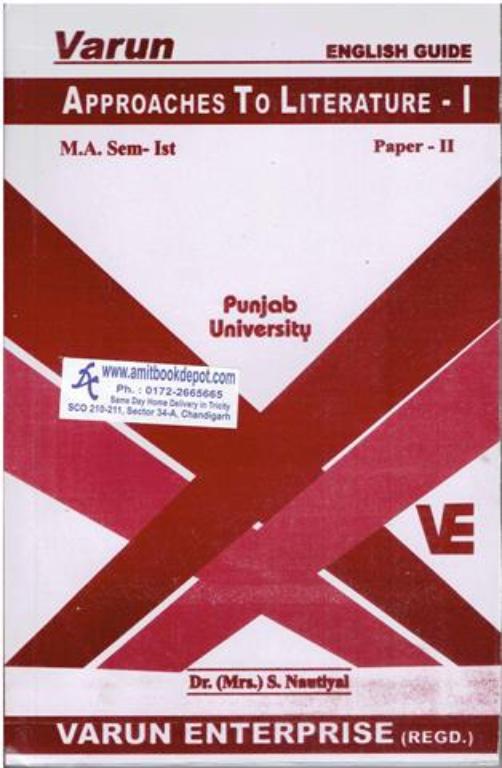
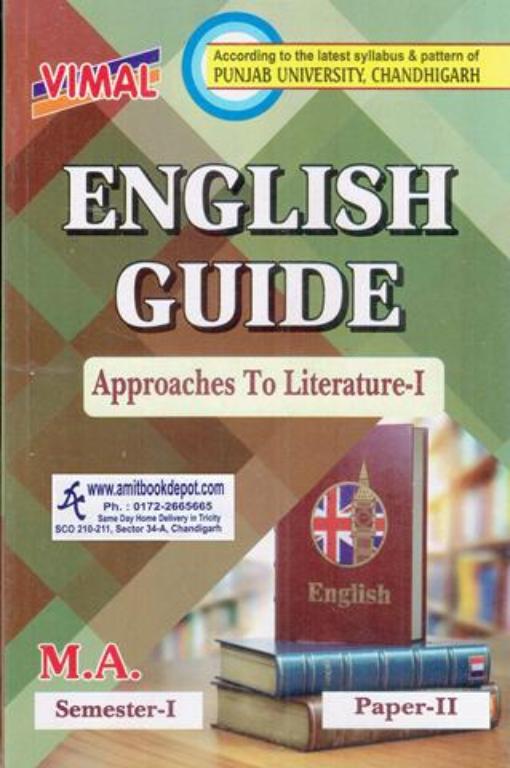
Varun English Guide Approaches to Literature 1 for MA 1st Semester Paper 2 Panjab University Chandigarh
Varun English Guide Approaches to Literature 1 for MA 1st Semester Paper 2 Panjab University Chandigarh
by Madhurima
₹350₹350.00(-/
off)
Rating & Reviews
23 Customer Review
The Varun English Guide: Approaches to Literature—I is the definitive study guide for MA 1st Semester students of Panjab University, Chandigarh, for Paper 2: Approaches to Literary Criticism—I. Authored by Dr. S. Nautiyal, this comprehensive resource covers the entire syllabus, including Abrams, Guerin, Taine, Brooks, Freudian criticism via Trilling, and archetypal theory via Frye. It is designed to foster critical pluralism and practical analytical skills, moving beyond theory to application. This guide is essential for mastering exam-specific questions and building a strong foundation in modern literary criticism and critical approaches.
Varun English Guide: Approaches to Literature – I am a meticulously structured academic companion designed explicitly for Master of Arts (MA) students in their first semester, undertaking Paper 2: Approaches to Literary Criticism—I am under the curriculum of Panjab University, Chandigarh. This comprehensive guide, authored by Dr. S. Nautiyal and published by Varun Enterprises, serves as an indispensable resource for navigating the complex terrain of modern literary theory and critical practice. It aligns perfectly with the university's prescribed syllabus, aiming to demystify various critical approaches to literature and empower students to engage with texts through multiple, sophisticated lenses.
The core objective of this MA English guide is to foster critical pluralism—the understanding that no single interpretive method holds a monopoly on meaning. The book systematically introduces students to the foundational worldviews and methodologies that shape literary analysis, moving beyond rote learning to cultivate deep analytical skills. As outlined in the syllabus, the examination tests the candidate's understanding and practical application of these approaches, and this guide is engineered precisely to meet that demand. It breaks down dense theoretical material into digestible segments, providing clear explanations, contextual backgrounds, and pathways for applying each critical framework to literary texts.
Organized into five cohesive units, the guide delves into the seminal texts and thinkers mandated by Panjab University. Unit I establishes the foundation with M.H. Abrams's seminal essay, "Orientation of Critical Theories," from The Mirror and the Lamp, helping students categorize critical theories based on their orientation towards the universe, artist, work, or audience. Unit II explores historical and biographical approaches, featuring Wilfred Guerin's handbook and the influential introduction by Hippolyte Taine, emphasizing the role of race, milieu, and moment in literary production. Unit III is dedicated to the Formalist Approach, combining Guerin's handbook with Cleanth Brooks's iconic "The Heresy of Paraphrase," training students in close reading and the intrinsic analysis of literary form, structure, and paradox.
Unit IV introduces the psychological approach, primarily through a Freudian lens. It integrates Guerin's explanation of key concepts like the unconscious, dream work, and symbolism with Lionel Trilling's critical engagement in "Freud and Literature," enabling students to analyze character motivation, authorial psyche, and symbolic content. Finally, Unit V ascends to the mythological and archetypal approaches, pairing Guerin's handbook with Northrop Frye's groundbreaking essay, "The Archetypes of Literature." This unit equips students to identify recurring myths, symbols, and narrative patterns across literature, connecting individual works to broader collective unconsciousness and narrative traditions.
This Varun Enterprises publication is more than a mere compilation; it is a focused study guide that bridges the gap between theoretical exposition and practical application. Each unit is presented to highlight the "theoretical base, set of tested tools, and sustained methodology" that the syllabus emphasizes. The guide anticipates the exam pattern, where questions demand answers of 500-600 words with internal choice, focusing on understanding and application rather than memorization. It aids students in constructing well-argued, precise responses that demonstrate a command of critical vocabulary and methodological nuance.
For MA first-semester students at Panjab University, this book is an essential exam preparation tool. It clarifies complex arguments from original texts, provides a structured overview of each critical school, and illustrates how to apply these approaches to unseen texts—a key component of the assessment. By mastering the content of this guide, students will not only excel in their Paper 2 examinations but also build a robust foundation in literary criticism that will support their entire academic journey in English literature. Dr. S. Nautiyal's expertise ensures a reliable, syllabus-specific, and pedagogically sound resource tailored for success in this challenging and intellectually stimulating paper.
Is this guide specifically tailored to the latest syllabus of Panjab University's MA English 1st Semester, Paper 2?
A1
Yes, this guide by Dr. S. Nautiyal is meticulously structured to cover the exact syllabus, prescribed texts, and units (I-V) for Panjab University's MA English 1st Semester, Paper 2: Approaches to Literary Criticism—I.
Q2
Does the book contain the full original texts of essays like "The Heresy of Paraphrase" or "The Archetypes of Literature"?
A2
No, this is a critical guide and study companion. It provides detailed explanations, summaries, analyses, and contextual frameworks for the prescribed readings from Abrams, Guerin's handbook, Taine, Brooks, Trilling, and Frye, as per the syllabus. It does not reproduce the full copyrighted texts.
Q3
How does this guide help with exam preparation, given the paper tests "understanding" and not just memorization?
A3
The guide breaks down complex theories into clear concepts, illustrates methodological applications, and shows how to approach practical criticism questions. It focuses on building analytical skills to deconstruct texts using different approaches, directly aligning with the exam's emphasis on understanding and application.
Q4
I'm struggling with the difference between Formalist and Archetypal approaches. Does the book clarify this?
A4
Absolutely. A key strength of the guide is its comparative clarity. It delineates the focus of each critical school—from the Formalist's close reading of the text itself to the Archetypal's search for universal myths and patterns—helping you understand their unique tools and worldviews as per the syllabus objective of "critical pluralism."
Q5
Is the psychological approach covered only from a Freudian perspective?
A5
Yes, as mandated by the Panjab University syllabus (Unit IV), this guide focuses specifically on the Freudian psychological approach through the prescribed chapters from Guerin's handbook and Lionel Trilling's "Freud and Literature."
Q6
Does this book cover Moral and Philosophical approaches mentioned in the syllabus for Unit II?
A6
The provided table of contents shows a focus on Historical/Biographical and the listed theorists. For complete coverage of all sub-sections (like Moral/Philosophical in Guerin's handbook), please check the latest index of the guide or consult the publisher, as editions may update.
Q7
How is Hippolyte Taine's theory, which isn't detailed in the contents, handled in the book?
A7
The guide will include a dedicated section or analysis for Taine's "Introduction" as required by Unit II of the syllabus, explaining his concepts of race, milieu, and moment within the historical-biographical approach.
Q8
Can this guide be used by students from universities other than Panjab University?
A8
While it is specifically optimized for Panjab University's syllabus, students from other universities covering similar critical approaches (Formalism, Freudian Criticism, Archetypal theory, etc.) will find the theoretical explanations and analytical frameworks highly beneficial.
Q9
Is the language of the guide academic and difficult?
A9
The language is academic yet accessible. It aims to clarify rather than obfuscate, using precise terminology while ensuring key concepts from the prescribed readings are explained in a student-friendly manner.
Q10
How does this book help in answering questions with "internal choice" as per the exam pattern?
A10
By providing a comprehensive understanding of each unit's core issues, the guide equips you with the knowledge to attempt any option within a question confidently. It ensures you have a grasp of all major themes and applications within a unit.
0.00
0 Overall Rating
5
0
4
0
3
0
2
0
1
0
Try this product & share your review &
thoughts
UNIT - I
1. M.H. Abrams: Orientation of Critical Theories, The Mirror and the Lamp.
UNIT - II
1. Wilfred Guerin: Historical and Biographical Approaches
2. Hippolyte Taine: (not given)
UNIT - III
Wilfred Guerin’s
1. Handbook: The Formalist Approach
2. Cleanth Brooks: The Heresy of Paraphrase
UNIT - IV
Wilfred Guerin’s
1. Handbook: Psychological Approach: Freud
2. Lionel Trilling: Freud and Literature
UNIT - V
Wilfred Guerin’s
1. Handbook: Mythological and Archetypal Approaches
2. Northrop Frye: The Archetypes of Literature
Latest Syllabus of English Guide Approaches to Literature 1 for MA 1st Semester Paper 2 Panjab University (PU) Chandigarh
Paper II
Approaches to Literary Criticism—I
Time: 3 Hrs.
M.M.: 80
The objective of the course is to familiarize students with various approaches to literature and the particular worldviews these are based on. The students should be able to relate literary texts to their lives in terms of their own times and location. The number of approaches suggests that there is no one privileged way to understand a text and that a text can yield multiple meanings if it is accessed through different worldviews. Each approach has a claim to total meaning till it is countered by another equally compelling approach. Each approach has its own well-argued theoretical base, a set of tested tools, and a sustained methodology to help the student to navigate through the text with a degree of precision. These approaches put together give rise to what is often called critical pluralism. Testing: The paper shall consist of five questions of 16 marks each, one from each unit. The questions shall be designed in such a way that they focus more on the candidate’s understanding of the issues involved in literary studies and not just his/her capability for memorizing information. Also, there should be questions of a
practical nature in which the candidate has to apply his/her analytical skills to literary texts. Each question shall have an internal choice and is to be answered in 500-600 words. The paper shall carry a total of 80 marks.
Unit I
1. M. H. Abrams, “Orientation of Critical Theories,” The Mirror and the Lamp: Romantic Theory and the Critical Tradition, (Oxford UP, 1958), 3-29.
Unit II
1. Wilfred Guerin et al., eds., “Historical and Biographical Approaches (I, IIA, IIB); Moral and Philosophical Approaches (I, IIA, IIB),” A Handbook of Critical Approaches to Literature (Oxford: OUP, 2005) 5th Ed.
2. Hippolyte Taine, “Introduction” to History of English Literature, Vol. I, (New York: Holt & Williams, 1871) 1-21.
Unit III
1. Chapter 5 of Wilfred Guerin’s Handbook: The Formalist Approach (I, II, III, IV, VA, VD)
2. Cleanth Brooks, “The Heresy of Paraphrase,” The Well Wrought Urn (London: Dobson Books, 1960, 2nd Impression), 176-196.
Unit IV
1. Chapter 6 of Wilfred Guerin’s Handbook: The Psychological Approach: Freud (I, IIA, IIG)
2. Lionel Trilling, “Freud and Literature,” The Liberal Imagination (New York: Viking Press, 1950) 34-57.
Unit V
1. Chapter 7 of Wilfred Guerin’s Handbook: Mythological and Archetypal Approaches (I, II, IIIA, IIIB)
2. Northrop Frye, “The Archetypes of Literature,” The Kenyon Review, Vol. 13, No. 1 (Winter, 1951), 92-110.
Varun English Guide: Approaches to Literature – I am a meticulously structured academic companion designed explicitly for Master of Arts (MA) students in their first semester, undertaking Paper 2: Approaches to Literary Criticism—I am under the curriculum of Panjab University, Chandigarh. This comprehensive guide, authored by Dr. S. Nautiyal and published by Varun Enterprises, serves as an indispensable resource for navigating the complex terrain of modern literary theory and critical practice. It aligns perfectly with the university's prescribed syllabus, aiming to demystify various critical approaches to literature and empower students to engage with texts through multiple, sophisticated lenses.
The core objective of this MA English guide is to foster critical pluralism—the understanding that no single interpretive method holds a monopoly on meaning. The book systematically introduces students to the foundational worldviews and methodologies that shape literary analysis, moving beyond rote learning to cultivate deep analytical skills. As outlined in the syllabus, the examination tests the candidate's understanding and practical application of these approaches, and this guide is engineered precisely to meet that demand. It breaks down dense theoretical material into digestible segments, providing clear explanations, contextual backgrounds, and pathways for applying each critical framework to literary texts.
Organized into five cohesive units, the guide delves into the seminal texts and thinkers mandated by Panjab University. Unit I establishes the foundation with M.H. Abrams's seminal essay, "Orientation of Critical Theories," from The Mirror and the Lamp, helping students categorize critical theories based on their orientation towards the universe, artist, work, or audience. Unit II explores historical and biographical approaches, featuring Wilfred Guerin's handbook and the influential introduction by Hippolyte Taine, emphasizing the role of race, milieu, and moment in literary production. Unit III is dedicated to the Formalist Approach, combining Guerin's handbook with Cleanth Brooks's iconic "The Heresy of Paraphrase," training students in close reading and the intrinsic analysis of literary form, structure, and paradox.
Unit IV introduces the psychological approach, primarily through a Freudian lens. It integrates Guerin's explanation of key concepts like the unconscious, dream work, and symbolism with Lionel Trilling's critical engagement in "Freud and Literature," enabling students to analyze character motivation, authorial psyche, and symbolic content. Finally, Unit V ascends to the mythological and archetypal approaches, pairing Guerin's handbook with Northrop Frye's groundbreaking essay, "The Archetypes of Literature." This unit equips students to identify recurring myths, symbols, and narrative patterns across literature, connecting individual works to broader collective unconsciousness and narrative traditions.
This Varun Enterprises publication is more than a mere compilation; it is a focused study guide that bridges the gap between theoretical exposition and practical application. Each unit is presented to highlight the "theoretical base, set of tested tools, and sustained methodology" that the syllabus emphasizes. The guide anticipates the exam pattern, where questions demand answers of 500-600 words with internal choice, focusing on understanding and application rather than memorization. It aids students in constructing well-argued, precise responses that demonstrate a command of critical vocabulary and methodological nuance.
For MA first-semester students at Panjab University, this book is an essential exam preparation tool. It clarifies complex arguments from original texts, provides a structured overview of each critical school, and illustrates how to apply these approaches to unseen texts—a key component of the assessment. By mastering the content of this guide, students will not only excel in their Paper 2 examinations but also build a robust foundation in literary criticism that will support their entire academic journey in English literature. Dr. S. Nautiyal's expertise ensures a reliable, syllabus-specific, and pedagogically sound resource tailored for success in this challenging and intellectually stimulating paper.
UNIT - I
1. M.H. Abrams: Orientation of Critical Theories, The Mirror and the Lamp.
UNIT - II
1. Wilfred Guerin: Historical and Biographical Approaches
2. Hippolyte Taine: (not given)
UNIT - III
Wilfred Guerin’s
1. Handbook: The Formalist Approach
2. Cleanth Brooks: The Heresy of Paraphrase
UNIT - IV
Wilfred Guerin’s
1. Handbook: Psychological Approach: Freud
2. Lionel Trilling: Freud and Literature
UNIT - V
Wilfred Guerin’s
1. Handbook: Mythological and Archetypal Approaches
Is this guide specifically tailored to the latest syllabus of Panjab University's MA English 1st Semester, Paper 2?
A1
Yes, this guide by Dr. S. Nautiyal is meticulously structured to cover the exact syllabus, prescribed texts, and units (I-V) for Panjab University's MA English 1st Semester, Paper 2: Approaches to Literary Criticism—I.
Q2
Does the book contain the full original texts of essays like "The Heresy of Paraphrase" or "The Archetypes of Literature"?
A2
No, this is a critical guide and study companion. It provides detailed explanations, summaries, analyses, and contextual frameworks for the prescribed readings from Abrams, Guerin's handbook, Taine, Brooks, Trilling, and Frye, as per the syllabus. It does not reproduce the full copyrighted texts.
Q3
How does this guide help with exam preparation, given the paper tests "understanding" and not just memorization?
A3
The guide breaks down complex theories into clear concepts, illustrates methodological applications, and shows how to approach practical criticism questions. It focuses on building analytical skills to deconstruct texts using different approaches, directly aligning with the exam's emphasis on understanding and application.
Q4
I'm struggling with the difference between Formalist and Archetypal approaches. Does the book clarify this?
A4
Absolutely. A key strength of the guide is its comparative clarity. It delineates the focus of each critical school—from the Formalist's close reading of the text itself to the Archetypal's search for universal myths and patterns—helping you understand their unique tools and worldviews as per the syllabus objective of "critical pluralism."
Q5
Is the psychological approach covered only from a Freudian perspective?
A5
Yes, as mandated by the Panjab University syllabus (Unit IV), this guide focuses specifically on the Freudian psychological approach through the prescribed chapters from Guerin's handbook and Lionel Trilling's "Freud and Literature."
Q6
Does this book cover Moral and Philosophical approaches mentioned in the syllabus for Unit II?
A6
The provided table of contents shows a focus on Historical/Biographical and the listed theorists. For complete coverage of all sub-sections (like Moral/Philosophical in Guerin's handbook), please check the latest index of the guide or consult the publisher, as editions may update.
Q7
How is Hippolyte Taine's theory, which isn't detailed in the contents, handled in the book?
A7
The guide will include a dedicated section or analysis for Taine's "Introduction" as required by Unit II of the syllabus, explaining his concepts of race, milieu, and moment within the historical-biographical approach.
Q8
Can this guide be used by students from universities other than Panjab University?
A8
While it is specifically optimized for Panjab University's syllabus, students from other universities covering similar critical approaches (Formalism, Freudian Criticism, Archetypal theory, etc.) will find the theoretical explanations and analytical frameworks highly beneficial.
Q9
Is the language of the guide academic and difficult?
A9
The language is academic yet accessible. It aims to clarify rather than obfuscate, using precise terminology while ensuring key concepts from the prescribed readings are explained in a student-friendly manner.
Q10
How does this book help in answering questions with "internal choice" as per the exam pattern?
A10
By providing a comprehensive understanding of each unit's core issues, the guide equips you with the knowledge to attempt any option within a question confidently. It ensures you have a grasp of all major themes and applications within a unit.
Latest Syllabus of English Guide Approaches to Literature 1 for MA 1st Semester Paper 2 Panjab University (PU) Chandigarh
Paper II
Approaches to Literary Criticism—I
Time: 3 Hrs.
M.M.: 80
The objective of the course is to familiarize students with various approaches to literature and the particular worldviews these are based on. The students should be able to relate literary texts to their lives in terms of their own times and location. The number of approaches suggests that there is no one privileged way to understand a text and that a text can yield multiple meanings if it is accessed through different worldviews. Each approach has a claim to total meaning till it is countered by another equally compelling approach. Each approach has its own well-argued theoretical base, a set of tested tools, and a sustained methodology to help the student to navigate through the text with a degree of precision. These approaches put together give rise to what is often called critical pluralism. Testing: The paper shall consist of five questions of 16 marks each, one from each unit. The questions shall be designed in such a way that they focus more on the candidate’s understanding of the issues involved in literary studies and not just his/her capability for memorizing information. Also, there should be questions of a
practical nature in which the candidate has to apply his/her analytical skills to literary texts. Each question shall have an internal choice and is to be answered in 500-600 words. The paper shall carry a total of 80 marks.
Unit I
1. M. H. Abrams, “Orientation of Critical Theories,” The Mirror and the Lamp: Romantic Theory and the Critical Tradition, (Oxford UP, 1958), 3-29.
Unit II
1. Wilfred Guerin et al., eds., “Historical and Biographical Approaches (I, IIA, IIB); Moral and Philosophical Approaches (I, IIA, IIB),” A Handbook of Critical Approaches to Literature (Oxford: OUP, 2005) 5th Ed.
2. Hippolyte Taine, “Introduction” to History of English Literature, Vol. I, (New York: Holt & Williams, 1871) 1-21.
Unit III
1. Chapter 5 of Wilfred Guerin’s Handbook: The Formalist Approach (I, II, III, IV, VA, VD)
2. Cleanth Brooks, “The Heresy of Paraphrase,” The Well Wrought Urn (London: Dobson Books, 1960, 2nd Impression), 176-196.
Unit IV
1. Chapter 6 of Wilfred Guerin’s Handbook: The Psychological Approach: Freud (I, IIA, IIG)
2. Lionel Trilling, “Freud and Literature,” The Liberal Imagination (New York: Viking Press, 1950) 34-57.
Unit V
1. Chapter 7 of Wilfred Guerin’s Handbook: Mythological and Archetypal Approaches (I, II, IIIA, IIIB)
2. Northrop Frye, “The Archetypes of Literature,” The Kenyon Review, Vol. 13, No. 1 (Winter, 1951), 92-110.
0.00
0 Overall Rating
5
0
4
0
3
0
2
0
1
0
Try this product & share your review &
thoughts
Top Trending Product
Related
Product
Related Product
Related Blog Posts
Latest Blogs
Latest Blogs
Classic Literature Reimagined: Discuss modern twists on classic novels.
Lorem ipsum dolor sit amet, consectetur adipiscing elit, sed
do
eiusmod tempor incididunt ut labore et dolore magna aliqua. Ut enim ad minim
veniam, quis nostrud exercitation ullamco Lorem ipsum dolor sit amet,
consectetur adipiscing elit, sed do eiusmod tempor incididunt ut labore et
dolore magna aliqua. Utenim ad minim veniam, quis nostrud exercitation
ullamco
Lorem ipsum dolor sit amet, consecte...
Classic Literature Reimagined: Discuss modern twists on classic novels.
Lorem ipsum dolor sit amet, consectetur adipiscing elit, sed
do
eiusmod tempor incididunt ut labore et dolore magna aliqua. Ut enim ad minim
veniam, quis nostrud exercitation ullamco Lorem ipsum dolor sit amet,
consectetur adipiscing elit, sed do eiusmod tempor incididunt ut labore et
dolore magna aliqua. Utenim ad minim veniam, quis nostrud exercitation
ullamco
Lorem ipsum dolor sit amet, consecte...
Classic Literature Reimagined: Discuss modern twists on classic novels.
Lorem ipsum dolor sit amet, consectetur adipiscing elit, sed
do
eiusmod tempor incididunt ut labore et dolore magna aliqua. Ut enim ad minim
veniam, quis nostrud exercitation ullamco Lorem ipsum dolor sit amet,
consectetur adipiscing elit, sed do eiusmod tempor incididunt ut labore et
dolore magna aliqua. Utenim ad minim veniam, quis nostrud exercitation
ullamco
Lorem ipsum dolor sit amet, consecte...


.jpg)