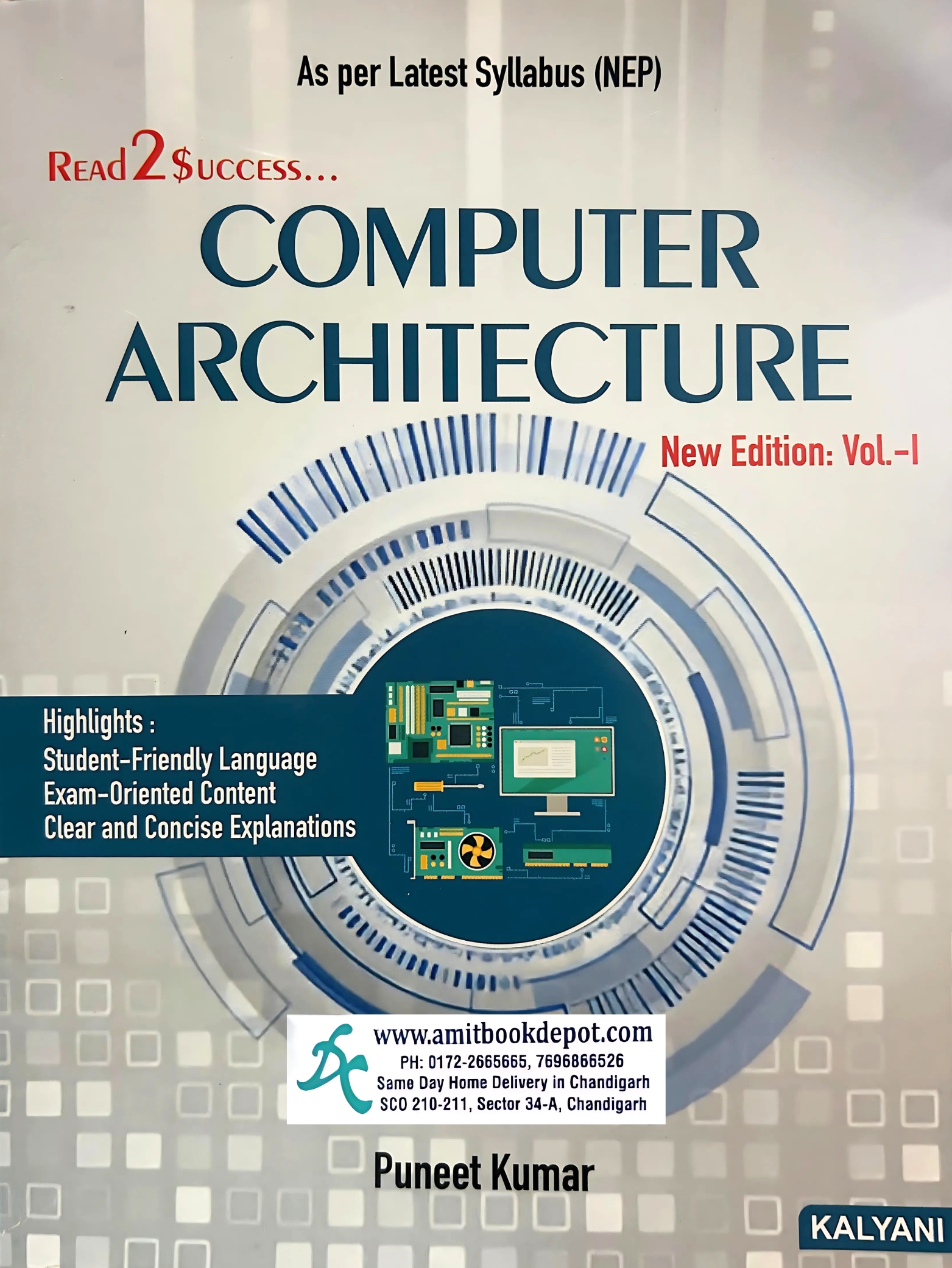
Yes, this "New Edition" is meticulously crafted to cover 100% of the revised NEP syllabus for Paper Code BCA-DSC-3 (Maj)-301, ensuring all units and topics are thoroughly addressed.
Absolutely. Unit I provides a dedicated chapter on ALU Design, including Register Transfer Language, bus transfers, and the hardware implementation of arithmetic, logic, and shift microoperations that form a complete Arithmetic Logic Shift Unit.
The book breaks down microoperations into clear categories (Arithmetic, Logic, Shift) and illustrates their implementation using fundamental digital logic circuits like the binary adder-subtractor and combinational shifters, linking theory to hardware.
Yes, Unit II offers a step-by-step explanation of the instruction cycle and dedicates a section to the interrupt cycle, clearly defining different types of interrupts and their role in basic computer operation.
The book includes an introduction to Assembly Language, primarily focusing on its conceptual understanding and how it differs from machine language, as required by the syllabus, rather than being a full programming guide.
Unit III structures the explanation logically, starting from the need for a memory hierarchy. It then details different cache mapping techniques (Associative, Set-Associative, Direct) with clarity, highlighting their differences.
Yes, it includes a practical example on how to connect four 128x8 RAM chips and one 512x8 ROM chip to a CPU, bridging the gap between abstract concepts and physical design.
Yes, Unit III provides a dedicated section on the 8086/8088 microprocessor, covering its features, block diagram, register organization, flag register, and addressing modes.
Yes, this is a key topic in Unit IV. The book clearly distinguishes between these two I/O addressing methods, explaining the advantages and operational differences of each.
Comprehensively. The book details all these data transfer schemes, explaining their mechanisms, relative speeds, and use cases, including a dedicated section on DMA controllers and transfer modes.
No Description Added
Yes, this "New Edition" is meticulously crafted to cover 100% of the revised NEP syllabus for Paper Code BCA-DSC-3 (Maj)-301, ensuring all units and topics are thoroughly addressed.
Absolutely. Unit I provides a dedicated chapter on ALU Design, including Register Transfer Language, bus transfers, and the hardware implementation of arithmetic, logic, and shift microoperations that form a complete Arithmetic Logic Shift Unit.
The book breaks down microoperations into clear categories (Arithmetic, Logic, Shift) and illustrates their implementation using fundamental digital logic circuits like the binary adder-subtractor and combinational shifters, linking theory to hardware.
Yes, Unit II offers a step-by-step explanation of the instruction cycle and dedicates a section to the interrupt cycle, clearly defining different types of interrupts and their role in basic computer operation.
The book includes an introduction to Assembly Language, primarily focusing on its conceptual understanding and how it differs from machine language, as required by the syllabus, rather than being a full programming guide.
Unit III structures the explanation logically, starting from the need for a memory hierarchy. It then details different cache mapping techniques (Associative, Set-Associative, Direct) with clarity, highlighting their differences.
Yes, it includes a practical example on how to connect four 128x8 RAM chips and one 512x8 ROM chip to a CPU, bridging the gap between abstract concepts and physical design.
Yes, Unit III provides a dedicated section on the 8086/8088 microprocessor, covering its features, block diagram, register organization, flag register, and addressing modes.
Yes, this is a key topic in Unit IV. The book clearly distinguishes between these two I/O addressing methods, explaining the advantages and operational differences of each.
Comprehensively. The book details all these data transfer schemes, explaining their mechanisms, relative speeds, and use cases, including a dedicated section on DMA controllers and transfer modes.