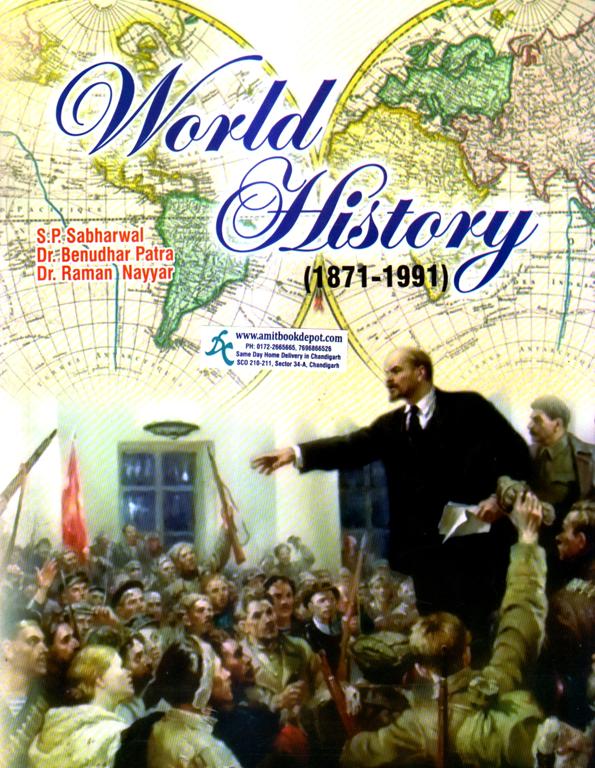
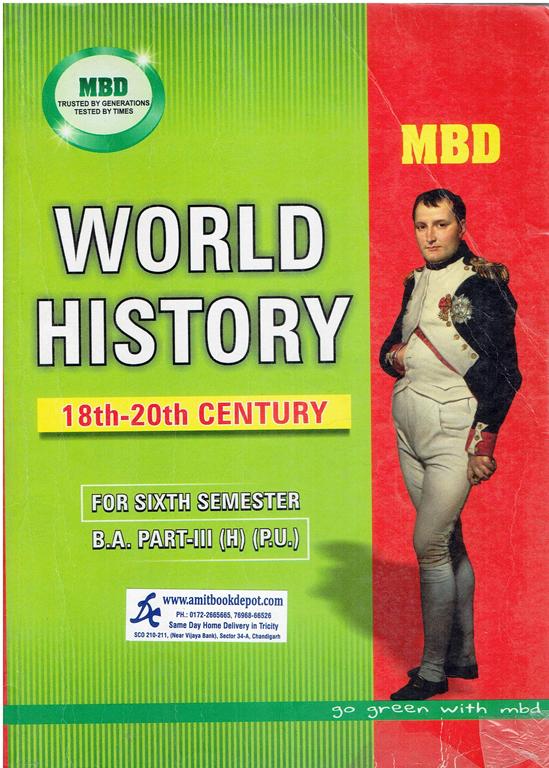
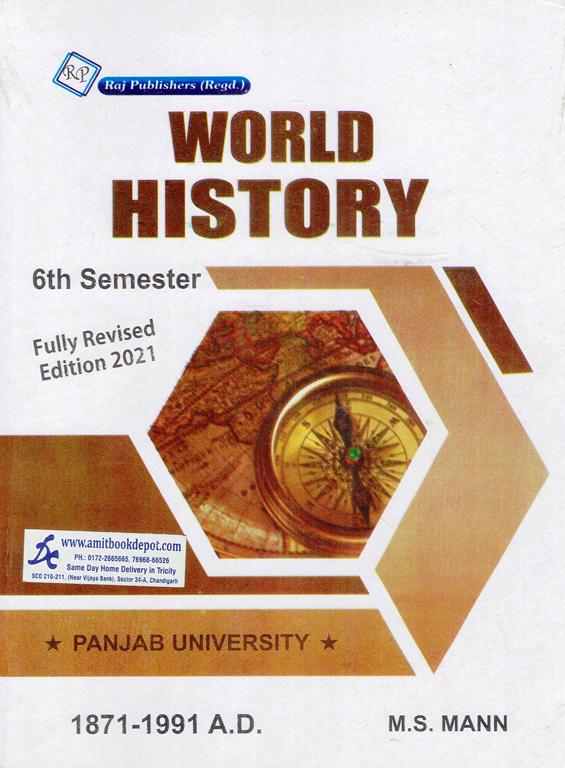
World History (1871-1991) is the prescribed book for BA 6th Semester students of Panjab University, Chandigarh. Authored by S.P. Sabharwal, Dr. Benudar Patra, and Dr. Raman Nayyar, this comprehensive guide covers the critical global events from the era of New Imperialism through the end of the Cold War. Published by K. Duggal & Co., the book provides a structured syllabus analysis and detailed chapters on key themes like the World Wars, the Russian Revolution, and the rise of Fascism and Nazism. It includes essential study aids such as very short question-answers and maps with explanatory notes, making it an indispensable university-specific resource for exam preparation.
World History (1871-1991) is the authoritative and prescribed book designed specifically for BA 6th Semester students of Panjab University, Chandigarh. Meticulously crafted by the esteemed authors S.P. Sabharwal, Dr. Benudar Patra, and Dr. Raman Nayyar, and published by K. Duggal & Co., this volume serves as a definitive guide to the transformative period in global history, from the age of New Imperialism to the dawn of the post-Cold War unipolar world.
This book is structured to align precisely with the Panjab University syllabus, providing a systematic and in-depth exploration of the political, diplomatic, and ideological forces that shaped the modern world. It is an essential resource for undergraduate students pursuing a BA in History, offering a clear, concise, and comprehensive analysis tailored for exam preparation.
Comprehensive Coverage and Syllabus-Oriented Content:
The book is organized into four logical units, each dissecting pivotal themes and events. Unit I begins with an analysis of New Imperialism (1871-1914), exploring the Congress of Berlin and the complex diplomatic developments in Europe that created the powder keg for global conflict. Unit II delves into the cataclysmic World War I, its aftermath in the Paris Peace Conference, and the epoch-making Russian Revolution of 1917, detailing its causes, events, and profound global consequences.
Unit III expands the scope beyond Europe, examining the rise of nationalism and communism in China and the process of modernization in Japan. It also provides a critical account of the Great Depression of 1929, analyzing its worldwide economic and political fallout. Unit IV is dedicated to the interwar and postwar era, offering detailed studies of the rise of Fascism and Nazism, the causes and course of the Second World War, and the subsequent postwar foundations that led to the Cold War and ultimately, a unipolar world by 1991.
Special Features for Enhanced Learning and Exam Success:
Recognizing the needs of university students, this textbook includes dedicated sections to solidify understanding and ensure exam readiness:
1. Very Short Type Questions (25-30 Words): A curated collection of precise questions and answers covering the entire syllabus, perfect for quick revision and tackling objective/short-answer sections in exams.
2. Maps with Explanatory Notes: Strategically included maps provide geographical context to historical events, accompanied by explanatory notes. This visual aid is crucial for mastering the cartographic elements often required in university examinations.
Key Benefits for the Student:
1. University-Specific: Written and published keeping the Panjab University, Chandigarh BA 6th Semester syllabus as the core framework.
2. Authored by Experts: Compiled by renowned academics S.P. Sabharwal, Dr. Benudar Patra, and Dr. Raman Nayyar, ensuring authoritative and reliable content.
3. Structured for Clarity: The division into units and chapters mirrors the syllabus flow, facilitating easy navigation and structured study.
4. Exam-Centric Design: The inclusion of short questions and historical maps directly targets common exam patterns and scoring areas.
5. Comprehensive Yet Concise: Covers a vast timeline from 1871 to 1991 with clarity, focusing on key concepts, events, and their interconnections without overwhelming detail.
Target Audience:
This book is primarily intended for BA (Bachelor of Arts) students, specifically those in their sixth semester at Panjab University and its affiliated colleges. It is also a valuable reference for competitive exam aspirants seeking a clear overview of modern world history and for anyone interested in the pivotal century that defined contemporary global geopolitics.
Conclusion:
World History (1871-1991) is more than just a book; it is a complete learning package for Panjab University students. By integrating detailed narrative chapters with practical, exam-focused aids, it provides all the necessary tools for mastering the semester's curriculum. Ensure academic success with this indispensable guide to modern global history.
How is this book tailored to meet the specific syllabus of Panjab University’s BA 6th Semester?
A1
The book is meticulously structured into four units directly aligned with the Panjab University syllabus, covering all key themes, events, and maps required for the exam, ensuring focused and relevant preparation.
Q2
Does the book include visual aids to help understand geographical and historical contexts?
A2
Yes, it features detailed maps with explanatory notes, helping students visualize and better grasp the geographical aspects of historical events, which is essential for exam success.
Q3
How does this book facilitate quick revision before exams?
A3
The inclusion of Very Short Type Questions (25-30 words) provides concise revision points, covering the entire syllabus for rapid review and effective preparation.
Q4
Are the authors of this book credible and authoritative for the subject?
A4
Absolutely, the book is authored by renowned academics S.P. Sabharwal, Dr. Benudar Patra, and Dr. Raman Nayyar, ensuring accurate and reliable content.
Q5
How is the content organized within the book to aid easy navigation?
A5
The content is divided into four logical units, each with focused chapters on major themes, making it easy for students to locate and study specific topics systematically.
Q6
Does the book cover recent developments in world history up to 1991?
A6
Yes, it comprehensively covers events from the age of New Imperialism to the end of the Cold War in 1991, including the rise of unipolarity and end of Soviet dominance.
Q7
Are there any special features that enhance the learning experience?
A7
Yes, apart from maps and short questions, the book offers detailed chapter summaries, exam tips, and contextual explanations to reinforce learning.
Q8
Are there any practice questions or exam-oriented content included?
A8
Yes, the book features practice questions, especially Very Short Questions, designed to help students prepare effectively for university exams.
Q9
Is the book suitable for self-study or does it require supplementary materials?
A9
The comprehensive coverage, maps, questions, and summaries make it highly suitable for self-study; however, students may supplement with lecture notes for deeper understanding.
Q10
Does the book cover important global landmarks and their historical significance?
A10
Yes, it includes a dedicated map question covering notable places like Versailles, Geneva, Tokyo, and others, with explanatory notes to contextualize their importance.
0.00
0 Overall Rating
5
0
4
0
3
0
2
0
1
0
Try this product & share your review &
thoughts
UNIT - I
1. New Imperialism, 1871-1914 AD
2. Congress of Berlin
3. Diplomatic Developments in Europe
UNIT - II
4. World War I
5. Paris Peace Conference
6. Russian Revolution
UNIT - III
7. Nationalism and Communism in China
8. Modernization in Japan
9. The Great Depression of 1929
UNIT - IV
10. Fascism, Nazism, and the Second World War
11. Post-War Foundations—Towards a Unipolar World
Very Short Type Question (25-30 Words)
Maps with Explanatory Notes
Latest Syllabus of World History From 1871 to 1991 For BA 6th Semester Panjab University (PU) Chandigarh
Max. Marks: 100 Marks
Theory: 90 Marks
Internal Assessment: 10 Marks
Time duration: 3 hours
INSTRUCTIONS FOR THE PAPER-SETTER AND CANDIDATES:
1. The syllabus has been divided into four units.
There shall be 9 questions in all. The first question is compulsory and shall be of the short-answer type, containing 15 short questions spread over the whole syllabus to be answered in about 25 to 30 words each. The candidates are required to attempt any 9 short answer-type questions carrying 18 marks, i.e., 2 marks each. The rest of the candidates shall be given an internal choice of attempting one question from each unit and 4 questions in all. Each question will carry 18 marks.
2. For private candidates, who have not been assessed earlier for internal assessment, the marks secured by them in the theory paper will proportionately be increased to the maximum marks of the paper in lieu of internal assessment.
3. One question from Unit-4 shall be set on the map.
EXPLANATION
1. Each essay-type question would cover about one-third or one-half of a topic detailed in the syllabus.
2. The distribution of marks for the map question would be as under:
Map : 10 Marks
Explanatory Note: 8 Marks
3. In case the paper setter chooses to set a question on important historical places, the paper setter will be required to ask the students to mark 05 places on a map for 02 marks each and write an explanatory note on any 04 of 02 marks each.
4. The paper-setter would avoid repetition between different types of questions within one question paper.
UNIT-1
1. New Imperialism 1871-1914: Main features; Partition of Africa—Causes, colonization, and impact
2. Congress of Berlin 1878: Circumstances, Provisions, and Significance.
3 Diplomatic Developments in Europe: Circumstances Leading to the Formation of the Triple Alliance of 1882 and the Triple Entente
UNIT-2
4. World War 1: Division of Europe into two blocks; Causes of the First World War.
5. Paris Peace Conference: Treaty of Versailles 1919: provisions, major defects, and their impact.
6. Russian Revolution 1917: Causes and Consequences.
UNIT-3
7. Nationalism and Communism in China: Causes for the nationalist revolution of 1911 and its results; circumstances leading to the revolution of 1949 and its results.
8. Modernization of Japan: The Meiji Restoration and Modernization.
9. The Great Depression of 1929: Causes of the Great Depression in the USA; its spread to Germany, France, and Britain; its impact; Roosevelt's New Deal.
UNIT-4
10. Fascism and Nazism and World War 2: circumstances responsible for the rise of Fascism under Mussolini in Italy and Nazism in Germany under Adolf Hitler.
11. Post-War Foundations and the Rise of a Unipolar World: NOTA, SESTO, and the Cold War; Factors leading to the collapse of Soviet Communism and the Soviet Union, 1985-1991; End of the Cold War and US Ascendancy in the World as the Lone Superpower.
12 Map:
(a) Important Historical Places—Geneva, Washington, Tokyo, Versailles, Johannesburg, Cairo, Jerusalem, Nagasaki, Warsaw, and Stalingrad.
World History (1871-1991) is the authoritative and prescribed book designed specifically for BA 6th Semester students of Panjab University, Chandigarh. Meticulously crafted by the esteemed authors S.P. Sabharwal, Dr. Benudar Patra, and Dr. Raman Nayyar, and published by K. Duggal & Co., this volume serves as a definitive guide to the transformative period in global history, from the age of New Imperialism to the dawn of the post-Cold War unipolar world.
This book is structured to align precisely with the Panjab University syllabus, providing a systematic and in-depth exploration of the political, diplomatic, and ideological forces that shaped the modern world. It is an essential resource for undergraduate students pursuing a BA in History, offering a clear, concise, and comprehensive analysis tailored for exam preparation.
Comprehensive Coverage and Syllabus-Oriented Content:
The book is organized into four logical units, each dissecting pivotal themes and events. Unit I begins with an analysis of New Imperialism (1871-1914), exploring the Congress of Berlin and the complex diplomatic developments in Europe that created the powder keg for global conflict. Unit II delves into the cataclysmic World War I, its aftermath in the Paris Peace Conference, and the epoch-making Russian Revolution of 1917, detailing its causes, events, and profound global consequences.
Unit III expands the scope beyond Europe, examining the rise of nationalism and communism in China and the process of modernization in Japan. It also provides a critical account of the Great Depression of 1929, analyzing its worldwide economic and political fallout. Unit IV is dedicated to the interwar and postwar era, offering detailed studies of the rise of Fascism and Nazism, the causes and course of the Second World War, and the subsequent postwar foundations that led to the Cold War and ultimately, a unipolar world by 1991.
Special Features for Enhanced Learning and Exam Success:
Recognizing the needs of university students, this textbook includes dedicated sections to solidify understanding and ensure exam readiness:
1. Very Short Type Questions (25-30 Words): A curated collection of precise questions and answers covering the entire syllabus, perfect for quick revision and tackling objective/short-answer sections in exams.
2. Maps with Explanatory Notes: Strategically included maps provide geographical context to historical events, accompanied by explanatory notes. This visual aid is crucial for mastering the cartographic elements often required in university examinations.
Key Benefits for the Student:
1. University-Specific: Written and published keeping the Panjab University, Chandigarh BA 6th Semester syllabus as the core framework.
2. Authored by Experts: Compiled by renowned academics S.P. Sabharwal, Dr. Benudar Patra, and Dr. Raman Nayyar, ensuring authoritative and reliable content.
3. Structured for Clarity: The division into units and chapters mirrors the syllabus flow, facilitating easy navigation and structured study.
4. Exam-Centric Design: The inclusion of short questions and historical maps directly targets common exam patterns and scoring areas.
5. Comprehensive Yet Concise: Covers a vast timeline from 1871 to 1991 with clarity, focusing on key concepts, events, and their interconnections without overwhelming detail.
Target Audience:
This book is primarily intended for BA (Bachelor of Arts) students, specifically those in their sixth semester at Panjab University and its affiliated colleges. It is also a valuable reference for competitive exam aspirants seeking a clear overview of modern world history and for anyone interested in the pivotal century that defined contemporary global geopolitics.
Conclusion:
World History (1871-1991) is more than just a book; it is a complete learning package for Panjab University students. By integrating detailed narrative chapters with practical, exam-focused aids, it provides all the necessary tools for mastering the semester's curriculum. Ensure academic success with this indispensable guide to modern global history.
How is this book tailored to meet the specific syllabus of Panjab University’s BA 6th Semester?
A1
The book is meticulously structured into four units directly aligned with the Panjab University syllabus, covering all key themes, events, and maps required for the exam, ensuring focused and relevant preparation.
Q2
Does the book include visual aids to help understand geographical and historical contexts?
A2
Yes, it features detailed maps with explanatory notes, helping students visualize and better grasp the geographical aspects of historical events, which is essential for exam success.
Q3
How does this book facilitate quick revision before exams?
A3
The inclusion of Very Short Type Questions (25-30 words) provides concise revision points, covering the entire syllabus for rapid review and effective preparation.
Q4
Are the authors of this book credible and authoritative for the subject?
A4
Absolutely, the book is authored by renowned academics S.P. Sabharwal, Dr. Benudar Patra, and Dr. Raman Nayyar, ensuring accurate and reliable content.
Q5
How is the content organized within the book to aid easy navigation?
A5
The content is divided into four logical units, each with focused chapters on major themes, making it easy for students to locate and study specific topics systematically.
Q6
Does the book cover recent developments in world history up to 1991?
A6
Yes, it comprehensively covers events from the age of New Imperialism to the end of the Cold War in 1991, including the rise of unipolarity and end of Soviet dominance.
Q7
Are there any special features that enhance the learning experience?
A7
Yes, apart from maps and short questions, the book offers detailed chapter summaries, exam tips, and contextual explanations to reinforce learning.
Q8
Are there any practice questions or exam-oriented content included?
A8
Yes, the book features practice questions, especially Very Short Questions, designed to help students prepare effectively for university exams.
Q9
Is the book suitable for self-study or does it require supplementary materials?
A9
The comprehensive coverage, maps, questions, and summaries make it highly suitable for self-study; however, students may supplement with lecture notes for deeper understanding.
Q10
Does the book cover important global landmarks and their historical significance?
A10
Yes, it includes a dedicated map question covering notable places like Versailles, Geneva, Tokyo, and others, with explanatory notes to contextualize their importance.
Latest Syllabus of World History From 1871 to 1991 For BA 6th Semester Panjab University (PU) Chandigarh
Max. Marks: 100 Marks
Theory: 90 Marks
Internal Assessment: 10 Marks
Time duration: 3 hours
INSTRUCTIONS FOR THE PAPER-SETTER AND CANDIDATES:
1. The syllabus has been divided into four units.
There shall be 9 questions in all. The first question is compulsory and shall be of the short-answer type, containing 15 short questions spread over the whole syllabus to be answered in about 25 to 30 words each. The candidates are required to attempt any 9 short answer-type questions carrying 18 marks, i.e., 2 marks each. The rest of the candidates shall be given an internal choice of attempting one question from each unit and 4 questions in all. Each question will carry 18 marks.
2. For private candidates, who have not been assessed earlier for internal assessment, the marks secured by them in the theory paper will proportionately be increased to the maximum marks of the paper in lieu of internal assessment.
3. One question from Unit-4 shall be set on the map.
EXPLANATION
1. Each essay-type question would cover about one-third or one-half of a topic detailed in the syllabus.
2. The distribution of marks for the map question would be as under:
Map : 10 Marks
Explanatory Note: 8 Marks
3. In case the paper setter chooses to set a question on important historical places, the paper setter will be required to ask the students to mark 05 places on a map for 02 marks each and write an explanatory note on any 04 of 02 marks each.
4. The paper-setter would avoid repetition between different types of questions within one question paper.
UNIT-1
1. New Imperialism 1871-1914: Main features; Partition of Africa—Causes, colonization, and impact
2. Congress of Berlin 1878: Circumstances, Provisions, and Significance.
3 Diplomatic Developments in Europe: Circumstances Leading to the Formation of the Triple Alliance of 1882 and the Triple Entente
UNIT-2
4. World War 1: Division of Europe into two blocks; Causes of the First World War.
5. Paris Peace Conference: Treaty of Versailles 1919: provisions, major defects, and their impact.
6. Russian Revolution 1917: Causes and Consequences.
UNIT-3
7. Nationalism and Communism in China: Causes for the nationalist revolution of 1911 and its results; circumstances leading to the revolution of 1949 and its results.
8. Modernization of Japan: The Meiji Restoration and Modernization.
9. The Great Depression of 1929: Causes of the Great Depression in the USA; its spread to Germany, France, and Britain; its impact; Roosevelt's New Deal.
UNIT-4
10. Fascism and Nazism and World War 2: circumstances responsible for the rise of Fascism under Mussolini in Italy and Nazism in Germany under Adolf Hitler.
11. Post-War Foundations and the Rise of a Unipolar World: NOTA, SESTO, and the Cold War; Factors leading to the collapse of Soviet Communism and the Soviet Union, 1985-1991; End of the Cold War and US Ascendancy in the World as the Lone Superpower.
12 Map:
(a) Important Historical Places—Geneva, Washington, Tokyo, Versailles, Johannesburg, Cairo, Jerusalem, Nagasaki, Warsaw, and Stalingrad.
Classic Literature Reimagined: Discuss modern twists on classic novels.
Lorem ipsum dolor sit amet, consectetur adipiscing elit, sed
do
eiusmod tempor incididunt ut labore et dolore magna aliqua. Ut enim ad minim
veniam, quis nostrud exercitation ullamco Lorem ipsum dolor sit amet,
consectetur adipiscing elit, sed do eiusmod tempor incididunt ut labore et
dolore magna aliqua. Utenim ad minim veniam, quis nostrud exercitation
ullamco
Lorem ipsum dolor sit amet, consecte...
Classic Literature Reimagined: Discuss modern twists on classic novels.
Lorem ipsum dolor sit amet, consectetur adipiscing elit, sed
do
eiusmod tempor incididunt ut labore et dolore magna aliqua. Ut enim ad minim
veniam, quis nostrud exercitation ullamco Lorem ipsum dolor sit amet,
consectetur adipiscing elit, sed do eiusmod tempor incididunt ut labore et
dolore magna aliqua. Utenim ad minim veniam, quis nostrud exercitation
ullamco
Lorem ipsum dolor sit amet, consecte...
Classic Literature Reimagined: Discuss modern twists on classic novels.
Lorem ipsum dolor sit amet, consectetur adipiscing elit, sed
do
eiusmod tempor incididunt ut labore et dolore magna aliqua. Ut enim ad minim
veniam, quis nostrud exercitation ullamco Lorem ipsum dolor sit amet,
consectetur adipiscing elit, sed do eiusmod tempor incididunt ut labore et
dolore magna aliqua. Utenim ad minim veniam, quis nostrud exercitation
ullamco
Lorem ipsum dolor sit amet, consecte...