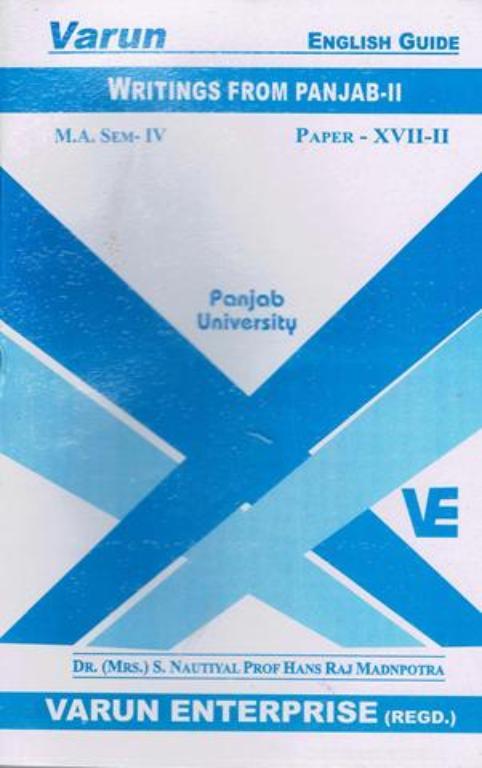
Varun English Guide Writings From Punjab 2 for MA 4th Sem Paper 17 (2) Panjab University Chandigarh
Varun English Guide Writings From Punjab 2 for MA 4th Sem Paper 17 (2) Panjab University Chandigarh
by Madhurima
₹350₹350.00(-/
off)
Rating & Reviews
23 Customer Review
Varun English Guide: Writings From Punjab 2 is the definitive study companion for Panjab University MA 4th Sem (Paper 17 (2)) students. Authored by Dr. S. Nautiyal, this comprehensive guide provides detailed, unit-wise analysis of the entire syllabus on modern Punjabi literature. It covers essential themes of Partition, Dalit identity, feminist narratives, and diasporic writing through texts by Manto, Amrita Pritam, Faiz, Pash, Daljit Nagra, and others. Designed for exam success, it features critical summaries, thematic explorations, and model answers. Published by Varun Enterprises, this book is an indispensable resource for mastering the complex literary landscape of twentieth-century Punjab.
Varun English Guide: Writings From Punjab 2 for MA 4th Semester, Paper 17 (2), Panjab University, Chandigarh
The Varun English Guide for MA 4th Sem Paper 17 (2) is an essential and comprehensive academic resource meticulously designed for students pursuing their Master of Arts in English at Panjab University, Chandigarh. Authored by the esteemed Dr. S. Nautiyal and published by Varun Enterprises, this guidebook provides an in-depth, unit-wise analysis of the prescribed syllabus, "Writings from Punjab—II." It serves as a critical companion for navigating the complex literary landscape of twentieth-century Punjab, a region profoundly shaped by the Partition of India, civil strife, Dalit identity movements, feminist literature, and the Punjabi diaspora.
This guide is structured to align perfectly with the university's examination pattern, offering detailed explanations, thematic explorations, and critical commentaries on all prescribed texts. The Panjab University MA English curriculum for this paper delves into the multifaceted narratives of Punjabiyat—the cultural essence of Punjab—as expressed through various genres and languages, including Punjabi literature, Urdu literature, and Hindustani writings. This guide systematically breaks down these diverse voices, making challenging texts accessible and examination-ready.
Content Overview and Thematic Depth:
The book is organized into five distinct units, each focusing on pivotal themes and authors from the syllabus.
1. Unit I grapples with the human tragedy of the 1947 Partition. It features critical analyses of seminal works like Saadat Hassan Manto's "Toba Tek Singh," a poignant satire on the insanity of Partition, and Bhisham Sahni's "We Have Reached Amritsar." It also explores gender narratives through Amrita Pritam's iconic poem "Ajj Akhan Waris Nu" and Urvashi Butalia's powerful oral history in "Ranamama" from The Other Side of Silence.
2. Unit II focuses on women's writing and narratives of displacement. It provides detailed summaries and critiques of Dalip Kaur Tiwana's novel Gone are the Rivers and Krishna Sobti's Memory’s Daughter, examining their portrayal of female subjectivity, memory, and social change in Punjab.
3. Unit III addresses themes of caste, class, and social justice. This section covers Mulk Raj Anand's classic "The Barber's Trade Union," which critiques social hierarchies, alongside powerful autobiographical accounts of Dalit experience from Balbir Madhopuri's Chhangiya Rukh and the revolutionary poetry of Lal Singh Dil in "Friends and Foes."
4. Unit IV presents a rich tapestry of Punjabi poetry spanning spiritual, romantic, and protest traditions. It includes analyses of Bhai Vir Singh's devotional verses, Faiz Ahmad Faiz's revolutionary Urdu poetry ("Do Not Ask My Love," "Dogs"), Shiv Kumar Batalvi's passionate folk-inspired "Birha," and the stark, ideological poems of the Naxalite poet Pash.
5. Unit V expands the geographical and cultural scope to the Punjabi diaspora. It explores the hybrid, often humorous works of Daljit Nagra (UK), the historical and personal reflections in Ajmer Rode's poems (Canada), and the rooted storytelling of Raghbir Dhand in "Third Eye."
Key Features for Academic Success:
1. Syllabus-Centric Approach: Every chapter corresponds directly to the Panjab University MA 4th Sem syllabus, ensuring complete coverage.
2. Detailed Textual Analysis: Each prescribed story, poem, and excerpt is explored with comprehensive summaries, character sketches, thematic discussions, and literary device identification.
3. Critical Perspectives: The guide introduces students to various critical lenses—historical, feminist, postcolonial, and Marxist—to interpret the texts as per advanced academic standards.
4. Examination Orientation: Designed to help students answer essay-type questions effectively, it includes potential question patterns, important quotations, and model answers.
5. Keyword & Concept Highlighting: Important keywords like "partition literature," "diasporic writing," "Dalit literature," "feminist narratives," and "postcolonial Punjab" are emphasized throughout for better retention and exam preparation.
Target Audience:
This guide is indispensable for:
1. MA English (4th Semester) students of Panjab University, Chandigarh, specifically for Paper 17 (2): Writings from Punjab – II.
2. Competitive exam aspirants seeking knowledge of modern Indian literature.
3. Researchers and readers interested in the socio-literary history of Punjab.
The Varun English Guide: Writings From Punjab 2 is more than a study aid; it is a gateway to understanding the trauma, resilience, and evolving identity of a people through their literature. Published by Varun Enterprises and crafted by an expert in the field, it is the definitive resource for mastering this specialized paper.
Is this Varun English Guide updated for the latest syllabus of Panjab University's MA English 4th Semester, Paper 17 (2)?
A1
Yes, this guide by Dr. S. Nautiyal is meticulously compiled to align with the current prescribed syllabus and pattern for "Writings from Punjab – II."
Q2
Does the guide include the complete texts of stories like "Toba Tek Singh" or poems by Faiz?
A2
No, this is a critical guide and analysis book. It provides detailed summaries, explanations, and critical commentary on the prescribed texts. Students must refer to the original anthologies specified by the university for the full texts.
Q3
Are there notes on both the literary and socio-political aspects of Dalit writings in Unit III?
A3
Absolutely. The analyses of Balbir Madhopuri's Chhangiya Rukh and Lal Singh Dil's poetry focus on their portrayal of caste discrimination, Dalit identity, and social resistance, linking the literary form to its political context.
Q4
Does the guide cover the poetic devices and translation challenges in Unit IV (Poetry section)?
A4
Yes, it discusses key poetic devices, imagery, and thematic concerns. It also touches upon the nuances of translating works from Punjabi and Urdu, helping students appreciate the layers of meaning.
Q5
Is the diasporic literature in Unit V analyzed from a postcolonial perspective?
A5
Yes, the guide examines the works of Daljit Nagra and Ajmer Rode through lenses of diaspora, identity, hybridity, and postcolonialism, as relevant to the syllabus.
Q6
How is the feminist perspective addressed in units featuring writers like Amrita Pritam, Dalip Kaur Tiwana, and Krishna Sobti?
A6
The guide dedicates specific analysis to the feminist themes, portrayal of women's experiences, and critique of patriarchy found in these prescribed texts, as required by the syllabus.
Q7
Is there a comparison drawn between the different "Punjabs" (Indian, Pakistani, Diasporic) as mentioned in the syllabus introduction?
A7
Yes, the introduction and unit analyses frequently highlight this comparative perspective, showing how different geographies and histories shape the idea of Punjabiyat across the selected texts.
Q8
Is the language of the guide suitable for students who are not native Punjabi speakers?
A8
Certainly. The guide is written in clear, academic English and is designed to make the regional themes and references in Punjabi, Urdu, and Hindustani texts accessible to all students.
Q9
How does it handle the multidisciplinary approach of the syllabus, which intersects history, politics, and literature?
A9
The guide consistently intertwines literary analysis with historical events, political movements (e.g., Naxalism in Pash's poetry), and social issues, reflecting the interdisciplinary nature of the paper.
Q10
Are the translations referenced in the guide the same as those prescribed by Panjab University?
A10
The guide analyses the texts based on the translations and editions listed in the official syllabus (e.g., Kiernan for Faiz, specific translators for Sobti and Dil), ensuring academic accuracy.v
0.00
0 Overall Rating
5
0
4
0
3
0
2
0
1
0
Try this product & share your review &
thoughts
UNIT - I
1. Sadat Hassan Manto: Toba Tek Singh
2. Bhishm Sahni: We have reached Amritsar.
3. Amrita Pritam’s Ajj Akhan Waris Nu
4. Urvashi Butalia: “Ranamama,” Blood, Part, from The Other Side of Silence
UNIT - II
1. Dalip Kaur Tiwana: Gone are the Rivers
2. Krishna Sobti: Memory’s Daughter
UNIT - III
1. Mulk Raj Anand: The Barber’s Trade Union
2. Balbir Madhopuri: Sunshine Through Clouds and "Flowering of the Cactus" from Chhangiya Rukh—Against the Night.
3. Lal Singh Dil: “Friends and Foes” Translated by Nirupama Dutt
UNIT - IV
1. Bhai Vir Singh: “The Song of the Godavari” and “O Flower Gatherer”
2. Faiz Ahmad Faiz: Do Not Ask My Love, Again “Dogs”
3. Shiv Kumar: “Birha Tu Sultan” (Separation, You are the King), “Maye Ni Maye”
4. Pash: “To a Policy Constable,” “Ma, You Are Wearing Out”
UNIT - V
1. Daljit Nagar: “The Balcony Song of Raju and Jaswinder,” “The Punjab,” Tippoo Sultan’s Incredible White-Man-Eating Tiger Toy Machine
2. Ajmer Rode: “Playing with Big Numbers,” “Hay Beds and Brick Chulas 1914 - 1915,” “Love Letters—Canada to India, 1930s”
3. Raghbir Dhand: “Third Eye” Stories of the Soil, translated & edited by Nirupama Dutt.
Latest Syllabus of English Guide Writings From Punjab 2 for MA 4th Sem Paper 17 (2) Panjab University (PU) Chandigarh
Writings from Punjab – II
Pattern of the Question Paper
Time: 3 Hrs.
M.M.: 80
Twentieth-century Punjab contributed its fair share of struggle in the Indian Independence movement, which, for its people, culminated in the cataclysmic event of Partition. With 14 million displaced and a million dead, scarcely any household remained untouched by the human tragedy. Apart from this, civil strife in the 1980s
ripped apart the social fabric of a society that had syncretic roots. With these events, the idea of community was decidedly disrupted. The period has additionally been marked with struggles for a more strident Dalit identity and women’s liberation. Importantly, the experience of the community has also found echoes in the
burgeoning diasporic space. Thus, as a region having undergone multiple divisions, there are many Punjabs—one inside the nation, another beyond the border, and yet another in its ever-expanding diaspora. All this has found its way into the literary writings of this era. A representational list of texts is drawn up to acquaint students with these trends as well as genres. There is an attempt to showcase the continuing syncretic ethos of Punjab by including languages such as Urdu and Hindustani in addition to Punjabi and the multiple identities that have gone on to shape Punjabiyat. Additionally, the course seeks to explore the shifting contours of literary trends of Punjab in the modern period. The chosen texts contend with the intersection of class, caste, gender, and the multiple pasts and geographies of Punjab. There will be five essay-type questions of 16 marks each (to be answered in about 500 words each). One question with internal choice will be set from each of the following five prescribed texts/units:
Unit I
• Sa’dat Hassan Manto, “Toba Tek Singh” from Black Margins: Sa’dat Hasan Manto, Stories, Translated & Selected by M. Asadudin. Katha, 2001.
• Bhishm Sahni, “We Have Reached Amritsar,” The Stories about the Partition of India, Vol. I, ed. Alok Bhalla. New Delhi: Manohar, 2012.
• Amrita Pritam’s “Ajj Akhan Waris Noo,” translated by Amrita Pritam, Selected Poems of Amrita Poems, ed. Pritish Nandy, Kolkata: Dialog Calcutta Publication (Available at ApnaOrg)
• Urvashi Butalia, “Ranamama,” Blood, Part I, The Other Side of Silence, New Delhi: Penguin, 27-52.
Unit II
1. Dalip Kaur Tiwana, Gone are the Rivers, Macmillan, 1999.
2. Krishna Sobti, Memory’s Daughter, translation of Dar Se Bichudi, tr. Menakshi Bhardwaj, Katha, 2007.
Unit III
1. Mulk Raj Anand, “The Barber’s Trade Union” from The Barber’s Trade Union and Other Stories. Mumbai: Jaico, 2012.
2. Balbir Madhopuri, “Sunshine Through Clouds” (69-75) and “Flowering of the Cactus” (40-52) from Chhangiya Rukh—Against the Night. New Delhi: OUP, 2010.
3. Lal Singh Dil, “Friends and Foes” from Nirupama Dutt: Poet of the Revolution: The Memoirs and Poems of Lal Singh Dil. Viking Penguin, 2012.
Unit IV
1. Bhai Vir Singh. “The Song of the Godavari” (66) and “O Flower Gatherer” (34), trans. Puran Singh. Nargas: Songs of a Sikh. New Delhi: Bhai Vir Singh Bhawan. Available online at https://www.vidhia.com/Bhai%20Veer%20Singh%20Ji/NargasBhai%20Vir%20Singh%20English.pdf.
2. Faiz Ahmad Faiz: “Love, Do Not Ask” (65-68), “Dogs” (83-85), Poems by Faiz. Tr. V. G. Kiernan. (Oxford India, 2000)
3. Shiv Kumar. “Birha Tu Sultan” (Separation, You are the King) & “Maye Ni Maye” (Hawk), trans. Suman Kashayap at PoemHunter.Com
4. Pash, “To a Police Constable” (112-116), “Ma, You Are Wearing Out” Pash. Pash: A Poet of Impossible Dreams. Tr. T. C. Ghai. (Delhi: Pash Memorial Trust, 2010)
Unit V
1. Daljit Nagra: “The Balcony Song of Raju and Jaswinder” & “The Punjab,” Tippoo Sultan’s Incredible White-Man-Eating Tiger Toy Machine!!!. London, Faber and Faber, 2011.
2. Ajmer Rode: “Playing with Big Numbers,” “Mustard Flowers” http://www.ajmerrode.com/?page_id=2790
3. Raghbir Dhand, “Third Eye,” Stories of the Soil, translated by Nirupama Dutt.
Varun English Guide: Writings From Punjab 2 for MA 4th Semester, Paper 17 (2), Panjab University, Chandigarh
The Varun English Guide for MA 4th Sem Paper 17 (2) is an essential and comprehensive academic resource meticulously designed for students pursuing their Master of Arts in English at Panjab University, Chandigarh. Authored by the esteemed Dr. S. Nautiyal and published by Varun Enterprises, this guidebook provides an in-depth, unit-wise analysis of the prescribed syllabus, "Writings from Punjab—II." It serves as a critical companion for navigating the complex literary landscape of twentieth-century Punjab, a region profoundly shaped by the Partition of India, civil strife, Dalit identity movements, feminist literature, and the Punjabi diaspora.
This guide is structured to align perfectly with the university's examination pattern, offering detailed explanations, thematic explorations, and critical commentaries on all prescribed texts. The Panjab University MA English curriculum for this paper delves into the multifaceted narratives of Punjabiyat—the cultural essence of Punjab—as expressed through various genres and languages, including Punjabi literature, Urdu literature, and Hindustani writings. This guide systematically breaks down these diverse voices, making challenging texts accessible and examination-ready.
Content Overview and Thematic Depth:
The book is organized into five distinct units, each focusing on pivotal themes and authors from the syllabus.
1. Unit I grapples with the human tragedy of the 1947 Partition. It features critical analyses of seminal works like Saadat Hassan Manto's "Toba Tek Singh," a poignant satire on the insanity of Partition, and Bhisham Sahni's "We Have Reached Amritsar." It also explores gender narratives through Amrita Pritam's iconic poem "Ajj Akhan Waris Nu" and Urvashi Butalia's powerful oral history in "Ranamama" from The Other Side of Silence.
2. Unit II focuses on women's writing and narratives of displacement. It provides detailed summaries and critiques of Dalip Kaur Tiwana's novel Gone are the Rivers and Krishna Sobti's Memory’s Daughter, examining their portrayal of female subjectivity, memory, and social change in Punjab.
3. Unit III addresses themes of caste, class, and social justice. This section covers Mulk Raj Anand's classic "The Barber's Trade Union," which critiques social hierarchies, alongside powerful autobiographical accounts of Dalit experience from Balbir Madhopuri's Chhangiya Rukh and the revolutionary poetry of Lal Singh Dil in "Friends and Foes."
4. Unit IV presents a rich tapestry of Punjabi poetry spanning spiritual, romantic, and protest traditions. It includes analyses of Bhai Vir Singh's devotional verses, Faiz Ahmad Faiz's revolutionary Urdu poetry ("Do Not Ask My Love," "Dogs"), Shiv Kumar Batalvi's passionate folk-inspired "Birha," and the stark, ideological poems of the Naxalite poet Pash.
5. Unit V expands the geographical and cultural scope to the Punjabi diaspora. It explores the hybrid, often humorous works of Daljit Nagra (UK), the historical and personal reflections in Ajmer Rode's poems (Canada), and the rooted storytelling of Raghbir Dhand in "Third Eye."
Key Features for Academic Success:
1. Syllabus-Centric Approach: Every chapter corresponds directly to the Panjab University MA 4th Sem syllabus, ensuring complete coverage.
2. Detailed Textual Analysis: Each prescribed story, poem, and excerpt is explored with comprehensive summaries, character sketches, thematic discussions, and literary device identification.
3. Critical Perspectives: The guide introduces students to various critical lenses—historical, feminist, postcolonial, and Marxist—to interpret the texts as per advanced academic standards.
4. Examination Orientation: Designed to help students answer essay-type questions effectively, it includes potential question patterns, important quotations, and model answers.
5. Keyword & Concept Highlighting: Important keywords like "partition literature," "diasporic writing," "Dalit literature," "feminist narratives," and "postcolonial Punjab" are emphasized throughout for better retention and exam preparation.
Target Audience:
This guide is indispensable for:
1. MA English (4th Semester) students of Panjab University, Chandigarh, specifically for Paper 17 (2): Writings from Punjab – II.
2. Competitive exam aspirants seeking knowledge of modern Indian literature.
3. Researchers and readers interested in the socio-literary history of Punjab.
The Varun English Guide: Writings From Punjab 2 is more than a study aid; it is a gateway to understanding the trauma, resilience, and evolving identity of a people through their literature. Published by Varun Enterprises and crafted by an expert in the field, it is the definitive resource for mastering this specialized paper.
UNIT - I
1. Sadat Hassan Manto: Toba Tek Singh
2. Bhishm Sahni: We have reached Amritsar.
3. Amrita Pritam’s Ajj Akhan Waris Nu
4. Urvashi Butalia: “Ranamama,” Blood, Part, from The Other Side of Silence
UNIT - II
1. Dalip Kaur Tiwana: Gone are the Rivers
2. Krishna Sobti: Memory’s Daughter
UNIT - III
1. Mulk Raj Anand: The Barber’s Trade Union
2. Balbir Madhopuri: Sunshine Through Clouds and "Flowering of the Cactus" from Chhangiya Rukh—Against the Night.
3. Lal Singh Dil: “Friends and Foes” Translated by Nirupama Dutt
UNIT - IV
1. Bhai Vir Singh: “The Song of the Godavari” and “O Flower Gatherer”
2. Faiz Ahmad Faiz: Do Not Ask My Love, Again “Dogs”
3. Shiv Kumar: “Birha Tu Sultan” (Separation, You are the King), “Maye Ni Maye”
4. Pash: “To a Policy Constable,” “Ma, You Are Wearing Out”
UNIT - V
1. Daljit Nagar: “The Balcony Song of Raju and Jaswinder,” “The Punjab,” Tippoo Sultan’s Incredible White-Man-Eating Tiger Toy Machine
2. Ajmer Rode: “Playing with Big Numbers,” “Hay Beds and Brick Chulas 1914 - 1915,” “Love Letters—Canada to India, 1930s”
3. Raghbir Dhand: “Third Eye” Stories of the Soil, translated & edited by Nirupama Dutt.
Is this Varun English Guide updated for the latest syllabus of Panjab University's MA English 4th Semester, Paper 17 (2)?
A1
Yes, this guide by Dr. S. Nautiyal is meticulously compiled to align with the current prescribed syllabus and pattern for "Writings from Punjab – II."
Q2
Does the guide include the complete texts of stories like "Toba Tek Singh" or poems by Faiz?
A2
No, this is a critical guide and analysis book. It provides detailed summaries, explanations, and critical commentary on the prescribed texts. Students must refer to the original anthologies specified by the university for the full texts.
Q3
Are there notes on both the literary and socio-political aspects of Dalit writings in Unit III?
A3
Absolutely. The analyses of Balbir Madhopuri's Chhangiya Rukh and Lal Singh Dil's poetry focus on their portrayal of caste discrimination, Dalit identity, and social resistance, linking the literary form to its political context.
Q4
Does the guide cover the poetic devices and translation challenges in Unit IV (Poetry section)?
A4
Yes, it discusses key poetic devices, imagery, and thematic concerns. It also touches upon the nuances of translating works from Punjabi and Urdu, helping students appreciate the layers of meaning.
Q5
Is the diasporic literature in Unit V analyzed from a postcolonial perspective?
A5
Yes, the guide examines the works of Daljit Nagra and Ajmer Rode through lenses of diaspora, identity, hybridity, and postcolonialism, as relevant to the syllabus.
Q6
How is the feminist perspective addressed in units featuring writers like Amrita Pritam, Dalip Kaur Tiwana, and Krishna Sobti?
A6
The guide dedicates specific analysis to the feminist themes, portrayal of women's experiences, and critique of patriarchy found in these prescribed texts, as required by the syllabus.
Q7
Is there a comparison drawn between the different "Punjabs" (Indian, Pakistani, Diasporic) as mentioned in the syllabus introduction?
A7
Yes, the introduction and unit analyses frequently highlight this comparative perspective, showing how different geographies and histories shape the idea of Punjabiyat across the selected texts.
Q8
Is the language of the guide suitable for students who are not native Punjabi speakers?
A8
Certainly. The guide is written in clear, academic English and is designed to make the regional themes and references in Punjabi, Urdu, and Hindustani texts accessible to all students.
Q9
How does it handle the multidisciplinary approach of the syllabus, which intersects history, politics, and literature?
A9
The guide consistently intertwines literary analysis with historical events, political movements (e.g., Naxalism in Pash's poetry), and social issues, reflecting the interdisciplinary nature of the paper.
Q10
Are the translations referenced in the guide the same as those prescribed by Panjab University?
A10
The guide analyses the texts based on the translations and editions listed in the official syllabus (e.g., Kiernan for Faiz, specific translators for Sobti and Dil), ensuring academic accuracy.v
Latest Syllabus of English Guide Writings From Punjab 2 for MA 4th Sem Paper 17 (2) Panjab University (PU) Chandigarh
Writings from Punjab – II
Pattern of the Question Paper
Time: 3 Hrs.
M.M.: 80
Twentieth-century Punjab contributed its fair share of struggle in the Indian Independence movement, which, for its people, culminated in the cataclysmic event of Partition. With 14 million displaced and a million dead, scarcely any household remained untouched by the human tragedy. Apart from this, civil strife in the 1980s
ripped apart the social fabric of a society that had syncretic roots. With these events, the idea of community was decidedly disrupted. The period has additionally been marked with struggles for a more strident Dalit identity and women’s liberation. Importantly, the experience of the community has also found echoes in the
burgeoning diasporic space. Thus, as a region having undergone multiple divisions, there are many Punjabs—one inside the nation, another beyond the border, and yet another in its ever-expanding diaspora. All this has found its way into the literary writings of this era. A representational list of texts is drawn up to acquaint students with these trends as well as genres. There is an attempt to showcase the continuing syncretic ethos of Punjab by including languages such as Urdu and Hindustani in addition to Punjabi and the multiple identities that have gone on to shape Punjabiyat. Additionally, the course seeks to explore the shifting contours of literary trends of Punjab in the modern period. The chosen texts contend with the intersection of class, caste, gender, and the multiple pasts and geographies of Punjab. There will be five essay-type questions of 16 marks each (to be answered in about 500 words each). One question with internal choice will be set from each of the following five prescribed texts/units:
Unit I
• Sa’dat Hassan Manto, “Toba Tek Singh” from Black Margins: Sa’dat Hasan Manto, Stories, Translated & Selected by M. Asadudin. Katha, 2001.
• Bhishm Sahni, “We Have Reached Amritsar,” The Stories about the Partition of India, Vol. I, ed. Alok Bhalla. New Delhi: Manohar, 2012.
• Amrita Pritam’s “Ajj Akhan Waris Noo,” translated by Amrita Pritam, Selected Poems of Amrita Poems, ed. Pritish Nandy, Kolkata: Dialog Calcutta Publication (Available at ApnaOrg)
• Urvashi Butalia, “Ranamama,” Blood, Part I, The Other Side of Silence, New Delhi: Penguin, 27-52.
Unit II
1. Dalip Kaur Tiwana, Gone are the Rivers, Macmillan, 1999.
2. Krishna Sobti, Memory’s Daughter, translation of Dar Se Bichudi, tr. Menakshi Bhardwaj, Katha, 2007.
Unit III
1. Mulk Raj Anand, “The Barber’s Trade Union” from The Barber’s Trade Union and Other Stories. Mumbai: Jaico, 2012.
2. Balbir Madhopuri, “Sunshine Through Clouds” (69-75) and “Flowering of the Cactus” (40-52) from Chhangiya Rukh—Against the Night. New Delhi: OUP, 2010.
3. Lal Singh Dil, “Friends and Foes” from Nirupama Dutt: Poet of the Revolution: The Memoirs and Poems of Lal Singh Dil. Viking Penguin, 2012.
Unit IV
1. Bhai Vir Singh. “The Song of the Godavari” (66) and “O Flower Gatherer” (34), trans. Puran Singh. Nargas: Songs of a Sikh. New Delhi: Bhai Vir Singh Bhawan. Available online at https://www.vidhia.com/Bhai%20Veer%20Singh%20Ji/NargasBhai%20Vir%20Singh%20English.pdf.
2. Faiz Ahmad Faiz: “Love, Do Not Ask” (65-68), “Dogs” (83-85), Poems by Faiz. Tr. V. G. Kiernan. (Oxford India, 2000)
3. Shiv Kumar. “Birha Tu Sultan” (Separation, You are the King) & “Maye Ni Maye” (Hawk), trans. Suman Kashayap at PoemHunter.Com
4. Pash, “To a Police Constable” (112-116), “Ma, You Are Wearing Out” Pash. Pash: A Poet of Impossible Dreams. Tr. T. C. Ghai. (Delhi: Pash Memorial Trust, 2010)
Unit V
1. Daljit Nagra: “The Balcony Song of Raju and Jaswinder” & “The Punjab,” Tippoo Sultan’s Incredible White-Man-Eating Tiger Toy Machine!!!. London, Faber and Faber, 2011.
2. Ajmer Rode: “Playing with Big Numbers,” “Mustard Flowers” http://www.ajmerrode.com/?page_id=2790
3. Raghbir Dhand, “Third Eye,” Stories of the Soil, translated by Nirupama Dutt.
0.00
0 Overall Rating
5
0
4
0
3
0
2
0
1
0
Try this product & share your review &
thoughts
Top Trending Product
Related
Product
Related Product
Related Blog Posts
Latest Blogs
Latest Blogs
Classic Literature Reimagined: Discuss modern twists on classic novels.
Lorem ipsum dolor sit amet, consectetur adipiscing elit, sed
do
eiusmod tempor incididunt ut labore et dolore magna aliqua. Ut enim ad minim
veniam, quis nostrud exercitation ullamco Lorem ipsum dolor sit amet,
consectetur adipiscing elit, sed do eiusmod tempor incididunt ut labore et
dolore magna aliqua. Utenim ad minim veniam, quis nostrud exercitation
ullamco
Lorem ipsum dolor sit amet, consecte...
Classic Literature Reimagined: Discuss modern twists on classic novels.
Lorem ipsum dolor sit amet, consectetur adipiscing elit, sed
do
eiusmod tempor incididunt ut labore et dolore magna aliqua. Ut enim ad minim
veniam, quis nostrud exercitation ullamco Lorem ipsum dolor sit amet,
consectetur adipiscing elit, sed do eiusmod tempor incididunt ut labore et
dolore magna aliqua. Utenim ad minim veniam, quis nostrud exercitation
ullamco
Lorem ipsum dolor sit amet, consecte...
Classic Literature Reimagined: Discuss modern twists on classic novels.
Lorem ipsum dolor sit amet, consectetur adipiscing elit, sed
do
eiusmod tempor incididunt ut labore et dolore magna aliqua. Ut enim ad minim
veniam, quis nostrud exercitation ullamco Lorem ipsum dolor sit amet,
consectetur adipiscing elit, sed do eiusmod tempor incididunt ut labore et
dolore magna aliqua. Utenim ad minim veniam, quis nostrud exercitation
ullamco
Lorem ipsum dolor sit amet, consecte...