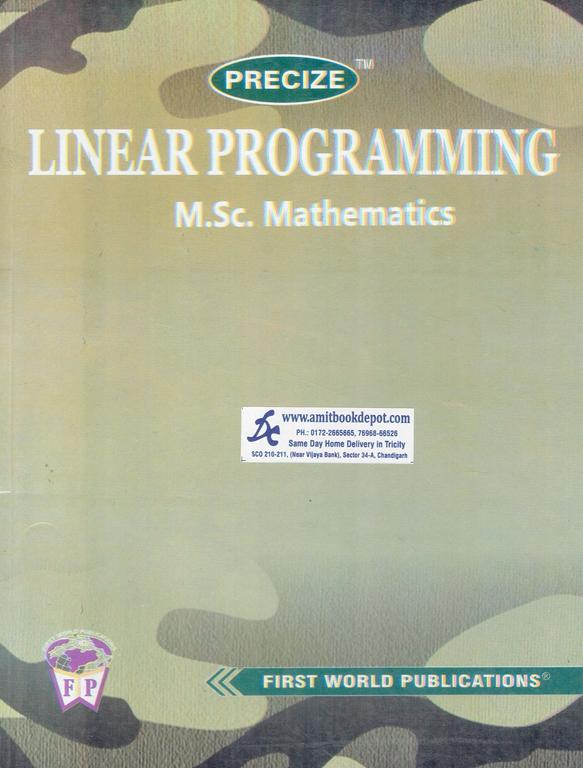
Yes, the book "Precise Linear Programming" is specifically written and structured to cover the entire prescribed syllabus for MATH-678S at Panjab University, Chandigarh, including all units and topics.
Absolutely. The book provides a balanced approach, delving into theoretical concepts like convex sets and hyperplanes, while also offering detailed, step-by-step explanations of algorithms like the Simplex method and Gomory's cutting plane.
It dedicates entire chapters to the Theory of the Simplex Method, explaining it from first principles. It also separately covers the Charnes' M-method, the Two-Phase method, and the more efficient Revised Simplex Method in a structured manner.
Yes, the book contains a dedicated chapter on Duality Theory and the Dual Simplex Method, including fundamental properties, complementary slackness, and handling unbounded solutions, which are crucial for scoring high marks.
Yes, as per the syllabus requirements, the book covers the Travelling Salesman Problem, linking it to the concepts of assignment and integer programming.
The book breaks down Integer Programming into Pure, Mixed, and 0-1 Programming problems and provides a detailed walkthrough of both the Gomory's Cutting Plane algorithm and the Branch and Bound Technique.
Yes, Chapter 5 is entirely dedicated to Sensitivity Analysis and Parametric Programming, explaining how changes in input parameters affect the optimal solution, with clear mathematical explanations.
The book is written in a precise and structured manner, making it highly suitable for self-study. The logical flow from basic to advanced topics allows students to learn and revise effectively on their own.
The graphical method is covered in the very first chapter, establishing an intuitive understanding of concepts like feasible regions and optimal solutions before moving to algebraic methods.
Yes, Chapter 2 is entirely dedicated to Convex Sets and Hyperplanes, providing the necessary geometric foundation to understand the mathematics behind the Simplex method.
No Description Added
Yes, the book "Precise Linear Programming" is specifically written and structured to cover the entire prescribed syllabus for MATH-678S at Panjab University, Chandigarh, including all units and topics.
Absolutely. The book provides a balanced approach, delving into theoretical concepts like convex sets and hyperplanes, while also offering detailed, step-by-step explanations of algorithms like the Simplex method and Gomory's cutting plane.
It dedicates entire chapters to the Theory of the Simplex Method, explaining it from first principles. It also separately covers the Charnes' M-method, the Two-Phase method, and the more efficient Revised Simplex Method in a structured manner.
Yes, the book contains a dedicated chapter on Duality Theory and the Dual Simplex Method, including fundamental properties, complementary slackness, and handling unbounded solutions, which are crucial for scoring high marks.
Yes, as per the syllabus requirements, the book covers the Travelling Salesman Problem, linking it to the concepts of assignment and integer programming.
The book breaks down Integer Programming into Pure, Mixed, and 0-1 Programming problems and provides a detailed walkthrough of both the Gomory's Cutting Plane algorithm and the Branch and Bound Technique.
Yes, Chapter 5 is entirely dedicated to Sensitivity Analysis and Parametric Programming, explaining how changes in input parameters affect the optimal solution, with clear mathematical explanations.
The book is written in a precise and structured manner, making it highly suitable for self-study. The logical flow from basic to advanced topics allows students to learn and revise effectively on their own.
The graphical method is covered in the very first chapter, establishing an intuitive understanding of concepts like feasible regions and optimal solutions before moving to algebraic methods.
Yes, Chapter 2 is entirely dedicated to Convex Sets and Hyperplanes, providing the necessary geometric foundation to understand the mathematics behind the Simplex method.