-
Mon-Fri: 10AM to 8PM 01722665665
-
My Account
-
-
0
Total :
₹ 0.00

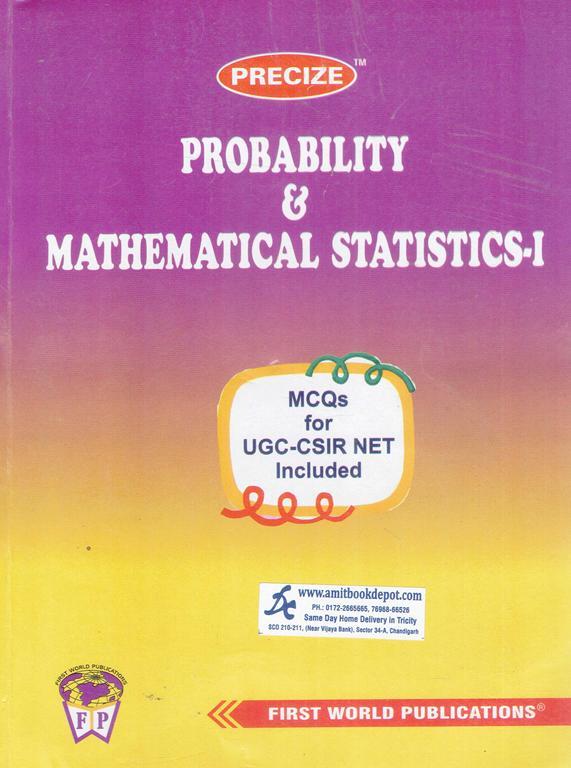

Yes, the book is meticulously structured to cover 100% of the prescribed syllabus for MATH 661S, including all units on data compilation, measures of central tendency, correlation, regression, probability, random variables, and all specified probability distributions.
The book includes a vast repository of MCQs that mirror the style and complexity of questions asked in the Mathematical Sciences paper of the UGC CSIR NET, particularly for the Probability and Statistics section.
Absolutely. Dedicated chapters cover key discrete distributions (Bernoulli, Binomial, Poisson) and continuous distributions (Uniform, Normal, Gamma, Chi-square, Bivariate Normal) as per the syllabus.
These are critical topics covered in a dedicated chapter (Chapter 15). The book breaks down these complex limiting theorems with clarity, linking them to their practical applications in statistical inference.
Yes, Chapter 9 is entirely dedicated to the "Theory of Attributes," covering concepts of independence and association, which is a specific requirement of the syllabus.
Yes, the combination of detailed theoretical content and a large number of practice MCQs makes it an excellent resource for preparing for both the final theory exam and the internal assessments, which often include objective-type tests.
Yes, Chapter 3 on "Presentation of Data" thoroughly covers graphical representations including histograms, frequency polygons, frequency curves, and ogives.
Yes, elements of probability theory, including conditional probability and Bayes’ theorem with its applications, are covered in Chapter 10 as required by the syllabus.
Yes, Chapter 7 on "Correlation Analysis" provides a comprehensive look at both Karl Pearson’s coefficient of correlation and Spearman’s rank correlation coefficient.
Yes, the properties and applications of Moment Generating Functions (MGF) and Probability Generating Functions (PGF) for random variables are covered in the relevant chapters on Random Variables and Distributions.
No Description Added
Yes, the book is meticulously structured to cover 100% of the prescribed syllabus for MATH 661S, including all units on data compilation, measures of central tendency, correlation, regression, probability, random variables, and all specified probability distributions.
The book includes a vast repository of MCQs that mirror the style and complexity of questions asked in the Mathematical Sciences paper of the UGC CSIR NET, particularly for the Probability and Statistics section.
Absolutely. Dedicated chapters cover key discrete distributions (Bernoulli, Binomial, Poisson) and continuous distributions (Uniform, Normal, Gamma, Chi-square, Bivariate Normal) as per the syllabus.
These are critical topics covered in a dedicated chapter (Chapter 15). The book breaks down these complex limiting theorems with clarity, linking them to their practical applications in statistical inference.
Yes, Chapter 9 is entirely dedicated to the "Theory of Attributes," covering concepts of independence and association, which is a specific requirement of the syllabus.
Yes, the combination of detailed theoretical content and a large number of practice MCQs makes it an excellent resource for preparing for both the final theory exam and the internal assessments, which often include objective-type tests.
Yes, Chapter 3 on "Presentation of Data" thoroughly covers graphical representations including histograms, frequency polygons, frequency curves, and ogives.
Yes, elements of probability theory, including conditional probability and Bayes’ theorem with its applications, are covered in Chapter 10 as required by the syllabus.
Yes, Chapter 7 on "Correlation Analysis" provides a comprehensive look at both Karl Pearson’s coefficient of correlation and Spearman’s rank correlation coefficient.
Yes, the properties and applications of Moment Generating Functions (MGF) and Probability Generating Functions (PGF) for random variables are covered in the relevant chapters on Random Variables and Distributions.