Categories
College Bookssss >
BA PU Chandigarh
BSC PU Chandigarh
MSC PU Chandigarh
BBA PU Chandigarh
MA PU Chandigarh
Medical Books
Engineering Books
Management Books
PGDCA Books
BCOM PU Chandigarh
MCOM PU Chandigarh
BCA PU Chandigarh
MCA PU Chandigarh
animate-books

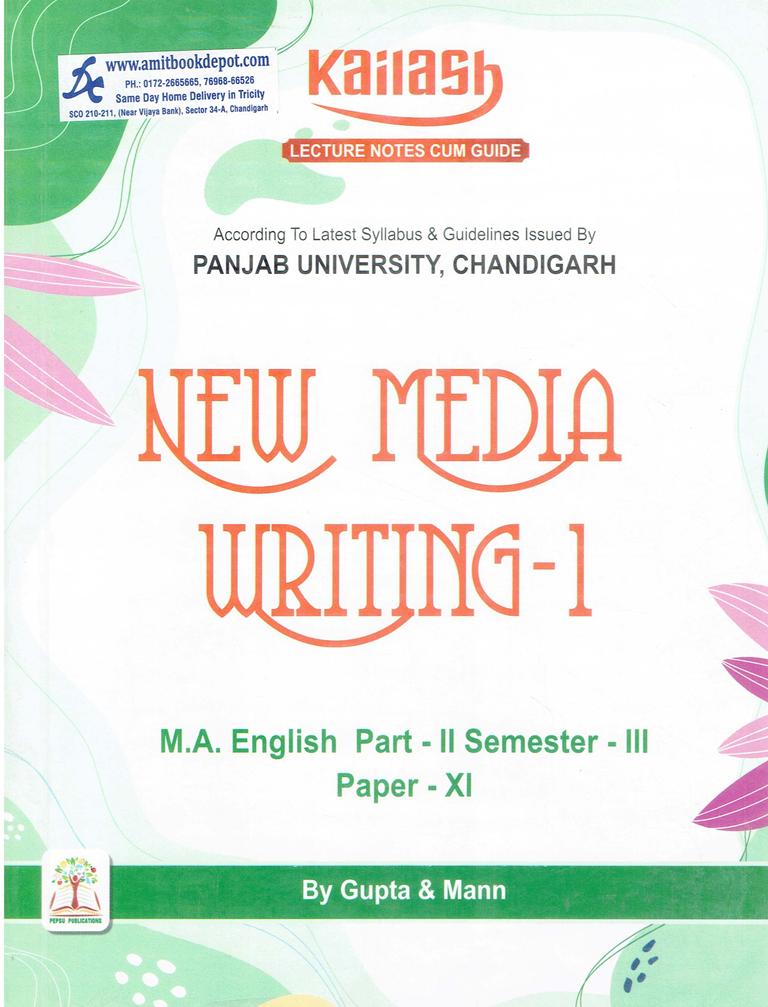
Kailash New Media Writing 1 For MA Semester 3rd Paper 11 Panjab University Chandigarh

by Madhurima
₹550 ₹550.00(-/ off)

Rating & Reviews

23 Customer Review

Kailash New Media Writing 1 is the prescribed book for Panjab University MA Semester 3, Paper 11 students. Authored by Gupta & Mann and published by Pepsu Book Depot, it provides complete coverage of the New Media Writing (Theory) syllabus. This guide offers detailed, exam-focused content on key theorists like Marshall McLuhan, Lev Manovich, and George P. Landow. It explains core concepts such as hot vs. cool media, the principles of new media, hypertext, and digital humanities in a clear Q&A format. Essential for mastering the curriculum and achieving high marks in university examinations.

Have Doubts Regarding This Product ? Ask Your Question

  • Q1
    Is this book strictly aligned with the latest MA Semester 3 Paper 11 syllabus of Panjab University, Chandigarh?
    A1

    Yes, this book by Gupta and Mann is meticulously crafted to cover 100% of the prescribed syllabus, including all five units and their specific readings as outlined by Panjab University.

  • Q2
    Does the book contain the original texts by McLuhan, Manovich, and Landow, or is it a guide?
    A2

    This is a comprehensive academic guide and textbook. It does not reproduce the full original texts but provides detailed summaries, analyses, life works of authors, and exam-oriented explanations of the concepts from the prescribed readings.

  • Q3
    Are the important concepts like 'Hot vs. Cool Media' and 'Transcoding' explained with contemporary examples?
    A3

    Yes, the book includes discussions that apply classic theories to contemporary contexts, such as analyzing today's Internet and social media through McLuhan's lens and explaining Manovich's principles with clarity.

  • Q4
    Does this guide cover both theoretical concepts and their application in new media writing?
    A4

    While the focus of Paper 11 is on theory, the book provides critical analysis and discusses the implications of theory (e.g., the politics of hypertext, characteristics of new media) which forms the essential foundation for understanding new media writing.

  • Q5
    Is this book useful only for Panjab University students, or can others use it?
    A5

    While specifically designed for Panjab University's syllabus, students of Mass Communication, Journalism, and Media Studies from other universities studying these core theorists will find it a valuable reference guide.

  • Q6
    How is the unit on George P. Landow's hypertext theory presented?
    A6

    Landow's work is covered across two units (III and V). The book explains hypertext and critical theory, key terms like multivocality and disorientation, and the politics of control in hypertext, as required by the syllabus.

  • Q7
    What is the writing style of the book—is it academic or simplified?
    A7

    It maintains an academic tone appropriate for MA-level study but is designed for clarity and comprehension, breaking down complex philosophical and theoretical ideas into understandable segments.

  • Q8
    Does the book cover Ithiel de Sola Pool's work in depth, as it is a part of Unit I?
    A8

    Absolutely. It provides details on his life, works, a review and analysis of Technologies of Freedom, and explains the core theme of "Electronics Takes Command" as required.

  • Q9
    How current is the content regarding rapidly evolving new media?
    A9

    The book focuses on the foundational theories that are essential to understanding new media. While it applies these to modern contexts where relevant (like the Internet), its primary value is in teaching the timeless theoretical frameworks prescribed in the syllabus.

  • Q10
    Is this a single resource sufficient for preparing for Paper 11 exams?
    A10

    This book is designed as the primary and comprehensive textbook for Paper 11. It covers all mandated topics in detail. Students are advised to use it alongside a careful reading of the syllabus and, if possible, the original texts for deeper insight.

0.00

0 Overall Rating
  • 5
    0
  • 4
    0
  • 3
    0
  • 2
    0
  • 1
    0

Try this product & share your review & thoughts

UNIT-I
1. Media: Hot and Cold (Marshall McLuhan)

Life and Works
Q. Describe the life and works of Marshall McLuhan.
or
What do you know about Marshall McLuhan?

Understanding Media
Q. What do you know about Understanding Media?

Understanding Media: An Introduction
Q. Give an introduction to Understanding Media: The Extensions of Man, by Marshall McLuhan.

Understanding Media: Summary
Q. Give a detailed summary of 'Understanding Media.'

An Essay
Q. Write an essay upon Understanding Media.

Hot Media vs. Cool Media
Q. Discuss hot media vs. cool media.

Today's Internet
Q. How would McLuhan blow hot and cold about today's Internet?

'Hot' and 'Cool' Social Media
Q. Describe hot and cool social media.

Themes
Q. Discuss the themes of 'Understanding Media' in your own words.

2. Electronics Takes Command (Ithiel de Sola Pool)

Life and Works
Q. Describe the life and works of Ithiel de Sola Pool.

Technologies of Freedom
Q. What do you know about Technologies of Freedom?

Classic Review
Q. Give a classic review of Ithiel de Sola Pool's Technologies of Freedom in your own words.

An Introduction
Q. Give an introduction to Ithiel de Sola Pool's "Technologies of Freedom."

Intellectual Legacy
Q. Describe the intellectual legacy of Ithiel de Sola Pool in your own words.

Technologies of Freedom: Analysis
Q. Give a constitutional analysis of Technologies of Freedom given by Ithiel de Sola Pool.

Theme
Q. Describe the theme of The Technologies of Freedom.

Foundations of Pool's Concerns
Q. Describe Foundations of Pool's concerns with special reference to the Electronics Takes Command.

UNIT-II
1. What is New Media (Lev Manovich)

Life and Works
Q. What do you know about the life and works of Lev Manovich?
or
Write an essay upon the Life and Works of Lev Manovich.

The Language of New Media: An Introduction
Q. Give an introduction to The Language of New Media.

A Review
Q. Give a review of The Language of New Media, written by Lev Manovich.

New Media and Cinema
Q. Discuss new media and cinema in your own words.

The Lexicon of New Media
Q. Describe the lexicon of new media in your own words.

Pedagogical and Rhetorical Applications
Q. Describe what you know about pedagogical and rhetorical applications of new media.

What is New Media?
Q. What is New Media? Discuss in detail.

Numerical Representation
Q. Describe numerical representation as a principle of New India.

Modularity
Q. Discuss modularity as a principle of new media.

Automation
Q. Discuss automation as a principle of new media.

Variability
Q. Discuss Variability as a Principle of New Media.

Transcoding
Q. Discuss transcoding as a principle of new media.

Cinema as New Media
Q. Discuss cinema as new media.

The Myth of the Digital Media
Q. What is the myth of the digital media?

The Myth of Interactivity
Q. What is the Myth of Interactivity?

2. "The Characteristics of New Media: Some Defining Concepts"
(Martin Lister, Jon Dovey, Seth Giddings, Jain Grant, and Kieran Kelly)

Main Characteristics: Introduction
Q. Discuss the main characteristics of new media in your own words.

The Concept of New Media
Q. Describe the concept of new media.

New Media Theory
Q. Describe New Media Theory in your own words.

New Media: An Essay
Q. Write an essay upon new media in detail.

Globalization
Q. Discuss the effect of globalization upon new media.

New Media and New Technologies
Q. What do you understand by "new media" and "new technologies"?

Digital
Q. Discuss Digital Characteristics of New Media.

Fixity and Flux
Q. What is fixity and flux with special regard to new media?

Interactivity
Q. Write an essay upon 'Interactivity' as a Main Feature of New Media.

The Center of a Circle
Q. What is the center of a circle with special regard to new media?

Consumption meets Production.
Q. What do you mean by "consumption meets production"?

Virtual World
Q. Define "virtual world" in your own words with special reference to new media.

Simulation
Q. Write a note upon simulation in detail.

UNIT-III
1. Hypertext and Critical Theory (George P. Landow)

An Introduction
Q. Write down an introduction of George P. Landow.
or
What do you know about George P. Landow?

Hypertext and Critical Theory: An Introduction
Q. Give an introduction to hypertext and critical theory.

Hypertext and Critical/Cultural Theory
Q. How can you describe hypertext and critical/cultural theory?

Hypertext: Summary
Q. Give a summary of George P. Landow's Hypertext.

Hot Links
Q. How can you discuss hot links and hypertext and George P. Landow?

Hypertextual
Q. Write an essay upon hypertext.

UNIT-IV
1. The Digital Humanities Manifesto 2.0

Introduction
Q. What are the digital humanities? Discuss in detail.

The Digital Humanities Manifesto 2.0
Q. What is The Digital Humanities Manifesto 2.0?

A Report on Knowledge
Q. How is Digital Humanities 2.0 a report on knowledge?

2. What is digital humanities, and what's it doing in English departments? (Matthew G. Kirschenbaum)

Introduction
Q. Who is Matthew G. Kirschenbaum?

The Meaning of the Digital Humanities
Q. What is the meaning of the digital humanities to the humanities?

Thinking Activity: Digital Humanities
Q. What is digital humanities? With special regard to Matthew G. Kirschenbaum.

The Importance of Digital Humanities
Q. What is the importance of digital humanities?
or
Why Is Digital Humanities Important and Relevant?

UNIT-V
1. The Politics of Hypertext: Who Controls the Text (George P. Landow)

Life and Works
Q. What do you know about the life and works of George P. Landow? 1
or
Give a life sketch of George P. Landow.

Hypertext 3.0
Q. What do you know about George P. Landow's creation, Hypertext 3.0?

A Convergence
Q. Discuss Text, Hypertext, and Hyperfiction: A Convergence Between Poststructuralism and Narrative Theories.

Hypertext and Critical Theory
Q. What do you know about hypertext and critical theory?

Multivocality
Q. What is multivocality? Discuss.

Author-Reader Relationship
Q. Describe the author-reader relationship in your own words.

Disorientation
Q. What is Disorientation?

The Politics of Connection
Q. Discuss Landow and The Politics of Connection.

Latest Syllabus of New Media Writing 1 For MA Semester 3rd Paper 11 Panjab University (PU) Chandigarh


New Media Writing (Theory)—I

The course intends to explore the emerging relationship between new media and writing. New media is an umbrella term used for various kinds of electronic
communications that are conceivable due to innovation in computer technology. The ‘old’ media largely consisted of newspapers, magazines, books, television, and other such non-interactive media; the new media includes websites, online video/audio streams, email, online social platforms, online communities, online forums, blogs, web advertisements, online education, and much more. The students will gain perspective on the cultural uses and practices of writing since the development of literacy 2700 years ago through a reading and discussion of conceptual essays and new media texts. In the course the emphasis is on the history, theory, and politics of new media. The course is divided into five units. Each unit consists of general introductory essays on the historical and conceptual understanding of various aspects of new media writing. The students are expected to study the prescribed texts closely. The students are also expected to study books and articles mentioned in the suggested readings to enhance their understanding of the primary texts, but there will be no question on the suggested readings. The paper shall consist of five compulsory questions—one each from a unit. Each question shall, however, have an internal choice. The paper shall carry a total of 80 marks.

Unit –I

1. Marshall McLuhan, “Media: Hot and Cold,” Understanding Media: The Extensions of Man (First MIT Press Edition, 1994) 22-32.
2. Ithiel de Sola Pool, “Electronics Takes Command,” Technologies of Freedom (Cambridge, Massachusetts, and London: The Belknap Press of Harvard University Press, 1983), 23-54.

Unit – II

1. Lev Manovich, “What is new media,” The Language of New Media 43-65.
2. Martin Lister, Jon Dovey, Seth Giddings, Iain Grant, and Kieran Kelly, “The characteristics of new media: some defining concepts,” New Media: A Critical Introduction (London & New York: Routledge, 2009), 2003 Ist. Ed. 13-43.

Unit – III

1. George P. Landow. “Hypertext and Critical Theory,” Hypertext 3.0: Critical Theory and New Media in an Era of Globalization (Baltimore: John Hopkins University Press, 1992), 2006 Ed. 53-68.

Unit IV

1. The Digital Humanities Manifesto 2.0 can be accessed from http://jeffreyschnapp.com/wp-content/uploads/2011/10/Manifesto_V2.pdf.
2. Matthew G. Kirschenbaum, “What Is Digital Humanities and What’s It Doing in English Departments? ” Defining Digital Humanities Reader. Eds. Melissa Terras, Julianne Nyhan, and Edward Vanhoutte (Farnham and Burlington: Ashgate Publishing House, 2013), 195-204.

Unit V
1. George P. Landow, “The Politics of Hypertext: Who Controls the Text?” Hypertext 3.0: Critical Theory and New Media in an Era of Globalization (Baltimore: John Hopkins University Press, 1992), 2006 Ed. 321-376.

Product Name: Kailash New Media Writing 1 for MA Semester 3rd (Paper 11), Panjab University, Chandigarh
Authors: Gupta & Mann
Publisher: Pepsu Book Depot

Master Your MA in New Media Writing with This Comprehensive Guide

Kailash New Media Writing 1 is the definitive, syllabus-specific academic book designed exclusively for students pursuing their Master of Arts (MA) at Panjab University, Chandigarh. This essential resource meticulously covers the complete curriculum for Semester 3, Paper 11: New Media Writing (Theory)—I. Authored by experts Gupta and Mann and published by the trusted Pepsu Book Depot, this book is structured to provide in-depth analysis, clear summaries, and exam-focused content for complete conceptual mastery.
The book systematically explores the foundational theories and critical thinkers that define the study of new media. It aligns perfectly with the university syllabus, breaking down complex theories into accessible, examination-oriented content. Each unit is crafted to build a progressive understanding, from the seminal ideas of early media theorists to contemporary debates in digital humanities.

Comprehensive Unit-Wise Coverage for Exam Success:

- Unit I delves into the groundbreaking work of Marshall McLuhan, providing a detailed exploration of his life, works, and the core concepts from Understanding Media. It offers a thorough summary, an in-depth essay on the text, and a critical discussion of hot media vs. cool media, applying these theories to analyze today's Internet and social media platforms. This unit also covers Ithiel de Sola Pool's pivotal ideas from Technologies of Freedom, examining his intellectual legacy and the theme of electronics taking command in modern communication.
- Unit II focuses on defining the digital age through Lev Manovich's The Language of New Media. It explains the five core principles of new media: numerical representation, modularity, automation, variability, and transcoding. Additionally, it addresses common myths of digital media and interactivity. The unit further expands with the work of Martin Lister et al., discussing key characteristics of new media such as digitality, interactivity, virtual worlds, simulation, and the convergence of consumption and production.
- Unit III introduces the revolutionary concepts of hypertext and critical theory as presented by George P. Landow. It clarifies the convergence of poststructuralist thought with digital narrative forms, explaining critical terms like "hypertextuality" and "hot links."
- Unit IV bridges theory with modern academic practice by exploring the Digital Humanities. It includes a detailed analysis of The Digital Humanities Manifesto 2.0 and Matthew G. Kirschenbaum's influential work on the role of digital humanities within English departments, highlighting its importance and relevance.
- Unit V investigates the socio-political dimensions of digital texts with Landow's The Politics of Hypertext. It examines crucial questions of control, authorship, and reading in digital spaces, covering concepts like multivocality, the evolving author-reader relationship, disorientation, and the politics of connection.

Key Features for Panjab University MA Students:

1. Strict Syllabus Adherence: Covers all prescribed texts and topics from the Panjab University MA Semester 3, Paper 11 syllabus without deviation.
2. Exam-Oriented Presentation: Content is organized in a clear question & answer format, featuring potential long and short essay questions as outlined in the table of contents.
3. Conceptual Clarity: Provides detailed introductions, summaries, life sketches of theorists, and thematic analyses to build strong foundational knowledge.
4. Critical Analysis: Moves beyond summaries to offer discussions, reviews, and applications of theory to contemporary media like the internet and social media.
5. Keyword Integration: Ensures mastery of essential terminology such as hot and cool media, digital humanities, hypertext, interactivity, and new media principles for scoring high marks.

This book is an indispensable study companion for Panjab University MA students aiming for academic excellence. It simplifies complex theoretical discourse, provides direct answers to anticipated exam questions, and serves as a single, reliable resource for mastering New Media Writing (Theory)—I.

UNIT-I
1. Media: Hot and Cold (Marshall McLuhan)

Life and Works
Q. Describe the life and works of Marshall McLuhan.
or
What do you know about Marshall McLuhan?

Understanding Media
Q. What do you know about Understanding Media?

Understanding Media: An Introduction
Q. Give an introduction to Understanding Media: The Extensions of Man, by Marshall McLuhan.

Understanding Media: Summary
Q. Give a detailed summary of 'Understanding Media.'

An Essay
Q. Write an essay upon Understanding Media.

Hot Media vs. Cool Media
Q. Discuss hot media vs. cool media.

Today's Internet
Q. How would McLuhan blow hot and cold about today's Internet?

'Hot' and 'Cool' Social Media
Q. Describe hot and cool social media.

Themes
Q. Discuss the themes of 'Understanding Media' in your own words.

2. Electronics Takes Command (Ithiel de Sola Pool)

Life and Works
Q. Describe the life and works of Ithiel de Sola Pool.

Technologies of Freedom
Q. What do you know about Technologies of Freedom?

Classic Review
Q. Give a classic review of Ithiel de Sola Pool's Technologies of Freedom in your own words.

An Introduction
Q. Give an introduction to Ithiel de Sola Pool's "Technologies of Freedom."

Intellectual Legacy
Q. Describe the intellectual legacy of Ithiel de Sola Pool in your own words.

Technologies of Freedom: Analysis
Q. Give a constitutional analysis of Technologies of Freedom given by Ithiel de Sola Pool.

Theme
Q. Describe the theme of The Technologies of Freedom.

Foundations of Pool's Concerns
Q. Describe Foundations of Pool's concerns with special reference to the Electronics Takes Command.

UNIT-II
1. What is New Media (Lev Manovich)

Life and Works
Q. What do you know about the life and works of Lev Manovich?
or
Write an essay upon the Life and Works of Lev Manovich.

The Language of New Media: An Introduction
Q. Give an introduction to The Language of New Media.

A Review
Q. Give a review of The Language of New Media, written by Lev Manovich.

New Media and Cinema
Q. Discuss new media and cinema in your own words.

The Lexicon of New Media
Q. Describe the lexicon of new media in your own words.

Pedagogical and Rhetorical Applications
Q. Describe what you know about pedagogical and rhetorical applications of new media.

What is New Media?
Q. What is New Media? Discuss in detail.

Numerical Representation
Q. Describe numerical representation as a principle of New India.

Modularity
Q. Discuss modularity as a principle of new media.

Automation
Q. Discuss automation as a principle of new media.

Variability
Q. Discuss Variability as a Principle of New Media.

Transcoding
Q. Discuss transcoding as a principle of new media.

Cinema as New Media
Q. Discuss cinema as new media.

The Myth of the Digital Media
Q. What is the myth of the digital media?

The Myth of Interactivity
Q. What is the Myth of Interactivity?

2. "The Characteristics of New Media: Some Defining Concepts"
(Martin Lister, Jon Dovey, Seth Giddings, Jain Grant, and Kieran Kelly)

Main Characteristics: Introduction
Q. Discuss the main characteristics of new media in your own words.

The Concept of New Media
Q. Describe the concept of new media.

New Media Theory
Q. Describe New Media Theory in your own words.

New Media: An Essay
Q. Write an essay upon new media in detail.

Globalization
Q. Discuss the effect of globalization upon new media.

New Media and New Technologies
Q. What do you understand by "new media" and "new technologies"?

Digital
Q. Discuss Digital Characteristics of New Media.

Fixity and Flux
Q. What is fixity and flux with special regard to new media?

Interactivity
Q. Write an essay upon 'Interactivity' as a Main Feature of New Media.

The Center of a Circle
Q. What is the center of a circle with special regard to new media?

Consumption meets Production.
Q. What do you mean by "consumption meets production"?

Virtual World
Q. Define "virtual world" in your own words with special reference to new media.

Simulation
Q. Write a note upon simulation in detail.

UNIT-III
1. Hypertext and Critical Theory (George P. Landow)

An Introduction
Q. Write down an introduction of George P. Landow.
or
What do you know about George P. Landow?

Hypertext and Critical Theory: An Introduction
Q. Give an introduction to hypertext and critical theory.

Hypertext and Critical/Cultural Theory
Q. How can you describe hypertext and critical/cultural theory?

Hypertext: Summary
Q. Give a summary of George P. Landow's Hypertext.

Hot Links
Q. How can you discuss hot links and hypertext and George P. Landow?

Hypertextual
Q. Write an essay upon hypertext.

UNIT-IV
1. The Digital Humanities Manifesto 2.0

Introduction
Q. What are the digital humanities? Discuss in detail.

The Digital Humanities Manifesto 2.0
Q. What is The Digital Humanities Manifesto 2.0?

A Report on Knowledge
Q. How is Digital Humanities 2.0 a report on knowledge?

2. What is digital humanities, and what's it doing in English departments? (Matthew G. Kirschenbaum)

Introduction
Q. Who is Matthew G. Kirschenbaum?

The Meaning of the Digital Humanities
Q. What is the meaning of the digital humanities to the humanities?

Thinking Activity: Digital Humanities
Q. What is digital humanities? With special regard to Matthew G. Kirschenbaum.

The Importance of Digital Humanities
Q. What is the importance of digital humanities?
or
Why Is Digital Humanities Important and Relevant?

UNIT-V
1. The Politics of Hypertext: Who Controls the Text (George P. Landow)

Life and Works
Q. What do you know about the life and works of George P. Landow? 1
or
Give a life sketch of George P. Landow.

Hypertext 3.0
Q. What do you know about George P. Landow's creation, Hypertext 3.0?

A Convergence
Q. Discuss Text, Hypertext, and Hyperfiction: A Convergence Between Poststructuralism and Narrative Theories.

Hypertext and Critical Theory
Q. What do you know about hypertext and critical theory?

Multivocality
Q. What is multivocality? Discuss.

Author-Reader Relationship
Q. Describe the author-reader relationship in your own words.

Disorientation
Q. What is Disorientation?

The Politics of Connection
Q. Discuss Landow and The Politics of Connection.

Have Doubts Regarding This Product ? Ask Your Question

  • Q1
    Is this book strictly aligned with the latest MA Semester 3 Paper 11 syllabus of Panjab University, Chandigarh?
    A1

    Yes, this book by Gupta and Mann is meticulously crafted to cover 100% of the prescribed syllabus, including all five units and their specific readings as outlined by Panjab University.

  • Q2
    Does the book contain the original texts by McLuhan, Manovich, and Landow, or is it a guide?
    A2

    This is a comprehensive academic guide and textbook. It does not reproduce the full original texts but provides detailed summaries, analyses, life works of authors, and exam-oriented explanations of the concepts from the prescribed readings.

  • Q3
    Are the important concepts like 'Hot vs. Cool Media' and 'Transcoding' explained with contemporary examples?
    A3

    Yes, the book includes discussions that apply classic theories to contemporary contexts, such as analyzing today's Internet and social media through McLuhan's lens and explaining Manovich's principles with clarity.

  • Q4
    Does this guide cover both theoretical concepts and their application in new media writing?
    A4

    While the focus of Paper 11 is on theory, the book provides critical analysis and discusses the implications of theory (e.g., the politics of hypertext, characteristics of new media) which forms the essential foundation for understanding new media writing.
  • Q5
    Is this book useful only for Panjab University students, or can others use it?
    A5

    While specifically designed for Panjab University's syllabus, students of Mass Communication, Journalism, and Media Studies from other universities studying these core theorists will find it a valuable reference guide.

  • Q6
    How is the unit on George P. Landow's hypertext theory presented?
    A6

    Landow's work is covered across two units (III and V). The book explains hypertext and critical theory, key terms like multivocality and disorientation, and the politics of control in hypertext, as required by the syllabus.

  • Q7
    What is the writing style of the book—is it academic or simplified?
    A7

    It maintains an academic tone appropriate for MA-level study but is designed for clarity and comprehension, breaking down complex philosophical and theoretical ideas into understandable segments.

  • Q8
    Does the book cover Ithiel de Sola Pool's work in depth, as it is a part of Unit I?
    A8

    Absolutely. It provides details on his life, works, a review and analysis of Technologies of Freedom, and explains the core theme of "Electronics Takes Command" as required.

  • Q9
    How current is the content regarding rapidly evolving new media?
    A9

    The book focuses on the foundational theories that are essential to understanding new media. While it applies these to modern contexts where relevant (like the Internet), its primary value is in teaching the timeless theoretical frameworks prescribed in the syllabus.

  • Q10
    Is this a single resource sufficient for preparing for Paper 11 exams?
    A10

    This book is designed as the primary and comprehensive textbook for Paper 11. It covers all mandated topics in detail. Students are advised to use it alongside a careful reading of the syllabus and, if possible, the original texts for deeper insight.

Latest Syllabus of New Media Writing 1 For MA Semester 3rd Paper 11 Panjab University (PU) Chandigarh


New Media Writing (Theory)—I

The course intends to explore the emerging relationship between new media and writing. New media is an umbrella term used for various kinds of electronic
communications that are conceivable due to innovation in computer technology. The ‘old’ media largely consisted of newspapers, magazines, books, television, and other such non-interactive media; the new media includes websites, online video/audio streams, email, online social platforms, online communities, online forums, blogs, web advertisements, online education, and much more. The students will gain perspective on the cultural uses and practices of writing since the development of literacy 2700 years ago through a reading and discussion of conceptual essays and new media texts. In the course the emphasis is on the history, theory, and politics of new media. The course is divided into five units. Each unit consists of general introductory essays on the historical and conceptual understanding of various aspects of new media writing. The students are expected to study the prescribed texts closely. The students are also expected to study books and articles mentioned in the suggested readings to enhance their understanding of the primary texts, but there will be no question on the suggested readings. The paper shall consist of five compulsory questions—one each from a unit. Each question shall, however, have an internal choice. The paper shall carry a total of 80 marks.

Unit –I

1. Marshall McLuhan, “Media: Hot and Cold,” Understanding Media: The Extensions of Man (First MIT Press Edition, 1994) 22-32.
2. Ithiel de Sola Pool, “Electronics Takes Command,” Technologies of Freedom (Cambridge, Massachusetts, and London: The Belknap Press of Harvard University Press, 1983), 23-54.

Unit – II

1. Lev Manovich, “What is new media,” The Language of New Media 43-65.
2. Martin Lister, Jon Dovey, Seth Giddings, Iain Grant, and Kieran Kelly, “The characteristics of new media: some defining concepts,” New Media: A Critical Introduction (London & New York: Routledge, 2009), 2003 Ist. Ed. 13-43.

Unit – III

1. George P. Landow. “Hypertext and Critical Theory,” Hypertext 3.0: Critical Theory and New Media in an Era of Globalization (Baltimore: John Hopkins University Press, 1992), 2006 Ed. 53-68.

Unit IV

1. The Digital Humanities Manifesto 2.0 can be accessed from http://jeffreyschnapp.com/wp-content/uploads/2011/10/Manifesto_V2.pdf.
2. Matthew G. Kirschenbaum, “What Is Digital Humanities and What’s It Doing in English Departments? ” Defining Digital Humanities Reader. Eds. Melissa Terras, Julianne Nyhan, and Edward Vanhoutte (Farnham and Burlington: Ashgate Publishing House, 2013), 195-204.

Unit V
1. George P. Landow, “The Politics of Hypertext: Who Controls the Text?” Hypertext 3.0: Critical Theory and New Media in an Era of Globalization (Baltimore: John Hopkins University Press, 1992), 2006 Ed. 321-376.

0.00

0 Overall Rating
  • 5
    0
  • 4
    0
  • 3
    0
  • 2
    0
  • 1
    0

Try this product & share your review & thoughts

Top Trending Product

Related Product

Related Product

Related Blog Posts

Latest Blogs

Latest Blogs

blog-img
Classic Literature Reimagined: Discuss modern twists on classic novels.
Lorem ipsum dolor sit amet, consectetur adipiscing elit, sed do eiusmod tempor incididunt ut labore et dolore magna aliqua. Ut enim ad minim veniam, quis nostrud exercitation ullamco Lorem ipsum dolor sit amet, consectetur adipiscing elit, sed do eiusmod tempor incididunt ut labore et dolore magna aliqua. Utenim ad minim veniam, quis nostrud exercitation ullamco Lorem ipsum dolor sit amet, consecte...
Read more
Author name | 10 jan, 2025
blog-img
Classic Literature Reimagined: Discuss modern twists on classic novels.
Lorem ipsum dolor sit amet, consectetur adipiscing elit, sed do eiusmod tempor incididunt ut labore et dolore magna aliqua. Ut enim ad minim veniam, quis nostrud exercitation ullamco Lorem ipsum dolor sit amet, consectetur adipiscing elit, sed do eiusmod tempor incididunt ut labore et dolore magna aliqua. Utenim ad minim veniam, quis nostrud exercitation ullamco Lorem ipsum dolor sit amet, consecte...
Read more
Author name | 10 jan, 2025
blog-img
Classic Literature Reimagined: Discuss modern twists on classic novels.
Lorem ipsum dolor sit amet, consectetur adipiscing elit, sed do eiusmod tempor incididunt ut labore et dolore magna aliqua. Ut enim ad minim veniam, quis nostrud exercitation ullamco Lorem ipsum dolor sit amet, consectetur adipiscing elit, sed do eiusmod tempor incididunt ut labore et dolore magna aliqua. Utenim ad minim veniam, quis nostrud exercitation ullamco Lorem ipsum dolor sit amet, consecte...
Read more
Author name | 10 jan, 2025
blog-img
Classic Literature Reimagined: Discuss modern twists on classic novels.
Lorem ipsum dolor sit amet, consectetur adipiscing elit...
Read more
Author Name | 10 Jan, 2025
blog-img
Classic Literature Reimagined: Discuss modern twists on classic novels.
Lorem ipsum dolor sit amet, consectetur adipiscing elit...
Read more
Author Name | 10 Jan, 2025
blog-img
Classic Literature Reimagined: Discuss modern twists on classic novels.
Lorem ipsum dolor sit amet, consectetur adipiscing elit...
Read more
Author Name | 10 Jan, 2025
blog-img
Classic Literature Reimagined: Discuss modern twists on classic novels.
Lorem ipsum dolor sit amet, consectetur adipiscing elit...
Read more
Author Name | 10 Jan, 2025
blog-img
Classic Literature Reimagined: Discuss modern twists on classic novels.
Lorem ipsum dolor sit amet, consectetur adipiscing elit...
Read more
Author Name | 10 Jan, 2025
blog-img
Classic Literature Reimagined: Discuss modern twists on classic novels.
Lorem ipsum dolor sit amet, consectetur adipiscing elit...
Read more
Author Name | 10 Jan, 2025
blog-img
Classic Literature Reimagined: Discuss modern twists on classic novels.
Lorem ipsum dolor sit amet, consectetur adipiscing elit...
Read more
Author Name | 10 Jan, 2025
blog-img
Classic Literature Reimagined: Discuss modern twists on classic novels.
Lorem ipsum dolor sit amet, consectetur adipiscing elit...
Read more
Author Name | 10 Jan, 2025
blog-img
Classic Literature Reimagined: Discuss modern twists on classic novels.
Lorem ipsum dolor sit amet, consectetur adipiscing elit...
Read more
Author Name | 10 Jan, 2025