Categories
College Bookssss >
BA PU Chandigarh
BSC PU Chandigarh
MSC PU Chandigarh
BBA PU Chandigarh
MA PU Chandigarh
Medical Books
Engineering Books
Management Books
PGDCA Books
BCOM PU Chandigarh
MCOM PU Chandigarh
BCA PU Chandigarh
MCA PU Chandigarh
animate-books

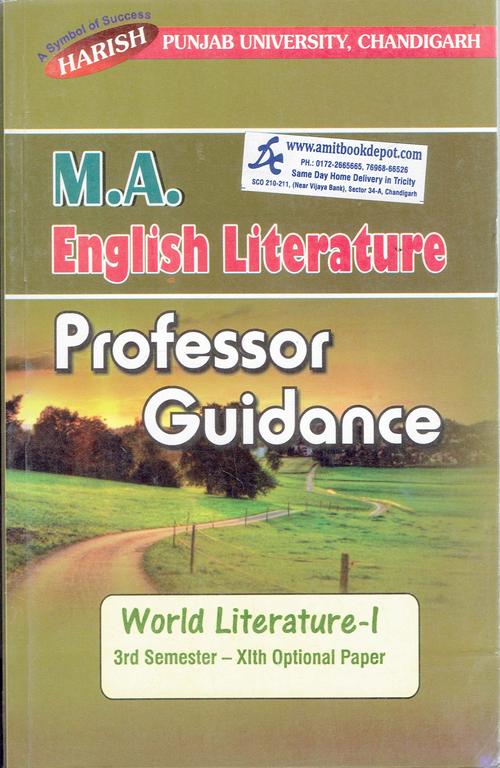
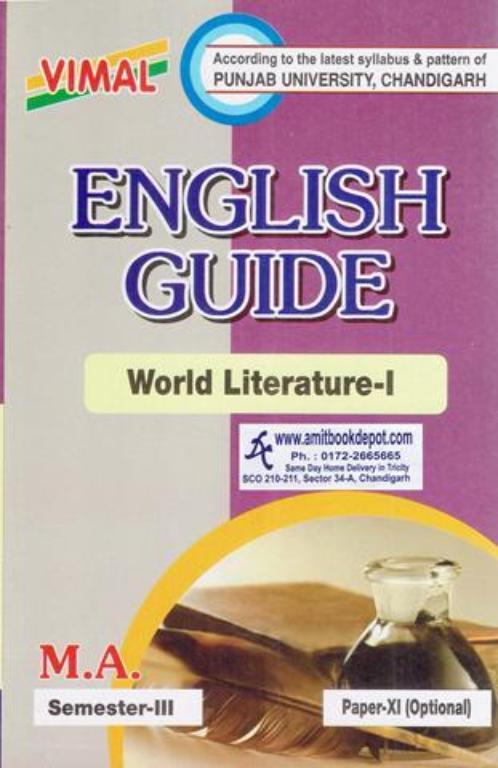
Harish Professor Guidance World Literature 1 For MA 3rd Semester 11th Optional Paper Panjab University Chandigarh

by Madhurima
₹360 ₹360.00(-/ off)

Rating & Reviews

23 Customer Review

Master your MA 3rd Semester World Literature paper with this essential guide from Harish Prakashan Mandir. Specifically designed for the Panjab University, Chandigarh 11th Optional Paper syllabus, this book by Dr. Chakreshwari Dixit provides comprehensive coverage of all prescribed texts. From Goethe's theory to Kalidasa's Shakuntalam, the Arabian Nights, the Rig Veda, Dante's Inferno, and Cervantes' Don Quixote, it offers detailed analyses, summaries, and critical perspectives. This study guide is the perfect exam preparation resource for students aiming to develop a comparatist perspective and achieve academic excellence in their MA English program.

Have Doubts Regarding This Product ? Ask Your Question

  • Q1
    Is this book a compilation of the original literary texts or a critical guide?
    A1

    This is a critical guide and study aid. It provides analysis, summaries, and explanations of the texts prescribed in the syllabus. You will need the original texts or their translations (as listed in the syllabus) for the primary reading.

  • Q2
    Does the guide include detailed notes on Milan Kundera's "Die Weltliteratur," which is a complex theoretical essay?
    A2

    Yes, Unit I is dedicated to theory and includes detailed commentary and explanations on both Goethe's and Kundera's essays, breaking down their key arguments about the concept of World Literature.

  • Q3
    Which translation of Abhijanana Sakuntalam does this guidebook align with and analyze?
    A3

    The guide aligns with the syllabus-prescribed translation by Somadeva Vasudeva (Clay Sanskrit Library). The analysis and notes are based on this version to ensure syllabus accuracy.

  • Q4
    Are all the tales from Arabian Nights and Chinese Fables mentioned in the syllabus covered in detail?
    A4

    Yes, the guide provides specific analysis for each of the selected tales: "The Tale of Ox and Donkey," "The Tale of the Husband and the Parrot," and "The Tale of Hunchback" from Arabian Nights, and the three specified stories from Chinese Fables and Folk Stories.

  • Q5
    How does the book help in comparing the poetic traditions of the Rig Veda and Dante's Inferno?
    A5

    Unit IV provides individual analysis of the selected hymns and cantos, and often includes comparative insights highlighting contrasts in theme, cosmology, and cultural context, aiding in the development of a comparatist perspective as encouraged by the syllabus.

  • Q6
    For Don Quixote, does the guide cover the entire novel or specific parts relevant to the MA syllabus?
    A6

    The guide focuses on providing a comprehensive overview, major themes, character analyses, and critical perspectives relevant to the novel as a whole, as required for a holistic understanding at the MA level.

  • Q7
    Is this book useful for students from universities other than Panjab University?
    A7

    While it is tailor-made for Panjab University, students of MA English from other universities with similar syllabi covering these core World Literature texts will find the critical analyses and commentaries immensely beneficial.

  • Q8
    How does this guide help in understanding the "cosmopolitan expansiveness" of World Literature as mentioned in the syllabus?
    A8

    The introduction and theoretical unit directly address this concept. The selection and analysis of texts from Sanskrit, Arabic, Chinese, Italian, and Spanish traditions inherently demonstrate this expansiveness, which is highlighted throughout the book.

  • Q9
    Is the language of the guide complex or is it student-friendly?
    A9

    It is written in clear, academic yet accessible English, designed specifically for postgraduate students to grasp complex literary concepts easily.

  • Q10
    Does it cover the comparative aspects between the fables of different cultures (Arabian and Chinese) as suggested in the syllabus structure?
    A10

    Yes, Unit III on Tales/Fables often draws parallels and contrasts between the narrative styles, moral lessons, and cultural values reflected in the Arabian Nights and the Chinese Fables, fostering a comparative approach.

0.00

0 Overall Rating
  • 5
    0
  • 4
    0
  • 3
    0
  • 2
    0
  • 1
    0

Try this product & share your review & thoughts

1. ON WORLD LITERATURE—Johann Wolfgang (Von Goethe)

- Introduction to the Author
On World Literature
- Introduction to 'The World Literature'

Summary of "World Literature'
1. World Literature in Theory and Practice
2. Goethe's Conversation with Eckermann
3. Study and Origin of World Literature
4. Goethe's Concept of National Literature
5. Concept of World Literature

2. DIE WELTLITERATUR—Milan Kundera
- Introduction to the Author
World literature

Summary of 'World Literature'
1. Milan Kundera's Contribution
2. Milan Kundera's views on world literature
3. Milan Kundera as an anti-modern Modernist
4. Who is Pleaides to Kundera?
5. How is Milan Kundera's study important today?
6. Kitsch and Vulgarity
7. Distinction between Large and Small Nation's Provincialism

Unit II: Play

3. ABHIJANA SAKUNTALAM-Kalidasa Kalidas

(A) Life Sketch and Works of Kalidas
(B) Works of Kalidasa
Abhigyan Shakuntalam
Actwise Summary of Abhigyan Shakuntalam Story of 'Abhigyan Shakuntalam' (in Hindi)
Detailed Summary of Kalidas's Abhigyan Shakuntalam Along with Critical Appreciation
1. Kalidasa is indisputably the greatest mastermind in Sanskrit poetry—the brightest star in the firmament of Indian poetry. Do you agree?
Give illustrations to substantiate your answer.
2. According to Sir Monier Williams, "...The exuberance of two imaginations, the warmth and play of his fancy, his promoted knowledge of the human heart...in short, none entitled him to rank as the Shakespeare of India." Do you agree, and substantiate your answer with illustrations?
3. In the rough, prosaic, dull, and lifeless story of Mahabharata, Kalidasa, by his faculties of imagination, has visualized the seed of his greatest play. Do you agree? Please describe the main source of his play and also enumerate the main changes effected by him in the original story.
4. Why is this play named Abhigyan Shakuntalam?
5. Prove that the name of the play Abhigyan Shakuntalam is appropriate.
or
Why did Kalidas put the name of the play as Abhigyan Shakuntalam?
6. Write the summary of Abhigyan Shakuntalam in short.
7. What is the main source of the play Abhigyan Shakuntalam? Discuss.
8. What changes had taken place in Kalidas's Abhigyan Shakuntalam in the main story to give it the form of a play, and why? Or
To change the main Abhigyan Shakuntalam for the sake of the play was justified. Discuss.
There is a lot of difference between the main subject and the play. Comment.
9. What is the meaning of "hero"? With reference to Abhigyan Shakuntalam, prove that Dushyant was the hero of the play.

Who is the main hero of the play Abhigyan Shakuntalam?
or
Write a character sketch of the hero of "Abhigyan Shakuntalam."
10. Prove that the heroine of Abhigyan Shakuntalam is Shakuntala.
or
Write a character sketch of Shakuntala in the play.
Abhigyan Shakuntalam.
or
Who is the heroine of Abhigyan Shakuntalam?
11. Write the character sketch of Maharishi Kanva.
12. Write a short essay on true love in reference to Abhigyan Shakuntalam.
13. Comment upon the style of Kalidas in the light of Abhigyan Shakuntalam.
14. Write about the plot of Abhigyan Shakuntalam.

Unit III: Tales/Fables

4. ARABIAN NIGHTS (TALES)—Hussein Haddawy
Text—(1) The Tale of Ox and Donkey
(2) The Tale of the Husband and Parrot
(3) The Tale of Hunchback

Arabian Nights
Introduction

1. Critical Evaluation of A Thousand and One Nights as Described in the Literary World
2. The World of the Arabian Nights
3. The Story of 'One Thousand and One Nights'

(1) The Tale of Ox and Donkey
Summary
Moral Lesson of the Story: The Tale of Ox and
Donkey

(2) The Tale of the Husband and Parrot
Summary
Moral of the Story: Husband and Parrot

(3) The Tale of Hunchback
Summary
Critical Appreciation of Story 'Hunchback'

5. CHINESE FABLES AND FOLK STORIES—Mary Hayes Davis & Chow-Leung

Text—(1) How the Moon Became Beautiful
(2) The Animals' Peace Party
(3) The Widow and Her Son

Chinese Fables and Folk Stories
Introduction
Fables and Their Impacts
Comparative Study of Indian and Classical

Folk Tales
(1) How the Moon Became Beautiful
Summary
Moral of the Story
(2) The Animals' Peace Party
Summary
Learn From Story
(3) The Widow and Her Son
Summary
Analysis and Moral of 'The Widow and Her Son'

Unit IV: Poetry

6. RIG VED—An Anthology

Text-Nasadiye Sukta (10-129)
Rig Veda.
Introduction
Historical Evidence and Date
Nasadiya Sukta, the so-called Hymn 10-129 of
Rig Veda 'Creation' and 'Speech'
1. The Creation in Rigveda 10:129
2. The sublime depiction of Advaitic Monism
3. The Rigveda and the Universe
4. Rigveda—Language and Composition

7. INFERNO (CANTO IV-VI)—Dante Alighieri

Text—Canto IV-VI
Dante Alighieri
- Introduction
Inferno

Brief Summary Information
Canto IV: Summary
Canto V: Summary
Canto VI: Summary

1. Dante's Inferno Theme
2. The Character Sketch of Dante
3. Character Sketch of Virgil
4. Analysis of Canto IV
5. Significance of Canto V
6. Literary Significance of Canto VI

Unit V: Novel

8. DON QUIXOTE—Miguel de Cervantes
- Introduction
Don Quixote

Summary of the Novel
Part 1: The Prologue and From Chapter 1 to 54
Part 2: The Prologue & Chapters 1 to 74

Brief Summary
Commentary
The Novel The Adventures of Don Quixote:
The Plot
The Characters of the Adventures of Don Quixote
Major Characters
Minor Characters
Other Element Settings
Themes: Quixotism
A Parody of Chivalry
The Nature of Faith
Idealism vs. Realism
Illusion vs. Reality
Style

Form and Structure
1. Diversity and Contradiction in Don Quixote
2. Timeless Popularity and Universality of Don Quixote
3. Structure of Don Quixote as a Novel
4. Comparison and Contrast in Both the Characters
5. Varied Aspects of the Personality of Don Quixote
6. Cervantes' Concept of Chivalresque Romance and Don Quixote
7. Comparison of Parts 'I' and 'II' of Don Quixote
8. Importance of Use of Proverbs and Eloquent Language by Sancho in Don Quixote
9. Comedy in Don Quixote

Latest Syllabus of Professor Guidance World Literature 1 For MA 3rd Semester 11th Optional Paper Panjab University (PU) Chandigarh


World Literature – I

Far from being an aggregation of literatures produced by European nations, the idea of world literature has acquired wider cosmopolitan expansiveness. As writings from ‘other’ cultures such as Latin America, Africa, India, China, and Arab nations make their headway by virtue of their culturally specific experience and aesthetics, world literature as a category has become more inclusive. This paper would help the students understand the concept of world literature. It is designed around classical and canonical ancient, medieval, and modern texts and as such offers opportunities to remap one’s literary horizons at a global scale. It encourages a comparatist perspective and would inculcate an awareness of the best in world literature.

Unit I Theory

• Johann Wolfgang (von) Goethe, “On World Literature” (1827), World Literature—A Reader (Routledge, 2013), 9-16.
• Milan Kundera, “Die Weltliteratur” (2005), World Literature: A Reader (Routledge, 2013), 289-301.

Unit II Play

• Kalidasa, Abhijnana Sakuntalam (The Recognition of Shakuntala), ed. and trans. by Somadeva Vasudeva (New York: The Clay Sanskrit Library & New York University Press, 2006).

Unit III Tales/Fables

• “The Tale of Ox and Donkey,” “The Tale of the Husband and the Parrot,” & “The Tale of Hunchback,” The Arabian Nights, trans. Husain Haddawy (Norton, 1990)
• “How the Moon Became Beautiful,” “The Animals’ Peace Party,” & “The Widow and Her Son,” Chinese Fables and Folk Stories, trans., Mary Hayes Davis & Chow-Leung (New York, Cincinnati & Chicago: American Book Company, 1908)

Unit IV Poetry

• Rig Veda, “Creation” and “Speech.” The Rig Veda: An Anthology: One Hundred and Eight Hymns. (Penguin Books, 1981).
• Dante Aligheri, Canto IV-VI, Inferno (Penguin Classic, 2013).

Unit V Novel

a. Cervantes, Don Quixote (Penguin Classics, 2011).

Harish Professor Guidance World Literature 1 For MA 3rd Semester 11th Optional Paper Panjab University Chandigarh is an indispensable academic resource meticulously crafted for postgraduate students of Panjab University. Authored by the esteemed Dr. Chakreshwari Dixit and published by Harish Prakashan Mandir, this comprehensive guidebook is meticulously aligned with the prescribed syllabus, offering a structured and in-depth exploration of global literary masterpieces. This book serves as a definitive companion for mastering the MA 3rd Semester curriculum, providing critical insights, summaries, and analyses tailored specifically for the 11th Optional Paper.

The core objective of this Panjab University MA guidebook is to facilitate a profound understanding of world literature as a dynamic and inclusive discipline. Moving beyond a Eurocentric canon, the syllabus and this guide embrace a cosmopolitan perspective, incorporating seminal texts from diverse cultures, including India, the Arab world, China, and Europe. This literary criticism volume begins with a robust theoretical foundation in Unit I, featuring pivotal essays by Johann Wolfgang von Goethe on the very concept of "Weltliteratur" (World Literature) and Milan Kundera's modern reflections in "Die Weltliteratur." These chapters equip students with the critical frameworks necessary to appreciate literature in a global context, fostering a comparatist perspective.

Unit II delves into classical drama with an authoritative study of Kalidasa's Abhijnanasakuntalam (The Recognition of Shakuntala). This section provides essential commentary on the play's themes, characters, and its monumental significance in Sanskrit literature and world theatre. Unit III expands the horizon into narrative traditions through tales and fables. It includes analysis of selected stories from the Arabian Nights (translated by Husain Haddawy) and timeless parables from Chinese Fables and Folk Stories. This unit highlights the universal human experiences encapsulated in these ancient folk tales and their narrative artistry.

The poetic grandeur of ancient and medieval epochs is unpacked in Unit IV. Students will find detailed examinations of profound hymns from the Rig Veda, focusing on themes of Creation and Speech, alongside a guided exploration of Cantos IV-VI from Dante Alighieri's Inferno. This comparative study between sacred Indian verse and the cornerstone of Italian literature offers a unique scholarly contrast. Finally, Unit V is dedicated to the foundational modern novel, Miguel de Cervantes' Don Quixote. This section provides critical analysis of the novel's structure, themes of chivalry and reality, and its enduring legacy in the literary canon.

Structured as a perfect study guide and exam preparation tool, this book by Harish Prakashan Mandir features clear explanations, potential question-answer formats, and thematic discussions that cater directly to the evaluation patterns of Panjab University, Chandigarh. It bridges the gap between the original texts and the student's need for concise, syllabus-specific comprehension. For any MA English student seeking to excel in their third-semester optional paper, this Professor Guidance book is an essential investment. It not only aids in academic success but also genuinely helps in remapping literary horizons at a global scale, instilling a deep and appreciative awareness of the world's richest literary traditions.

1. ON WORLD LITERATURE—Johann Wolfgang (Von Goethe)

- Introduction to the Author
On World Literature
- Introduction to 'The World Literature'

Summary of "World Literature'
1. World Literature in Theory and Practice
2. Goethe's Conversation with Eckermann
3. Study and Origin of World Literature
4. Goethe's Concept of National Literature
5. Concept of World Literature

2. DIE WELTLITERATUR—Milan Kundera
- Introduction to the Author
World literature

Summary of 'World Literature'
1. Milan Kundera's Contribution
2. Milan Kundera's views on world literature
3. Milan Kundera as an anti-modern Modernist
4. Who is Pleaides to Kundera?
5. How is Milan Kundera's study important today?
6. Kitsch and Vulgarity
7. Distinction between Large and Small Nation's Provincialism

Unit II: Play

3. ABHIJANA SAKUNTALAM-Kalidasa Kalidas

(A) Life Sketch and Works of Kalidas
(B) Works of Kalidasa
Abhigyan Shakuntalam
Actwise Summary of Abhigyan Shakuntalam Story of 'Abhigyan Shakuntalam' (in Hindi)
Detailed Summary of Kalidas's Abhigyan Shakuntalam Along with Critical Appreciation
1. Kalidasa is indisputably the greatest mastermind in Sanskrit poetry—the brightest star in the firmament of Indian poetry. Do you agree?
Give illustrations to substantiate your answer.
2. According to Sir Monier Williams, "...The exuberance of two imaginations, the warmth and play of his fancy, his promoted knowledge of the human heart...in short, none entitled him to rank as the Shakespeare of India." Do you agree, and substantiate your answer with illustrations?
3. In the rough, prosaic, dull, and lifeless story of Mahabharata, Kalidasa, by his faculties of imagination, has visualized the seed of his greatest play. Do you agree? Please describe the main source of his play and also enumerate the main changes effected by him in the original story.
4. Why is this play named Abhigyan Shakuntalam?
5. Prove that the name of the play Abhigyan Shakuntalam is appropriate.
or
Why did Kalidas put the name of the play as Abhigyan Shakuntalam?
6. Write the summary of Abhigyan Shakuntalam in short.
7. What is the main source of the play Abhigyan Shakuntalam? Discuss.
8. What changes had taken place in Kalidas's Abhigyan Shakuntalam in the main story to give it the form of a play, and why? Or
To change the main Abhigyan Shakuntalam for the sake of the play was justified. Discuss.
There is a lot of difference between the main subject and the play. Comment.
9. What is the meaning of "hero"? With reference to Abhigyan Shakuntalam, prove that Dushyant was the hero of the play.

Who is the main hero of the play Abhigyan Shakuntalam?
or
Write a character sketch of the hero of "Abhigyan Shakuntalam."
10. Prove that the heroine of Abhigyan Shakuntalam is Shakuntala.
or
Write a character sketch of Shakuntala in the play.
Abhigyan Shakuntalam.
or
Who is the heroine of Abhigyan Shakuntalam?
11. Write the character sketch of Maharishi Kanva.
12. Write a short essay on true love in reference to Abhigyan Shakuntalam.
13. Comment upon the style of Kalidas in the light of Abhigyan Shakuntalam.
14. Write about the plot of Abhigyan Shakuntalam.

Unit III: Tales/Fables

4. ARABIAN NIGHTS (TALES)—Hussein Haddawy
Text—(1) The Tale of Ox and Donkey
(2) The Tale of the Husband and Parrot
(3) The Tale of Hunchback

Arabian Nights
Introduction

1. Critical Evaluation of A Thousand and One Nights as Described in the Literary World
2. The World of the Arabian Nights
3. The Story of 'One Thousand and One Nights'

(1) The Tale of Ox and Donkey
Summary
Moral Lesson of the Story: The Tale of Ox and
Donkey

(2) The Tale of the Husband and Parrot
Summary
Moral of the Story: Husband and Parrot

(3) The Tale of Hunchback
Summary
Critical Appreciation of Story 'Hunchback'

5. CHINESE FABLES AND FOLK STORIES—Mary Hayes Davis & Chow-Leung

Text—(1) How the Moon Became Beautiful
(2) The Animals' Peace Party
(3) The Widow and Her Son

Chinese Fables and Folk Stories
Introduction
Fables and Their Impacts
Comparative Study of Indian and Classical

Folk Tales
(1) How the Moon Became Beautiful
Summary
Moral of the Story
(2) The Animals' Peace Party
Summary
Learn From Story
(3) The Widow and Her Son
Summary
Analysis and Moral of 'The Widow and Her Son'

Unit IV: Poetry

6. RIG VED—An Anthology

Text-Nasadiye Sukta (10-129)
Rig Veda.
Introduction
Historical Evidence and Date
Nasadiya Sukta, the so-called Hymn 10-129 of
Rig Veda 'Creation' and 'Speech'
1. The Creation in Rigveda 10:129
2. The sublime depiction of Advaitic Monism
3. The Rigveda and the Universe
4. Rigveda—Language and Composition

7. INFERNO (CANTO IV-VI)—Dante Alighieri

Text—Canto IV-VI
Dante Alighieri
- Introduction
Inferno

Brief Summary Information
Canto IV: Summary
Canto V: Summary
Canto VI: Summary

1. Dante's Inferno Theme
2. The Character Sketch of Dante
3. Character Sketch of Virgil
4. Analysis of Canto IV
5. Significance of Canto V
6. Literary Significance of Canto VI

Unit V: Novel

8. DON QUIXOTE—Miguel de Cervantes
- Introduction
Don Quixote

Summary of the Novel
Part 1: The Prologue and From Chapter 1 to 54
Part 2: The Prologue & Chapters 1 to 74

Brief Summary
Commentary
The Novel The Adventures of Don Quixote:
The Plot
The Characters of the Adventures of Don Quixote
Major Characters
Minor Characters
Other Element Settings
Themes: Quixotism
A Parody of Chivalry
The Nature of Faith
Idealism vs. Realism
Illusion vs. Reality
Style

Form and Structure
1. Diversity and Contradiction in Don Quixote
2. Timeless Popularity and Universality of Don Quixote
3. Structure of Don Quixote as a Novel
4. Comparison and Contrast in Both the Characters
5. Varied Aspects of the Personality of Don Quixote
6. Cervantes' Concept of Chivalresque Romance and Don Quixote
7. Comparison of Parts 'I' and 'II' of Don Quixote
8. Importance of Use of Proverbs and Eloquent Language by Sancho in Don Quixote
9. Comedy in Don Quixote

Have Doubts Regarding This Product ? Ask Your Question

  • Q1
    Is this book a compilation of the original literary texts or a critical guide?
    A1

    This is a critical guide and study aid. It provides analysis, summaries, and explanations of the texts prescribed in the syllabus. You will need the original texts or their translations (as listed in the syllabus) for the primary reading.
  • Q2
    Does the guide include detailed notes on Milan Kundera's "Die Weltliteratur," which is a complex theoretical essay?
    A2

    Yes, Unit I is dedicated to theory and includes detailed commentary and explanations on both Goethe's and Kundera's essays, breaking down their key arguments about the concept of World Literature.

  • Q3
    Which translation of Abhijanana Sakuntalam does this guidebook align with and analyze?
    A3

    The guide aligns with the syllabus-prescribed translation by Somadeva Vasudeva (Clay Sanskrit Library). The analysis and notes are based on this version to ensure syllabus accuracy.

  • Q4
    Are all the tales from Arabian Nights and Chinese Fables mentioned in the syllabus covered in detail?
    A4

    Yes, the guide provides specific analysis for each of the selected tales: "The Tale of Ox and Donkey," "The Tale of the Husband and the Parrot," and "The Tale of Hunchback" from Arabian Nights, and the three specified stories from Chinese Fables and Folk Stories.

  • Q5
    How does the book help in comparing the poetic traditions of the Rig Veda and Dante's Inferno?
    A5

    Unit IV provides individual analysis of the selected hymns and cantos, and often includes comparative insights highlighting contrasts in theme, cosmology, and cultural context, aiding in the development of a comparatist perspective as encouraged by the syllabus.

  • Q6
    For Don Quixote, does the guide cover the entire novel or specific parts relevant to the MA syllabus?
    A6

    The guide focuses on providing a comprehensive overview, major themes, character analyses, and critical perspectives relevant to the novel as a whole, as required for a holistic understanding at the MA level.

  • Q7
    Is this book useful for students from universities other than Panjab University?
    A7

    While it is tailor-made for Panjab University, students of MA English from other universities with similar syllabi covering these core World Literature texts will find the critical analyses and commentaries immensely beneficial.

  • Q8
    How does this guide help in understanding the "cosmopolitan expansiveness" of World Literature as mentioned in the syllabus?
    A8

    The introduction and theoretical unit directly address this concept. The selection and analysis of texts from Sanskrit, Arabic, Chinese, Italian, and Spanish traditions inherently demonstrate this expansiveness, which is highlighted throughout the book.

  • Q9
    Is the language of the guide complex or is it student-friendly?
    A9

    It is written in clear, academic yet accessible English, designed specifically for postgraduate students to grasp complex literary concepts easily.

  • Q10
    Does it cover the comparative aspects between the fables of different cultures (Arabian and Chinese) as suggested in the syllabus structure?
    A10

    Yes, Unit III on Tales/Fables often draws parallels and contrasts between the narrative styles, moral lessons, and cultural values reflected in the Arabian Nights and the Chinese Fables, fostering a comparative approach.

Latest Syllabus of Professor Guidance World Literature 1 For MA 3rd Semester 11th Optional Paper Panjab University (PU) Chandigarh


World Literature – I

Far from being an aggregation of literatures produced by European nations, the idea of world literature has acquired wider cosmopolitan expansiveness. As writings from ‘other’ cultures such as Latin America, Africa, India, China, and Arab nations make their headway by virtue of their culturally specific experience and aesthetics, world literature as a category has become more inclusive. This paper would help the students understand the concept of world literature. It is designed around classical and canonical ancient, medieval, and modern texts and as such offers opportunities to remap one’s literary horizons at a global scale. It encourages a comparatist perspective and would inculcate an awareness of the best in world literature.

Unit I Theory

• Johann Wolfgang (von) Goethe, “On World Literature” (1827), World Literature—A Reader (Routledge, 2013), 9-16.
• Milan Kundera, “Die Weltliteratur” (2005), World Literature: A Reader (Routledge, 2013), 289-301.

Unit II Play

• Kalidasa, Abhijnana Sakuntalam (The Recognition of Shakuntala), ed. and trans. by Somadeva Vasudeva (New York: The Clay Sanskrit Library & New York University Press, 2006).

Unit III Tales/Fables

• “The Tale of Ox and Donkey,” “The Tale of the Husband and the Parrot,” & “The Tale of Hunchback,” The Arabian Nights, trans. Husain Haddawy (Norton, 1990)
• “How the Moon Became Beautiful,” “The Animals’ Peace Party,” & “The Widow and Her Son,” Chinese Fables and Folk Stories, trans., Mary Hayes Davis & Chow-Leung (New York, Cincinnati & Chicago: American Book Company, 1908)

Unit IV Poetry

• Rig Veda, “Creation” and “Speech.” The Rig Veda: An Anthology: One Hundred and Eight Hymns. (Penguin Books, 1981).
• Dante Aligheri, Canto IV-VI, Inferno (Penguin Classic, 2013).

Unit V Novel

a. Cervantes, Don Quixote (Penguin Classics, 2011).

0.00

0 Overall Rating
  • 5
    0
  • 4
    0
  • 3
    0
  • 2
    0
  • 1
    0

Try this product & share your review & thoughts

Top Trending Product

Related Product

Related Product

Related Blog Posts

Latest Blogs

Latest Blogs

blog-img
Classic Literature Reimagined: Discuss modern twists on classic novels.
Lorem ipsum dolor sit amet, consectetur adipiscing elit, sed do eiusmod tempor incididunt ut labore et dolore magna aliqua. Ut enim ad minim veniam, quis nostrud exercitation ullamco Lorem ipsum dolor sit amet, consectetur adipiscing elit, sed do eiusmod tempor incididunt ut labore et dolore magna aliqua. Utenim ad minim veniam, quis nostrud exercitation ullamco Lorem ipsum dolor sit amet, consecte...
Read more
Author name | 10 jan, 2025
blog-img
Classic Literature Reimagined: Discuss modern twists on classic novels.
Lorem ipsum dolor sit amet, consectetur adipiscing elit, sed do eiusmod tempor incididunt ut labore et dolore magna aliqua. Ut enim ad minim veniam, quis nostrud exercitation ullamco Lorem ipsum dolor sit amet, consectetur adipiscing elit, sed do eiusmod tempor incididunt ut labore et dolore magna aliqua. Utenim ad minim veniam, quis nostrud exercitation ullamco Lorem ipsum dolor sit amet, consecte...
Read more
Author name | 10 jan, 2025
blog-img
Classic Literature Reimagined: Discuss modern twists on classic novels.
Lorem ipsum dolor sit amet, consectetur adipiscing elit, sed do eiusmod tempor incididunt ut labore et dolore magna aliqua. Ut enim ad minim veniam, quis nostrud exercitation ullamco Lorem ipsum dolor sit amet, consectetur adipiscing elit, sed do eiusmod tempor incididunt ut labore et dolore magna aliqua. Utenim ad minim veniam, quis nostrud exercitation ullamco Lorem ipsum dolor sit amet, consecte...
Read more
Author name | 10 jan, 2025
blog-img
Classic Literature Reimagined: Discuss modern twists on classic novels.
Lorem ipsum dolor sit amet, consectetur adipiscing elit...
Read more
Author Name | 10 Jan, 2025
blog-img
Classic Literature Reimagined: Discuss modern twists on classic novels.
Lorem ipsum dolor sit amet, consectetur adipiscing elit...
Read more
Author Name | 10 Jan, 2025
blog-img
Classic Literature Reimagined: Discuss modern twists on classic novels.
Lorem ipsum dolor sit amet, consectetur adipiscing elit...
Read more
Author Name | 10 Jan, 2025
blog-img
Classic Literature Reimagined: Discuss modern twists on classic novels.
Lorem ipsum dolor sit amet, consectetur adipiscing elit...
Read more
Author Name | 10 Jan, 2025
blog-img
Classic Literature Reimagined: Discuss modern twists on classic novels.
Lorem ipsum dolor sit amet, consectetur adipiscing elit...
Read more
Author Name | 10 Jan, 2025
blog-img
Classic Literature Reimagined: Discuss modern twists on classic novels.
Lorem ipsum dolor sit amet, consectetur adipiscing elit...
Read more
Author Name | 10 Jan, 2025
blog-img
Classic Literature Reimagined: Discuss modern twists on classic novels.
Lorem ipsum dolor sit amet, consectetur adipiscing elit...
Read more
Author Name | 10 Jan, 2025
blog-img
Classic Literature Reimagined: Discuss modern twists on classic novels.
Lorem ipsum dolor sit amet, consectetur adipiscing elit...
Read more
Author Name | 10 Jan, 2025
blog-img
Classic Literature Reimagined: Discuss modern twists on classic novels.
Lorem ipsum dolor sit amet, consectetur adipiscing elit...
Read more
Author Name | 10 Jan, 2025