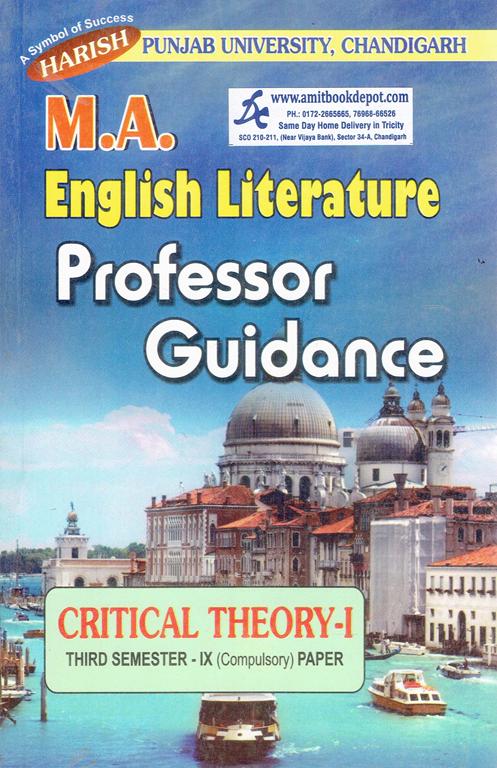
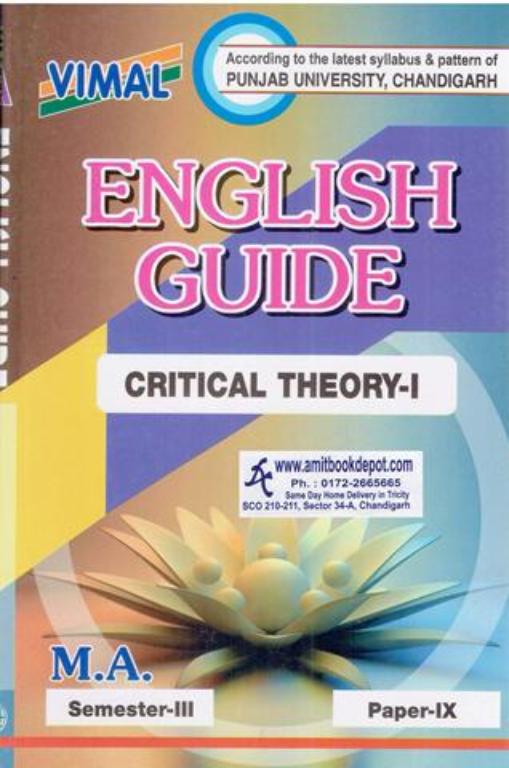
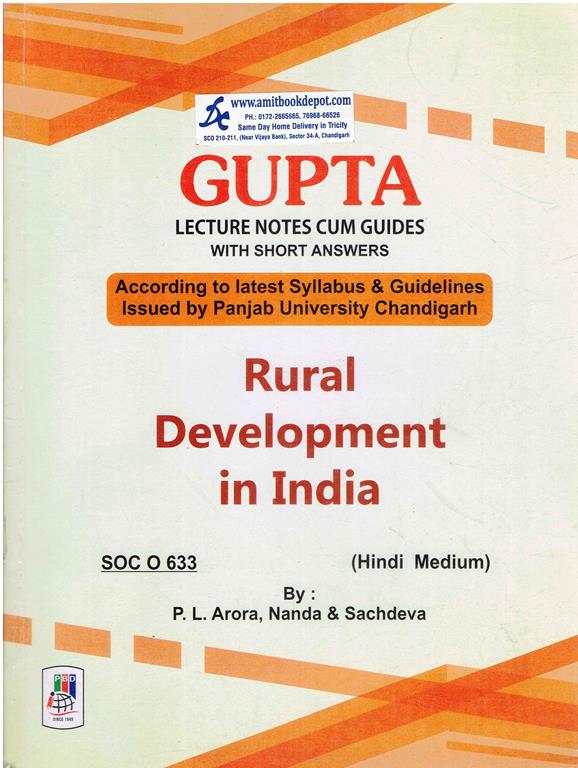
Harish Professor Guidance Critical Theory 1 For MA 3rd Semester Paper 9 (Compulsory) Panjab University Chandigarh
Harish Professor Guidance Critical Theory 1 For MA 3rd Semester Paper 9 (Compulsory) Panjab University Chandigarh
by Madhurima
₹360₹360.00(-/
off)
Rating & Reviews
23 Customer Review
The "Harish Professor Guidance Critical Theory I" is the prescribed book for Panjab University, Chandigarh's M.A. English Semester III, Paper 9. Authored by Dr. Chakreshwari Dixit and Dr. Mohd Mazhar, this comprehensive guide covers the entire syllabus, from Abrams and Jakobson to Foucault, Derrida, Lyotard, and Baudrillard. Published by Harish Prakashan Mandir, it provides clear explanations, summaries, and critical commentary on complex theoretical texts, serving as an essential study aid and exam preparation resource. This book is an indispensable companion for mastering literary and cultural theory for university examinations.
Harish, Professor, Guidance Critical Theory I: The Definitive Book for M.A. (Semester III) Paper 9, Panjab University, Chandigarh
The "Harish Professor Guidance Critical Theory I" is an authoritative and meticulously crafted book designed exclusively for Master of Arts students at Panjab University, Chandigarh, enrolled in the third semester for the compulsory Paper IX. Authored by the distinguished academics Dr. Chakreshwari Dixit and Dr. Mohd Mazhar and published by the renowned Harish Prakashan Mandir, this book serves as an indispensable guide through the complex and foundational terrain of modern literary and cultural theory. It is precisely aligned with the university's prescribed syllabus, ensuring comprehensive coverage of all critical texts and concepts mandated for the course.
This essential academic resource addresses the paradigm shift in literary studies, where traditional analysis has expanded to incorporate interdisciplinary tools from economics, psychology, history, and sociology. The course, and consequently this book, is structured to introduce students to the core texts that represent the historical progression and ideological evolution of literary theory. Moving beyond mere textual analysis, the "Harish Professor Guidance" illuminates how theory now exerts a tangible influence on the very production of literature, equipping students with the critical frameworks necessary for advanced literary scholarship.
The content is systematically organized into five coherent units, each focusing on pivotal theorists and their groundbreaking essays. The journey begins with M.H. Abrams' seminal interrogation, "What's the Use of Theorizing About the Art?", which sets the stage by justifying the theoretical enterprise itself. Unit II delves into structuralist and post-structuralist thought, featuring Roman Jakobson's linguistic analysis in "Two Aspects of Language" and Roland Barthes' revolutionary proclamation, "The Death of the Author," which fundamentally reorients the relationship between text, writer, and reader.
Unit III navigates the challenging waters of postmodernism and deconstruction. It includes Jacques Derrida's clarifying "Letter to a Japanese Friend" on différance, alongside Jean-François Lyotard's definitive explorations in "Answer to the Question: What is Postmodern?" and "Note on the Postmodern." This section demystifies complex philosophical concepts crucial for understanding contemporary critical discourse. Unit IV shifts focus to power, surveillance, and society, presenting key excerpts from Michel Foucault's "Discipline and Punish: The Birth of the Prison" and Gilles Deleuze's prognostic "Postscript on the Societies of Control," offering tools to analyze institutional and social mechanisms of power.
The final unit explores the hyperreal world of Jean Baudrillard through "The System of Objects" and "Simulacra and Simulations," guiding students through concepts of simulation, simulacra, and the nature of reality in consumer society. Each chapter in this MA English book is presented with the clarity and pedagogical insight that the "Harish Professor Guidance" series is celebrated for. The explanations are designed to decode dense theoretical material, providing contextual background, clear summaries, and critical commentary that bridges the gap between the original text and the student's understanding.
As a vital study guide for Panjab University MA English, this volume is more than a compilation; it is a structured critical theory companion. It is an essential resource for exam preparation, ensuring students grasp not only the content but also the interconnections between different theoretical movements. Keywords for this indispensable academic tool include Panjab University MA English Book, Critical Theory I Paper 9, Harish Prakashan Mandir, MA 3rd Semester Guide, Literary Theory book, Poststructuralism, Postmodernism, Foucault, Derrida, Baudrillard, Barthes, Syllabus-specific Guide, University Prescribed Book, and MA English Literature Study Material. For any student pursuing an MA in English at Panjab University, the "Harish Professor Guidance Critical Theory I" is the definitive key to mastering the compulsory paper and excelling in academic examinations.
Is this book the latest edition and does it fully cover the revised syllabus for Panjab University's MA English Paper 9 (Critical Theory I) for the current academic year?
A1
Yes, this edition is meticulously updated to align completely with the latest syllabus prescribed by Panjab University for MA 3rd Semester, Paper IX.
Q2
How does this "Professor Guidance" book differ from simply reading the original essays by Abrams, Barthes, or Foucault?
A2
This book acts as a crucial companion. It provides expert introductions, contextualizes each theorist's work within the broader trajectory of literary theory, clarifies complex terminology, and explains dense philosophical arguments, making the original texts significantly more accessible for students.
Q3
Are summaries of each theorist's essay included, or is it purely analytical commentary?
A3
The book typically includes both. You will find clear, chapter-wise summaries of the key arguments from each prescribed essay, followed by detailed analytical commentary that highlights important concepts and their interconnections.
Q4
I find Postmodernism and Deconstruction particularly challenging. How well are Derrida and Lyotard explained in this volume?
A4
Demystifying complex theorists is a key strength of this guide. The chapters on Derrida's "Letter to a Japanese Friend" and Lyotard's writings on postmodernism break down concepts like différance, grand narratives, and the postmodern condition into understandable segments with relevant examples.
Q5
Is the section on Foucault's "Discipline and Punish" based on the full text or just the "Panopticism" excerpt mentioned in the syllabus?
A5
The book focuses precisely on the syllabus-prescribed excerpt related to Panopticism. It provides the necessary background to Foucault's ideas on power, surveillance, and discipline, offering a deep analysis of the panopticon as a metaphor.
Q6
Can this book be used as a standalone resource for preparing for Paper 9, or will I still need to consult the original theoretical texts?
A6
This guide is designed to be a comprehensive primary resource for syllabus coverage and conceptual understanding. However, for in-depth scholarly work, referring to the original essays is always encouraged. This book ensures you are fully prepared to engage with those originals.
Q7
Does the book draw connections between the different units, like how Structuralism (Unit II) leads to Postmodernism (Unit III)?
A7
Yes, a key feature of a good guidance book is to show the evolution of thought. The commentary often links concepts across units, helping you understand the historical and critical progression from formalism to poststructuralism and beyond.
Q8
Is the language used in the explanations academic and complex, or is it student-friendly?
A8
The primary aim of the "Professor Guidance" series is to simplify complex material. The language is clear, direct, and pedagogical, prioritizing student comprehension without compromising on academic rigor.
Q9
Are keywords and important terms from each theorist (like "Simulacra," "Panopticon," "Différance") clearly defined and highlighted?
A9
Absolutely. Defining and explaining key terminologies is a fundamental part of the book's design, ensuring you can confidently use these terms in your examinations.
Q10
As the syllabus mentions "eclectic" fields, does the book help connect literary theory to sociology, history, and psychology as promised?
A10
Yes, the explanatory notes frequently draw these interdisciplinary connections, especially in units covering Foucault (history/sociology), Baudrillard (sociology/media), and psychoanalytic undercurrents in other theorists, fulfilling the syllabus's stated intent.
0.00
0 Overall Rating
5
0
4
0
3
0
2
0
1
0
Try this product & share your review &
thoughts
UNIT - I
1. What's the Use of Theorizing About the Art? - M.H. Abrams
- Introduction to the Author
What’s the use of theorizing about the art?
A Detailed Study
1. Concept of Art
2. Formalist Theories: “Organic Unity”
3. Art is creation.
4. The Status of Theories of Art
5. Institutional Theory of Art
6. The Expression Theory of Art
7. Literary Theory and Literary Criticism
8. Usefulness of a Literary Theory
UNIT - II
2. Two Aspects of Language—Roman Jakobson
- Introduction to the Author
Two Aspects of Language
Introduction to the Chapter
1. Two Aspects of Language and Two Types of Aphasic Disturbance
2. A Review
3. Poetics and Communication
3. The Death of the Author—Ronald Barthes
- Introduction to the Author
The Death of the Author
- Introduction to the Essay
1. The Death of the Author
2. Interpretation of the Title of the Essay
3. Criticism of the Death of the Author
4. Death of the Author: The Birth of the Reader
UNIT - III
4. Letter to a Japanese Friend—Jacques Derrida
- Introduction to Jacques Derrida
Letter to a Japanese Friend
- Introduction to the Essay
Summary of the Latter
1. Interpretation
2. Derrida’s theory of deconstruction
3. Derrida’s Meaning of Deconstruction
4. Contribution of Critics to Deconstruction
5. Deconstruction
5. Answer to the Question: What is Postmodern? - Jean Francois Lyotard
- Introduction to the Author
Answer to the Question: What is Postmodern?
- The Postmodern (Summary)
1. Postmodernism
2. Realism
3. The Sublime and the Avant-Garde
4. The Postmodern
6. Note on the Postmodern—In Postmodern—Jean-François Lyotard
1. Lyotard as Pre-eminent Non-Marxist
2. Problem of Legitimation and Knowledge
3. Capitalism in the Postmodern Condition
4. Lyotard’s Postmodern Condition: A Report on Knowledge
5. The Two Metanarratives
UNIT - IV
7. Discipline and Punish: The Birth of the Prison - Michael Foucault
- Introduction to the Author
Discipline and Punish: The Birth of the Prison
Summary
1. Formation of the Disciplinary Society
2. Foucault’s Discipline and Punishment
3. Panopticon: The Age of Digital Surveillance
4. Prison and Its Importance
5. Social and Theoretical Mechanism of the Western Penal System
6. Marxism's Influence on Michel Foucault
7. Foucault’s Disciplinary Techniques
8. Postscript on the Societies of Control—Gilles Deleuze
- Introduction to the Author
Postscript on the Societies of Control
Summary
1. Gilles Deleuze’s Society of Control
2. Deleuze’s Views on Capitalism and Poverty
3. Control of Society from Government to Companies
4. Creative Multiplicity in Ideas of Deleuze and Gauttari
UNIT - V
9. The System of Objects—Jean Baudrillard
10. Simulacra and Simulations—Jean Baudrillard
- Introduction to the Author
The System of Objects
Summary
1. The Role of Object and Commodity
2. Model Object dominated as a series distinction.
3. Baudrillard’s Concept of Consumer Society
Simulacra and Simulations
Summary
1. Simulation—Definition and Different Orders
2. Hyperreality and Simulation
3. Difference between Representation and Simulation
4. Simulacra and Simulations: Relationship among Reality, Symbols, and Society
Latest Syllabus of Professor Guidance Critical Theory 1 For MA 3rd Semester Paper 9 (Compulsory) Panjab University (PU) Chandigarh
M.A. II (Semester III)
Compulsory Paper
Paper IX
Critical Theory – I
With the changing contours of power dynamics and a sustained emphasis on representational politics, a reassessment of the methodology of the literature
The classroom has been affected. Not only is the canon spilling outside the erstwhile ambit of “Wulf to Woolf,” but the tools of analysis have, likewise, witnessed a shift. From literary benchmarks to extra-literary ones to progressively borrowing from diverse fields, viz., economics to psychology, history to sociology, and theory, it represents a wide spectrum. Today this eclectic field is thoroughly aligned to the purposes of the study of literature and collected under the rubric of “theory.” The effect of literary theory on the study of literature has clearly transcended the original impulse of text analysis and is witnessing a more integral role, with theory asserting a tangible influence on the production of literature itself. The course is designed with the intent of introducing an MA classroom to core texts representing a range of literary theory. The selected texts represent a historical progression of literature analysis as well as the ideological impulses that have modified the practice of literary studies.
Unit I
1. M.H. Abrams, “What's the Use of Theorizing about the Arts?” Doing Things with Texts (London & New York: Norton Paperback, 1991) 31-72.
Unit II
1. Roman Jakobson, “Two Aspects of Language,” Literary Theory: An Anthology, eds. Julie Rivkin and Michael Ryan (Blackwell, 2004, 2nd Ed.) 76-80.
2. Roland Barthes, “The Death of the Author,” Image/Music/Text. Trans. Stephen Heath (Hill and Wang, 1977) 142-147.
Unit III
1. Jacques Derrida, “Letter to a Japanese Friend,” Derrida and Differance. Eds. David Wood and Robert Bernasconi (Evanston, III: Northwestern University Press, 1988) 1-6.
2. Jean Francois Lyotard, “Answer to the Question, What is the Postmodern?” (1-16) & “Note on the Post- in Postmodern” (75-80), The Postmodern Explained:
Correspondence 1982-85 (Minnesota & London: University of Minnesota Press, 1992)
Unit IV
1. Michel Foucault, "Panopticism" from "Discipline & Punish: The Birth of the Prison," Race/Ethnicity: Multidisciplinary Global Contexts, Vol. 2, No. 1, The Dynamics of Race and Incarceration: Social Integration, Social Welfare, and Social Control (Autumn, 2008), 1-12.
2. Giles Deleuze, “Postscript on the Societies of Control,” October, Vol. 59 (Winter, 1992), 3-7.
Unit V
1. Jean Baudrillard, “The System of Objects” (10-28) & “Simulacra and Simulations” (166-184), Jean Baudrillard: Selected Writings, ed. Mark Poster (Stanford: Stanford University Press, 1988)
Harish, Professor, Guidance Critical Theory I: The Definitive Book for M.A. (Semester III) Paper 9, Panjab University, Chandigarh
The "Harish Professor Guidance Critical Theory I" is an authoritative and meticulously crafted book designed exclusively for Master of Arts students at Panjab University, Chandigarh, enrolled in the third semester for the compulsory Paper IX. Authored by the distinguished academics Dr. Chakreshwari Dixit and Dr. Mohd Mazhar and published by the renowned Harish Prakashan Mandir, this book serves as an indispensable guide through the complex and foundational terrain of modern literary and cultural theory. It is precisely aligned with the university's prescribed syllabus, ensuring comprehensive coverage of all critical texts and concepts mandated for the course.
This essential academic resource addresses the paradigm shift in literary studies, where traditional analysis has expanded to incorporate interdisciplinary tools from economics, psychology, history, and sociology. The course, and consequently this book, is structured to introduce students to the core texts that represent the historical progression and ideological evolution of literary theory. Moving beyond mere textual analysis, the "Harish Professor Guidance" illuminates how theory now exerts a tangible influence on the very production of literature, equipping students with the critical frameworks necessary for advanced literary scholarship.
The content is systematically organized into five coherent units, each focusing on pivotal theorists and their groundbreaking essays. The journey begins with M.H. Abrams' seminal interrogation, "What's the Use of Theorizing About the Art?", which sets the stage by justifying the theoretical enterprise itself. Unit II delves into structuralist and post-structuralist thought, featuring Roman Jakobson's linguistic analysis in "Two Aspects of Language" and Roland Barthes' revolutionary proclamation, "The Death of the Author," which fundamentally reorients the relationship between text, writer, and reader.
Unit III navigates the challenging waters of postmodernism and deconstruction. It includes Jacques Derrida's clarifying "Letter to a Japanese Friend" on différance, alongside Jean-François Lyotard's definitive explorations in "Answer to the Question: What is Postmodern?" and "Note on the Postmodern." This section demystifies complex philosophical concepts crucial for understanding contemporary critical discourse. Unit IV shifts focus to power, surveillance, and society, presenting key excerpts from Michel Foucault's "Discipline and Punish: The Birth of the Prison" and Gilles Deleuze's prognostic "Postscript on the Societies of Control," offering tools to analyze institutional and social mechanisms of power.
The final unit explores the hyperreal world of Jean Baudrillard through "The System of Objects" and "Simulacra and Simulations," guiding students through concepts of simulation, simulacra, and the nature of reality in consumer society. Each chapter in this MA English book is presented with the clarity and pedagogical insight that the "Harish Professor Guidance" series is celebrated for. The explanations are designed to decode dense theoretical material, providing contextual background, clear summaries, and critical commentary that bridges the gap between the original text and the student's understanding.
As a vital study guide for Panjab University MA English, this volume is more than a compilation; it is a structured critical theory companion. It is an essential resource for exam preparation, ensuring students grasp not only the content but also the interconnections between different theoretical movements. Keywords for this indispensable academic tool include Panjab University MA English Book, Critical Theory I Paper 9, Harish Prakashan Mandir, MA 3rd Semester Guide, Literary Theory book, Poststructuralism, Postmodernism, Foucault, Derrida, Baudrillard, Barthes, Syllabus-specific Guide, University Prescribed Book, and MA English Literature Study Material. For any student pursuing an MA in English at Panjab University, the "Harish Professor Guidance Critical Theory I" is the definitive key to mastering the compulsory paper and excelling in academic examinations.
UNIT - I
1. What's the Use of Theorizing About the Art? - M.H. Abrams
- Introduction to the Author
What’s the use of theorizing about the art?
A Detailed Study
1. Concept of Art
2. Formalist Theories: “Organic Unity”
3. Art is creation.
4. The Status of Theories of Art
5. Institutional Theory of Art
6. The Expression Theory of Art
7. Literary Theory and Literary Criticism
8. Usefulness of a Literary Theory
UNIT - II
2. Two Aspects of Language—Roman Jakobson
- Introduction to the Author
Two Aspects of Language
Introduction to the Chapter
1. Two Aspects of Language and Two Types of Aphasic Disturbance
2. A Review
3. Poetics and Communication
3. The Death of the Author—Ronald Barthes
- Introduction to the Author
The Death of the Author
- Introduction to the Essay
1. The Death of the Author
2. Interpretation of the Title of the Essay
3. Criticism of the Death of the Author
4. Death of the Author: The Birth of the Reader
UNIT - III
4. Letter to a Japanese Friend—Jacques Derrida
- Introduction to Jacques Derrida
Letter to a Japanese Friend
- Introduction to the Essay
Summary of the Latter
1. Interpretation
2. Derrida’s theory of deconstruction
3. Derrida’s Meaning of Deconstruction
4. Contribution of Critics to Deconstruction
5. Deconstruction
5. Answer to the Question: What is Postmodern? - Jean Francois Lyotard
- Introduction to the Author
Answer to the Question: What is Postmodern?
- The Postmodern (Summary)
1. Postmodernism
2. Realism
3. The Sublime and the Avant-Garde
4. The Postmodern
6. Note on the Postmodern—In Postmodern—Jean-François Lyotard
1. Lyotard as Pre-eminent Non-Marxist
2. Problem of Legitimation and Knowledge
3. Capitalism in the Postmodern Condition
4. Lyotard’s Postmodern Condition: A Report on Knowledge
5. The Two Metanarratives
UNIT - IV
7. Discipline and Punish: The Birth of the Prison - Michael Foucault
- Introduction to the Author
Discipline and Punish: The Birth of the Prison
Summary
1. Formation of the Disciplinary Society
2. Foucault’s Discipline and Punishment
3. Panopticon: The Age of Digital Surveillance
4. Prison and Its Importance
5. Social and Theoretical Mechanism of the Western Penal System
6. Marxism's Influence on Michel Foucault
7. Foucault’s Disciplinary Techniques
8. Postscript on the Societies of Control—Gilles Deleuze
- Introduction to the Author
Postscript on the Societies of Control
Summary
1. Gilles Deleuze’s Society of Control
2. Deleuze’s Views on Capitalism and Poverty
3. Control of Society from Government to Companies
4. Creative Multiplicity in Ideas of Deleuze and Gauttari
UNIT - V
9. The System of Objects—Jean Baudrillard
10. Simulacra and Simulations—Jean Baudrillard
- Introduction to the Author
The System of Objects
Summary
1. The Role of Object and Commodity
2. Model Object dominated as a series distinction.
3. Baudrillard’s Concept of Consumer Society
Simulacra and Simulations
Summary
1. Simulation—Definition and Different Orders
2. Hyperreality and Simulation
3. Difference between Representation and Simulation
4. Simulacra and Simulations: Relationship among Reality, Symbols, and Society
Is this book the latest edition and does it fully cover the revised syllabus for Panjab University's MA English Paper 9 (Critical Theory I) for the current academic year?
A1
Yes, this edition is meticulously updated to align completely with the latest syllabus prescribed by Panjab University for MA 3rd Semester, Paper IX.
Q2
How does this "Professor Guidance" book differ from simply reading the original essays by Abrams, Barthes, or Foucault?
A2
This book acts as a crucial companion. It provides expert introductions, contextualizes each theorist's work within the broader trajectory of literary theory, clarifies complex terminology, and explains dense philosophical arguments, making the original texts significantly more accessible for students.
Q3
Are summaries of each theorist's essay included, or is it purely analytical commentary?
A3
The book typically includes both. You will find clear, chapter-wise summaries of the key arguments from each prescribed essay, followed by detailed analytical commentary that highlights important concepts and their interconnections.
Q4
I find Postmodernism and Deconstruction particularly challenging. How well are Derrida and Lyotard explained in this volume?
A4
Demystifying complex theorists is a key strength of this guide. The chapters on Derrida's "Letter to a Japanese Friend" and Lyotard's writings on postmodernism break down concepts like différance, grand narratives, and the postmodern condition into understandable segments with relevant examples.
Q5
Is the section on Foucault's "Discipline and Punish" based on the full text or just the "Panopticism" excerpt mentioned in the syllabus?
A5
The book focuses precisely on the syllabus-prescribed excerpt related to Panopticism. It provides the necessary background to Foucault's ideas on power, surveillance, and discipline, offering a deep analysis of the panopticon as a metaphor.
Q6
Can this book be used as a standalone resource for preparing for Paper 9, or will I still need to consult the original theoretical texts?
A6
This guide is designed to be a comprehensive primary resource for syllabus coverage and conceptual understanding. However, for in-depth scholarly work, referring to the original essays is always encouraged. This book ensures you are fully prepared to engage with those originals.
Q7
Does the book draw connections between the different units, like how Structuralism (Unit II) leads to Postmodernism (Unit III)?
A7
Yes, a key feature of a good guidance book is to show the evolution of thought. The commentary often links concepts across units, helping you understand the historical and critical progression from formalism to poststructuralism and beyond.
Q8
Is the language used in the explanations academic and complex, or is it student-friendly?
A8
The primary aim of the "Professor Guidance" series is to simplify complex material. The language is clear, direct, and pedagogical, prioritizing student comprehension without compromising on academic rigor.
Q9
Are keywords and important terms from each theorist (like "Simulacra," "Panopticon," "Différance") clearly defined and highlighted?
A9
Absolutely. Defining and explaining key terminologies is a fundamental part of the book's design, ensuring you can confidently use these terms in your examinations.
Q10
As the syllabus mentions "eclectic" fields, does the book help connect literary theory to sociology, history, and psychology as promised?
A10
Yes, the explanatory notes frequently draw these interdisciplinary connections, especially in units covering Foucault (history/sociology), Baudrillard (sociology/media), and psychoanalytic undercurrents in other theorists, fulfilling the syllabus's stated intent.
Latest Syllabus of Professor Guidance Critical Theory 1 For MA 3rd Semester Paper 9 (Compulsory) Panjab University (PU) Chandigarh
M.A. II (Semester III)
Compulsory Paper
Paper IX
Critical Theory – I
With the changing contours of power dynamics and a sustained emphasis on representational politics, a reassessment of the methodology of the literature
The classroom has been affected. Not only is the canon spilling outside the erstwhile ambit of “Wulf to Woolf,” but the tools of analysis have, likewise, witnessed a shift. From literary benchmarks to extra-literary ones to progressively borrowing from diverse fields, viz., economics to psychology, history to sociology, and theory, it represents a wide spectrum. Today this eclectic field is thoroughly aligned to the purposes of the study of literature and collected under the rubric of “theory.” The effect of literary theory on the study of literature has clearly transcended the original impulse of text analysis and is witnessing a more integral role, with theory asserting a tangible influence on the production of literature itself. The course is designed with the intent of introducing an MA classroom to core texts representing a range of literary theory. The selected texts represent a historical progression of literature analysis as well as the ideological impulses that have modified the practice of literary studies.
Unit I
1. M.H. Abrams, “What's the Use of Theorizing about the Arts?” Doing Things with Texts (London & New York: Norton Paperback, 1991) 31-72.
Unit II
1. Roman Jakobson, “Two Aspects of Language,” Literary Theory: An Anthology, eds. Julie Rivkin and Michael Ryan (Blackwell, 2004, 2nd Ed.) 76-80.
2. Roland Barthes, “The Death of the Author,” Image/Music/Text. Trans. Stephen Heath (Hill and Wang, 1977) 142-147.
Unit III
1. Jacques Derrida, “Letter to a Japanese Friend,” Derrida and Differance. Eds. David Wood and Robert Bernasconi (Evanston, III: Northwestern University Press, 1988) 1-6.
2. Jean Francois Lyotard, “Answer to the Question, What is the Postmodern?” (1-16) & “Note on the Post- in Postmodern” (75-80), The Postmodern Explained:
Correspondence 1982-85 (Minnesota & London: University of Minnesota Press, 1992)
Unit IV
1. Michel Foucault, "Panopticism" from "Discipline & Punish: The Birth of the Prison," Race/Ethnicity: Multidisciplinary Global Contexts, Vol. 2, No. 1, The Dynamics of Race and Incarceration: Social Integration, Social Welfare, and Social Control (Autumn, 2008), 1-12.
2. Giles Deleuze, “Postscript on the Societies of Control,” October, Vol. 59 (Winter, 1992), 3-7.
Unit V
1. Jean Baudrillard, “The System of Objects” (10-28) & “Simulacra and Simulations” (166-184), Jean Baudrillard: Selected Writings, ed. Mark Poster (Stanford: Stanford University Press, 1988)
0.00
0 Overall Rating
5
0
4
0
3
0
2
0
1
0
Try this product & share your review &
thoughts
Top Trending Product
Related
Product
Related Product
Related Blog Posts
Latest Blogs
Latest Blogs
Classic Literature Reimagined: Discuss modern twists on classic novels.
Lorem ipsum dolor sit amet, consectetur adipiscing elit, sed
do
eiusmod tempor incididunt ut labore et dolore magna aliqua. Ut enim ad minim
veniam, quis nostrud exercitation ullamco Lorem ipsum dolor sit amet,
consectetur adipiscing elit, sed do eiusmod tempor incididunt ut labore et
dolore magna aliqua. Utenim ad minim veniam, quis nostrud exercitation
ullamco
Lorem ipsum dolor sit amet, consecte...
Classic Literature Reimagined: Discuss modern twists on classic novels.
Lorem ipsum dolor sit amet, consectetur adipiscing elit, sed
do
eiusmod tempor incididunt ut labore et dolore magna aliqua. Ut enim ad minim
veniam, quis nostrud exercitation ullamco Lorem ipsum dolor sit amet,
consectetur adipiscing elit, sed do eiusmod tempor incididunt ut labore et
dolore magna aliqua. Utenim ad minim veniam, quis nostrud exercitation
ullamco
Lorem ipsum dolor sit amet, consecte...
Classic Literature Reimagined: Discuss modern twists on classic novels.
Lorem ipsum dolor sit amet, consectetur adipiscing elit, sed
do
eiusmod tempor incididunt ut labore et dolore magna aliqua. Ut enim ad minim
veniam, quis nostrud exercitation ullamco Lorem ipsum dolor sit amet,
consectetur adipiscing elit, sed do eiusmod tempor incididunt ut labore et
dolore magna aliqua. Utenim ad minim veniam, quis nostrud exercitation
ullamco
Lorem ipsum dolor sit amet, consecte...


.jpg)