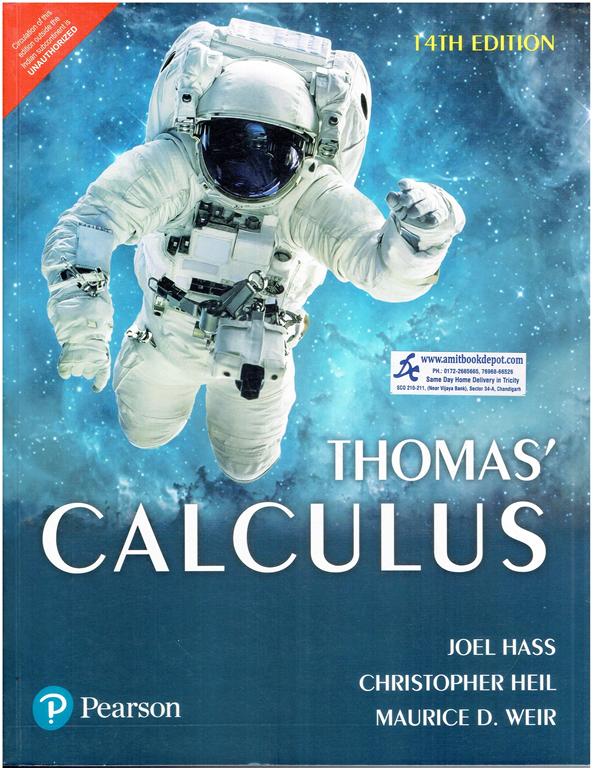
Thomas’ Calculus by Maurice D. Weir, Joel Hass, and Christopher Heil, published by Pearson Education, stands as the definitive text for mainstream calculus instruction. This renowned resource delivers a rigors yet accessible approach to calculus, integrating applied mathematics with theoretical foundations. The 15th edition continues the legacy of precision and clarity, making it an indispensable asset for STEM majors, engineering students, and mathematics educators seeking a comprehensive calculus book.
Key Features and Content Coverage
This volume provides a complete journey from foundational concepts to advanced multivariable calculus. The table of contents is systematically organised to build conceptual understanding:
- Foundations (Chapters 1-3): Begins with Functions, then Limits and Continuity, establishing the bedrock for Derivatives. These initial chapters focus on rate-of-change problems and tangent lines.
- Single-Variable Calculus (Chapters 4-6): Explores Applications of Derivatives (optimisation, concavity), followed by Integrals and Applications of Definite Integrals (area, volume, work).
- Advanced Techniques (Chapters 7-10): Covers Transcendental Functions (logarithms, exponentials, and inverse trig), Techniques of Integration (integration by parts and partial fractions), First-Order Differential Equations, and Infinite Sequences and Series (convergence tests, power series, and Taylor series).
- Multivariable Calculus (Chapters 11-16): Progresses to Parametric Equations and Polar Coordinates, Vectors and the Geometry of Space, Vector-Valued Functions and Motion in Space, Partial Derivatives, Multiple Integrals, culminating with Integrals and Vector Fields (line integrals, Green’s, Stokes’, Divergence theorems).
- Differential Equations (Chapter 17): Second-Order Differential equations for advanced modelling.
Supplementary Materials
The appendix includes a brief table of integrals, answers to odd-numbered exercises for self-assessment, a subject index, an applications index, and credits. This structure supports both classroom instruction and independent study.
Target Audience
- Undergraduate students in calculus I, II, and III sequences.
- Engineering and physical science majors requiring rigors problem-solving.
- Instructors seeking a trusted calculus book for syllabus design.
Why Choose This Edition?
Authored by Weir, Hass, and Heil, this edition modernises examples, enhances graphical visualisation, and reinforces step-by-step reasoning. The integration of real-world applications—from physics to economics—ensures relevance across disciplines.
Format Availability: Available in hardcover, loose-leaf, and ebook formats.







.jpg)