Categories
College Bookssss >
BA PU Chandigarh
BSC PU Chandigarh
MSC PU Chandigarh
BBA PU Chandigarh
MA PU Chandigarh
Medical Books
Engineering Books
Management Books
PGDCA Books
BCOM PU Chandigarh
MCOM PU Chandigarh
BCA PU Chandigarh
MCA PU Chandigarh
animate-books

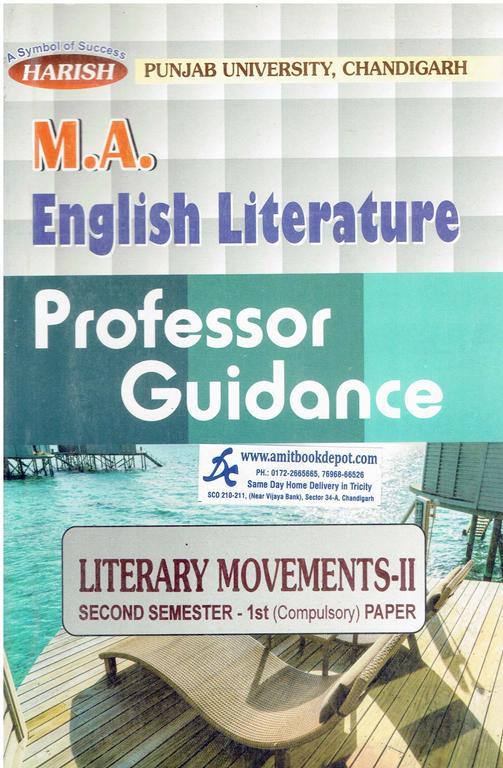
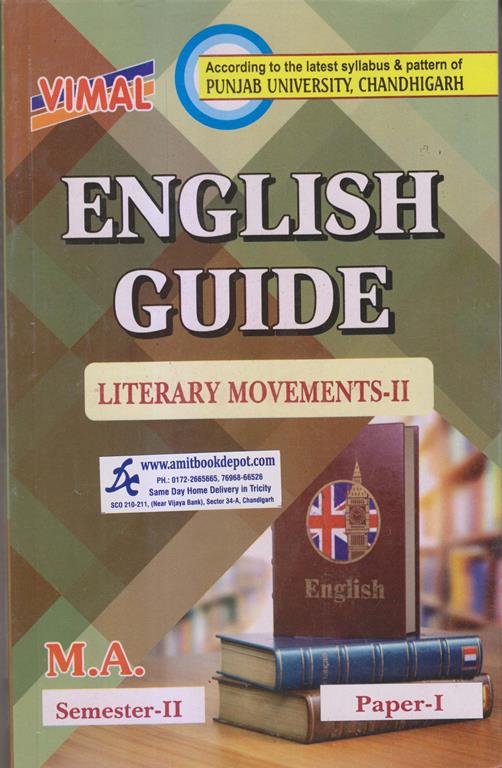
Harish M.A. English Literature Professor Guidance Literary Movements 2, 2nd Semester Compulsory Panjab University Chandigarh

by Madhurima
₹360 ₹360.00(-/ off)

Rating & Reviews

23 Customer Review

The Harish M.A. English Literary Movements 2 guide is the prescribed book for Panjab University's second-semester compulsory paper. Authored by Dr. Mohd Mazharl, it provides comprehensive coverage of realism, modernism, postmodernism, postcolonialism, and periodization debates. Designed for precise syllabus alignment, it combines key theoretical essays by critics like Ian Watt and Linda Hutcheon with primary texts from George Eliot and Borges. This all-in-one volume is an essential study and exam preparation resource for M.A. English students, ensuring focused learning and academic success. Published by Harish Prakashan Mandir.

Have Doubts Regarding This Product ? Ask Your Question

  • Q1
    Is this book the latest edition and fully aligned with the current Panjab University, Chandigarh, M.A. English Semester 2 syllabus?
    A1

    Yes, this is the updated edition specifically designed to match the prescribed syllabus for the compulsory Paper V: Literary Movements – II.

  • Q2
    Does the book include the full text of the primary readings, like Chapter 17 of Adam Bede and "The Library of Babel"?
    A2

    Yes, it includes the complete prescribed excerpts and primary texts as per the syllabus, so you do not need to source them separately.

  • Q3
    I am a distance learning student. Can this book serve as my primary study material for this paper?
    A3

    Absolutely. This guide is compiled as a comprehensive resource covering all prescribed units, making it ideal for distance education students who require self-contained study material.

  • Q4
    How does this book handle the complex Unit V on Periodization? Is it explained clearly?
    A4

    The book presents the challenging essays by Underwood and Hayot as per the syllabus. Its strength is in providing the essential text and framing the debate, though students may need to engage in further critical discussion for full mastery.

  • Q5
    Is the language used in the book student-friendly for those new to literary theory?
    A5

    While the included essays are academic in nature, the book's compilation and presentation are designed for students. It serves as a focused guide to navigate these complex texts efficiently.

  • Q6
    Can I use this book for competitive exams like UGC NET or SET that cover literary movements?
    A6

    Yes, the theoretical frameworks and concepts covered in this book (Realism, Modernism, Postmodernism, Postcolonialism) form a crucial part of the literature syllabus for various competitive exams, making it a valuable reference.

  • Q7
    Is the essay by Ezra Pound, "A Few Don'ts by an Imagiste," printed from the Poetry Foundation source as mentioned in the syllabus?
    A7

    The book includes the complete text of this prescribed manifesto, ensuring you have the correct and full material for study.

  • Q8
    Is Ngũgĩ wa Thiong’o's essay "The Language of African Literature" the complete chapter as per the syllabus?
    A8

    Yes, the book includes the prescribed portion of the essay (pages 3-33 from Decolonizing the Mind), as specified in the university syllabus.

  • Q9
    Is the publisher, Harish Prakashan Mandir, a recognized publisher for Panjab University books?
    A9

    Yes, Harish Prakashan Mandir is a well-known and trusted publisher specializing in academic texts for Panjab University and other institutions, particularly in the field of humanities.

  • Q10
    If the university syllabus undergoes a minor change, will this edition still be relevant?
    A10

    This edition is prepared for the current syllabus. It is always advisable to cross-check the latest syllabus document. However, the core concepts of these literary movements remain constant, so the majority of the content will remain fundamentally useful.

0.00

0 Overall Rating
  • 5
    0
  • 4
    0
  • 3
    0
  • 2
    0
  • 1
    0

Try this product & share your review & thoughts

LITERARY MOVEMENTS-II
Second Semester - Ist (Compulsory) Paper

Unit I: REALISM
Realism and the Realists

- REALISM AND THE NOVEL FORM: THE RISE OF THE NOVEL—Ian Watt
Introduction to Ian Watt
Summary of Realism and the Novel Form
1. Rise and the Form of the Novel
2. Types of Realism and Applicability
3. Realism in Defoe's Robinson Crusoe
4. Realism in 'Tom Jones'
5. Realism in Plot and Characterization
6. The Problem of Identity in the Novel
7. The Role of Time in the Novel
8. Various Prose Styles Used in the Novel
9. Formal Realism in the Novel

- CHAPTER 17 (ADAM BEDE)—George Eliot
Introduction to George Eliot
Summary of Chapter 17
1. Stress on Realistic Portrayal of Life
2. Realism in Painting
3. Eliot's views about two clergymen

Unit II: MODERNISM
- Modern Ages
1. Literary Tendencies of the Modern Age
2. Characteristics of Modern Literature

- Modernism
3. Meaning of Modernism
4. Brief History of Modernism
5. Modernism in English Fiction
6. Influence of Modernism in Criticism

- INTRODUCTION TO MODERNISM - Malcolm Bradbury
Introduction to Malcolm Bradbury
1. Modernism Definition and Trends
2. The Beginnings of Modernism in the Late Nineteenth Century
3. Modernism from the Early 20th Century to 1930
4. Futurism as a Part of the Modernist Movement
5. Modernism Continues: 1930-1945
6. Realism Movement in Literature

- A FEW DON'TS BY AN IMAGISTE -Ezra Pound
Introduction to Ezra Pound
A Summary of Pound's Imagist Manifesto
1. An Introduction to the Imagism Movement
2. Ezra Pound's Suggestions to the New Poets

Unit III: POST MODERNISM

1. Impact of Postmodernism
2. From Modernism to Postmodernism
3. Difference between Modernism and Postmodernism
4. Postmodernist Criticism
5. Postmodernism and Its Features
6. Culture and Postmodernism

- THEORIZING POSTMODERNISM: TOWARDS A POETICS—Linda Hutcheon
Introduction to Linda Hutcheon
Summary of Theorizing the Postmodernism:
Towards a Poetics
1. Postmodernism and Linda Hutcheon
2. Linda Hutcheon and Historiographic Metafiction
3. Postmodern Scene after 1970
4. Consequence of Postmodern Inquiry
5. Postmodern Contradictions
6. Foucault to Postmodern Contradiction
7. Requirement to make a thorough study of postmodernism
8. Complexity of Postmodernism

- TOWARDS THE CONCEPT OF POSTMODERNISM, THE POSTMODERNISM—Ihab Hassan
Introduction to Ihab Hassan

A Brief Introduction to Postmodern Theory
Summary of Towards a Concept of Post
Modernism
Origin and Development of Postmodernism

1. How is postmodernism related to modernism?
2. Ferdinunand Postmodernism
3. Relationship between Capitalism and Modernism
4. Modernity in the eyes of Eagleton
5. Postmodernism in the eyes of Eagleton
6. Neologism: Its Meaning

- THE LIBRARY OF BABEL—Borges, Jorge Luis

Introduction to Jorges: Luis Borges's Summary of the Library of Babel
1. The Story of the Library of Babel
2. Analysis of the Library of Babel

Unit IV: POSTCOLONIALISM
1. Definition and the Major Theme
2. Postcolonialism, Postcolonial Theory
3. Postcolonial Literary Theory
4. Postcolonial Criticism
5. Postcolonial Writers: Their role in nation building

- THE EMPIRE WRITES BACK -Bill Ashcroft, Gareth Griffiths, and Helen Tiffin
Introduction to the Author
Bill Ashcroft
Gareth Griffiths
Helen M. Tiffin
Cutting the Ground: Critical Models of
Postcolonial Literature-
Introduction
Detailed Summary of the Essay
1. National and Regional Models and Postcolonial Literature
2. Reflection of Postcolonial Literature
3. Analysis of the Concept of Black Writing
4. Features of Wilder Comparative Models
5. Purpose of the Book 'The Empire Writes Back'

- THE LANGUAGE OF AFRICAN LITERATURE -Ngugi Wa Thiong'o
Introduction to Ngugi Wa Thiong'o
About the language of African literature Summary of the Chapter "The Language of African Literature"
1. Dominance of English over African Languages
2. About the Author's Childhood and Education
3. The Dual Character of Language
4. Relation of Language and Culture
5. Harms of Foreign Language
6. Literary Scenario after 1962
7. The Language of African Literature and Colonialism
8. Contribution of African writers to their languages

Unit V: Debating 'Periodization' in History
Introduction to Periodization and Its Limitations
Literary Period: A Brief Overview

THE DISCIPLINARY RATIONALE FOR PERIODIZATION AND THE FORGOTTEN CHALLENGE TO IT (1886-1949): WHY LITERARY PERIODS MATTERED: HISTORICAL CONTRAST AND THE PRESTIGE OF ENGLISH STUDIES -Ted Underwood

Introduction to the Author
1. Periodization and Its History
2. Traits of Different Periods
3. Periodization in the 19th and the 20th centuries

AGAINST PERIODIZATION OR ON INSTITUTIONAL TIME—Eric Hayot
Introduction to Eric Hayot
1. Against Periodization, On Institutional Time
2. Limitations of Periodization

Latest Syllabus of M.A. English Literature Professor Guidance Literary Movements 2, 2nd Semester Compulsory Panjab University (PU) Chandigarh


Semester II

Compulsory Papers:
Paper V
Literary Movements – II

Many distinct literary movements mark the journey of writing from ancient times to the very contemporary. The paper identifies some of the major literary movements. that form the essential frame of reference for a critical engagement with the vast corpus of literature. Movements such as classicism, romanticism, or realism constitute the primer of critical vocabulary, and therefore a basic understanding of these movements is necessary for a nuanced understanding of varieties of literary articulation. Each movement has its own specific set of aesthetic, cultural, and ethical values and preferences. The writers and writings that fall within a movement, despite their heterogeneity and particularities, do converge in terms of fostering an identifiable literary taste and trend. Though these movements do occur in the literature of the world and across languages, the focus of this course is primarily on European literature, with special emphasis on the British. The course is divided into five units. Each unit consists of general introductory essays on the specific movement and some primary texts that belong to the movement. The emphasis of the paper is on the historical and conceptual understanding of various literary movements. The students are expected to study the prescribed texts closely. The students are also expected to study books and articles mentioned in the suggested readings to enhance their understanding of the primary texts, but there will be no question on the suggested readings. The paper shall consist of five compulsory questions—one each from a unit. Each question shall, however, have an internal choice. The paper shall carry a total of 80 marks.

Unit I: Realism

1. Ian Watt, “Realism and the Novel Form,” The Rise of the Novel, (University of California Press, 2001) 11-36.
2. George Eliot, Chapter 17, Adam Bede, Volume 3 (William Blackwood and Sons, 1859), 223-244.

Unit II: Modernism

1. Malcolm Bradbury and James McFarlane, “The Name and Nature of Modernism” from Modernism: A Guide to European Literature 1890-1930, ed. By Malcolm Bradbury and James McFarlane (Penguin, 1976), 19-35.
2. Ezra Pound, “A Few Don’ts by an Imagiste,” https://www.poetryfoundation.org/poetrymagazine/articles/58900/a-fewdonts-by-an-imagiste

Unit III: Postmodernism

1. Linda Hutcheon, “Theorizing the Postmodern: Toward a Poetics,” A Poetics of Postmodernism: History, Theory, Fiction (Routledge, London & New York, 1988) 3-21.
2. Ihab Hassan, “Toward a Concept of Postmodernism,” The Postmodern Turn (Ohio: Ohio State University Press, 1987) 1-10.
3. Borges, Jorge Luis. "The Library of Babel," Collected Fictions. Trans. Andrew Hurley (New York: Penguin, 1998) 112-118.

Unit IV: Postcolonialism

1. Bill Ashcroft, Gareth Griffiths, Helen Tiffin, eds. “Introduction” to The Empire Writes Back (Routledge: London & New York, 1991) 2002, 2nd ed., 1-13.
2. Ngugi wa Thiong’o, “The Language of African Literature,” Decolonizing the Mind: The Politics of Language in African Literature (Harare: Zimbabwe Publishing House, 1987) 1994 rpt. 3-33.

Unit V Debating ‘Periodization’ in History

1. Ted Underwood, “The Disciplinary Rationale for Periodization and a Forgotten Challenge to It (1886–1949),” Why Literary Periods Mattered: Historical Contrast and the Prestige of English Studies (Stanford & California: Stanford University Press, 2013) 114-135.
2. Eric Hayot, “Against Periodization; or, On Institutional Time,” New Literary History, Vol. 42, No. 4, (Autumn 2011), 739-754.

Harish M.A. English Literature Professor Guidance Literary Movements 2, 2nd Semester (Compulsory)—Panjab University, Chandigarh, by Dr. Mohd Mazharl, is the definitive and meticulously crafted academic resource prescribed for the Master of Arts in English second semester under Panjab University, Chandigarh. Published by Harish Prakashan Mandir, this guide is an indispensable companion for students navigating the complex terrain of modern and contemporary literary theory and criticism.

This comprehensive book is structured to provide a rigorous conceptual and historical understanding of the major literary movements that have shaped Western, particularly British, literature from the 19th century to the contemporary era. Aligned perfectly with the prescribed Panjab University syllabus, the book systematically covers all five compulsory units: realism, modernism, postmodernism, postcolonialism, and the critical debate on periodization. It serves as an essential study guide and exam preparation tool, offering clear explanations of dense theoretical material.

The book’s content is carefully curated to balance foundational critical essays with seminal primary texts. In Unit I: Realism, students engage with Ian Watt’s seminal exploration of the novel form and a key chapter from George Eliot’s Adam Bede, providing both theory and practice. Unit II: Modernism features the authoritative introduction by Malcolm Bradbury and James McFarlane, coupled with Ezra Pound’s revolutionary manifesto, "A Few Don’ts by an Imagiste," crucial for understanding modernist aesthetics.

For Unit III: Postmodernism, the guide presents Linda Hutcheon’s poetics and Ihab Hassan’s conceptual framework, alongside Jorge Luis Borges’ paradigmatic short story, "The Library of Babel," illustrating postmodern themes of paradox and infinite recursion. Unit IV: Postcolonialism includes the groundbreaking introduction from The Empire Writes Back and Ngũgĩ wa Thiong’o’s powerful essay on language and decolonization, offering vital perspectives on literature, power, and identity.

The final Unit V: Debating ‘Periodization’ challenges students to think critically about the very frameworks of literary history itself, featuring essays by Ted Underwood and Eric Hayot. This unit encourages advanced critical thinking about the construction of literary timelines and categories, moving beyond rote learning.

Designed specifically for Panjab University M.A. English students, this volume simplifies complex theoretical discourses, making them accessible for exam-oriented study. Each section is presented with the clarity needed for effective note-making and concept revision. As a prescribed book, it ensures students focus their efforts precisely on the material relevant to their compulsory paper (Paper V: Literary Movements – II). The inclusion of both critical and primary texts within one cover eliminates the need for multiple sources, making it a cost-effective and efficient reference book.

Authored by Dr. Mohd Mazharl and bearing the trusted imprint of Harish Prakashan Mandir, this book is synonymous with academic reliability and syllabus-specific accuracy. It is the most important semester 2 book for any M.A. English literature student at Panjab University aiming for a deep, nuanced understanding of literary movements and academic success.

LITERARY MOVEMENTS-II
Second Semester - Ist (Compulsory) Paper

Unit I: REALISM
Realism and the Realists

- REALISM AND THE NOVEL FORM: THE RISE OF THE NOVEL—Ian Watt
Introduction to Ian Watt
Summary of Realism and the Novel Form
1. Rise and the Form of the Novel
2. Types of Realism and Applicability
3. Realism in Defoe's Robinson Crusoe
4. Realism in 'Tom Jones'
5. Realism in Plot and Characterization
6. The Problem of Identity in the Novel
7. The Role of Time in the Novel
8. Various Prose Styles Used in the Novel
9. Formal Realism in the Novel

- CHAPTER 17 (ADAM BEDE)—George Eliot
Introduction to George Eliot
Summary of Chapter 17
1. Stress on Realistic Portrayal of Life
2. Realism in Painting
3. Eliot's views about two clergymen

Unit II: MODERNISM
- Modern Ages
1. Literary Tendencies of the Modern Age
2. Characteristics of Modern Literature

- Modernism
3. Meaning of Modernism
4. Brief History of Modernism
5. Modernism in English Fiction
6. Influence of Modernism in Criticism

- INTRODUCTION TO MODERNISM - Malcolm Bradbury
Introduction to Malcolm Bradbury
1. Modernism Definition and Trends
2. The Beginnings of Modernism in the Late Nineteenth Century
3. Modernism from the Early 20th Century to 1930
4. Futurism as a Part of the Modernist Movement
5. Modernism Continues: 1930-1945
6. Realism Movement in Literature

- A FEW DON'TS BY AN IMAGISTE -Ezra Pound
Introduction to Ezra Pound
A Summary of Pound's Imagist Manifesto
1. An Introduction to the Imagism Movement
2. Ezra Pound's Suggestions to the New Poets

Unit III: POST MODERNISM

1. Impact of Postmodernism
2. From Modernism to Postmodernism
3. Difference between Modernism and Postmodernism
4. Postmodernist Criticism
5. Postmodernism and Its Features
6. Culture and Postmodernism

- THEORIZING POSTMODERNISM: TOWARDS A POETICS—Linda Hutcheon
Introduction to Linda Hutcheon
Summary of Theorizing the Postmodernism:
Towards a Poetics
1. Postmodernism and Linda Hutcheon
2. Linda Hutcheon and Historiographic Metafiction
3. Postmodern Scene after 1970
4. Consequence of Postmodern Inquiry
5. Postmodern Contradictions
6. Foucault to Postmodern Contradiction
7. Requirement to make a thorough study of postmodernism
8. Complexity of Postmodernism

- TOWARDS THE CONCEPT OF POSTMODERNISM, THE POSTMODERNISM—Ihab Hassan
Introduction to Ihab Hassan

A Brief Introduction to Postmodern Theory
Summary of Towards a Concept of Post
Modernism
Origin and Development of Postmodernism

1. How is postmodernism related to modernism?
2. Ferdinunand Postmodernism
3. Relationship between Capitalism and Modernism
4. Modernity in the eyes of Eagleton
5. Postmodernism in the eyes of Eagleton
6. Neologism: Its Meaning

- THE LIBRARY OF BABEL—Borges, Jorge Luis

Introduction to Jorges: Luis Borges's Summary of the Library of Babel
1. The Story of the Library of Babel
2. Analysis of the Library of Babel

Unit IV: POSTCOLONIALISM
1. Definition and the Major Theme
2. Postcolonialism, Postcolonial Theory
3. Postcolonial Literary Theory
4. Postcolonial Criticism
5. Postcolonial Writers: Their role in nation building

- THE EMPIRE WRITES BACK -Bill Ashcroft, Gareth Griffiths, and Helen Tiffin
Introduction to the Author
Bill Ashcroft
Gareth Griffiths
Helen M. Tiffin
Cutting the Ground: Critical Models of
Postcolonial Literature-
Introduction
Detailed Summary of the Essay
1. National and Regional Models and Postcolonial Literature
2. Reflection of Postcolonial Literature
3. Analysis of the Concept of Black Writing
4. Features of Wilder Comparative Models
5. Purpose of the Book 'The Empire Writes Back'

- THE LANGUAGE OF AFRICAN LITERATURE -Ngugi Wa Thiong'o
Introduction to Ngugi Wa Thiong'o
About the language of African literature Summary of the Chapter "The Language of African Literature"
1. Dominance of English over African Languages
2. About the Author's Childhood and Education
3. The Dual Character of Language
4. Relation of Language and Culture
5. Harms of Foreign Language
6. Literary Scenario after 1962
7. The Language of African Literature and Colonialism
8. Contribution of African writers to their languages

Unit V: Debating 'Periodization' in History
Introduction to Periodization and Its Limitations
Literary Period: A Brief Overview

THE DISCIPLINARY RATIONALE FOR PERIODIZATION AND THE FORGOTTEN CHALLENGE TO IT (1886-1949): WHY LITERARY PERIODS MATTERED: HISTORICAL CONTRAST AND THE PRESTIGE OF ENGLISH STUDIES -Ted Underwood

Introduction to the Author
1. Periodization and Its History
2. Traits of Different Periods
3. Periodization in the 19th and the 20th centuries

AGAINST PERIODIZATION OR ON INSTITUTIONAL TIME—Eric Hayot
Introduction to Eric Hayot
1. Against Periodization, On Institutional Time
2. Limitations of Periodization

Have Doubts Regarding This Product ? Ask Your Question

  • Q1
    Is this book the latest edition and fully aligned with the current Panjab University, Chandigarh, M.A. English Semester 2 syllabus?
    A1

    Yes, this is the updated edition specifically designed to match the prescribed syllabus for the compulsory Paper V: Literary Movements – II.

  • Q2
    Does the book include the full text of the primary readings, like Chapter 17 of Adam Bede and "The Library of Babel"?
    A2

    Yes, it includes the complete prescribed excerpts and primary texts as per the syllabus, so you do not need to source them separately.

  • Q3
    I am a distance learning student. Can this book serve as my primary study material for this paper?
    A3

    Absolutely. This guide is compiled as a comprehensive resource covering all prescribed units, making it ideal for distance education students who require self-contained study material.

  • Q4
    How does this book handle the complex Unit V on Periodization? Is it explained clearly?
    A4

    The book presents the challenging essays by Underwood and Hayot as per the syllabus. Its strength is in providing the essential text and framing the debate, though students may need to engage in further critical discussion for full mastery.

  • Q5
    Is the language used in the book student-friendly for those new to literary theory?
    A5

    While the included essays are academic in nature, the book's compilation and presentation are designed for students. It serves as a focused guide to navigate these complex texts efficiently.

  • Q6
    Can I use this book for competitive exams like UGC NET or SET that cover literary movements?
    A6

    Yes, the theoretical frameworks and concepts covered in this book (Realism, Modernism, Postmodernism, Postcolonialism) form a crucial part of the literature syllabus for various competitive exams, making it a valuable reference.
  • Q7
    Is the essay by Ezra Pound, "A Few Don'ts by an Imagiste," printed from the Poetry Foundation source as mentioned in the syllabus?
    A7

    The book includes the complete text of this prescribed manifesto, ensuring you have the correct and full material for study.

  • Q8
    Is Ngũgĩ wa Thiong’o's essay "The Language of African Literature" the complete chapter as per the syllabus?
    A8

    Yes, the book includes the prescribed portion of the essay (pages 3-33 from Decolonizing the Mind), as specified in the university syllabus.

  • Q9
    Is the publisher, Harish Prakashan Mandir, a recognized publisher for Panjab University books?
    A9

    Yes, Harish Prakashan Mandir is a well-known and trusted publisher specializing in academic texts for Panjab University and other institutions, particularly in the field of humanities.

  • Q10
    If the university syllabus undergoes a minor change, will this edition still be relevant?
    A10

    This edition is prepared for the current syllabus. It is always advisable to cross-check the latest syllabus document. However, the core concepts of these literary movements remain constant, so the majority of the content will remain fundamentally useful.

Latest Syllabus of M.A. English Literature Professor Guidance Literary Movements 2, 2nd Semester Compulsory Panjab University (PU) Chandigarh


Semester II

Compulsory Papers:
Paper V
Literary Movements – II

Many distinct literary movements mark the journey of writing from ancient times to the very contemporary. The paper identifies some of the major literary movements. that form the essential frame of reference for a critical engagement with the vast corpus of literature. Movements such as classicism, romanticism, or realism constitute the primer of critical vocabulary, and therefore a basic understanding of these movements is necessary for a nuanced understanding of varieties of literary articulation. Each movement has its own specific set of aesthetic, cultural, and ethical values and preferences. The writers and writings that fall within a movement, despite their heterogeneity and particularities, do converge in terms of fostering an identifiable literary taste and trend. Though these movements do occur in the literature of the world and across languages, the focus of this course is primarily on European literature, with special emphasis on the British. The course is divided into five units. Each unit consists of general introductory essays on the specific movement and some primary texts that belong to the movement. The emphasis of the paper is on the historical and conceptual understanding of various literary movements. The students are expected to study the prescribed texts closely. The students are also expected to study books and articles mentioned in the suggested readings to enhance their understanding of the primary texts, but there will be no question on the suggested readings. The paper shall consist of five compulsory questions—one each from a unit. Each question shall, however, have an internal choice. The paper shall carry a total of 80 marks.

Unit I: Realism

1. Ian Watt, “Realism and the Novel Form,” The Rise of the Novel, (University of California Press, 2001) 11-36.
2. George Eliot, Chapter 17, Adam Bede, Volume 3 (William Blackwood and Sons, 1859), 223-244.

Unit II: Modernism

1. Malcolm Bradbury and James McFarlane, “The Name and Nature of Modernism” from Modernism: A Guide to European Literature 1890-1930, ed. By Malcolm Bradbury and James McFarlane (Penguin, 1976), 19-35.
2. Ezra Pound, “A Few Don’ts by an Imagiste,” https://www.poetryfoundation.org/poetrymagazine/articles/58900/a-fewdonts-by-an-imagiste

Unit III: Postmodernism

1. Linda Hutcheon, “Theorizing the Postmodern: Toward a Poetics,” A Poetics of Postmodernism: History, Theory, Fiction (Routledge, London & New York, 1988) 3-21.
2. Ihab Hassan, “Toward a Concept of Postmodernism,” The Postmodern Turn (Ohio: Ohio State University Press, 1987) 1-10.
3. Borges, Jorge Luis. "The Library of Babel," Collected Fictions. Trans. Andrew Hurley (New York: Penguin, 1998) 112-118.

Unit IV: Postcolonialism

1. Bill Ashcroft, Gareth Griffiths, Helen Tiffin, eds. “Introduction” to The Empire Writes Back (Routledge: London & New York, 1991) 2002, 2nd ed., 1-13.
2. Ngugi wa Thiong’o, “The Language of African Literature,” Decolonizing the Mind: The Politics of Language in African Literature (Harare: Zimbabwe Publishing House, 1987) 1994 rpt. 3-33.

Unit V Debating ‘Periodization’ in History

1. Ted Underwood, “The Disciplinary Rationale for Periodization and a Forgotten Challenge to It (1886–1949),” Why Literary Periods Mattered: Historical Contrast and the Prestige of English Studies (Stanford & California: Stanford University Press, 2013) 114-135.
2. Eric Hayot, “Against Periodization; or, On Institutional Time,” New Literary History, Vol. 42, No. 4, (Autumn 2011), 739-754.

0.00

0 Overall Rating
  • 5
    0
  • 4
    0
  • 3
    0
  • 2
    0
  • 1
    0

Try this product & share your review & thoughts

Top Trending Product

Related Product

Related Product

Related Blog Posts

Latest Blogs

Latest Blogs

blog-img
Classic Literature Reimagined: Discuss modern twists on classic novels.
Lorem ipsum dolor sit amet, consectetur adipiscing elit, sed do eiusmod tempor incididunt ut labore et dolore magna aliqua. Ut enim ad minim veniam, quis nostrud exercitation ullamco Lorem ipsum dolor sit amet, consectetur adipiscing elit, sed do eiusmod tempor incididunt ut labore et dolore magna aliqua. Utenim ad minim veniam, quis nostrud exercitation ullamco Lorem ipsum dolor sit amet, consecte...
Read more
Author name | 10 jan, 2025
blog-img
Classic Literature Reimagined: Discuss modern twists on classic novels.
Lorem ipsum dolor sit amet, consectetur adipiscing elit, sed do eiusmod tempor incididunt ut labore et dolore magna aliqua. Ut enim ad minim veniam, quis nostrud exercitation ullamco Lorem ipsum dolor sit amet, consectetur adipiscing elit, sed do eiusmod tempor incididunt ut labore et dolore magna aliqua. Utenim ad minim veniam, quis nostrud exercitation ullamco Lorem ipsum dolor sit amet, consecte...
Read more
Author name | 10 jan, 2025
blog-img
Classic Literature Reimagined: Discuss modern twists on classic novels.
Lorem ipsum dolor sit amet, consectetur adipiscing elit, sed do eiusmod tempor incididunt ut labore et dolore magna aliqua. Ut enim ad minim veniam, quis nostrud exercitation ullamco Lorem ipsum dolor sit amet, consectetur adipiscing elit, sed do eiusmod tempor incididunt ut labore et dolore magna aliqua. Utenim ad minim veniam, quis nostrud exercitation ullamco Lorem ipsum dolor sit amet, consecte...
Read more
Author name | 10 jan, 2025
blog-img
Classic Literature Reimagined: Discuss modern twists on classic novels.
Lorem ipsum dolor sit amet, consectetur adipiscing elit...
Read more
Author Name | 10 Jan, 2025
blog-img
Classic Literature Reimagined: Discuss modern twists on classic novels.
Lorem ipsum dolor sit amet, consectetur adipiscing elit...
Read more
Author Name | 10 Jan, 2025
blog-img
Classic Literature Reimagined: Discuss modern twists on classic novels.
Lorem ipsum dolor sit amet, consectetur adipiscing elit...
Read more
Author Name | 10 Jan, 2025
blog-img
Classic Literature Reimagined: Discuss modern twists on classic novels.
Lorem ipsum dolor sit amet, consectetur adipiscing elit...
Read more
Author Name | 10 Jan, 2025
blog-img
Classic Literature Reimagined: Discuss modern twists on classic novels.
Lorem ipsum dolor sit amet, consectetur adipiscing elit...
Read more
Author Name | 10 Jan, 2025
blog-img
Classic Literature Reimagined: Discuss modern twists on classic novels.
Lorem ipsum dolor sit amet, consectetur adipiscing elit...
Read more
Author Name | 10 Jan, 2025
blog-img
Classic Literature Reimagined: Discuss modern twists on classic novels.
Lorem ipsum dolor sit amet, consectetur adipiscing elit...
Read more
Author Name | 10 Jan, 2025
blog-img
Classic Literature Reimagined: Discuss modern twists on classic novels.
Lorem ipsum dolor sit amet, consectetur adipiscing elit...
Read more
Author Name | 10 Jan, 2025
blog-img
Classic Literature Reimagined: Discuss modern twists on classic novels.
Lorem ipsum dolor sit amet, consectetur adipiscing elit...
Read more
Author Name | 10 Jan, 2025