Categories
College Bookssss >
BA PU Chandigarh
BSC PU Chandigarh
MSC PU Chandigarh
BBA PU Chandigarh
MA PU Chandigarh
Medical Books
Engineering Books
Management Books
PGDCA Books
BCOM PU Chandigarh
MCOM PU Chandigarh
BCA PU Chandigarh
MCA PU Chandigarh
animate-books

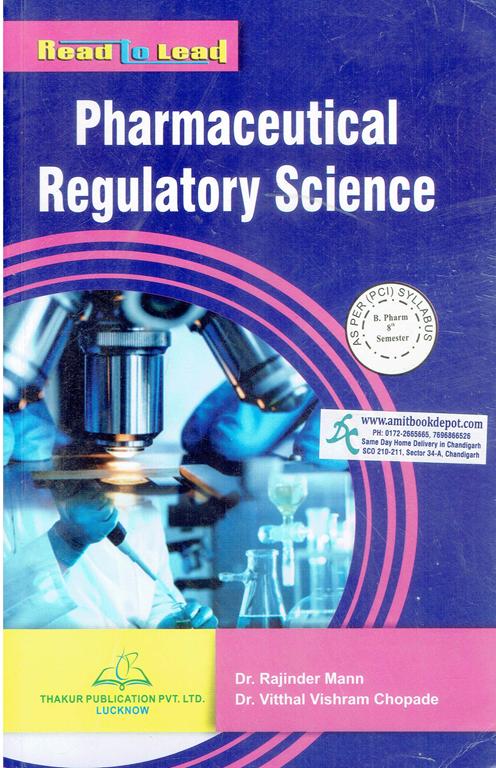
Thakur Pharmaceutical Regulatory Science For B Pharm 8th Semester PTU

by Madhurima
₹125 ₹125.00(-/ off)

Rating & Reviews

23 Customer Review

Thakur Pharmaceutical Regulatory Science is the prescribed book for PTU B Pharm 8th Semester (Subject Code: BP804 ET). Authored by Prof. Dr. V.V. Chopade and Dr. Rajinder Mann, this comprehensive guide covers the complete syllabus, including drug discovery, clinical trials, regulatory approval processes (IND, NDA, and ANDA), and global regulatory authorities like CDSCO and FDA. It details Drug Master Files (DMF), Common Technical Document (CTD), and the export of Indian pharmaceuticals. Essential for mastering pharmacovigilance, GCP, and key regulatory concepts, this book is an indispensable resource for exam success and a career in pharmaceutical regulation, quality assurance, and clinical research.

Have Doubts Regarding This Product ? Ask Your Question

  • Q1
    Is this book strictly aligned with the Punjab Technical University (PTU) B. Pharm Semester 8 syllabus?
    A1

    Yes, this textbook is meticulously crafted to cover 100% of the prescribed syllabus for the subject "Pharmaceutical Regulatory Science" (BP804 ET) for PTU's 8th Semester B. Pharm program.

  • Q2
    Does the book cover the regulatory authorities of countries beyond India and the USA?
    A2

    Absolutely. It provides detailed overviews of the regulatory agencies in the European Union (EMA), Australia (TGA), Japan (MHLW), and Canada (Health Canada), in addition to India's CDSCO and the US FDA.

  • Q3
    Are the Drug Master File (DMF) and Common Technical Document (CTD) formats explained in detail?
    A3

    Yes, Module 3 is dedicated to the registration of Indian drugs overseas and includes detailed sections on the content, preparation, and submission of DMFs, CTD, eCTD, and the ASEAN ACTD.

  • Q4
    Is the process for exporting pharmaceutical products from India explained?
    A4

    Yes, Chapter 6 explicitly covers the rules, procedures, and technical documentation required for the export of pharmaceutical products and medicines from India.

  • Q5
    Are clinical trial protocols and ethical committees covered?
    A5

    Yes, Module 4 covers the development of clinical trial protocols, the formation and workings of Institutional Review Boards/Ethics Committees, and the informed consent process in detail.

  • Q6
    What is included in the chapter on Pharmacovigilance?
    A6

    The Pharmacovigilance chapter focuses on safety monitoring in clinical trials, outlining the roles of various stakeholders (sponsor, investigator, IRB) and the monitoring processes across different trial phases.

  • Q7
    Is the drug discovery and development process covered from a regulatory perspective?
    A7

    Yes, Module 1 integrates the scientific stages of drug discovery and development with the corresponding regulatory milestones, such as the pre-clinical to IND transition and clinical development phases.

  • Q8
    Does it cover the different types of changes (major, moderate, minor) to an approved application?
    A8

    Yes, Chapter 4 includes a section (4.4) that details the classifications and regulatory reporting requirements for post-approval changes to an approved NDA or ANDA.

  • Q9
    Is Good Clinical Practice (GCP) explained in the context of investigator and sponsor obligations?
    A9

    Yes, Chapter 7 explicitly outlines the GCP obligations of principal investigators, sponsors, and monitors, as well as procedures for managing and monitoring clinical trials.

  • Q10
    Is this book useful only for PTU students, or can others use it?
    A10

    While tailored for PTU syllabus, the comprehensive coverage of global regulatory science makes it a valuable reference for B. Pharm students from other universities, as well as for professionals entering regulatory affairs, clinical research, and quality assurance roles.

0.00

0 Overall Rating
  • 5
    0
  • 4
    0
  • 3
    0
  • 2
    0
  • 1
    0

Try this product & share your review & thoughts

Module 1
Chapter 1: Stages of drug discovery

1.1. Drug Discovery
1.1.1. Introduction
1.1.2. History of Drug Discovery

1.2. Stages of Drug Discovery
1.2.1. Discovery
1.2.2. Product Characterization
1.2.3. Delivery. Formulation. Packaging Development
1.2.4. Pharmacokinetics and Drug Disposition
1.2.5. Preclinical Toxicology Testing and IND Application
1.2.6. Bioanalytical Testing
1.2.7. Clinical Trials
1.3. Summary
1.4. Exercise

Chapter 2: Drug Development Process

2.1. Drug Development Process
2.1.1. Introduction
2.1.2. Discovery and Development
2.1.2.1. Target Discovery
2.1.2.2. Target Validation
2.1.2.3. Lead Compound Identification
2.1.2.4. Lead Optimization
2.1.2.5. Active Pharmaceutical Ingredients (APIs)
2.1.3. Pre-Clinical Studies
2.1.3.1. Absorption, Distribution, Metabolism, and Excretion
2.1.3.2. Proof of Principle / Proof of Concept
2.1.3.3. In Vivo, In Vitro, and Ex Vivo Assays
2.1.3.4. In Silico Assays
2.1.3.5. Drug Delivery
2.1.3.6. Formulation Optimization and Improving Bioavailability
2.1.4. Clinical Studies/Development
2.1.4.1. Biological Samples Collection, Storage, and Shipment of Biological Samples
2.1.4.2. Patient Protection (GCP, HIPAA, and Adverse Event Reporting)
2.1.4.3. Pharmacodynamic (PD) Biomarkers 
2.1.4.4. Clinical Trials
2.1.3 FDA/Development (Non-22 Clinical Activities)
2.1.6. Post-Marketing Monitoring
2.2. Summary
2.3. Exercise

Chapter 3: Innovators and Generics

3.1. Innovator and Generic Drugs 
3.1.1. Introduction
3.1.5. Advantages of Generic Drugs
3.1.6. Disadvantages of Generic Drugs
3.1.8. Generic Drug Approval Process
3.1.7. Concept of Generics
3.1.9. Generic Drug Product Development
3.2. Summary
3.3. Exercise

Module 2
Chapter 4: Regulatory Approval Process

4.1. Investigational New Drug (IND)
4.1.1. Introduction
4.1.2. Classification
4.1.5. Content and Format 38
4.1.6. Approval Process
4.1.7. Timeline Involved

4.2. New Drug Application
4.2.1. Introduction
4.2.2. Objective
4.2.3. Classification
4.2.4. Requirements for Filling NDA
4.2.5. Guidance Documents for NDAs
4.2.6. NDA Forms
4.2.7. Content and Format
4.2.8. Approval Process for NDA Drug 

4.3. Abbreviated New Application (ANDA)
4.3.1. Introduction
4.3.2. Objective
4.3.3. Classification
4.3.4. Requirement for Filling ANDA
4.3.5. Content and Format
4.3.6. Approval of ANDA
4.3.7 Timeline for ANDA Approval

4.4. Changes to an Approved 49 NDA/ANDA
4.4.1. Introduction
4.4.2. Major Changes
4.4.3. Moderate Change
4.4.4. Minor Changes
4.4.5. Assessing the Effect of Manufacturing Changes
4.5. Summary
4.6. Exercise 

Chapter 5: Regulatory Authorities and Agencies

5.1. Regulatory Authorities and Agencies
5.1.1. Introduction
5.1.2. Regulatory Agencies in Different Countries: 56 in 56
5.1.3. Functions of Regulatory Authority 57

5.2. Drug Regulatory Agencies in India
5.2.1. Introduction
5.2.2. Organizational Structure of 58 Regulatory Bodies in India
5.2.3. Central Drug Standard and 58 Control Organisation (CDSCO)
5.2.3.1. Organizational Structure
5.2.3.2. Types of Applications
5.2.4. National Institute of Health and 59 Family Welfare (NIHFW)
5.2.4.1. Organizational Structure
5.2.4.2. Types of Applications
5.2.5. Drug Technical Advisory Board (DTAB) 60
5.2.5.1. Organizational Structure
5.2.5.2. Types of Applications
5.2.6. Central Drug Laboratory (CDTL)
5.2.6.1. Organizational Structure
5.2.6.2. Types of Applications

5.3. Drug Regulatory Agency in the USA—FDA
5.3.1. Organizational Structure
5.3.2. Responsibilities
5.3.3. Types of Applications

5.4. Drug Regulatory Agency in Australia—TGA
5.4.1. Organizational Structure
5.4.2. Responsibilities
5.4.3. Types of Applications
5.4.4. Drug Regulatory Agencies in 

5.5. European Union—EMA
5.5.1. Organizational Structure
5.5.2. Responsibilities
5.5.3. Types of Applications

5.6. Drug Regulatory Agency in Japan - MHLW
5.6.1. Organizational Structure
5.6.2. Responsibilities
5.6.3. Types of Applications

5.7. Drug Regulatory Agencies in Canada—Health Canada
5.7.1. Organizational Structure
5.7.2. Responsibilities
5.7.3. Types of Applications
5.8. Summary
5.9. Exercise

Module 3
Chapter 6: Registration of Indian Drug Products in Overseas Markets

6.1. Indian Pharmaceutical
6.1.1. Introduction
6.1.2. Government Initiatives to Promote the Pharmaceutical Sector
6.1.3. Rules Related to Export of Drugs from India
6.1.4. Procedure for Export of Pharmaceutical Products and Medicines from India

6.2. Technical Documentation
6.3. Drug Master Files (DMF)
6.3.1. Types
6.3.2. Content of Drug Master File Submissions
6.3.3. General Information and Suggestions to Prepare DMF  
6.3.4. Authorization to Refer a Drug Master File
6.3.5. Processing and Reviewing Policies
6.3.6. Holder Obligation
6.3.7. Closure of a Drug Master File

6.4. Common Document (CTD) Technical
6.4.1. Benefits of CTD
6.4.2. Organization of the Common Technical Document

6.5. Electronic Common Technical Document (eCTD)
6.5.1. Benefits of eCTD
6.5.2. Organization of e-CTD
6.5.3. e-CTD-Ready Document

6.6. ASEAN Common Technical Document (ACTD) Research
6.6.1. Parts of ACTD
6.6.2. Scope of the Document
6.7. Summary
6.8. Exercise Market

Module 4
Chapter 7: Clinical Trials

7.1. Clinical Trials
7.1.1. Introduction
7.1.2. Developing Clinical Trials Protocols

7.2. Institutional Review Board (IRB)/Independent Ethical Committees (IEC)
7.2.1. Objective of IRB/IEC
7.2.2. Formation of the IRB/IEC
7.2.3. Working Procedures
7.2.4. Responsibilities of IRB/IEC

7.3. Informed Consent Process and Procedures
7.3.1. Format of Consent Form
7.3.2. Verbal Consent Process
7.3.3. Written Consent Process
7.3.4. Explanation of the Research
7.3.5. Subject Comprehension Assessment 
7.3.6. Required Signatures
7.3.7. Subject Advocates
7.3.8. Reconsent and Significant New Findings
7.3.9. English-Speaking Subjects Unable to Read and Write

7.4. GCP Obligations
7.4.1. Introduction
7.4.2. Principal Investigator
7.4.3. Sponsors
7.4.4. Monitor
7.4.5. Managing and Monitoring Clinical Trials
7.4.6. Purpose
7.4.7. Types of Monitoring
7.4.8. Monitoring Plans
7.4.9. Monitoring Reports
7.5. Summary
7.6. Exercise

Chapter 8: Pharmacovigilance

8.1. Safety Monitoring in Clinical Trials
8.1.1. Introduction
8.1.2. Good Clinical Practice (GCP)
8.1.3. Stakeholders in Safety Monitoring
8.1.3.1. Sponsor
8.1.3.2. Subjects
8.1.3.3. Investigators
8.1.3.4. Institutional Review Board/Ethics Committee
8.1.3.5. Data and Safety Monitoring Board (DSMB)
8.1.3.6. Regulatory Authorities
8.1.3.7. Medical Community and Patients
8.1.4. Safety Monitoring in Different Phases of Clinical Trials
8.2. Summary
8.3. Exercise

Module 5
Chapter 9: Regulatory Concepts

9.1. Regulatory concepts
9.1.1. Introduction
9.1.2. Basic Terminologies
9.1.3. Laws and Acts
9.1.4. Regulations and Guidelines
9.1.5. Guidance

9.2. Orange Book
9.2.1. History
9.2.2. Objective
9.2.3. Content

9.3. Federal Register
9.3.1. Code of Federal Regulations (CFR)
9.3.2. Classification
9.3.3. Content
9.3.4. Structure of Organization
9.3.5. Searching the CFR
9.3.6. Search Examples
9.3.7. Sample Code of Federal Regulations URLs

9.4. Purple Book
9.4.1. Purpose
9.4.2. Content
9.4.3. Biologics Price Competition and Innovation Act of 2009 (BPCI Act)
9.4.4. Biosimilar Product
9.4.5. Interchangeable Biological Product
9.5. Summary
9.6. Exercise

Latest Syllabus of Pharmaceutical Regulatory Science For B Pharm 8th Semester PTU


BP804 ET: PHARMACEUTICAL REGULATORY SCIENCE (Theory) (45 Hours)

Scope: This course is designed to impart the fundamental knowledge on the regulatory requirements for approval of new drugs and drug products in regulated markets of India & other countries like the US, EU, Japan, Australia, the UK, etc. It prepares the students to learn in detail about the regulatory requirements, documentation requirements, and registration procedures for marketing the drug products.

Objectives: Upon completion of the subject, the student shall be able to
1. Know about the process of drug discovery and development.
2. Know the regulatory authorities and agencies governing the manufacture and sale of pharmaceuticals.
3. Know the regulatory approval process and their registration in Indian and international markets.

Course content:
Unit I (10 Hours)

New Drug Discovery and Development
Stages of drug discovery, Drug development process, preclinical studies, nonclinical activities, clinical studies, Innovators and generics, Concept of generics, Generic drug product development.

Unit II (10 Hours)

Regulatory Approval Process
Approval processes and timelines involved in Investigational New Drug (IND), New Drug Application (NDA), and Abbreviated New Drug Application (ANDA). Changes to an approved NDA / ANDA.

Regulatory authorities and agencies
Overview of regulatory authorities of India, the United States, the European Union, Australia, Japan, and Canada (organization structure and types of applications)

Unit III (10 Hours)

Registration of Indian drug products in overseas markets
Procedure for export of pharmaceutical products, technical documentation, Drug Master Files (DMF), Common Technical Document (CTD), electronic Common Technical Document (eCTD), ASEAN Common Technical Document (ACTD) research.

Unit IV: (08 Hours)

Clinical trials
Developing clinical trial protocols, Institutional Review Board / Independent Ethics Committee - formation and working procedures, Informed consent process and
procedures, GCP obligations of investigators, sponsors & monitors, Managing and monitoring clinical trials, pharmacovigilance—safety monitoring in clinical trials

Unit V (07 Hours)

Regulatory Concepts
Basic terminology, guidance, guidelines, regulations, Laws and Acts, Orange Book, Federal Register, Code of Federal Regulations, Purple book

Thakur Pharmaceutical Regulatory Science for B Pharm 8th Semester PTU is a definitive and syllabus-specific book meticulously crafted for Bachelor of Pharmacy students under the Punjab Technical University (PTU) curriculum. Authored by the esteemed Prof. Dr. Vitthal Vishram Chopade and Dr. Rajinder Mann and published by Thakur Publications, this book serves as an exhaustive guide to the complex and critical world of drug regulations. It is an indispensable resource designed to bridge theoretical knowledge with the practical, procedural, and legal frameworks governing the global pharmaceutical industry.

Aligned precisely with the prescribed PTU B Pharm Semester 8 syllabus for the subject BP804 ET: Pharmaceutical Regulatory Science, this text ensures complete coverage of all mandated units and topics. The book begins by laying a solid foundation in the drug discovery and development process, detailing stages from initial target identification and preclinical studies through to clinical trials. It elaborates on the crucial distinction between innovator drugs and generic drugs, outlining the generic drug approval process and product development strategies, which is vital for understanding the modern pharmaceutical landscape.

A core section of the book provides an in-depth exploration of the regulatory approval process in key global markets. Students gain comprehensive knowledge of critical regulatory submissions, including the Investigational New Drug (IND) Application, New Drug Application (NDA), and Abbreviated New Drug Application (ANDA). The text clarifies the approval timelines, content requirements, and procedures for post-approval changes. Furthermore, it offers a detailed overview of major regulatory authorities and agencies, including India’s Central Drugs Standard Control Organisation (CDSCO), the US Food and Drug Administration (FDA), the European Union’s European Medicines Agency (EMA), Australia’s Therapeutic Goods Administration (TGA), Japan’s Ministry of Health, Labour and Welfare (MHLW), and Health Canada. This global perspective is essential for aspiring professionals.

The book dedicates significant attention to the registration of Indian drug products in overseas markets, a key area for India's export-oriented pharmaceutical sector. It explains the export procedures, technical documentation, and the preparation of critical dossiers like the Drug Master File (DMF), Common Technical Document (CTD), Electronic Common Technical Document (eCTD), and the ASEAN Common Technical Document (ACTD). This practical knowledge is crucial for careers in regulatory affairs and pharmaceutical exports.

Unit IV delves deeply into the ethical and practical aspects of clinical trials, covering protocol development, the role and workings of Institutional Review Boards (IRB)/Independent Ethics Committees (IEC), the Informed Consent Process, and Good Clinical Practice (GCP) obligations for investigators, sponsors, and monitors. The chapter on pharmacovigilance emphasizes ongoing safety monitoring, a cornerstone of patient protection.

The final unit consolidates understanding of essential regulatory concepts, explaining fundamental terminologies, laws, acts, guidelines, and key references like the Orange Book (for drug products), the Federal Register and Code of Federal Regulations (CFR), and the Purple Book (for biological products).

Structured with clear modules and chapters that mirror the syllabus, each chapter includes a concise summary and end-of-chapter exercises to reinforce learning and aid in exam preparation. This book is not merely an academic requirement; it is a foundational pillar for B. Pharm students aiming to build careers in regulatory affairs, quality assurance, clinical research, pharmacovigilance, and pharmaceutical manufacturing. With its authoritative content, clear explanations, and practical orientation, Thakur Pharmaceutical Regulatory Science is the ultimate preparatory guide for PTU semester examinations and a valuable reference for entering the professional realm of pharmaceutical regulation.

Module 1
Chapter 1: Stages of drug discovery

1.1. Drug Discovery
1.1.1. Introduction
1.1.2. History of Drug Discovery

1.2. Stages of Drug Discovery
1.2.1. Discovery
1.2.2. Product Characterization
1.2.3. Delivery. Formulation. Packaging Development
1.2.4. Pharmacokinetics and Drug Disposition
1.2.5. Preclinical Toxicology Testing and IND Application
1.2.6. Bioanalytical Testing
1.2.7. Clinical Trials
1.3. Summary
1.4. Exercise

Chapter 2: Drug Development Process

2.1. Drug Development Process
2.1.1. Introduction
2.1.2. Discovery and Development
2.1.2.1. Target Discovery
2.1.2.2. Target Validation
2.1.2.3. Lead Compound Identification
2.1.2.4. Lead Optimization
2.1.2.5. Active Pharmaceutical Ingredients (APIs)
2.1.3. Pre-Clinical Studies
2.1.3.1. Absorption, Distribution, Metabolism, and Excretion
2.1.3.2. Proof of Principle / Proof of Concept
2.1.3.3. In Vivo, In Vitro, and Ex Vivo Assays
2.1.3.4. In Silico Assays
2.1.3.5. Drug Delivery
2.1.3.6. Formulation Optimization and Improving Bioavailability
2.1.4. Clinical Studies/Development
2.1.4.1. Biological Samples Collection, Storage, and Shipment of Biological Samples
2.1.4.2. Patient Protection (GCP, HIPAA, and Adverse Event Reporting)
2.1.4.3. Pharmacodynamic (PD) Biomarkers 
2.1.4.4. Clinical Trials
2.1.3 FDA/Development (Non-22 Clinical Activities)
2.1.6. Post-Marketing Monitoring
2.2. Summary
2.3. Exercise

Chapter 3: Innovators and Generics

3.1. Innovator and Generic Drugs 
3.1.1. Introduction
3.1.5. Advantages of Generic Drugs
3.1.6. Disadvantages of Generic Drugs
3.1.8. Generic Drug Approval Process
3.1.7. Concept of Generics
3.1.9. Generic Drug Product Development
3.2. Summary
3.3. Exercise

Module 2
Chapter 4: Regulatory Approval Process

4.1. Investigational New Drug (IND)
4.1.1. Introduction
4.1.2. Classification
4.1.5. Content and Format 38
4.1.6. Approval Process
4.1.7. Timeline Involved

4.2. New Drug Application
4.2.1. Introduction
4.2.2. Objective
4.2.3. Classification
4.2.4. Requirements for Filling NDA
4.2.5. Guidance Documents for NDAs
4.2.6. NDA Forms
4.2.7. Content and Format
4.2.8. Approval Process for NDA Drug 

4.3. Abbreviated New Application (ANDA)
4.3.1. Introduction
4.3.2. Objective
4.3.3. Classification
4.3.4. Requirement for Filling ANDA
4.3.5. Content and Format
4.3.6. Approval of ANDA
4.3.7 Timeline for ANDA Approval

4.4. Changes to an Approved 49 NDA/ANDA
4.4.1. Introduction
4.4.2. Major Changes
4.4.3. Moderate Change
4.4.4. Minor Changes
4.4.5. Assessing the Effect of Manufacturing Changes
4.5. Summary
4.6. Exercise 

Chapter 5: Regulatory Authorities and Agencies

5.1. Regulatory Authorities and Agencies
5.1.1. Introduction
5.1.2. Regulatory Agencies in Different Countries: 56 in 56
5.1.3. Functions of Regulatory Authority 57

5.2. Drug Regulatory Agencies in India
5.2.1. Introduction
5.2.2. Organizational Structure of 58 Regulatory Bodies in India
5.2.3. Central Drug Standard and 58 Control Organisation (CDSCO)
5.2.3.1. Organizational Structure
5.2.3.2. Types of Applications
5.2.4. National Institute of Health and 59 Family Welfare (NIHFW)
5.2.4.1. Organizational Structure
5.2.4.2. Types of Applications
5.2.5. Drug Technical Advisory Board (DTAB) 60
5.2.5.1. Organizational Structure
5.2.5.2. Types of Applications
5.2.6. Central Drug Laboratory (CDTL)
5.2.6.1. Organizational Structure
5.2.6.2. Types of Applications

5.3. Drug Regulatory Agency in the USA—FDA
5.3.1. Organizational Structure
5.3.2. Responsibilities
5.3.3. Types of Applications

5.4. Drug Regulatory Agency in Australia—TGA
5.4.1. Organizational Structure
5.4.2. Responsibilities
5.4.3. Types of Applications
5.4.4. Drug Regulatory Agencies in 

5.5. European Union—EMA
5.5.1. Organizational Structure
5.5.2. Responsibilities
5.5.3. Types of Applications

5.6. Drug Regulatory Agency in Japan - MHLW
5.6.1. Organizational Structure
5.6.2. Responsibilities
5.6.3. Types of Applications

5.7. Drug Regulatory Agencies in Canada—Health Canada
5.7.1. Organizational Structure
5.7.2. Responsibilities
5.7.3. Types of Applications
5.8. Summary
5.9. Exercise

Module 3
Chapter 6: Registration of Indian Drug Products in Overseas Markets

6.1. Indian Pharmaceutical
6.1.1. Introduction
6.1.2. Government Initiatives to Promote the Pharmaceutical Sector
6.1.3. Rules Related to Export of Drugs from India
6.1.4. Procedure for Export of Pharmaceutical Products and Medicines from India

6.2. Technical Documentation
6.3. Drug Master Files (DMF)
6.3.1. Types
6.3.2. Content of Drug Master File Submissions
6.3.3. General Information and Suggestions to Prepare DMF  
6.3.4. Authorization to Refer a Drug Master File
6.3.5. Processing and Reviewing Policies
6.3.6. Holder Obligation
6.3.7. Closure of a Drug Master File

6.4. Common Document (CTD) Technical
6.4.1. Benefits of CTD
6.4.2. Organization of the Common Technical Document

6.5. Electronic Common Technical Document (eCTD)
6.5.1. Benefits of eCTD
6.5.2. Organization of e-CTD
6.5.3. e-CTD-Ready Document

6.6. ASEAN Common Technical Document (ACTD) Research
6.6.1. Parts of ACTD
6.6.2. Scope of the Document
6.7. Summary
6.8. Exercise Market

Module 4
Chapter 7: Clinical Trials

7.1. Clinical Trials
7.1.1. Introduction
7.1.2. Developing Clinical Trials Protocols

7.2. Institutional Review Board (IRB)/Independent Ethical Committees (IEC)
7.2.1. Objective of IRB/IEC
7.2.2. Formation of the IRB/IEC
7.2.3. Working Procedures
7.2.4. Responsibilities of IRB/IEC

7.3. Informed Consent Process and Procedures
7.3.1. Format of Consent Form
7.3.2. Verbal Consent Process
7.3.3. Written Consent Process
7.3.4. Explanation of the Research
7.3.5. Subject Comprehension Assessment 
7.3.6. Required Signatures
7.3.7. Subject Advocates
7.3.8. Reconsent and Significant New Findings
7.3.9. English-Speaking Subjects Unable to Read and Write

7.4. GCP Obligations
7.4.1. Introduction
7.4.2. Principal Investigator
7.4.3. Sponsors
7.4.4. Monitor
7.4.5. Managing and Monitoring Clinical Trials
7.4.6. Purpose
7.4.7. Types of Monitoring
7.4.8. Monitoring Plans
7.4.9. Monitoring Reports
7.5. Summary
7.6. Exercise

Chapter 8: Pharmacovigilance

8.1. Safety Monitoring in Clinical Trials
8.1.1. Introduction
8.1.2. Good Clinical Practice (GCP)
8.1.3. Stakeholders in Safety Monitoring
8.1.3.1. Sponsor
8.1.3.2. Subjects
8.1.3.3. Investigators
8.1.3.4. Institutional Review Board/Ethics Committee
8.1.3.5. Data and Safety Monitoring Board (DSMB)
8.1.3.6. Regulatory Authorities
8.1.3.7. Medical Community and Patients
8.1.4. Safety Monitoring in Different Phases of Clinical Trials
8.2. Summary
8.3. Exercise

Module 5
Chapter 9: Regulatory Concepts

9.1. Regulatory concepts
9.1.1. Introduction
9.1.2. Basic Terminologies
9.1.3. Laws and Acts
9.1.4. Regulations and Guidelines
9.1.5. Guidance

9.2. Orange Book
9.2.1. History
9.2.2. Objective
9.2.3. Content

9.3. Federal Register
9.3.1. Code of Federal Regulations (CFR)
9.3.2. Classification
9.3.3. Content
9.3.4. Structure of Organization
9.3.5. Searching the CFR
9.3.6. Search Examples
9.3.7. Sample Code of Federal Regulations URLs

9.4. Purple Book
9.4.1. Purpose
9.4.2. Content
9.4.3. Biologics Price Competition and Innovation Act of 2009 (BPCI Act)
9.4.4. Biosimilar Product
9.4.5. Interchangeable Biological Product
9.5. Summary
9.6. Exercise

Have Doubts Regarding This Product ? Ask Your Question

  • Q1
    Is this book strictly aligned with the Punjab Technical University (PTU) B. Pharm Semester 8 syllabus?
    A1

    Yes, this textbook is meticulously crafted to cover 100% of the prescribed syllabus for the subject "Pharmaceutical Regulatory Science" (BP804 ET) for PTU's 8th Semester B. Pharm program.

  • Q2
    Does the book cover the regulatory authorities of countries beyond India and the USA?
    A2

    Absolutely. It provides detailed overviews of the regulatory agencies in the European Union (EMA), Australia (TGA), Japan (MHLW), and Canada (Health Canada), in addition to India's CDSCO and the US FDA.

  • Q3
    Are the Drug Master File (DMF) and Common Technical Document (CTD) formats explained in detail?
    A3

    Yes, Module 3 is dedicated to the registration of Indian drugs overseas and includes detailed sections on the content, preparation, and submission of DMFs, CTD, eCTD, and the ASEAN ACTD.

  • Q4
    Is the process for exporting pharmaceutical products from India explained?
    A4

    Yes, Chapter 6 explicitly covers the rules, procedures, and technical documentation required for the export of pharmaceutical products and medicines from India.

  • Q5
    Are clinical trial protocols and ethical committees covered?
    A5

    Yes, Module 4 covers the development of clinical trial protocols, the formation and workings of Institutional Review Boards/Ethics Committees, and the informed consent process in detail.

  • Q6
    What is included in the chapter on Pharmacovigilance?
    A6

    The Pharmacovigilance chapter focuses on safety monitoring in clinical trials, outlining the roles of various stakeholders (sponsor, investigator, IRB) and the monitoring processes across different trial phases.

  • Q7
    Is the drug discovery and development process covered from a regulatory perspective?
    A7

    Yes, Module 1 integrates the scientific stages of drug discovery and development with the corresponding regulatory milestones, such as the pre-clinical to IND transition and clinical development phases.

  • Q8
    Does it cover the different types of changes (major, moderate, minor) to an approved application?
    A8

    Yes, Chapter 4 includes a section (4.4) that details the classifications and regulatory reporting requirements for post-approval changes to an approved NDA or ANDA.

  • Q9
    Is Good Clinical Practice (GCP) explained in the context of investigator and sponsor obligations?
    A9

    Yes, Chapter 7 explicitly outlines the GCP obligations of principal investigators, sponsors, and monitors, as well as procedures for managing and monitoring clinical trials.

  • Q10
    Is this book useful only for PTU students, or can others use it?
    A10

    While tailored for PTU syllabus, the comprehensive coverage of global regulatory science makes it a valuable reference for B. Pharm students from other universities, as well as for professionals entering regulatory affairs, clinical research, and quality assurance roles.

Latest Syllabus of Pharmaceutical Regulatory Science For B Pharm 8th Semester PTU


BP804 ET: PHARMACEUTICAL REGULATORY SCIENCE (Theory) (45 Hours)

Scope: This course is designed to impart the fundamental knowledge on the regulatory requirements for approval of new drugs and drug products in regulated markets of India & other countries like the US, EU, Japan, Australia, the UK, etc. It prepares the students to learn in detail about the regulatory requirements, documentation requirements, and registration procedures for marketing the drug products.

Objectives: Upon completion of the subject, the student shall be able to
1. Know about the process of drug discovery and development.
2. Know the regulatory authorities and agencies governing the manufacture and sale of pharmaceuticals.
3. Know the regulatory approval process and their registration in Indian and international markets.

Course content:
Unit I (10 Hours)

New Drug Discovery and Development
Stages of drug discovery, Drug development process, preclinical studies, nonclinical activities, clinical studies, Innovators and generics, Concept of generics, Generic drug product development.

Unit II (10 Hours)

Regulatory Approval Process
Approval processes and timelines involved in Investigational New Drug (IND), New Drug Application (NDA), and Abbreviated New Drug Application (ANDA). Changes to an approved NDA / ANDA.

Regulatory authorities and agencies
Overview of regulatory authorities of India, the United States, the European Union, Australia, Japan, and Canada (organization structure and types of applications)

Unit III (10 Hours)

Registration of Indian drug products in overseas markets
Procedure for export of pharmaceutical products, technical documentation, Drug Master Files (DMF), Common Technical Document (CTD), electronic Common Technical Document (eCTD), ASEAN Common Technical Document (ACTD) research.

Unit IV: (08 Hours)

Clinical trials
Developing clinical trial protocols, Institutional Review Board / Independent Ethics Committee - formation and working procedures, Informed consent process and
procedures, GCP obligations of investigators, sponsors & monitors, Managing and monitoring clinical trials, pharmacovigilance—safety monitoring in clinical trials

Unit V (07 Hours)

Regulatory Concepts
Basic terminology, guidance, guidelines, regulations, Laws and Acts, Orange Book, Federal Register, Code of Federal Regulations, Purple book

0.00

0 Overall Rating
  • 5
    0
  • 4
    0
  • 3
    0
  • 2
    0
  • 1
    0

Try this product & share your review & thoughts

Top Trending Product

Related Product

Related Product

Related Blog Posts

Latest Blogs

Latest Blogs

blog-img
Classic Literature Reimagined: Discuss modern twists on classic novels.
Lorem ipsum dolor sit amet, consectetur adipiscing elit, sed do eiusmod tempor incididunt ut labore et dolore magna aliqua. Ut enim ad minim veniam, quis nostrud exercitation ullamco Lorem ipsum dolor sit amet, consectetur adipiscing elit, sed do eiusmod tempor incididunt ut labore et dolore magna aliqua. Utenim ad minim veniam, quis nostrud exercitation ullamco Lorem ipsum dolor sit amet, consecte...
Read more
Author name | 10 jan, 2025
blog-img
Classic Literature Reimagined: Discuss modern twists on classic novels.
Lorem ipsum dolor sit amet, consectetur adipiscing elit, sed do eiusmod tempor incididunt ut labore et dolore magna aliqua. Ut enim ad minim veniam, quis nostrud exercitation ullamco Lorem ipsum dolor sit amet, consectetur adipiscing elit, sed do eiusmod tempor incididunt ut labore et dolore magna aliqua. Utenim ad minim veniam, quis nostrud exercitation ullamco Lorem ipsum dolor sit amet, consecte...
Read more
Author name | 10 jan, 2025
blog-img
Classic Literature Reimagined: Discuss modern twists on classic novels.
Lorem ipsum dolor sit amet, consectetur adipiscing elit, sed do eiusmod tempor incididunt ut labore et dolore magna aliqua. Ut enim ad minim veniam, quis nostrud exercitation ullamco Lorem ipsum dolor sit amet, consectetur adipiscing elit, sed do eiusmod tempor incididunt ut labore et dolore magna aliqua. Utenim ad minim veniam, quis nostrud exercitation ullamco Lorem ipsum dolor sit amet, consecte...
Read more
Author name | 10 jan, 2025
blog-img
Classic Literature Reimagined: Discuss modern twists on classic novels.
Lorem ipsum dolor sit amet, consectetur adipiscing elit...
Read more
Author Name | 10 Jan, 2025
blog-img
Classic Literature Reimagined: Discuss modern twists on classic novels.
Lorem ipsum dolor sit amet, consectetur adipiscing elit...
Read more
Author Name | 10 Jan, 2025
blog-img
Classic Literature Reimagined: Discuss modern twists on classic novels.
Lorem ipsum dolor sit amet, consectetur adipiscing elit...
Read more
Author Name | 10 Jan, 2025
blog-img
Classic Literature Reimagined: Discuss modern twists on classic novels.
Lorem ipsum dolor sit amet, consectetur adipiscing elit...
Read more
Author Name | 10 Jan, 2025
blog-img
Classic Literature Reimagined: Discuss modern twists on classic novels.
Lorem ipsum dolor sit amet, consectetur adipiscing elit...
Read more
Author Name | 10 Jan, 2025
blog-img
Classic Literature Reimagined: Discuss modern twists on classic novels.
Lorem ipsum dolor sit amet, consectetur adipiscing elit...
Read more
Author Name | 10 Jan, 2025
blog-img
Classic Literature Reimagined: Discuss modern twists on classic novels.
Lorem ipsum dolor sit amet, consectetur adipiscing elit...
Read more
Author Name | 10 Jan, 2025
blog-img
Classic Literature Reimagined: Discuss modern twists on classic novels.
Lorem ipsum dolor sit amet, consectetur adipiscing elit...
Read more
Author Name | 10 Jan, 2025
blog-img
Classic Literature Reimagined: Discuss modern twists on classic novels.
Lorem ipsum dolor sit amet, consectetur adipiscing elit...
Read more
Author Name | 10 Jan, 2025