-
Mon-Fri: 10AM to 8PM 01722665665
-
My Account
-
-
0
Total :
₹ 0.00

 ISBN NOT GIVEN.jpg)
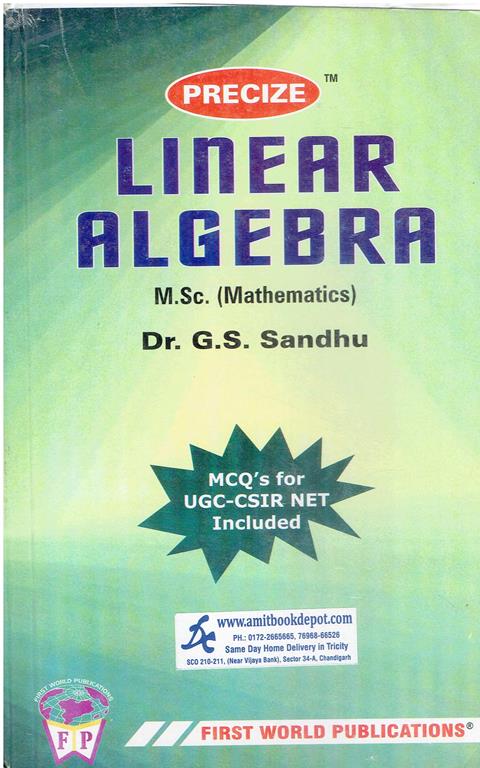
Yes, this book is written and updated to be fully compliant with the most recent Panjab University syllabus for the compulsory course MATH-637S: Linear Algebra.
Absolutely. The table of contents is structured to map directly onto the university's units, with dedicated chapters for all topics in both Unit I and Unit II.
The content is organized to match the exam pattern, helping you prepare for both the compulsory short-answer questions and the longer, unit-specific theoretical questions effectively.
The dedicated "MCQs for UGC NET" section provides a strong foundation and practice specifically for the Linear Algebra portion of the exam. For a more extensive practice, you may still refer to specialized UGC NET guides, but this book serves as an excellent primary theory resource.
Yes, the book breaks down the complex topic of Jordan Canonical Form into understandable steps, explaining its significance and the process of finding it for a given linear transformation or matrix.
Yes, Chapter 5, "Inner Product Spaces," provides a comprehensive treatment of the topic, including a detailed, step-by-step explanation of the Gram-Schmidt orthonormalization process.
The book begins with a "Preliminaries" chapter designed to refresh and establish the foundational knowledge required, making it largely self-contained for a diligent student.
The book is written in clear, academic English with a focus on conceptual clarity. The precise and straightforward language makes it accessible to all students familiar with technical mathematical texts.
Yes, the chapter on "Canonical Forms" covers both Rational and Jordan Canonical Forms, explaining their respective constructions, applications, and differences.
While it is specifically tailored for Panjab University, the core topics of advanced linear algebra are universal. Students from other universities can use it as a strong theoretical reference if their syllabus overlaps significantly.
No Description Added
Yes, this book is written and updated to be fully compliant with the most recent Panjab University syllabus for the compulsory course MATH-637S: Linear Algebra.
Absolutely. The table of contents is structured to map directly onto the university's units, with dedicated chapters for all topics in both Unit I and Unit II.
The content is organized to match the exam pattern, helping you prepare for both the compulsory short-answer questions and the longer, unit-specific theoretical questions effectively.
The dedicated "MCQs for UGC NET" section provides a strong foundation and practice specifically for the Linear Algebra portion of the exam. For a more extensive practice, you may still refer to specialized UGC NET guides, but this book serves as an excellent primary theory resource.
Yes, the book breaks down the complex topic of Jordan Canonical Form into understandable steps, explaining its significance and the process of finding it for a given linear transformation or matrix.
Yes, Chapter 5, "Inner Product Spaces," provides a comprehensive treatment of the topic, including a detailed, step-by-step explanation of the Gram-Schmidt orthonormalization process.
The book begins with a "Preliminaries" chapter designed to refresh and establish the foundational knowledge required, making it largely self-contained for a diligent student.
The book is written in clear, academic English with a focus on conceptual clarity. The precise and straightforward language makes it accessible to all students familiar with technical mathematical texts.
Yes, the chapter on "Canonical Forms" covers both Rational and Jordan Canonical Forms, explaining their respective constructions, applications, and differences.
While it is specifically tailored for Panjab University, the core topics of advanced linear algebra are universal. Students from other universities can use it as a strong theoretical reference if their syllabus overlaps significantly.