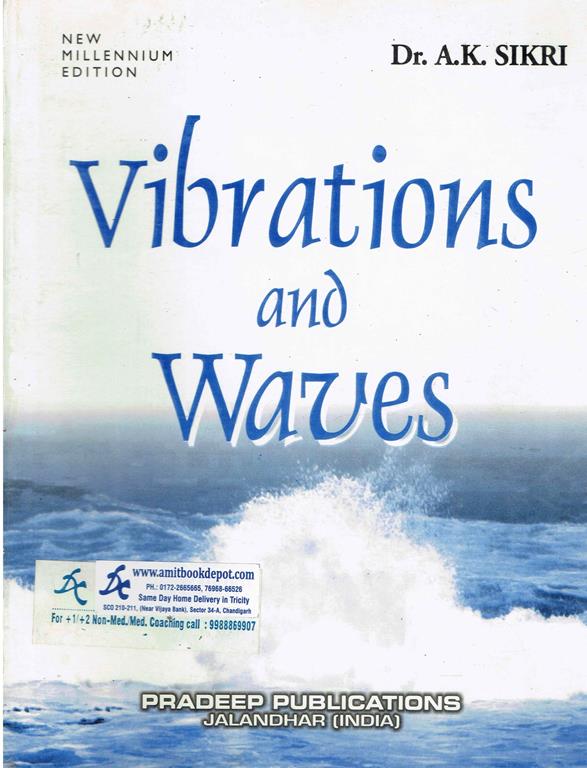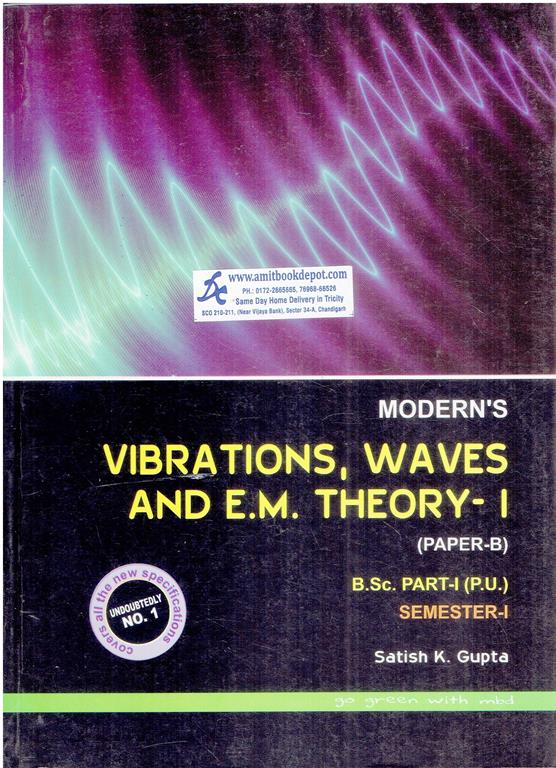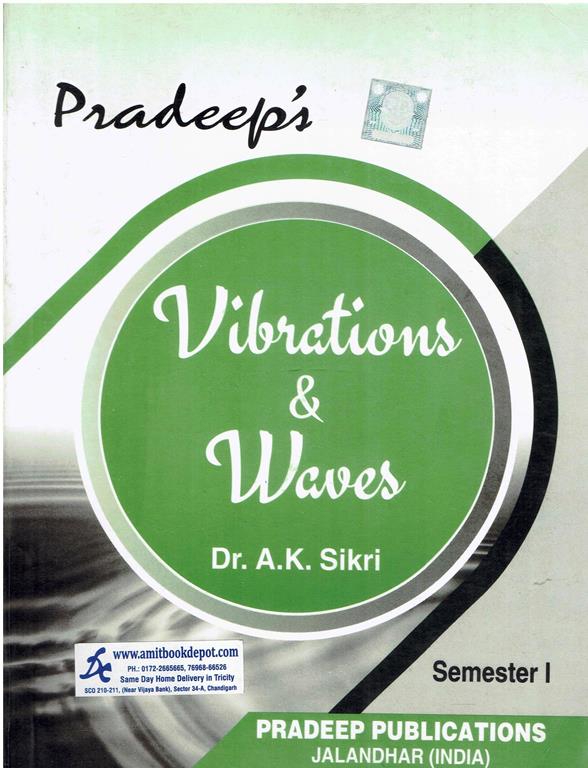

Yes, this book by Dr. A. K. Sikri is meticulously designed to cover the latest prescribed syllabus for Vibrations and Waves for BSc 1st Semester at Panjab University, Chandigarh.
Absolutely. Each chapter contains a variety of solved numerical examples and ends with a comprehensive set of numerical problems for practice, specifically tailored for university exams.
Yes, the book is written in a very lucid style, with concepts built from the ground up. Mathematical derivations are presented step-by-step, making it accessible to students beginning their undergraduate studies.
Yes, all critical derivations are covered in a detailed, sequential manner. The book places strong emphasis on understanding the derivation process for key formulas in SHM, damped, forced, and coupled oscillations.
The core focus of this specific volume is on Vibrations (Oscillations). The study of coupled oscillators directly leads to the concept of waves. Many university syllabi (like PU Chandigarh) treat "Waves" as a separate module in a subsequent semester or book.
Yes, the book includes necessary diagrams, figures, and graphs to illustrate physical systems, coordinate setups, and the behavior of oscillators under different conditions, aiding in visual learning.
This book is designed to be a comprehensive, self-contained resource for the syllabus it covers. Thorough study of the concepts, derivations, and practice of all examples and exercises provided will strongly equip a student to perform very well in exams.
Yes, it is a prescribed and widely used textbook for the relevant physics course in the BSc program at Punjabi University, Patiala, as indicated on the cover.
Yes, the chapter on Forced Oscillators dedicates significant space to the phenomenon of resonance, its physical characteristics, energy considerations, and practical examples of its applications and dangers.
Yes, the book covers systems of two and three coupled masses in detail, explaining the method to find normal modes and frequencies, which is a key part of the syllabus.
No Description Added
Yes, this book by Dr. A. K. Sikri is meticulously designed to cover the latest prescribed syllabus for Vibrations and Waves for BSc 1st Semester at Panjab University, Chandigarh.
Absolutely. Each chapter contains a variety of solved numerical examples and ends with a comprehensive set of numerical problems for practice, specifically tailored for university exams.
Yes, the book is written in a very lucid style, with concepts built from the ground up. Mathematical derivations are presented step-by-step, making it accessible to students beginning their undergraduate studies.
Yes, all critical derivations are covered in a detailed, sequential manner. The book places strong emphasis on understanding the derivation process for key formulas in SHM, damped, forced, and coupled oscillations.
The core focus of this specific volume is on Vibrations (Oscillations). The study of coupled oscillators directly leads to the concept of waves. Many university syllabi (like PU Chandigarh) treat "Waves" as a separate module in a subsequent semester or book.
Yes, the book includes necessary diagrams, figures, and graphs to illustrate physical systems, coordinate setups, and the behavior of oscillators under different conditions, aiding in visual learning.
This book is designed to be a comprehensive, self-contained resource for the syllabus it covers. Thorough study of the concepts, derivations, and practice of all examples and exercises provided will strongly equip a student to perform very well in exams.
Yes, it is a prescribed and widely used textbook for the relevant physics course in the BSc program at Punjabi University, Patiala, as indicated on the cover.
Yes, the chapter on Forced Oscillators dedicates significant space to the phenomenon of resonance, its physical characteristics, energy considerations, and practical examples of its applications and dangers.
Yes, the book covers systems of two and three coupled masses in detail, explaining the method to find normal modes and frequencies, which is a key part of the syllabus.