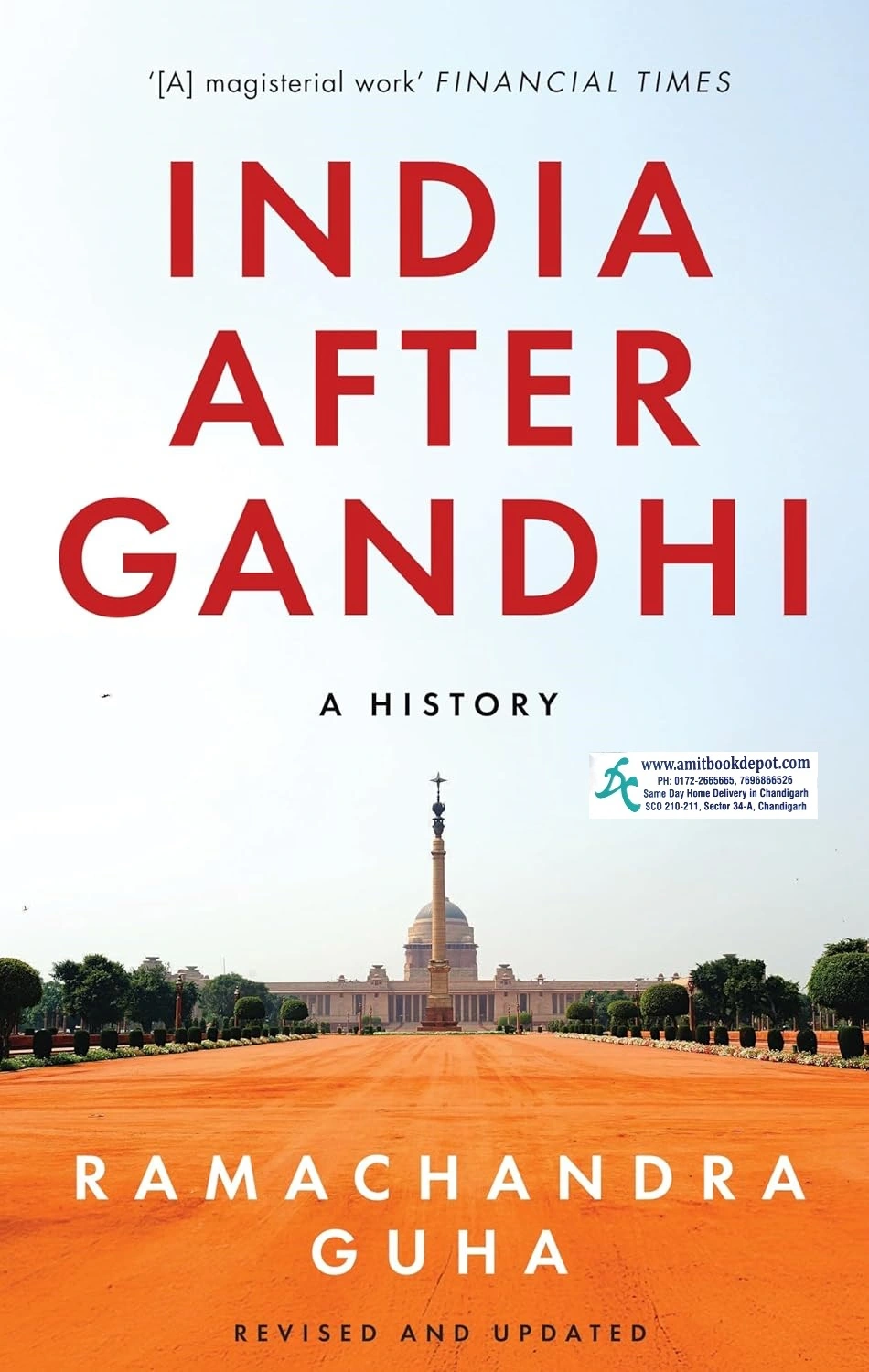
India After Gandhi: The History of the World's Largest Democracy by Ramachandra Guha (PICADOR INDIA) is a monumental work of historical scholarship that chronicles the tumultuous, vibrant, and often violent journey of the Indian Republic from its birth in 1947 to the early 21st century. Widely regarded as the definitive one-volume history of modern India, this masterfully revised edition offers an unflinching, panoramic view of a nation that has survived multiple crises—secessionist movements, state of emergency, religious riots, and economic transformation—to become an undeniable global power.
Unlike conventional political histories that merely list prime ministers and wars, Guha’s narrative is deeply social and cultural. He weaves together high politics with the lived experiences of ordinary citizens, drawing from literature, folklore, and memoirs. The book is structured across five major parts: Picking Up the Pieces (the Partition and its immediate aftermath); Nehru’s India (nation-building, the Constitution, and the Kashmir conflict); Shaking the Centre (the rise of regional parties and the Southern challenge); The Rise of Populism (the Emergency, the Janata experiment, and the decline of Congress dominance); and A History of Events (the Mandal-Mandir debates, economic liberalisation, the rise of the BJP system, and the Gujarat riots). An epilogue, The Republic’s Rocky Road, brings the narrative into the recent past.
This PICADOR INDIA edition includes a detailed table of contents covering chapters such as The Biggest Gamble in History (the first general election), Redrawing the Map (linguistic reorganisation of states), The Conquest of Nature (dams and developmentalism), Securing Kashmir, and Rights and Riots. With extensive notes and a comprehensive index, it serves equally as a reference for scholars and a compelling read for general audiences.
Key themes explored include the logic of division during Partition, the experience of defeat in the 1962 war with China, the autumn of the matriarch (Indira Gandhi’s later years), the rise of a multi-polar polity, and the shocking aftermath of the demolition of the Babri Masjid. Guha handles controversial figures and events—from Vallabhbhai Patel to Narendra Modi—with remarkable even-handedness, making this the gold standard for Indian political history, post-colonial studies, and understanding contemporary South Asia.
Whether you are a student preparing for the UPSC civil services examination, a journalist seeking context, or a general reader wanting to understand why India functions (and malfunctions) as it does, India After Gandhi is indispensable. It is not just a history of events; it is the story of an idea—democracy—surviving against all odds in the most improbable of environments.





.jpg)