Categories
College Bookssss >
BA PU Chandigarh
BSC PU Chandigarh
MSC PU Chandigarh
BBA PU Chandigarh
MA PU Chandigarh
Medical Books
Engineering Books
Management Books
PGDCA Books
BCOM PU Chandigarh
MCOM PU Chandigarh
BCA PU Chandigarh
MCA PU Chandigarh
animate-books

Business Studies for Class 11th Edition 2025-26 NEP/NCFSE

by Madhurima
₹596 ₹596.00(-/ off)

Rating & Reviews

23 Customer Review

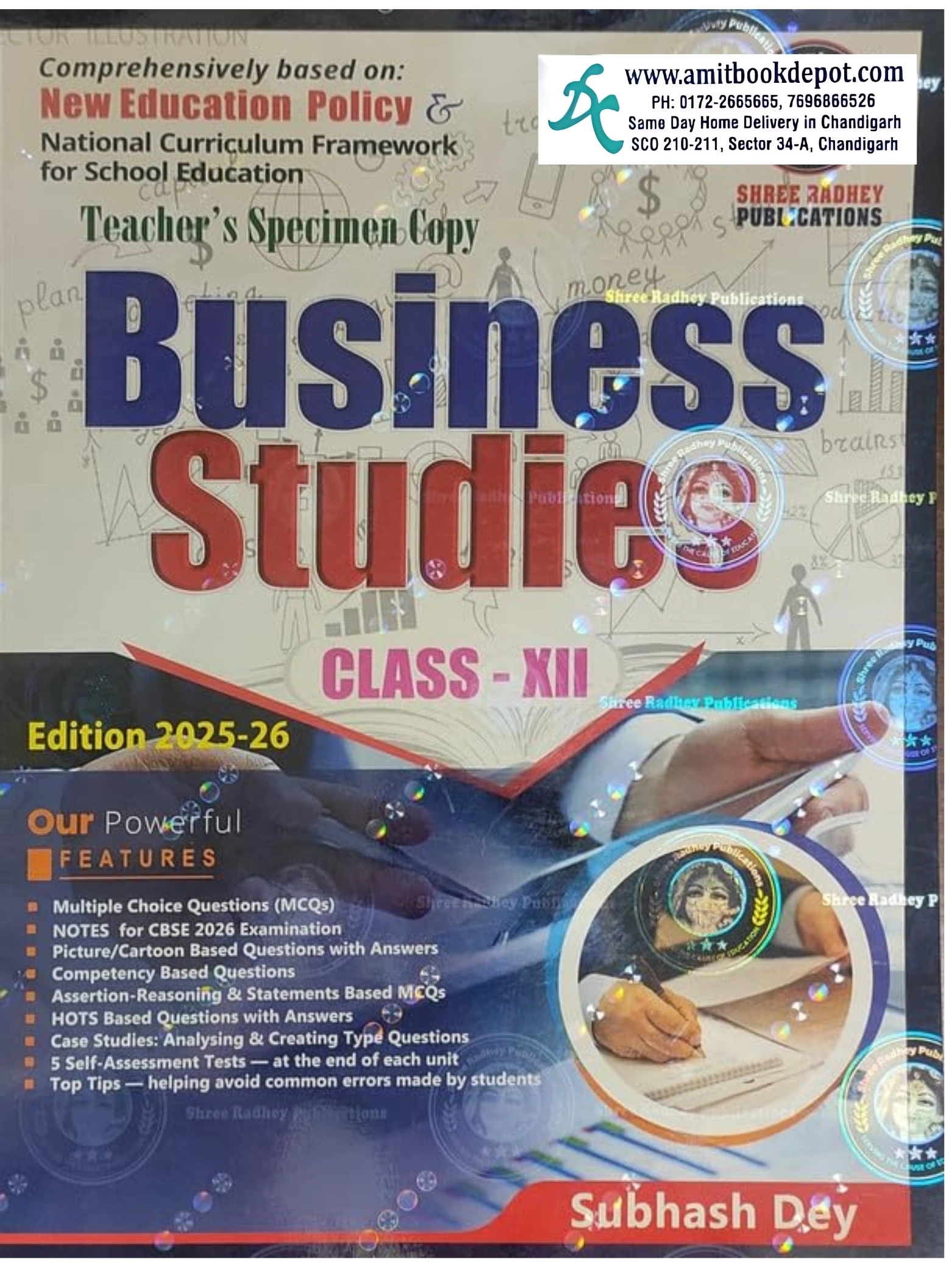
Business Studies for Class 11 (2025-26) by Subhash Dey | Shree Radhey Publications | NEP/NCFSE Aligned. Excel in your CBSE Class 11 Business Studies with this comprehensively updated book for the 2025-26 academic session. Authored by Subhash Dey, this edition is meticulously crafted to align with the National Education Policy (NEP 2020) and NCFSE guidelines. It provides complete coverage of the syllabus, from business fundamentals and forms of organizations to entrepreneurship, GST, and international trade. With clear explanations, real-world examples, and a focus on e-business and the Start-up India Scheme, this book is the perfect resource to build a strong conceptual foundation and develop critical thinking skills for academic success.

Have Doubts Regarding This Product ? Ask Your Question

  • Q1
    How is this book aligned with the National Education Policy (NEP) 2020?
    A1

    The book incorporates a competency-based learning approach, focuses on critical thinking and analytical skills, and includes contemporary topics like entrepreneurship and ethical business practices as advocated by the NEP 2020 framework.

  • Q2
    Does the book cover the latest CBSE syllabus for the 2025-26 academic session?
    A2

    Yes, this 2025-26 edition is thoroughly updated to include the complete and latest CBSE syllabus for Class 11 Business Studies without any omissions.

  • Q3
    Are topics like the Start-up India Scheme and Intellectual Property Rights (IPR) included?
    A3

    Absolutely. Chapter 8, "Small Business and Entrepreneurship Development," provides dedicated coverage of the Start-up India Scheme, funding for start-ups, and the importance of Intellectual Property Rights (IPR).

  • Q4
    How does this book help in understanding the formation of a company?
    A4

    Chapter 2, under "Forms of Business Organizations," breaks down the entire formation process of a company into stages and explains the important documents required.

  • Q5
    Are there explanations for the documents used in international trade?
    A5

    Yes, Unit 10 on "International Business" clearly explains key documents involved in export and import trade, such as the indent, letter of credit, shipping order, and shipping bills.

  • Q6
    How does the book address the social and environmental responsibilities of business?
    A6

    Chapter 6, "Social Responsibility of Business and Business Ethics," is entirely dedicated to this topic, discussing a business's responsibilities towards various stakeholders and its specific role in environmental protection.

  • Q7
    Is the One-Person Company (OPC), a modern form of business, covered?
    A7

    Yes, the concept of a One-Person Company (OPC) is included in the chapter on "Forms of Business Organizations" (Unit 2), alongside private and public companies.

  • Q8
    Is the historical context of Indian business covered?
    A8

    Yes, the book begins with a detailed section on the "History of Trade and Commerce in India," covering the indigenous banking system, trading communities, and India's position in the historical world economy.

  • Q9
    How is the MSMED Act 2006 addressed in the textbook?
    A9

    The MSMED Act 2006's definition of Micro, Small, and Medium Enterprises is covered in Unit 8, along with the role of small businesses in India and related government schemes.

  • Q10
    Is this book suitable for students who are new to the subject of Business Studies?
    A10

    Definitely. The book is written with a focus on conceptual clarity, using simple language and a structured approach to make complex topics easy to grasp for beginners, building a strong foundation for Class 12 and beyond.

0.00

0 Overall Rating
  • 5
    0
  • 4
    0
  • 3
    0
  • 2
    0
  • 1
    0

Try this product & share your review & thoughts

Chapter 1: Evolution and Fundamentals
Chapter 2: Forms of Business Organizations
Chapter 3: Public, Private, and Global Enterprises
Chapter 4: Business Services
Chapter 5: Emerging Modes of Business
Chapter 6: Social Responsibility of Business and Business Ethics
Chapter 7: Sources of Business Finance
Chapter 8: Small Business and Entrepreneurship Development
Chapter 9: Internal Trade
Chapter 10: International Business

CBSE SYLLABUS: Business Studies for Class 11th


Unit 1: Evolution and Fundamentals of Business

1. History of Trade and Commerce in India: Indigenous Banking System, Rise of Intermediaries, Transport, Trading Communities: Merchant Corporations, Major Trade Centers, Major Imports and Exports, Position of Indian Subcontinent in the World Economy.
2. Business—meaning and characteristics
3. Business, profession, and employment concept
4. Objectives of business
5. Classification of business activities—Industry and Commerce
6. Industry types: primary, secondary, tertiary Meaning and subgroups
7. Commerce-trade: (types-internal, external; wholesale and retail) and auxiliaries to trade (banking, insurance, transportation, warehousing, communication, and advertising)—meaning
8. Business risk—Concept

Unit 2: Forms of Business Organizations
1. Sole Proprietorship—Concept, merits, and limitations.
2. Partnership: concept, types, merits, and limitations of partnership, registration of a partnership firm, partnership deed. Types of partners
3. Hindu Undivided Family Business: Concept
4. Cooperative Societies: Concept, merits, and limitations.
5. Company—Concept, merits, and limitations; Types: Private, Public, and One-Person Company—Concept
6. Formation of company—stages, important documents to be used in the formation of a company
Choice of form of business organization

Unit 3: Public, Private, and Global Enterprises
1. Public sector and private sector enterprises—Concept
2. Forms of public sector enterprises: departmental undertakings, statutory corporations, and government companies.
3. Global Enterprises—Feature
Joint venture
4. Public-private partnership—concept

Unit 4: Business Services

Business services—meaning and types.
1. Banking: Types of bank accounts—savings, current, recurring, fixed deposit, and multiple option deposit account.
2. Banking services with particular reference to bank drafts, bank overdrafts, and cash credit. E-Banking meaning, types of digital payments
3. Insurance—Principles. Types—life, health, fire, and marine insurance—concept
Postal Service—Mail, Registered Post, Parcel, Speed Post, Courier—meaning

Unit 5: Emerging Modes of Business
1. E-business: concept, scope, and benefits

Unit 6: Social Responsibility of Business and Business Ethics
1. Concept of social responsibility
2. Case of social responsibility
3. Responsibility towards owners, investors, consumers, employees, government, and community
4. Role of business in environmental protection
5. Business Ethics—Concept and Elements

Part B: Finance and Trade

Unit 7: Sources of Business Finance
1. Concept of business finance
2. Owners’ funds—equity shares, preference shares, retained earnings
3. Borrowed funds: debentures and bonds, loans from financial institutions and commercial banks, public deposits, trade credit, and intercorporate deposits (ICD).

Unit 8: Small Business and Enterprises
1. Entrepreneurship Development (ED): Concept, Characteristics, and Need. Process of Entrepreneurship Development: Start-up India Scheme: ways to fund a start-up. Intellectual Property Rights and Entrepreneurship
2. Small scale enterprise as defined by the MSMED Act 2006 (Micro, Small and Medium Enterprise Development Act)
3. Role of small business in India with special reference to rural areas
4. Government schemes and agencies for small-scale industries: National Small Industries Corporation (NSIC) and District Industrial Centre (DIC) with special reference to rural, backward areas

Unit 9: Internal Trade
1. Internal trade—meaning and types of services rendered by a wholesaler and a retailer
2. Types of retail trade: itinerant and small-scale fixed shop retailers
3. Large-scale retailers—department stores, chain stores—concept
4. GST (Goods and Services Tax): Concept and Key Features

Unit 10: International Trade
1. International trade: concept and benefits
2. Export trade—Meaning and procedure
3. Import Trade—Meaning and Procedure
4. Documents involved in international trade: indent, letter of credit, shipping order, shipping bills, mate’s receipt (DA/DP)
5. World Trade Organization (WTO) meaning and objectives

Unit 11: Project Work
As per CBSE guidelines

Business Studies for Class 11 (2025-26 Edition)—NEP & NCFSE Aligned by Subhash Dey | Shree Radhey Publications

Master the fundamentals of commerce with the definitive book for Class 11 Business Studies, meticulously crafted to align with the National Education Policy (NEP) 2020 and the National Curriculum Framework for School Education (NCFSE). Authored by the renowned Subhash Dey and published by Shree Radhey Publications, this 2025-26 edition is an indispensable resource for CBSE students aiming to build a robust foundation in business principles and contemporary commercial practices.

This comprehensive book is strategically designed to meet the latest CBSE syllabus for Class 11, ensuring complete coverage of all prescribed topics. It empowers students to transition from rote learning to a competency-based approach, fostering critical thinking, analytical skills, and real-world application—the core tenets of the NEP 2020. The content is structured to provide a seamless learning journey, from the historical evolution of trade to the complexities of the modern global business environment.

Key Features and Chapter-wise Insights:

1. The book is systematically divided into logical units, beginning with "Evolution and Fundamentals of Business," which explores the rich history of Indian trade and commerce, the indigenous banking system, and the core concepts of business, profession, employment, and business risks. It then delves into various "Forms of Business Organizations," providing a clear, comparative analysis of sole proprietorships, partnerships, HUFs, cooperatives, and companies, including the modern concept of a one-person company and the stages of company formation.

2. A significant focus is placed on understanding the ecosystem of "Public, Private, and Global Enterprises," detailing departmental undertakings, statutory corporations, and government companies. It introduces students to vital concepts like joint ventures and public-private partnerships (PPP), which are crucial for understanding the contemporary Indian economy. The unit on "Business Services" offers practical knowledge of banking, including various bank accounts and modern e-banking services, insurance principles, and postal services, making the subject highly relevant to everyday life.

3. Embracing the digital shift, the book includes a dedicated chapter on "Emerging Modes of Business," explaining the concept, scope, and benefits of e-business. It strongly emphasizes the "Social Responsibility of Business and Business Ethics," guiding young minds on the importance of sustainable and ethical business practices, including environmental protection.

4. In the Finance and Trade section, students gain clarity on "Sources of Business Finance," covering both owners' funds like equity and preference shares and borrowed funds like debentures and loans. A pivotal chapter on "Small Business and Entrepreneurship Development" ignites the entrepreneurial spirit, detailing the Start-up India Scheme, funding avenues, and the role of Intellectual Property Rights (IPR), perfectly aligning with the national push for entrepreneurship development.

5. The curriculum is rounded off with in-depth coverage of "Internal Trade," explaining the roles of wholesalers and retailers and introducing the GST (Goods and Services Tax) regime. Finally, "International Business" demystifies global trade, its procedures, essential documents, and the role of the World Trade Organization (WTO).

Pedagogical Strengths for Enhanced Learning:

1. Strict Syllabus Adherence: Fully covers the latest CBSE Class 11 Business Studies syllabus.
2. NEP/NCFSE Compliance: Promotes holistic, inquiry-based, and application-oriented learning.
3. Conceptual Clarity: Complex topics are broken down into simple, easy-to-understand language.
4. Real-World Connect: Contemporary examples, case studies, and references to current government schemes like Start-up India and the MSMED Act.
5. Structured Content: Well-organized chapters with clear headings, tables, and bullet points for better retention.
6. Project Work Guidance: Includes support for the CBSE-mandated project work, helping students apply their learning practically.

Business Studies for Class 11 by Subhash Dey is more than just a book; it is a gateway to understanding the dynamic world of commerce and developing the acumen required for academic excellence and future business leadership.

Chapter 1: Evolution and Fundamentals
Chapter 2: Forms of Business Organizations
Chapter 3: Public, Private, and Global Enterprises
Chapter 4: Business Services
Chapter 5: Emerging Modes of Business
Chapter 6: Social Responsibility of Business and Business Ethics
Chapter 7: Sources of Business Finance
Chapter 8: Small Business and Entrepreneurship Development
Chapter 9: Internal Trade
Chapter 10: International Business

Have Doubts Regarding This Product ? Ask Your Question

  • Q1
    How is this book aligned with the National Education Policy (NEP) 2020?
    A1

    The book incorporates a competency-based learning approach, focuses on critical thinking and analytical skills, and includes contemporary topics like entrepreneurship and ethical business practices as advocated by the NEP 2020 framework.

  • Q2
    Does the book cover the latest CBSE syllabus for the 2025-26 academic session?
    A2

    Yes, this 2025-26 edition is thoroughly updated to include the complete and latest CBSE syllabus for Class 11 Business Studies without any omissions.

  • Q3
    Are topics like the Start-up India Scheme and Intellectual Property Rights (IPR) included?
    A3

    Absolutely. Chapter 8, "Small Business and Entrepreneurship Development," provides dedicated coverage of the Start-up India Scheme, funding for start-ups, and the importance of Intellectual Property Rights (IPR).

  • Q4
    How does this book help in understanding the formation of a company?
    A4

    Chapter 2, under "Forms of Business Organizations," breaks down the entire formation process of a company into stages and explains the important documents required.

  • Q5
    Are there explanations for the documents used in international trade?
    A5

    Yes, Unit 10 on "International Business" clearly explains key documents involved in export and import trade, such as the indent, letter of credit, shipping order, and shipping bills.

  • Q6
    How does the book address the social and environmental responsibilities of business?
    A6

    Chapter 6, "Social Responsibility of Business and Business Ethics," is entirely dedicated to this topic, discussing a business's responsibilities towards various stakeholders and its specific role in environmental protection.

  • Q7
    Is the One-Person Company (OPC), a modern form of business, covered?
    A7

    Yes, the concept of a One-Person Company (OPC) is included in the chapter on "Forms of Business Organizations" (Unit 2), alongside private and public companies.

  • Q8
    Is the historical context of Indian business covered?
    A8

    Yes, the book begins with a detailed section on the "History of Trade and Commerce in India," covering the indigenous banking system, trading communities, and India's position in the historical world economy.

  • Q9
    How is the MSMED Act 2006 addressed in the textbook?
    A9

    The MSMED Act 2006's definition of Micro, Small, and Medium Enterprises is covered in Unit 8, along with the role of small businesses in India and related government schemes.

  • Q10
    Is this book suitable for students who are new to the subject of Business Studies?
    A10

    Definitely. The book is written with a focus on conceptual clarity, using simple language and a structured approach to make complex topics easy to grasp for beginners, building a strong foundation for Class 12 and beyond.

CBSE SYLLABUS: Business Studies for Class 11th


Unit 1: Evolution and Fundamentals of Business

1. History of Trade and Commerce in India: Indigenous Banking System, Rise of Intermediaries, Transport, Trading Communities: Merchant Corporations, Major Trade Centers, Major Imports and Exports, Position of Indian Subcontinent in the World Economy.
2. Business—meaning and characteristics
3. Business, profession, and employment concept
4. Objectives of business
5. Classification of business activities—Industry and Commerce
6. Industry types: primary, secondary, tertiary Meaning and subgroups
7. Commerce-trade: (types-internal, external; wholesale and retail) and auxiliaries to trade (banking, insurance, transportation, warehousing, communication, and advertising)—meaning
8. Business risk—Concept

Unit 2: Forms of Business Organizations
1. Sole Proprietorship—Concept, merits, and limitations.
2. Partnership: concept, types, merits, and limitations of partnership, registration of a partnership firm, partnership deed. Types of partners
3. Hindu Undivided Family Business: Concept
4. Cooperative Societies: Concept, merits, and limitations.
5. Company—Concept, merits, and limitations; Types: Private, Public, and One-Person Company—Concept
6. Formation of company—stages, important documents to be used in the formation of a company
Choice of form of business organization

Unit 3: Public, Private, and Global Enterprises
1. Public sector and private sector enterprises—Concept
2. Forms of public sector enterprises: departmental undertakings, statutory corporations, and government companies.
3. Global Enterprises—Feature
Joint venture
4. Public-private partnership—concept

Unit 4: Business Services

Business services—meaning and types.
1. Banking: Types of bank accounts—savings, current, recurring, fixed deposit, and multiple option deposit account.
2. Banking services with particular reference to bank drafts, bank overdrafts, and cash credit. E-Banking meaning, types of digital payments
3. Insurance—Principles. Types—life, health, fire, and marine insurance—concept
Postal Service—Mail, Registered Post, Parcel, Speed Post, Courier—meaning

Unit 5: Emerging Modes of Business
1. E-business: concept, scope, and benefits

Unit 6: Social Responsibility of Business and Business Ethics
1. Concept of social responsibility
2. Case of social responsibility
3. Responsibility towards owners, investors, consumers, employees, government, and community
4. Role of business in environmental protection
5. Business Ethics—Concept and Elements

Part B: Finance and Trade

Unit 7: Sources of Business Finance
1. Concept of business finance
2. Owners’ funds—equity shares, preference shares, retained earnings
3. Borrowed funds: debentures and bonds, loans from financial institutions and commercial banks, public deposits, trade credit, and intercorporate deposits (ICD).

Unit 8: Small Business and Enterprises
1. Entrepreneurship Development (ED): Concept, Characteristics, and Need. Process of Entrepreneurship Development: Start-up India Scheme: ways to fund a start-up. Intellectual Property Rights and Entrepreneurship
2. Small scale enterprise as defined by the MSMED Act 2006 (Micro, Small and Medium Enterprise Development Act)
3. Role of small business in India with special reference to rural areas
4. Government schemes and agencies for small-scale industries: National Small Industries Corporation (NSIC) and District Industrial Centre (DIC) with special reference to rural, backward areas

Unit 9: Internal Trade
1. Internal trade—meaning and types of services rendered by a wholesaler and a retailer
2. Types of retail trade: itinerant and small-scale fixed shop retailers
3. Large-scale retailers—department stores, chain stores—concept
4. GST (Goods and Services Tax): Concept and Key Features

Unit 10: International Trade
1. International trade: concept and benefits
2. Export trade—Meaning and procedure
3. Import Trade—Meaning and Procedure
4. Documents involved in international trade: indent, letter of credit, shipping order, shipping bills, mate’s receipt (DA/DP)
5. World Trade Organization (WTO) meaning and objectives

Unit 11: Project Work
As per CBSE guidelines

0.00

0 Overall Rating
  • 5
    0
  • 4
    0
  • 3
    0
  • 2
    0
  • 1
    0

Try this product & share your review & thoughts

Top Trending Product

Related Product

Related Product

Related Blog Posts

Latest Blogs

Latest Blogs

blog-img
Classic Literature Reimagined: Discuss modern twists on classic novels.
Lorem ipsum dolor sit amet, consectetur adipiscing elit, sed do eiusmod tempor incididunt ut labore et dolore magna aliqua. Ut enim ad minim veniam, quis nostrud exercitation ullamco Lorem ipsum dolor sit amet, consectetur adipiscing elit, sed do eiusmod tempor incididunt ut labore et dolore magna aliqua. Utenim ad minim veniam, quis nostrud exercitation ullamco Lorem ipsum dolor sit amet, consecte...
Read more
Author name | 10 jan, 2025
blog-img
Classic Literature Reimagined: Discuss modern twists on classic novels.
Lorem ipsum dolor sit amet, consectetur adipiscing elit, sed do eiusmod tempor incididunt ut labore et dolore magna aliqua. Ut enim ad minim veniam, quis nostrud exercitation ullamco Lorem ipsum dolor sit amet, consectetur adipiscing elit, sed do eiusmod tempor incididunt ut labore et dolore magna aliqua. Utenim ad minim veniam, quis nostrud exercitation ullamco Lorem ipsum dolor sit amet, consecte...
Read more
Author name | 10 jan, 2025
blog-img
Classic Literature Reimagined: Discuss modern twists on classic novels.
Lorem ipsum dolor sit amet, consectetur adipiscing elit, sed do eiusmod tempor incididunt ut labore et dolore magna aliqua. Ut enim ad minim veniam, quis nostrud exercitation ullamco Lorem ipsum dolor sit amet, consectetur adipiscing elit, sed do eiusmod tempor incididunt ut labore et dolore magna aliqua. Utenim ad minim veniam, quis nostrud exercitation ullamco Lorem ipsum dolor sit amet, consecte...
Read more
Author name | 10 jan, 2025
blog-img
Classic Literature Reimagined: Discuss modern twists on classic novels.
Lorem ipsum dolor sit amet, consectetur adipiscing elit...
Read more
Author Name | 10 Jan, 2025
blog-img
Classic Literature Reimagined: Discuss modern twists on classic novels.
Lorem ipsum dolor sit amet, consectetur adipiscing elit...
Read more
Author Name | 10 Jan, 2025
blog-img
Classic Literature Reimagined: Discuss modern twists on classic novels.
Lorem ipsum dolor sit amet, consectetur adipiscing elit...
Read more
Author Name | 10 Jan, 2025
blog-img
Classic Literature Reimagined: Discuss modern twists on classic novels.
Lorem ipsum dolor sit amet, consectetur adipiscing elit...
Read more
Author Name | 10 Jan, 2025
blog-img
Classic Literature Reimagined: Discuss modern twists on classic novels.
Lorem ipsum dolor sit amet, consectetur adipiscing elit...
Read more
Author Name | 10 Jan, 2025
blog-img
Classic Literature Reimagined: Discuss modern twists on classic novels.
Lorem ipsum dolor sit amet, consectetur adipiscing elit...
Read more
Author Name | 10 Jan, 2025
blog-img
Classic Literature Reimagined: Discuss modern twists on classic novels.
Lorem ipsum dolor sit amet, consectetur adipiscing elit...
Read more
Author Name | 10 Jan, 2025
blog-img
Classic Literature Reimagined: Discuss modern twists on classic novels.
Lorem ipsum dolor sit amet, consectetur adipiscing elit...
Read more
Author Name | 10 Jan, 2025
blog-img
Classic Literature Reimagined: Discuss modern twists on classic novels.
Lorem ipsum dolor sit amet, consectetur adipiscing elit...
Read more
Author Name | 10 Jan, 2025