Categories
College Bookssss >
BA PU Chandigarh
BSC PU Chandigarh
MSC PU Chandigarh
BBA PU Chandigarh
MA PU Chandigarh
Medical Books
Engineering Books
Management Books
PGDCA Books
BCOM PU Chandigarh
MCOM PU Chandigarh
BCA PU Chandigarh
MCA PU Chandigarh
animate-books

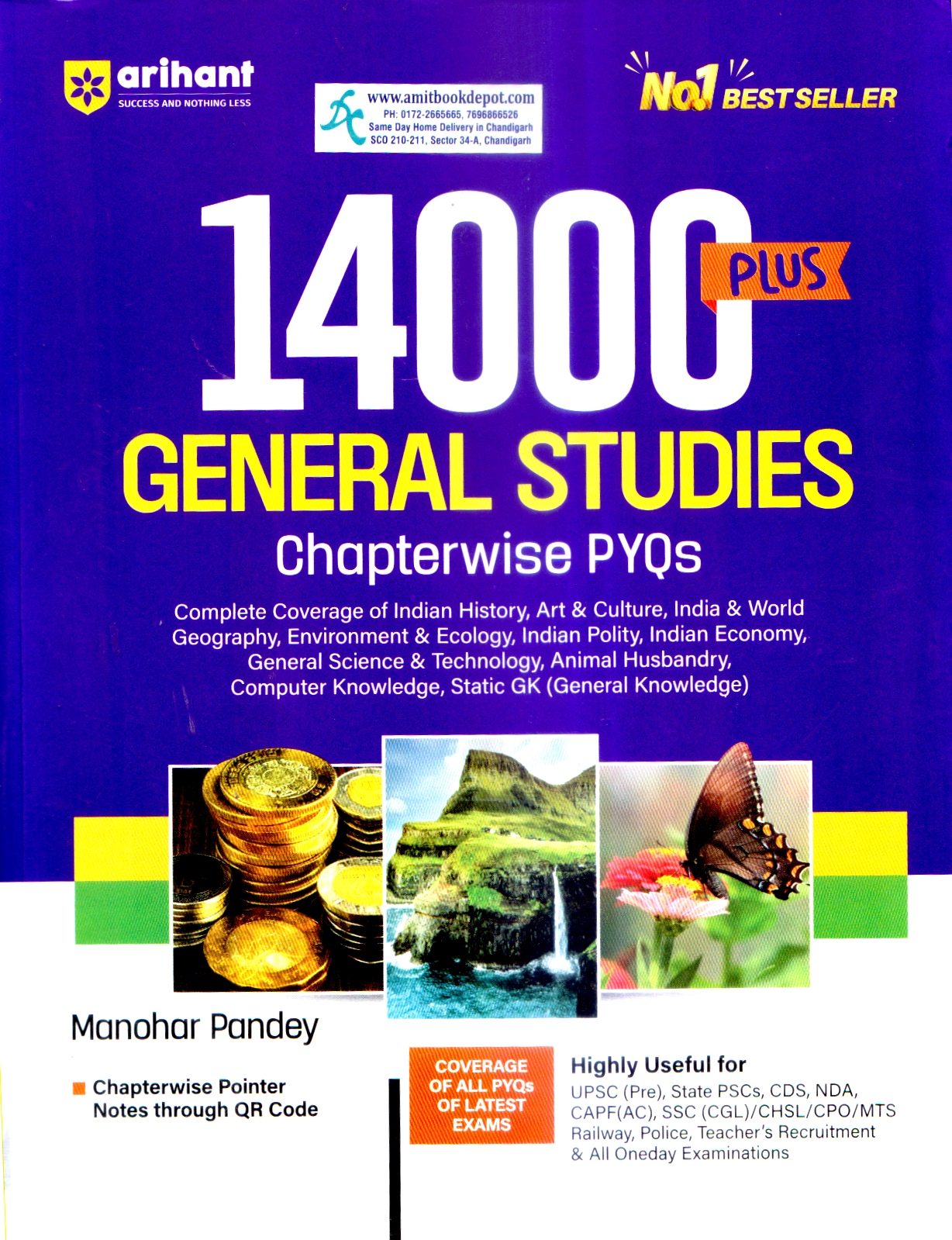
Arihant General Studies 14000+ Chapterwise PYQs (NEW)

by Madhurima
₹581 ₹645.00(-/ off)

Rating & Reviews

23 Customer Review

The Arihant General Studies 14000+ Chapterwise Objective Questions by Manohar Pandey is an essential resource for UPSC, State PSC, SSC, Railway, and other competitive exam aspirants. This comprehensive book provides over 14,000+ Previous Year Questions (PYQs) systematically arranged in chapterwise order across all key subjects: Indian History, Geography, Polity, Economy, General Science, Art & Culture, and Static GK. It is designed for targeted practice, trend analysis, and efficient revision. Enhance your exam preparation, identify important topics, and build confidence with this exhaustive question bank from Arihant Prakashan, your trusted partner in academic success.

Have Doubts Regarding This Product ? Ask Your Question

  • Q1
    Are the 14,000+ questions in this book exclusively from UPSC Prelims, or do they include other exams as well?
    A1

    The collection is curated from a wide range of competitive examinations, including UPSC Civil Services Prelims, State PSCs, SSC (CGL, CHSL, etc.), Railway (RRB NTPC, Group D), and other major government recruitment tests to provide comprehensive coverage.

  • Q2
    How are the questions within each chapter organized? Are they sorted by year, difficulty, or topic?
    A2

    Questions within each chapter are typically organized topic-wise for conceptual clarity, allowing you to master one sub-topic before moving to the next, rather than a strict year-wise sequence.

  • Q3
    Is the Static GK section updated with current information like new appointments, awards, and sports championships?
    A3

    The Static GK section covers perennial facts (e.g., First in India, Capitals, etc.). For highly dynamic current affairs (latest awards, sports events), you should supplement this book with a dedicated current affairs annual or monthly magazine.

  • Q4
    How does the "Chapterwise" format help in preparation compared to a mixed question paper format?
    A4

    The chapterwise format allows for focused, subject-wise practice. It helps in strengthening weak areas, revising specific topics from your theory notes, and understanding which sub-topics are most frequently asked in exams.

  • Q5
    Are questions from the Science & Technology and Computer Knowledge sections based on the latest developments?
    A5

    The book includes fundamental and frequently asked concepts. However, for the most recent advancements in these fast-evolving fields, supplementing with current affairs resources is advisable.

  • Q6
    Is the language and difficulty level of the questions suitable for both English and Hindi medium aspirants?
    A6

    The book is published in English. However, the objective nature of the questions makes it a valuable resource for all aspirants, as the core factual knowledge tested remains the same across mediums.

  • Q7
    Does the Indian Polity section include questions based on recent constitutional amendments and important Supreme Court judgments?
    A7

    The book covers fundamental polity principles and historically important amendments/judgments via PYQs. For the most recent ones, you will need to consult current affairs compilations.

  • Q8
    Are maps or diagrams included in the Geography section to assist with questions?
    A8

    As a primarily text-based Q&A book, it may not contain detailed maps or diagrams. It is recommended to use a good atlas alongside for geography preparation.

  • Q9
    Does the environment and ecology section cover topics like recent international agreements (e.g., COP meetings) and government schemes?
    A9

    The section covers core concepts, pollution, biodiversity, etc., through PYQs. For updates on recent agreements, treaties, and new schemes, refer to dedicated current affairs sources.

  • Q10
    How should I integrate this book into my daily study schedule?
    A10

    A recommended approach is to study a topic from your theory book and then immediately solve the corresponding chapter from this question bank to test your understanding and retention.

0.00

0 Overall Rating
  • 5
    0
  • 4
    0
  • 3
    0
  • 2
    0
  • 1
    0

Try this product & share your review & thoughts

INDIAN HISTORY
Ancient History

1. Historical Sources
2. Prehistoric Cultures
3. Indus Valley (Harappa) Civilization
4. Vedic Culture
5. Jainism
6. Buddhism and Other Major Religions
7. Mahajanapada Period and Magadha Empire
8. Mauryan Empire
9. Post-Mauryan Period
10. Gupta Period
11. Post-Gupta Period
12. History of South India
13. Early Medieval Period

Medieval History

14. Arab and Turkic Invasions in India
15. Delhi Sultanate (Major Dynasties)
16. Delhi Sultanate: Administrative, Economic, and Social System
17. Rise of Provincial States (Bengal, Jaunpur, Malwa, Kashmir, Gujarat, etc.)
18. Vijayanagara and Bahmani Empire
19. Bhakti and Sufi Movement
20. Mughal Empire
21. Mughal Administration
22. Later Mughal Period
23. Rise of Maratha Power
24. Rise of the Sikhs

Modern History

25. Arrival of European Companies in India
26. Emergence of New States
27. Expansion of East India Company
28. British Economic and Administrative Policies
29. Tribal Rebellion and Farmer’s Movement
30. Socio-religious Reform Movement
31. Development of Press and Education in India
32. Revolt of 1857
33. Formation of the Indian National Congress
34. First Phase of the Indian National Movement (1885 - 1905)
35. Second Phase of Indian National Movement (1905-1919)
36. Third Phase of the Indian National Movement (1919 - 1947)
37. British Governor, Governor-General, and Viceroy
38. World History

Art & Culture and Cultural Traditions

39. Art and Architecture
40. Sculpture and Painting of India
41. Music
42. Classical Dance/Folk Dance
43. Religion and Philosophy
44. Feasts, Festivals, and Fairs
45. Language and Literature
46. Folk Culture
47. Martial Arts and Other Arts (Drama/Playwright)

INDIA AND WORLD GEOGRAPHY
World Geography

1. Scope and Concepts Related to Geography
2. Universe
3. Solar System
4. Origin and Development of the Earth
5. Geomorphology
6. Principles Related to the Development of Landforms
7. Rocks
8. Earthquakes and Volcanoes
9 Endogenic and Exogenic Forces
10. Topography
11. Mountains
12. Plateaus
13. Plains, Islands, Deserts
14. Rivers, Lakes, and Waterfalls
15. Atmosphere, Weather, and Climate
16. Humidity, Clouds, Precipitation, and Rainfall
17. Wind masses, wind fronts, cyclones, and anticyclones
18. Climate Regions of the World
19. Ocean Relief and Sea Floor
20. Ocean Temperature and Salinity
21. Ocean Deposits, Currents, and Waves
22. Tides, Coral Reefs, and Water Straits
23. Soils of the World
24. Natural Vegetation and Grasslands
25. World Agriculture, Animal Husbandry, and Fisheries
26. Mineral and Energy Resources
27. Major Industries of the World
28. Transport and Communication
29. World Population and Urbanization
30. Ethnic Groups, Tribes, and Languages
31. Continents of the World

Indian Geography

1. General Introduction of India
2. Geological Structure of India
3. Geological Regions of India
4. Drainage System of India
5. Climate of India
6. Major Soils of India
7. Natural Vegetation
8. Agriculture, Irrigation, and Animal Husbandry
9. Mineral Resources
10. Energy Resources
11. Industries
12. Transportation and Communication
13. Human Resources (Population and Urbanization)
14. Ethnic Groups and Tribes
15. States and Union Territories

Environment and Ecology

1. Environment
2. Ecosystem
3. Environmental Pollution and Climate Change
4. Biodiversity
5. Sustainable Development
6. Disaster and Disaster Management

Indian Polity

1. Constitutional Development
2. Process of Constitution Making
3. Preamble and Features of the Constitution
4. Sources, Parts, Articles, and Schedules of the Constitution
5. Reorganization of Union Territories and States
6. Citizenship
7. Fundamental Rights
8. Directive Principles of State Policy
9. Fundamental Duties
10. President
11. Vice President
12. Prime Minister and Union Cabinet
13. Federal Legislature
14. Lok Sabha
15. Supreme Court
16. High Courts and Subordinate Courts
17. Executive of the State
18. Chief Minister and Council of Ministers
19. Legislative Council
20. Legislative Assembly
21. Center-State Relations
22. Emergency Provisions
23. Administrative Tribunal/State Language
24. Administration of Union Territory/Scheduled Caste and Tribe Area
25. Local Self-Government
26. Electoral System and Party System
27. Constitutional Bodies
28. Non-Constitutional Bodies
29. Constitutional Amendments

INDIAN ECONOMY

1. Structure of the Indian Economy
2. Economic Growth and Development
3. National Income
4. Economic Planning in India
5. Poverty and Unemployment
6. Social Programs and Schemes
7. Indian Agriculture
8. Indian Industry
9. Money
10. Banking
11. Money Market and Capital Market (Financial Market)
12. Public Finance
13. Foreign Trade and Investment (Balance of Payments)
14. International Organization

GENERAL SCIENCE
PHYSICS

1. Units and Dimensions of Physical Quantities
2. Motion
3. Force and Laws of Motion
4. Work, Energy, and Power
5. Gravitation
6. Properties of Liquids and Solids
7. Temperature and Heat
8. Thermodynamics
9. Periodic Motion
10. Wave Motion
11. Optics
12. Electrostatics
13. Magnetism and Electromagnetic Induction
14. Modern Physics
15. Semiconductor and Electronics Devices

CHEMISTRY

1. Atomic Structure and Radioactivity
2. States and Classification of Matter
3. Chemical Bonding
4. Periodic Classification of Elements
5. Acids, Bases, and Salts
6. Metals, Minerals, Ores, and Alloys
7. Nonmetals
8. Hydrocarbons
9. Chemicals in Everyday Life

BIOLOGY

1. Introduction to Biology
2. Diversity in the Living World
3. Classification to Plant Kingdom
4. Classification of Animal Kingdom
5. Cells
6. Tissues
7. Plant Physiology and Reproduction
8. Human Nutrition and Physiology
9. Genetics
10. Bio-evolution
11. Human Disease and Immunity
12. Microorganisms in Human Welfare
13. Various Crops and Farming Methods
14. Economic Zoology and Botany

SCIENCE AND TECHNOLOGY

1. Indian Space Programme
2. Indian Nuclear Program
3. Indian Defense and Internal Security
4. Biotechnology
5. Communication System and Nanotechnology

COMPUTER KNOWLEDGE

1. Introduction of Computer
2. Computer Architecture
3. Hardware (I/O Devices)
4. Computer Memory
5. Computer Software
6. Operating System
7. Microsoft Office
8. Programming Languages
9. Computer Network
10. Internet and Its Services
11. Computer Security
12. Emerging Technologies

STATIC GK

1. First in India
2. Largest, Tallest, and Longest in India
3. Prominent Persons and Places
4. Popular Surnames (Persons and Cities) and Sayings
5. First in the World
6. Capitals and Currencies of Major Countries of the World
7. Largest, Longest, and Highest in the World
8. National Monuments of Major Countries
9. National Animals, Birds, and Symbols of Major Countries
10. Major Cities Situated on the Banks of Rivers
11. Important Facts Related to Major Countries of the World
12. Famous Places of the World
13. Major Books and Their Authors
14. Awards and Honors
15. Sports
16. Major Institutions and Organizations
17. Other Major Institutions
18. Word Abbreviations
19. Important Dates & Days

The Arihant General Studies 14000+ Chapterwise Objective Questions is a definitive and exhaustive question bank meticulously compiled by Manohar Pandey, designed as an indispensable resource for serious aspirants of UPSC Civil Services (IAS), State PSCs, SSC, Railway, and other competitive examinations. This comprehensive volume stands as a powerhouse of practice, strategically engineered to equip candidates with the practice and insight needed to excel in the General Studies/General Awareness sections, which are the cornerstone of most government recruitment tests.

This book's core strength lies in its unparalleled collection of over 14,000+ Previous Year Questions (PYQs) drawn from a vast array of competitive exams. The questions are not merely aggregated but are systematically organized into detailed chapters that align perfectly with the prescribed syllabus for General Studies. This chapter-wise structuring allows for targeted, subject-specific preparation, enabling candidates to identify their strengths and weaknesses in every micro-topic, from ancient history to modern technology.

The content is divided into six major sections, ensuring holistic coverage: Indian History (Ancient, Medieval, and Modern), Art & Culture, India and World Geography (including Environment & Ecology), Indian Polity, Indian Economy, General Science (Physics, Chemistry, Biology, Science & Technology, and Computer Knowledge), and Static GK. Each section is further broken down into logically sequenced chapters, facilitating a gradual and thorough learning curve. For instance, under Indian Polity, the journey begins with Constitutional Development and proceeds methodically through Preamble, Fundamental Rights, Parliament, Judiciary, and up to Constitutional Amendments.

A key feature of this compendium is its focus on authentic PYQs. Solving these questions provides candidates with a genuine feel of the exam pattern, the difficulty level, and the evolving trend of questions over the years. This practice is critical for understanding the examiner's mindset and frequently tested areas. The objective question format with clear answers aids in quick revision and self-assessment, making it an ideal tool for the final leg of exam preparation.

Beyond being a question bank, this book serves as a concise revision guide. The presentation of questions topic-by-topic reinforces concepts from standard books. Sections like Static GK are particularly valuable, compiling essential facts on firsts in India & the world, largest/longest, capitals, currencies, awards, sports, and important institutions into an easily revisable format. The inclusion of Computer Knowledge and Science & Technology chapters addresses the modern and increasingly relevant segments of the syllabus.

Published by Arihant Prakashan, a trusted name in academic and competitive exam preparation, this book upholds the hallmark of quality, accuracy, and relevance. The language is clear and direct, and the formatting is designed for easy readability and prolonged study sessions.

For any aspirant aiming to crack competitive examinations, mastering general studies is non-negotiable. The Arihant General Studies 14000+ Chapterwise PYQs by Manohar Pandey is more than just a book; it is a strategic preparation partner. It builds exam temperament, enhances speed and accuracy, and ensures that the candidate has practiced virtually every type of question possible from the vast universe of general studies. Invest in this all-encompassing resource to transform your preparation, boost your confidence, and take a decisive step towards achieving your career goals.

INDIAN HISTORY
Ancient History

1. Historical Sources
2. Prehistoric Cultures
3. Indus Valley (Harappa) Civilization
4. Vedic Culture
5. Jainism
6. Buddhism and Other Major Religions
7. Mahajanapada Period and Magadha Empire
8. Mauryan Empire
9. Post-Mauryan Period
10. Gupta Period
11. Post-Gupta Period
12. History of South India
13. Early Medieval Period

Medieval History

14. Arab and Turkic Invasions in India
15. Delhi Sultanate (Major Dynasties)
16. Delhi Sultanate: Administrative, Economic, and Social System
17. Rise of Provincial States (Bengal, Jaunpur, Malwa, Kashmir, Gujarat, etc.)
18. Vijayanagara and Bahmani Empire
19. Bhakti and Sufi Movement
20. Mughal Empire
21. Mughal Administration
22. Later Mughal Period
23. Rise of Maratha Power
24. Rise of the Sikhs

Modern History

25. Arrival of European Companies in India
26. Emergence of New States
27. Expansion of East India Company
28. British Economic and Administrative Policies
29. Tribal Rebellion and Farmer’s Movement
30. Socio-religious Reform Movement
31. Development of Press and Education in India
32. Revolt of 1857
33. Formation of the Indian National Congress
34. First Phase of the Indian National Movement (1885 - 1905)
35. Second Phase of Indian National Movement (1905-1919)
36. Third Phase of the Indian National Movement (1919 - 1947)
37. British Governor, Governor-General, and Viceroy
38. World History

Art & Culture and Cultural Traditions

39. Art and Architecture
40. Sculpture and Painting of India
41. Music
42. Classical Dance/Folk Dance
43. Religion and Philosophy
44. Feasts, Festivals, and Fairs
45. Language and Literature
46. Folk Culture
47. Martial Arts and Other Arts (Drama/Playwright)

INDIA AND WORLD GEOGRAPHY
World Geography

1. Scope and Concepts Related to Geography
2. Universe
3. Solar System
4. Origin and Development of the Earth
5. Geomorphology
6. Principles Related to the Development of Landforms
7. Rocks
8. Earthquakes and Volcanoes
9 Endogenic and Exogenic Forces
10. Topography
11. Mountains
12. Plateaus
13. Plains, Islands, Deserts
14. Rivers, Lakes, and Waterfalls
15. Atmosphere, Weather, and Climate
16. Humidity, Clouds, Precipitation, and Rainfall
17. Wind masses, wind fronts, cyclones, and anticyclones
18. Climate Regions of the World
19. Ocean Relief and Sea Floor
20. Ocean Temperature and Salinity
21. Ocean Deposits, Currents, and Waves
22. Tides, Coral Reefs, and Water Straits
23. Soils of the World
24. Natural Vegetation and Grasslands
25. World Agriculture, Animal Husbandry, and Fisheries
26. Mineral and Energy Resources
27. Major Industries of the World
28. Transport and Communication
29. World Population and Urbanization
30. Ethnic Groups, Tribes, and Languages
31. Continents of the World

Indian Geography

1. General Introduction of India
2. Geological Structure of India
3. Geological Regions of India
4. Drainage System of India
5. Climate of India
6. Major Soils of India
7. Natural Vegetation
8. Agriculture, Irrigation, and Animal Husbandry
9. Mineral Resources
10. Energy Resources
11. Industries
12. Transportation and Communication
13. Human Resources (Population and Urbanization)
14. Ethnic Groups and Tribes
15. States and Union Territories

Environment and Ecology

1. Environment
2. Ecosystem
3. Environmental Pollution and Climate Change
4. Biodiversity
5. Sustainable Development
6. Disaster and Disaster Management

Indian Polity

1. Constitutional Development
2. Process of Constitution Making
3. Preamble and Features of the Constitution
4. Sources, Parts, Articles, and Schedules of the Constitution
5. Reorganization of Union Territories and States
6. Citizenship
7. Fundamental Rights
8. Directive Principles of State Policy
9. Fundamental Duties
10. President
11. Vice President
12. Prime Minister and Union Cabinet
13. Federal Legislature
14. Lok Sabha
15. Supreme Court
16. High Courts and Subordinate Courts
17. Executive of the State
18. Chief Minister and Council of Ministers
19. Legislative Council
20. Legislative Assembly
21. Center-State Relations
22. Emergency Provisions
23. Administrative Tribunal/State Language
24. Administration of Union Territory/Scheduled Caste and Tribe Area
25. Local Self-Government
26. Electoral System and Party System
27. Constitutional Bodies
28. Non-Constitutional Bodies
29. Constitutional Amendments

INDIAN ECONOMY

1. Structure of the Indian Economy
2. Economic Growth and Development
3. National Income
4. Economic Planning in India
5. Poverty and Unemployment
6. Social Programs and Schemes
7. Indian Agriculture
8. Indian Industry
9. Money
10. Banking
11. Money Market and Capital Market (Financial Market)
12. Public Finance
13. Foreign Trade and Investment (Balance of Payments)
14. International Organization

GENERAL SCIENCE
PHYSICS

1. Units and Dimensions of Physical Quantities
2. Motion
3. Force and Laws of Motion
4. Work, Energy, and Power
5. Gravitation
6. Properties of Liquids and Solids
7. Temperature and Heat
8. Thermodynamics
9. Periodic Motion
10. Wave Motion
11. Optics
12. Electrostatics
13. Magnetism and Electromagnetic Induction
14. Modern Physics
15. Semiconductor and Electronics Devices

CHEMISTRY

1. Atomic Structure and Radioactivity
2. States and Classification of Matter
3. Chemical Bonding
4. Periodic Classification of Elements
5. Acids, Bases, and Salts
6. Metals, Minerals, Ores, and Alloys
7. Nonmetals
8. Hydrocarbons
9. Chemicals in Everyday Life

BIOLOGY

1. Introduction to Biology
2. Diversity in the Living World
3. Classification to Plant Kingdom
4. Classification of Animal Kingdom
5. Cells
6. Tissues
7. Plant Physiology and Reproduction
8. Human Nutrition and Physiology
9. Genetics
10. Bio-evolution
11. Human Disease and Immunity
12. Microorganisms in Human Welfare
13. Various Crops and Farming Methods
14. Economic Zoology and Botany

SCIENCE AND TECHNOLOGY

1. Indian Space Programme
2. Indian Nuclear Program
3. Indian Defense and Internal Security
4. Biotechnology
5. Communication System and Nanotechnology

COMPUTER KNOWLEDGE

1. Introduction of Computer
2. Computer Architecture
3. Hardware (I/O Devices)
4. Computer Memory
5. Computer Software
6. Operating System
7. Microsoft Office
8. Programming Languages
9. Computer Network
10. Internet and Its Services
11. Computer Security
12. Emerging Technologies

STATIC GK

1. First in India
2. Largest, Tallest, and Longest in India
3. Prominent Persons and Places
4. Popular Surnames (Persons and Cities) and Sayings
5. First in the World
6. Capitals and Currencies of Major Countries of the World
7. Largest, Longest, and Highest in the World
8. National Monuments of Major Countries
9. National Animals, Birds, and Symbols of Major Countries
10. Major Cities Situated on the Banks of Rivers
11. Important Facts Related to Major Countries of the World
12. Famous Places of the World
13. Major Books and Their Authors
14. Awards and Honors
15. Sports
16. Major Institutions and Organizations
17. Other Major Institutions
18. Word Abbreviations
19. Important Dates & Days

Have Doubts Regarding This Product ? Ask Your Question

  • Q1
    Are the 14,000+ questions in this book exclusively from UPSC Prelims, or do they include other exams as well?
    A1

    The collection is curated from a wide range of competitive examinations, including UPSC Civil Services Prelims, State PSCs, SSC (CGL, CHSL, etc.), Railway (RRB NTPC, Group D), and other major government recruitment tests to provide comprehensive coverage.

  • Q2
    How are the questions within each chapter organized? Are they sorted by year, difficulty, or topic?
    A2

    Questions within each chapter are typically organized topic-wise for conceptual clarity, allowing you to master one sub-topic before moving to the next, rather than a strict year-wise sequence.

  • Q3
    Is the Static GK section updated with current information like new appointments, awards, and sports championships?
    A3

    The Static GK section covers perennial facts (e.g., First in India, Capitals, etc.). For highly dynamic current affairs (latest awards, sports events), you should supplement this book with a dedicated current affairs annual or monthly magazine.

  • Q4
    How does the "Chapterwise" format help in preparation compared to a mixed question paper format?
    A4

    The chapterwise format allows for focused, subject-wise practice. It helps in strengthening weak areas, revising specific topics from your theory notes, and understanding which sub-topics are most frequently asked in exams.

  • Q5
    Are questions from the Science & Technology and Computer Knowledge sections based on the latest developments?
    A5

    The book includes fundamental and frequently asked concepts. However, for the most recent advancements in these fast-evolving fields, supplementing with current affairs resources is advisable.

  • Q6
    Is the language and difficulty level of the questions suitable for both English and Hindi medium aspirants?
    A6

    The book is published in English. However, the objective nature of the questions makes it a valuable resource for all aspirants, as the core factual knowledge tested remains the same across mediums.

  • Q7
    Does the Indian Polity section include questions based on recent constitutional amendments and important Supreme Court judgments?
    A7

    The book covers fundamental polity principles and historically important amendments/judgments via PYQs. For the most recent ones, you will need to consult current affairs compilations.

  • Q8
    Are maps or diagrams included in the Geography section to assist with questions?
    A8

    As a primarily text-based Q&A book, it may not contain detailed maps or diagrams. It is recommended to use a good atlas alongside for geography preparation.

  • Q9
    Does the environment and ecology section cover topics like recent international agreements (e.g., COP meetings) and government schemes?
    A9

    The section covers core concepts, pollution, biodiversity, etc., through PYQs. For updates on recent agreements, treaties, and new schemes, refer to dedicated current affairs sources.

  • Q10
    How should I integrate this book into my daily study schedule?
    A10

    A recommended approach is to study a topic from your theory book and then immediately solve the corresponding chapter from this question bank to test your understanding and retention.

No Syllabus Added

0.00

0 Overall Rating
  • 5
    0
  • 4
    0
  • 3
    0
  • 2
    0
  • 1
    0

Try this product & share your review & thoughts

Top Trending Product

Related Product

Related Product

Related Blog Posts

Latest Blogs

Latest Blogs

blog-img
Classic Literature Reimagined: Discuss modern twists on classic novels.
Lorem ipsum dolor sit amet, consectetur adipiscing elit, sed do eiusmod tempor incididunt ut labore et dolore magna aliqua. Ut enim ad minim veniam, quis nostrud exercitation ullamco Lorem ipsum dolor sit amet, consectetur adipiscing elit, sed do eiusmod tempor incididunt ut labore et dolore magna aliqua. Utenim ad minim veniam, quis nostrud exercitation ullamco Lorem ipsum dolor sit amet, consecte...
Read more
Author name | 10 jan, 2025
blog-img
Classic Literature Reimagined: Discuss modern twists on classic novels.
Lorem ipsum dolor sit amet, consectetur adipiscing elit, sed do eiusmod tempor incididunt ut labore et dolore magna aliqua. Ut enim ad minim veniam, quis nostrud exercitation ullamco Lorem ipsum dolor sit amet, consectetur adipiscing elit, sed do eiusmod tempor incididunt ut labore et dolore magna aliqua. Utenim ad minim veniam, quis nostrud exercitation ullamco Lorem ipsum dolor sit amet, consecte...
Read more
Author name | 10 jan, 2025
blog-img
Classic Literature Reimagined: Discuss modern twists on classic novels.
Lorem ipsum dolor sit amet, consectetur adipiscing elit, sed do eiusmod tempor incididunt ut labore et dolore magna aliqua. Ut enim ad minim veniam, quis nostrud exercitation ullamco Lorem ipsum dolor sit amet, consectetur adipiscing elit, sed do eiusmod tempor incididunt ut labore et dolore magna aliqua. Utenim ad minim veniam, quis nostrud exercitation ullamco Lorem ipsum dolor sit amet, consecte...
Read more
Author name | 10 jan, 2025
blog-img
Classic Literature Reimagined: Discuss modern twists on classic novels.
Lorem ipsum dolor sit amet, consectetur adipiscing elit...
Read more
Author Name | 10 Jan, 2025
blog-img
Classic Literature Reimagined: Discuss modern twists on classic novels.
Lorem ipsum dolor sit amet, consectetur adipiscing elit...
Read more
Author Name | 10 Jan, 2025
blog-img
Classic Literature Reimagined: Discuss modern twists on classic novels.
Lorem ipsum dolor sit amet, consectetur adipiscing elit...
Read more
Author Name | 10 Jan, 2025
blog-img
Classic Literature Reimagined: Discuss modern twists on classic novels.
Lorem ipsum dolor sit amet, consectetur adipiscing elit...
Read more
Author Name | 10 Jan, 2025
blog-img
Classic Literature Reimagined: Discuss modern twists on classic novels.
Lorem ipsum dolor sit amet, consectetur adipiscing elit...
Read more
Author Name | 10 Jan, 2025
blog-img
Classic Literature Reimagined: Discuss modern twists on classic novels.
Lorem ipsum dolor sit amet, consectetur adipiscing elit...
Read more
Author Name | 10 Jan, 2025
blog-img
Classic Literature Reimagined: Discuss modern twists on classic novels.
Lorem ipsum dolor sit amet, consectetur adipiscing elit...
Read more
Author Name | 10 Jan, 2025
blog-img
Classic Literature Reimagined: Discuss modern twists on classic novels.
Lorem ipsum dolor sit amet, consectetur adipiscing elit...
Read more
Author Name | 10 Jan, 2025
blog-img
Classic Literature Reimagined: Discuss modern twists on classic novels.
Lorem ipsum dolor sit amet, consectetur adipiscing elit...
Read more
Author Name | 10 Jan, 2025