Categories
College Bookssss >
BA PU Chandigarh
BSC PU Chandigarh
MSC PU Chandigarh
BBA PU Chandigarh
MA PU Chandigarh
Medical Books
Engineering Books
Management Books
PGDCA Books
BCOM PU Chandigarh
MCOM PU Chandigarh
BCA PU Chandigarh
MCA PU Chandigarh
animate-books

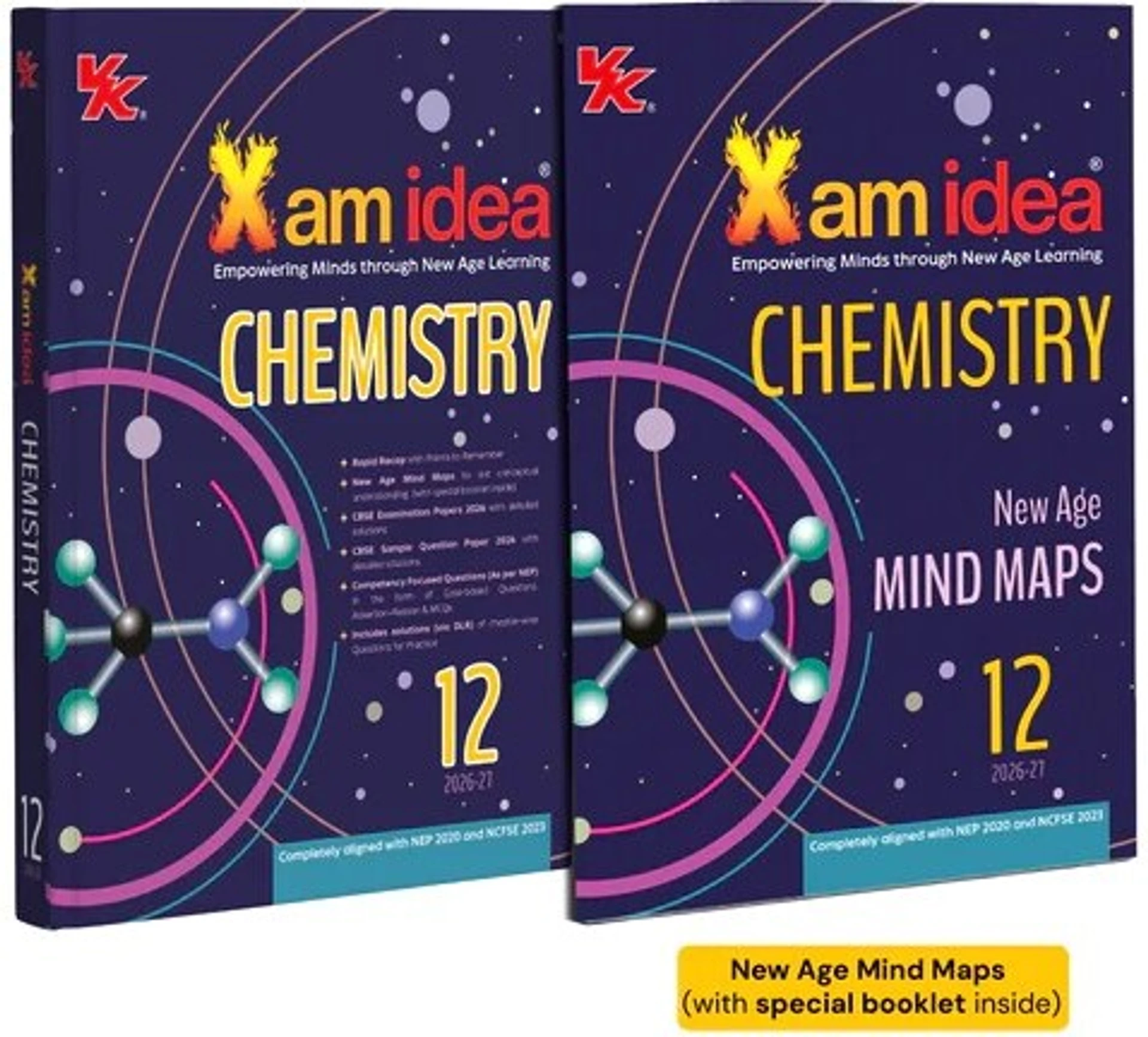
Xamidea Chemistry for Class 12th

by Madhurima
₹693 ₹693.00(-/ off)

Rating & Reviews

23 Customer Review

Xamidea Chemistry for Class 12th by VK Global Publications is a CBSE-aligned reference book covering NCERT syllabus topics like solutions, electrochemistry, biomolecules, and more. It includes detailed explanations, solved examples, HOTS questions, and previous years’ papers (solved & unsolved) for 2025 board exams. With chapter summaries, diagrams, and exam tips, this book aids in quick revision and high scores. Perfect for CBSE students and competitive exam aspirants (NEET/JEE).

Have Doubts Regarding This Product ? Ask Your Question

  • Q1
    Is this book based on the latest CBSE syllabus for 2024-25?
    A1

    Yes, it strictly follows the updated NCERT/CBSE syllabus for Class 12 Chemistry.

  • Q2
    Does it include NCERT exercise solutions?
    A2

    Yes, all NCERT textbook questions are solved with detailed explanations.

  • Q3
    Does this book help with competitive exams like NEET/JEE?
    A3

    Yes, it includes HOTS questions and advanced problems beneficial for entrance exams.

  • Q4
    Are diagrams and chemical equations well-explained?
    A4

    Absolutely, each chapter has illustrations, reaction mechanisms, and labeled diagrams.

  • Q5
    Is there a separate section for numerical problems?
    A5

    Yes, Electrochemistry, Chemical Kinetics, and Solutions include step-by-step numerical solutions.

  • Q6
    Are there answers to value-based questions?
    A6

    Yes, value-based and application-oriented questions are included as per CBSE patterns.

  • Q7
    Is the language easy to understand?
    A7

    The book is written in simple, student-friendly language with clear explanations.

  • Q8
    Does it cover all units from NCERT Part 1 and Part 2?
    A8

    Yes, it includes all chapters from both NCERT Chemistry textbooks.

  • Q9
    Is this book recommended by teachers?
    A9

    Yes, it is a trusted reference guide used by teachers and toppers for CBSE exam preparation.

  • Q10
    Does it include organic chemistry reaction mechanisms?
    A10

    Yes, Haloalkanes, Alcohols, Aldehydes, and Amines have detailed reaction mechanisms.

0.00

0 Overall Rating
  • 5
    0
  • 4
    0
  • 3
    0
  • 2
    0
  • 1
    0

Try this product & share your review & thoughts

PART A

1. Solutions
2. Electrochemistry
3. Chemical Kinetics
4. The d- and f-Block Elements
5. Coordination Compounds
6. Haloalkanes and Haloarenes
7. Alcohols, Phenols, and Ethers
8. Aldehydes, Ketones, and Carboxylic Acids
9. Amines
10. Biomolecules

PART B

EXAMINATION CORNER
CBSE Sample Question Paper—2025 (Solved)
CBSE Examination Paper—2025Code : 56/1/1 (Solved)]
CBSE Examination Paper—2025Code : 56/5/1 (Unsolved)]
CBSE Examination Paper—2025Code : 56/6/1 (Unsolved)]
Appendix
CBSE SYLLABUS: NCERT Chemistry Part 1 Textbook for Class 12th

Unit II: Solutions
Types of solutions, expression of concentration of solutions of solids in liquids, solubility of gases in liquids, solid solutions, Raoult's law, Colligative properties—relative lowering of vapor pressure, elevation of boiling point, depression of freezing point, osmotic pressure, determination of molecular masses using colligative properties, abnormal molecular mass, and the Van't Hoff factor.

Unit III: Electrochemistry
Redox reactions, EMF of a cell, standard electrode potential, the Nernst equation and its application to chemical cells, Relation between Gibbs energy change and EMF of a cell, conductance in electrolytic solutions, specific and molar conductivity, variations of conductivity with concentration, Kohlrausch's Law, electrolysis and the law of electrolysis (elementary idea), dry cell-electrolytic cells and galvanic cells, lead accumulators, fuel cells, and corrosion.

Unit IV: Chemical Kinetics
Rate of a reaction (average and instantaneous), factors affecting the rate of reaction: concentration, temperature, catalyst; order and molecularity of a reaction, rate law and specific rate constant, integrated rate equations, and half-life (only for zero- and first-order reactions), concept of collision theory (elementary idea, no mathematical treatment), activation energy, and Arrhenius equation.

Unit VIII: d and f Block Elements
General introduction, electronic configuration, occurrence and characteristics of transition metals, general trends in properties of the first-row transition metals—metallic character, ionization enthalpy, oxidation states, ionic radii, color, catalytic property, magnetic properties, interstitial compounds, alloy formation, preparation, and properties of K₂Cr₂O₇ and KMnO₄.
Lanthanoids—electronic configuration, oxidation states, chemical reactivity, lanthanoid contraction, and its consequences.
Actinoids—electronic configuration, oxidation states, and comparison with lanthanoids.

Unit IX: Coordination Compounds
Coordination compounds—introduction, ligands, coordination number, color, magnetic properties, and shapes; IUPAC nomenclature of mononuclear coordination compounds. Bonding, Werner's theory, VBT, and CFT; structure and stereoisomerism; importance of coordination compounds (in qualitative analysis, extraction of metals, and biological systems).


CBSE SYLLABUS: NCERT Chemistry Part 2 Textbook for Class 12th

Unit VI: Haloalkanes and Haloarenes.
Haloalkanes: Nomenclature, nature of C–X bond, physical and chemical properties, optical rotation mechanism of substitution reactions.
Haloarenes: Nature of C–X bond, substitution reactions (directive influence of halogen in monosubstituted compounds only).
Uses and environmental effects of dichloromethane, trichloromethane, tetrachloromethane, iodoform, Freons, and DDT.

Unit VII: Alcohols, Phenols, and Ethers
Alcohols: Nomenclature, methods of preparation, physical and chemical properties (of primary alcohols only), identification of primary, secondary, and tertiary alcohols, mechanism of dehydration, and uses with special reference to methanol and ethanol.
Phenols: Nomenclature, methods of preparation, physical and chemical properties, acidic nature of phenol, electrophilic substitution reactions, and uses of phenols.
Ethers: Nomenclature, methods of preparation, physical and chemical properties, and uses.

Unit VIII: Aldehydes, Ketones, and Carboxylic Acids
Aldehydes and Ketones: Nomenclature, nature of carbonyl group, methods of preparation, physical and chemical properties, mechanism of nucleophilic addition, reactivity of alpha hydrogen in aldehydes, uses.
Carboxylic Acids: Nomenclature, acidic nature, methods of preparation, physical and chemical properties, and uses.

Unit IX: Amines
Amines: Nomenclature, classification, structure, methods of preparation, physical and chemical properties, uses, and identification of primary, secondary, and tertiary amines.
Diazonium salts: Preparation, chemical reactions, and importance in synthetic organic chemistry.

Unit: X: Biomolecules
Carbohydrates: Classification (aldoses and ketoses), monosaccharides (glucose and fructose), D-L configuration oligosaccharides (sucrose, lactose, maltose), polysaccharides (starch, cellulose, glycogen); Importance of carbohydrates.
Proteins—Elementary idea of amino acids, peptide bonds, polypeptides, proteins, and structure of proteins
- primary, secondary, tertiary, and quaternary structures (qualitative idea only), denaturation of proteins, and enzymes.
Hormones—an elementary idea excluding structure.
Vitamins—Classification and functions.
Nucleic Acids: DNA and RNA.

Xamidea Chemistry for Class 12th by VK Global Publications Pvt. Ltd. is a comprehensive reference book designed to help students excel in their CBSE Class 12 Chemistry examinations. Aligned with the latest NCERT syllabus, this book provides in-depth explanations, solved examples, practice questions, and previous years’ papers to ensure thorough preparation.

Key Features of Xamidea Chemistry for Class 12th:

1. Structured Content as per CBSE Syllabus
- The book is divided into Part A (Theory) and Part B (Examination Corner), covering all essential topics prescribed by CBSE, including Solutions, Electrochemistry, Chemical Kinetics, d- and f-Block Elements, Coordination Compounds, Haloalkanes, Alcohols, Aldehydes, Amines, and Biomolecules.

2. Detailed Chapter-wise Explanation
- Each chapter includes clear concepts, diagrams, chemical equations, and step-by-step solutions to help students grasp complex topics easily.
- Important definitions, formulas, and reactions are highlighted for quick revision.

3. Exam-Oriented Practice Material
- Solved NCERT exercises and additional practice questions are provided to strengthen conceptual understanding.
- High-order thinking skills (HOTS) questions and value-based questions help students prepare for competitive exams like NEET and JEE.

4. Previous Years’ Solved & Unsolved Papers
- Includes CBSE Sample Question Paper 2025 (Solved) and CBSE Board Exam Papers (Solved & Unsolved) to familiarize students with the exam pattern and marking scheme.
- Appendix section with additional reference material for last-minute revision.

5. Conceptual Clarity & Quick Revision
- Flowcharts, tables, and summaries aid in quick memorization of key points.
- Important tips and tricks for numerical problems and chemical reactions.

6. Error-Free & Authentic Content
- Developed by subject experts, ensuring accuracy and adherence to CBSE guidelines.

Why Choose Xamidea Chemistry for Class 12th?
1. Best for CBSE Board Exam Preparation—Covers NCERT concepts with extra practice material.
2. Enhances Problem-Solving Skills— Includes a variety of questions (MCQs, short & long answers, and numerical problems).
3. Improves Exam Readiness—Solved and unsolved papers simulate real exam conditions.
4. Trusted by Toppers—A preferred choice among high-achieving students.

Ideal for:
1. Class 12 CBSE science students
2. NEET & JEE aspirants
3. Teachers for reference and assignments

PART A

1. Solutions
2. Electrochemistry
3. Chemical Kinetics
4. The d- and f-Block Elements
5. Coordination Compounds
6. Haloalkanes and Haloarenes
7. Alcohols, Phenols, and Ethers
8. Aldehydes, Ketones, and Carboxylic Acids
9. Amines
10. Biomolecules

PART B

EXAMINATION CORNER
CBSE Sample Question Paper—2025 (Solved)
CBSE Examination Paper—2025Code : 56/1/1 (Solved)]
CBSE Examination Paper—2025Code : 56/5/1 (Unsolved)]
CBSE Examination Paper—2025Code : 56/6/1 (Unsolved)]
Appendix

Have Doubts Regarding This Product ? Ask Your Question

  • Q1
    Is this book based on the latest CBSE syllabus for 2024-25?
    A1

    Yes, it strictly follows the updated NCERT/CBSE syllabus for Class 12 Chemistry.

  • Q2
    Does it include NCERT exercise solutions?
    A2

    Yes, all NCERT textbook questions are solved with detailed explanations.

  • Q3
    Does this book help with competitive exams like NEET/JEE?
    A3

    Yes, it includes HOTS questions and advanced problems beneficial for entrance exams.

  • Q4
    Are diagrams and chemical equations well-explained?
    A4

    Absolutely, each chapter has illustrations, reaction mechanisms, and labeled diagrams.

  • Q5
    Is there a separate section for numerical problems?
    A5

    Yes, Electrochemistry, Chemical Kinetics, and Solutions include step-by-step numerical solutions.

  • Q6
    Are there answers to value-based questions?
    A6

    Yes, value-based and application-oriented questions are included as per CBSE patterns.

  • Q7
    Is the language easy to understand?
    A7

    The book is written in simple, student-friendly language with clear explanations.

  • Q8
    Does it cover all units from NCERT Part 1 and Part 2?
    A8

    Yes, it includes all chapters from both NCERT Chemistry textbooks.

  • Q9
    Is this book recommended by teachers?
    A9

    Yes, it is a trusted reference guide used by teachers and toppers for CBSE exam preparation.

  • Q10
    Does it include organic chemistry reaction mechanisms?
    A10

    Yes, Haloalkanes, Alcohols, Aldehydes, and Amines have detailed reaction mechanisms.

CBSE SYLLABUS: NCERT Chemistry Part 1 Textbook for Class 12th

Unit II: Solutions
Types of solutions, expression of concentration of solutions of solids in liquids, solubility of gases in liquids, solid solutions, Raoult's law, Colligative properties—relative lowering of vapor pressure, elevation of boiling point, depression of freezing point, osmotic pressure, determination of molecular masses using colligative properties, abnormal molecular mass, and the Van't Hoff factor.

Unit III: Electrochemistry
Redox reactions, EMF of a cell, standard electrode potential, the Nernst equation and its application to chemical cells, Relation between Gibbs energy change and EMF of a cell, conductance in electrolytic solutions, specific and molar conductivity, variations of conductivity with concentration, Kohlrausch's Law, electrolysis and the law of electrolysis (elementary idea), dry cell-electrolytic cells and galvanic cells, lead accumulators, fuel cells, and corrosion.

Unit IV: Chemical Kinetics
Rate of a reaction (average and instantaneous), factors affecting the rate of reaction: concentration, temperature, catalyst; order and molecularity of a reaction, rate law and specific rate constant, integrated rate equations, and half-life (only for zero- and first-order reactions), concept of collision theory (elementary idea, no mathematical treatment), activation energy, and Arrhenius equation.

Unit VIII: d and f Block Elements
General introduction, electronic configuration, occurrence and characteristics of transition metals, general trends in properties of the first-row transition metals—metallic character, ionization enthalpy, oxidation states, ionic radii, color, catalytic property, magnetic properties, interstitial compounds, alloy formation, preparation, and properties of K₂Cr₂O₇ and KMnO₄.
Lanthanoids—electronic configuration, oxidation states, chemical reactivity, lanthanoid contraction, and its consequences.
Actinoids—electronic configuration, oxidation states, and comparison with lanthanoids.

Unit IX: Coordination Compounds
Coordination compounds—introduction, ligands, coordination number, color, magnetic properties, and shapes; IUPAC nomenclature of mononuclear coordination compounds. Bonding, Werner's theory, VBT, and CFT; structure and stereoisomerism; importance of coordination compounds (in qualitative analysis, extraction of metals, and biological systems).


CBSE SYLLABUS: NCERT Chemistry Part 2 Textbook for Class 12th

Unit VI: Haloalkanes and Haloarenes.
Haloalkanes: Nomenclature, nature of C–X bond, physical and chemical properties, optical rotation mechanism of substitution reactions.
Haloarenes: Nature of C–X bond, substitution reactions (directive influence of halogen in monosubstituted compounds only).
Uses and environmental effects of dichloromethane, trichloromethane, tetrachloromethane, iodoform, Freons, and DDT.

Unit VII: Alcohols, Phenols, and Ethers
Alcohols: Nomenclature, methods of preparation, physical and chemical properties (of primary alcohols only), identification of primary, secondary, and tertiary alcohols, mechanism of dehydration, and uses with special reference to methanol and ethanol.
Phenols: Nomenclature, methods of preparation, physical and chemical properties, acidic nature of phenol, electrophilic substitution reactions, and uses of phenols.
Ethers: Nomenclature, methods of preparation, physical and chemical properties, and uses.

Unit VIII: Aldehydes, Ketones, and Carboxylic Acids
Aldehydes and Ketones: Nomenclature, nature of carbonyl group, methods of preparation, physical and chemical properties, mechanism of nucleophilic addition, reactivity of alpha hydrogen in aldehydes, uses.
Carboxylic Acids: Nomenclature, acidic nature, methods of preparation, physical and chemical properties, and uses.

Unit IX: Amines
Amines: Nomenclature, classification, structure, methods of preparation, physical and chemical properties, uses, and identification of primary, secondary, and tertiary amines.
Diazonium salts: Preparation, chemical reactions, and importance in synthetic organic chemistry.

Unit: X: Biomolecules
Carbohydrates: Classification (aldoses and ketoses), monosaccharides (glucose and fructose), D-L configuration oligosaccharides (sucrose, lactose, maltose), polysaccharides (starch, cellulose, glycogen); Importance of carbohydrates.
Proteins—Elementary idea of amino acids, peptide bonds, polypeptides, proteins, and structure of proteins
- primary, secondary, tertiary, and quaternary structures (qualitative idea only), denaturation of proteins, and enzymes.
Hormones—an elementary idea excluding structure.
Vitamins—Classification and functions.
Nucleic Acids: DNA and RNA.

0.00

0 Overall Rating
  • 5
    0
  • 4
    0
  • 3
    0
  • 2
    0
  • 1
    0

Try this product & share your review & thoughts

Top Trending Product

Related Product

Related Product

Related Blog Posts

Latest Blogs

Latest Blogs

blog-img
Classic Literature Reimagined: Discuss modern twists on classic novels.
Lorem ipsum dolor sit amet, consectetur adipiscing elit, sed do eiusmod tempor incididunt ut labore et dolore magna aliqua. Ut enim ad minim veniam, quis nostrud exercitation ullamco Lorem ipsum dolor sit amet, consectetur adipiscing elit, sed do eiusmod tempor incididunt ut labore et dolore magna aliqua. Utenim ad minim veniam, quis nostrud exercitation ullamco Lorem ipsum dolor sit amet, consecte...
Read more
Author name | 10 jan, 2025
blog-img
Classic Literature Reimagined: Discuss modern twists on classic novels.
Lorem ipsum dolor sit amet, consectetur adipiscing elit, sed do eiusmod tempor incididunt ut labore et dolore magna aliqua. Ut enim ad minim veniam, quis nostrud exercitation ullamco Lorem ipsum dolor sit amet, consectetur adipiscing elit, sed do eiusmod tempor incididunt ut labore et dolore magna aliqua. Utenim ad minim veniam, quis nostrud exercitation ullamco Lorem ipsum dolor sit amet, consecte...
Read more
Author name | 10 jan, 2025
blog-img
Classic Literature Reimagined: Discuss modern twists on classic novels.
Lorem ipsum dolor sit amet, consectetur adipiscing elit, sed do eiusmod tempor incididunt ut labore et dolore magna aliqua. Ut enim ad minim veniam, quis nostrud exercitation ullamco Lorem ipsum dolor sit amet, consectetur adipiscing elit, sed do eiusmod tempor incididunt ut labore et dolore magna aliqua. Utenim ad minim veniam, quis nostrud exercitation ullamco Lorem ipsum dolor sit amet, consecte...
Read more
Author name | 10 jan, 2025
blog-img
Classic Literature Reimagined: Discuss modern twists on classic novels.
Lorem ipsum dolor sit amet, consectetur adipiscing elit...
Read more
Author Name | 10 Jan, 2025
blog-img
Classic Literature Reimagined: Discuss modern twists on classic novels.
Lorem ipsum dolor sit amet, consectetur adipiscing elit...
Read more
Author Name | 10 Jan, 2025
blog-img
Classic Literature Reimagined: Discuss modern twists on classic novels.
Lorem ipsum dolor sit amet, consectetur adipiscing elit...
Read more
Author Name | 10 Jan, 2025
blog-img
Classic Literature Reimagined: Discuss modern twists on classic novels.
Lorem ipsum dolor sit amet, consectetur adipiscing elit...
Read more
Author Name | 10 Jan, 2025
blog-img
Classic Literature Reimagined: Discuss modern twists on classic novels.
Lorem ipsum dolor sit amet, consectetur adipiscing elit...
Read more
Author Name | 10 Jan, 2025
blog-img
Classic Literature Reimagined: Discuss modern twists on classic novels.
Lorem ipsum dolor sit amet, consectetur adipiscing elit...
Read more
Author Name | 10 Jan, 2025
blog-img
Classic Literature Reimagined: Discuss modern twists on classic novels.
Lorem ipsum dolor sit amet, consectetur adipiscing elit...
Read more
Author Name | 10 Jan, 2025
blog-img
Classic Literature Reimagined: Discuss modern twists on classic novels.
Lorem ipsum dolor sit amet, consectetur adipiscing elit...
Read more
Author Name | 10 Jan, 2025
blog-img
Classic Literature Reimagined: Discuss modern twists on classic novels.
Lorem ipsum dolor sit amet, consectetur adipiscing elit...
Read more
Author Name | 10 Jan, 2025