Categories
College Bookssss >
BA PU Chandigarh
BSC PU Chandigarh
MSC PU Chandigarh
BBA PU Chandigarh
MA PU Chandigarh
Medical Books
Engineering Books
Management Books
PGDCA Books
BCOM PU Chandigarh
MCOM PU Chandigarh
BCA PU Chandigarh
MCA PU Chandigarh
animate-books

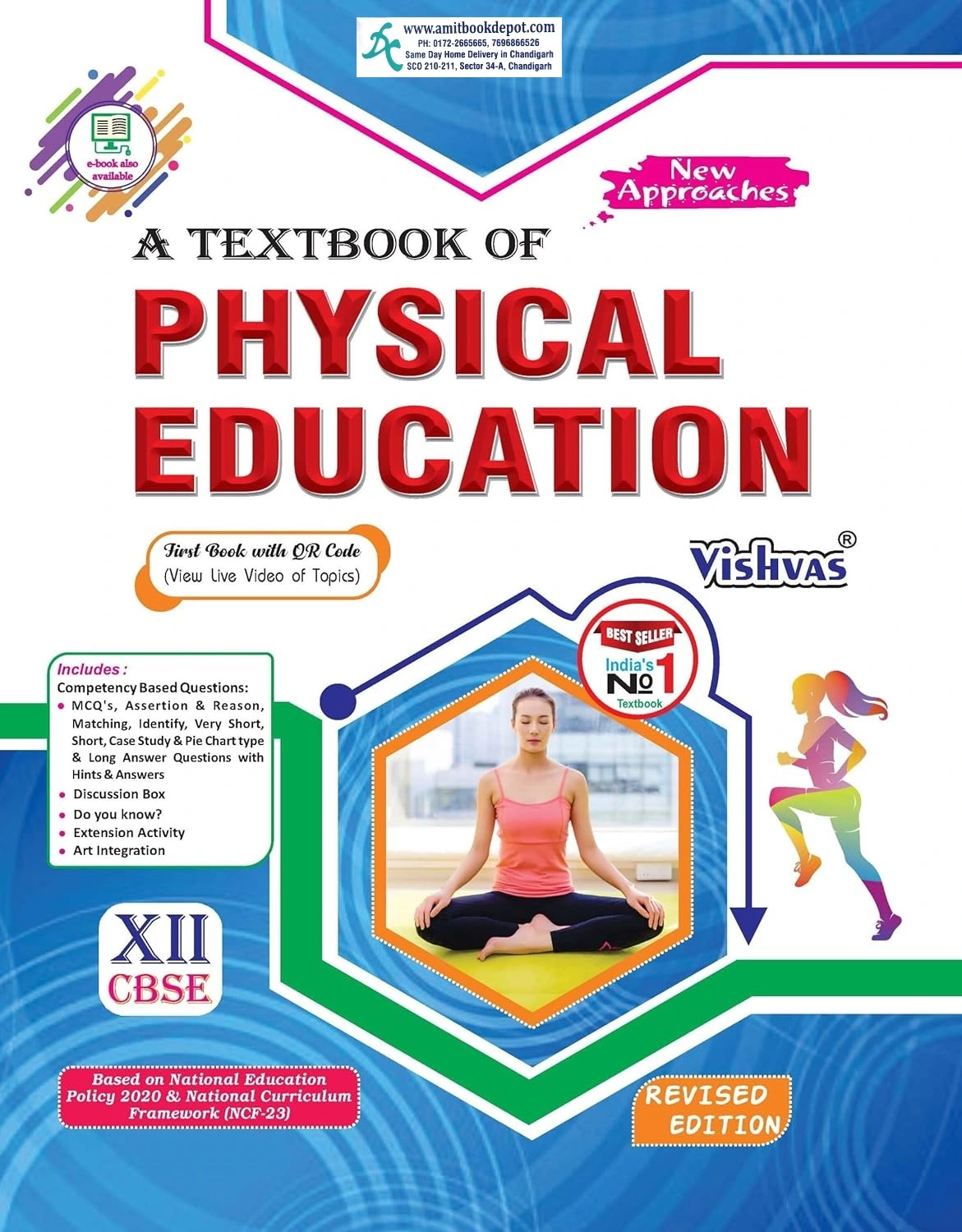
Vishvas A Textbook of Physical Education Class 12th

by Madhurima
₹441 ₹490.00(-/ off)

Rating & Reviews

23 Customer Review

Vishvas: A Book of Physical Education Class 12th by Ravinder Chaudhry, Zamirullah Khan & Kamlesh Chaudhry (Vishvas Publications) is a complete CBSE syllabus guide covering sports management, yoga for lifestyle diseases, CWSN (Divyang) inclusion, sports nutrition, fitness testing (SAI Khelo India, Harvard Step Test), physiology, biomechanics, psychology, and training methods. Includes sample papers and hints & answers. Ideal for exam preparation with detailed coverage of fixtures, postural deformities, female athlete triad, injury classification, and circuit training. Essential for Class 12 students seeking high scores in physical education.

Have Doubts Regarding This Product ? Ask Your Question

  • Q1
    What are the five functions of sports event management covered in Unit 1?
    A1

    Planning, organising, staffing, directing, and controlling. These functions ensure efficient execution of sporting events from conception to post-event responsibilities.

  • Q2
    Name four common postural deformities and their corrective measures from Unit 2.
    A2

    Knock knees, flat feet, round shoulders, and lordosis. Corrective measures include specific exercises, yoga asanas, and postural awareness drills.

  • Q3
    Which yoga asanas are contraindicated for obesity according to Unit 3?
    A3

    Unit 3 lists no contraindications for obesity asanas. All recommended asanas like Tadasana, Halasana, and Dhanurasana are beneficial when practised correctly.

  • Q4
    What is the female athlete triad as explained in the textbook?
    A4

    A syndrome comprising osteoporosis (bone loss), amenorrhoea (absence of menstruation), and eating disorders, commonly affecting active sportswomen.

  • Q5
    Which tests are included in SAI Khelo India Fitness Test for age group 5-8 years?
    A5

    BMI, Flamingo Balance Test, and Plate Tapping Test. These assess body composition, balance, and motor coordination.

  • Q6
    How is the Harvard Step Test score calculated per Unit 6?
    A6

    Duration of exercise in seconds × 100 ÷ (5.5 × pulse count from 1-1.5 minutes post-exercise). Higher scores indicate better cardiovascular fitness.

  • Q7
    What is the difference between intramural and extramural tournaments?
    A7

    Intramural are conducted within the same institution. Extramural involve teams from different institutions, promoting inter-school competition.

  • Q8
    What are macro and micro nutrients as per Unit 5?
    A8

    Macronutrients (carbs, proteins, fats) provide energy. Micronutrients (vitamins, minerals) support metabolism, immunity, and overall health.

  • Q9
    What is the concept of inclusion in sports for CWSN?
    A9

    Inclusion means integrating children with special needs into mainstream sports activities with modified rules, equipment, and supportive strategies.

  • Q10
    Which Newton’s Law applies to a sprinter pushing off the blocks?
    A10

    Newton’s Third Law – every action has an equal and opposite reaction. The sprinter pushes back, and the blocks push forward.

0.00

0 Overall Rating
  • 5
    0
  • 4
    0
  • 3
    0
  • 2
    0
  • 1
    0

Try this product & share your review & thoughts

UNIT - 1: MANAGEMENT OF SPORTING EVENTS

1. Functions of Sports Events Management (Planning, Organising, Staffing, Directing & Controlling)
2. Various committees & their responsibilities (pre, during & post)
3. Fixtures and their Procedures - Knock-Out (Bye & Seeding) & League (Staircase, Cyclic, Tabular Method) and Combination Tournaments.
4. Intramural & Extramural Tournaments – Meaning, Objectives & Their Significance
5. Community sports programme (Sports Day, Health Run, Run for Fun, Run for Specific Cause & Run for Unity)

UNIT - 2: CHILDREN & WOMEN IN SPORTS

1. Exercise guidelines of WHO for different age groups.
2. Common postural deformities – knock knees, flat feet, round shoulders, lordosis, kyphosis, scoliosis, and bow legs and their respective corrective measures.
3. Women’s participation in Sports - Physical, Psychological, and Social benefits.
4. Special consideration (menarche and menstrual dysfunction)
5. Female athlete triad (osteoporosis, amenorrhoea, eating disorders).

UNIT - 3: YOGA AS A PREVENTIVE MEASURE FOR LIFESTYLE DISEASES

1. Obesity: Procedure, Benefits and Contraindications for Tadasana, Katichakrasana, Pavanmuktasana, Matsyasana, Halasana, Paschimottansana, Ardha-Matsyendrasana, Dhanurasana, Ushtrasana, Surya Bhedana Pranayam.
2. Diabetes: Procedure, Benefits and Contraindications for Katichakrasana, Pavanmuktasana, Bhujangasana, Dhanurasana, Ushtrasana, Vakrasana, Kapalabhati, Gomukhasana, Matsyasana, and Anuloma-Viloma.
3. Asthma: Procedure, Benefits & Contraindications for Tadasana, Urdhva Hastottanasana, Uttan Mandukasana, Bhujangasana, Dhanurasana, Ushtrasana, Vakrasana, Kapalbhati, Gomukhasana, Matsyasana, and Anuloma-Viloma.
4. Hypertension: Procedure, Benefits & Contraindications for Tadasana, Katichakrasana, Uttanpadasana, Ardha Halasana, Sarala Matsyasana Gomukhasana, Uttan Mandukasana, Vakrasana, Bhujangasana, Makarasana, Shavasana, Nadi-Shodhana Pranayam, Sheetali Pranayama.
5. Back Pain and Arthritis: Procedure, Benefits & Contraindications for Tadasana, Urdhawahastottanasana, Ardha-Chakrasana, Ushtrasana, Vakrasana, Sarala Matsyendrasana, Bhujangasana, Gomukhasana, Bhadrasana, Makarasana, and Nadi-Shodhana Pranayam.

UNIT - 4: PHYSICAL EDUCATION & SPORTS FOR CWSN (CHILDREN WITH SPECIAL NEEDS – DIVYANG)

1. Organisations promoting disability sports (Special Olympics, Paralympics, Deaflympics)
2. Concept of Classification and Divisioning in Sports.
3. Concept of inclusion in sports, its need, and implementation.
4. Advantages of Physical Activities for Children with Special Needs.
5. Strategies to make physical activities accessible for children with special needs.

UNIT - 5: SPORTS & NUTRITION

1. Concept of balanced diet and nutrition
2. Macro and Micro Nutrients: Food sources & functions
3. Nutritive & Non-Nutritive Components of Diet
4. Eating for weight control - A Healthy Weight, The Pitfalls of Dieting, Food Intolerance, and Food Myths
5. Importance of Diet in Sports – Pre-, During- and Post-competition Requirements

UNIT - 6: TEST & MEASUREMENT IN SPORTS

1. Fitness Test - SAI Khelo India Fitness Test in school:
- 1. Age group 5-8 years/class 1-3: BMI, Flamingo Balance Test, Plate Tapping Test
- 2. Age group 9-18yrs/ class 4-12: BMI, 50mt Speed test, 600mt Run/Walk, Sit & Reach flexibility test, Strength Test (Partial Abdominal Curl Up, Push-Ups for boys, Modified Push-Ups for girls).
2. Measurement of Cardio-Vascular Fitness - Harvard Step Test - Duration of the Exercise in Seconds x 100/5.5 x Pulse count of 1-1.5 Min after Exercise.
3. Computing Basal Metabolic Rate (BMR)
4. Rikli & Jones - Senior Citizen Fitness Test
- 1. Chair Stand Test for lower body strength
- 2. Arm curl test for upper body strength
- 3. Chair Sit & Reach Test for lower body flexibility
- 4. Back scratch test for upper body flexibility
- 5. Eight-Foot Up & Go Test for agility
- 6. Six-Minute Walk Test for Aerobic Endurance
5. Johnson-Metheny Test of Motor Educability (Front Roll, Back Roll, Jumping Half-Turn, Jumping Full-Turn)

UNIT - 7: PHYSIOLOGY & INJURIES IN SPORTS

1. Physiological factors determining components of physical fitness
2. Effect of exercise on the muscular system
3. Effect of exercise on the Cardio - Respiratory System
4. Physiological changes due to aging
5. Sports injuries: Classification (Soft Tissue Injuries - Abrasion, Contusion, Laceration, Incision, Sprain & Strain; Bone & Joint Injuries - Dislocation, Fractures - Greenstick, Comminuted, Transverse, Oblique & Impacted)

UNIT - 8: BIOMECHANICS & SPORTS

1. Newton’s Law of Motion & its application in sports
2. Types of Leavers and their application in Sports.
3. Equilibrium - Dynamic & Static and Centre of Gravity and its application in sports
4. Friction & Sports
5. Projectile in Sports

UNIT - 9: PSYCHOLOGY & SPORTS

1. Personality; its definition & types (Jung Classification & Big Five Theory)
2. Motivation, its type & techniques
3. Exercise Adherence: Reasons, Benefits & Strategies for Enhancing It
4. Meaning, Concept & Types of Aggressions in Sports
5. Psychological Attributes in Sports - Self-Esteem, Mental Imagery, Self-Talk, Goal Setting

UNIT - 10: TRAINING IN SPORTS

1. Concept of Talent Identification and Talent Development in Sports
2. Introduction to Sports Training Cycle – Micro, Meso, and Macro Cycles
3. Types & Methods to Develop – Strength, Endurance, and Speed
4. Types & Methods to Develop – Flexibility and Coordinative Ability
5. Circuit Training - Introduction & Its importance

- SAMPLE PAPERS 1 & 2
- HINTS & ANSWERS UNIT 1 TO 10

Vishvas A book of Physical Education Class 12th (2025-26 Edition) is a comprehensive, syllabus-mapped resource authored by renowned academicians Ravinder Chaudhry, Zamirullah Khan, and Kamlesh Chaudhry and published by Vishvas Publications Pvt Ltd. This book is meticulously designed to empower Class 12 students with conceptual clarity and practical knowledge across ten core units, aligning with the latest CBSE curriculum requirements for physical education.

The book begins with Unit 1: Management of Sporting Events, covering essential functions like planning, organising, staffing, directing, and controlling. It delves into tournament fixtures, including knockout (bye & seeding), league (staircase, cyclic, and tabular), and combination tournaments. Students also learn about intramural, extramural, and community sports programmes such as sports day and health runs.

Unit 2: Children & Women in Sports addresses WHO exercise guidelines for different age groups, common postural deformities (knock knees, flat feet, lordosis, kyphosis, scoliosis, and bow legs) with corrective measures, and women’s participation benefits. Special considerations like menarche, menstrual dysfunction, and the female athlete triad (osteoporosis, amenorrhoea, and eating disorders) are thoroughly explained.

In Unit 3: Yoga as a Preventive Measure for Lifestyle Diseases, the book provides detailed procedures, benefits, and contraindications of specific asanas for obesity, diabetes, asthma, hypertension, back pain, and arthritis. Key asanas include Tadasana, Bhujangasana, Dhanurasana, Gomukhasana, and pranayamas like Anuloma-Viloma and Nadi-Shodhana.

Unit 4: Physical Education & Sports for CWSN (Divyang) covers organisations promoting disability sports (Special Olympics, Paralympics, Deaflympics), classification and divisioning concepts, inclusion strategies, and advantages of physical activities for children with special needs. Practical strategies to make sports accessible are highlighted.

Unit 5: Sports & Nutrition explains balanced diets, macronutrients and micronutrients, nutritive and non-nutritive diet components, weight control, food intolerance, food myths, and pre-, during-, and post-competition dietary requirements.

Unit 6: Test & Measurement in Sports includes the SAI Khelo India Fitness Test for age groups 5-8 and 9-18 years (BMI, Flamingo Balance, Plate Tapping, 50m speed test, 600m run/walk, sit & reach, partial abdominal curl-up, push-ups). It also covers the Harvard Step Test for cardiovascular fitness; BMR computation; the Rikli & Jones Senior Citizen Fitness Test (chair stand, arm curl, back scratch, eight-foot up & go, and six-minute walk); and the Johnson-Metheny Test of Motor Educability.

Unit 7: Physiology & Injuries in Sports examines physiological factors of physical fitness, effects of exercise on muscular and cardiorespiratory systems, physiological changes due to ageing, and sports injury classification – soft tissue (abrasion, contusion, laceration, sprain, strain) and bone & joint (dislocation, fractures: greenstick, comminuted, transverse, oblique, impacted).

Unit 8: Biomechanics & Sports applies Newton’s Laws of Motion, types of levers, equilibrium (dynamic & static), centre of gravity, friction, and projectile motion to sports scenarios.

Unit 9: Psychology & Sports explores personality (Jung & Big Five theory), motivation types & techniques, exercise adherence, aggression in sports, and psychological attributes like self-esteem, mental imagery, self-talk, and goal setting.

Unit 10: Training in Sports covers talent identification & development, sports training cycles (micro, meso, and macro), methods to develop strength, endurance, speed, flexibility, coordinative ability, and circuit training.

The book concludes with two sample papers and detailed hints & answers for all units. Ideal for CBSE Class 12 students, physical education teachers, and competitive exam aspirants, this book integrates theory with practical applications, fitness testing, injury prevention, and sports psychology.

UNIT - 1: MANAGEMENT OF SPORTING EVENTS

1. Functions of Sports Events Management (Planning, Organising, Staffing, Directing & Controlling)
2. Various committees & their responsibilities (pre, during & post)
3. Fixtures and their Procedures - Knock-Out (Bye & Seeding) & League (Staircase, Cyclic, Tabular Method) and Combination Tournaments.
4. Intramural & Extramural Tournaments – Meaning, Objectives & Their Significance
5. Community sports programme (Sports Day, Health Run, Run for Fun, Run for Specific Cause & Run for Unity)

UNIT - 2: CHILDREN & WOMEN IN SPORTS

1. Exercise guidelines of WHO for different age groups.
2. Common postural deformities – knock knees, flat feet, round shoulders, lordosis, kyphosis, scoliosis, and bow legs and their respective corrective measures.
3. Women’s participation in Sports - Physical, Psychological, and Social benefits.
4. Special consideration (menarche and menstrual dysfunction)
5. Female athlete triad (osteoporosis, amenorrhoea, eating disorders).

UNIT - 3: YOGA AS A PREVENTIVE MEASURE FOR LIFESTYLE DISEASES

1. Obesity: Procedure, Benefits and Contraindications for Tadasana, Katichakrasana, Pavanmuktasana, Matsyasana, Halasana, Paschimottansana, Ardha-Matsyendrasana, Dhanurasana, Ushtrasana, Surya Bhedana Pranayam.
2. Diabetes: Procedure, Benefits and Contraindications for Katichakrasana, Pavanmuktasana, Bhujangasana, Dhanurasana, Ushtrasana, Vakrasana, Kapalabhati, Gomukhasana, Matsyasana, and Anuloma-Viloma.
3. Asthma: Procedure, Benefits & Contraindications for Tadasana, Urdhva Hastottanasana, Uttan Mandukasana, Bhujangasana, Dhanurasana, Ushtrasana, Vakrasana, Kapalbhati, Gomukhasana, Matsyasana, and Anuloma-Viloma.
4. Hypertension: Procedure, Benefits & Contraindications for Tadasana, Katichakrasana, Uttanpadasana, Ardha Halasana, Sarala Matsyasana Gomukhasana, Uttan Mandukasana, Vakrasana, Bhujangasana, Makarasana, Shavasana, Nadi-Shodhana Pranayam, Sheetali Pranayama.
5. Back Pain and Arthritis: Procedure, Benefits & Contraindications for Tadasana, Urdhawahastottanasana, Ardha-Chakrasana, Ushtrasana, Vakrasana, Sarala Matsyendrasana, Bhujangasana, Gomukhasana, Bhadrasana, Makarasana, and Nadi-Shodhana Pranayam.

UNIT - 4: PHYSICAL EDUCATION & SPORTS FOR CWSN (CHILDREN WITH SPECIAL NEEDS – DIVYANG)

1. Organisations promoting disability sports (Special Olympics, Paralympics, Deaflympics)
2. Concept of Classification and Divisioning in Sports.
3. Concept of inclusion in sports, its need, and implementation.
4. Advantages of Physical Activities for Children with Special Needs.
5. Strategies to make physical activities accessible for children with special needs.

UNIT - 5: SPORTS & NUTRITION

1. Concept of balanced diet and nutrition
2. Macro and Micro Nutrients: Food sources & functions
3. Nutritive & Non-Nutritive Components of Diet
4. Eating for weight control - A Healthy Weight, The Pitfalls of Dieting, Food Intolerance, and Food Myths
5. Importance of Diet in Sports – Pre-, During- and Post-competition Requirements

UNIT - 6: TEST & MEASUREMENT IN SPORTS

1. Fitness Test - SAI Khelo India Fitness Test in school:
- 1. Age group 5-8 years/class 1-3: BMI, Flamingo Balance Test, Plate Tapping Test
- 2. Age group 9-18yrs/ class 4-12: BMI, 50mt Speed test, 600mt Run/Walk, Sit & Reach flexibility test, Strength Test (Partial Abdominal Curl Up, Push-Ups for boys, Modified Push-Ups for girls).
2. Measurement of Cardio-Vascular Fitness - Harvard Step Test - Duration of the Exercise in Seconds x 100/5.5 x Pulse count of 1-1.5 Min after Exercise.
3. Computing Basal Metabolic Rate (BMR)
4. Rikli & Jones - Senior Citizen Fitness Test
- 1. Chair Stand Test for lower body strength
- 2. Arm curl test for upper body strength
- 3. Chair Sit & Reach Test for lower body flexibility
- 4. Back scratch test for upper body flexibility
- 5. Eight-Foot Up & Go Test for agility
- 6. Six-Minute Walk Test for Aerobic Endurance
5. Johnson-Metheny Test of Motor Educability (Front Roll, Back Roll, Jumping Half-Turn, Jumping Full-Turn)

UNIT - 7: PHYSIOLOGY & INJURIES IN SPORTS

1. Physiological factors determining components of physical fitness
2. Effect of exercise on the muscular system
3. Effect of exercise on the Cardio - Respiratory System
4. Physiological changes due to aging
5. Sports injuries: Classification (Soft Tissue Injuries - Abrasion, Contusion, Laceration, Incision, Sprain & Strain; Bone & Joint Injuries - Dislocation, Fractures - Greenstick, Comminuted, Transverse, Oblique & Impacted)

UNIT - 8: BIOMECHANICS & SPORTS

1. Newton’s Law of Motion & its application in sports
2. Types of Leavers and their application in Sports.
3. Equilibrium - Dynamic & Static and Centre of Gravity and its application in sports
4. Friction & Sports
5. Projectile in Sports

UNIT - 9: PSYCHOLOGY & SPORTS

1. Personality; its definition & types (Jung Classification & Big Five Theory)
2. Motivation, its type & techniques
3. Exercise Adherence: Reasons, Benefits & Strategies for Enhancing It
4. Meaning, Concept & Types of Aggressions in Sports
5. Psychological Attributes in Sports - Self-Esteem, Mental Imagery, Self-Talk, Goal Setting

UNIT - 10: TRAINING IN SPORTS

1. Concept of Talent Identification and Talent Development in Sports
2. Introduction to Sports Training Cycle – Micro, Meso, and Macro Cycles
3. Types & Methods to Develop – Strength, Endurance, and Speed
4. Types & Methods to Develop – Flexibility and Coordinative Ability
5. Circuit Training - Introduction & Its importance

- SAMPLE PAPERS 1 & 2
- HINTS & ANSWERS UNIT 1 TO 10

Have Doubts Regarding This Product ? Ask Your Question

  • Q1
    What are the five functions of sports event management covered in Unit 1?
    A1

    Planning, organising, staffing, directing, and controlling. These functions ensure efficient execution of sporting events from conception to post-event responsibilities.

  • Q2
    Name four common postural deformities and their corrective measures from Unit 2.
    A2

    Knock knees, flat feet, round shoulders, and lordosis. Corrective measures include specific exercises, yoga asanas, and postural awareness drills.

  • Q3
    Which yoga asanas are contraindicated for obesity according to Unit 3?
    A3

    Unit 3 lists no contraindications for obesity asanas. All recommended asanas like Tadasana, Halasana, and Dhanurasana are beneficial when practised correctly.

  • Q4
    What is the female athlete triad as explained in the textbook?
    A4

    A syndrome comprising osteoporosis (bone loss), amenorrhoea (absence of menstruation), and eating disorders, commonly affecting active sportswomen.

  • Q5
    Which tests are included in SAI Khelo India Fitness Test for age group 5-8 years?
    A5

    BMI, Flamingo Balance Test, and Plate Tapping Test. These assess body composition, balance, and motor coordination.

  • Q6
    How is the Harvard Step Test score calculated per Unit 6?
    A6

    Duration of exercise in seconds × 100 ÷ (5.5 × pulse count from 1-1.5 minutes post-exercise). Higher scores indicate better cardiovascular fitness.

  • Q7
    What is the difference between intramural and extramural tournaments?
    A7

    Intramural are conducted within the same institution. Extramural involve teams from different institutions, promoting inter-school competition.

  • Q8
    What are macro and micro nutrients as per Unit 5?
    A8

    Macronutrients (carbs, proteins, fats) provide energy. Micronutrients (vitamins, minerals) support metabolism, immunity, and overall health.

  • Q9
    What is the concept of inclusion in sports for CWSN?
    A9

    Inclusion means integrating children with special needs into mainstream sports activities with modified rules, equipment, and supportive strategies.

  • Q10
    Which Newton’s Law applies to a sprinter pushing off the blocks?
    A10

    Newton’s Third Law – every action has an equal and opposite reaction. The sprinter pushes back, and the blocks push forward.

No Syllabus Added

0.00

0 Overall Rating
  • 5
    0
  • 4
    0
  • 3
    0
  • 2
    0
  • 1
    0

Try this product & share your review & thoughts

Top Trending Product

Related Product

Related Product

Related Blog Posts

Latest Blogs

Latest Blogs

blog-img
Classic Literature Reimagined: Discuss modern twists on classic novels.
Lorem ipsum dolor sit amet, consectetur adipiscing elit, sed do eiusmod tempor incididunt ut labore et dolore magna aliqua. Ut enim ad minim veniam, quis nostrud exercitation ullamco Lorem ipsum dolor sit amet, consectetur adipiscing elit, sed do eiusmod tempor incididunt ut labore et dolore magna aliqua. Utenim ad minim veniam, quis nostrud exercitation ullamco Lorem ipsum dolor sit amet, consecte...
Read more
Author name | 10 jan, 2025
blog-img
Classic Literature Reimagined: Discuss modern twists on classic novels.
Lorem ipsum dolor sit amet, consectetur adipiscing elit, sed do eiusmod tempor incididunt ut labore et dolore magna aliqua. Ut enim ad minim veniam, quis nostrud exercitation ullamco Lorem ipsum dolor sit amet, consectetur adipiscing elit, sed do eiusmod tempor incididunt ut labore et dolore magna aliqua. Utenim ad minim veniam, quis nostrud exercitation ullamco Lorem ipsum dolor sit amet, consecte...
Read more
Author name | 10 jan, 2025
blog-img
Classic Literature Reimagined: Discuss modern twists on classic novels.
Lorem ipsum dolor sit amet, consectetur adipiscing elit, sed do eiusmod tempor incididunt ut labore et dolore magna aliqua. Ut enim ad minim veniam, quis nostrud exercitation ullamco Lorem ipsum dolor sit amet, consectetur adipiscing elit, sed do eiusmod tempor incididunt ut labore et dolore magna aliqua. Utenim ad minim veniam, quis nostrud exercitation ullamco Lorem ipsum dolor sit amet, consecte...
Read more
Author name | 10 jan, 2025
blog-img
Classic Literature Reimagined: Discuss modern twists on classic novels.
Lorem ipsum dolor sit amet, consectetur adipiscing elit...
Read more
Author Name | 10 Jan, 2025
blog-img
Classic Literature Reimagined: Discuss modern twists on classic novels.
Lorem ipsum dolor sit amet, consectetur adipiscing elit...
Read more
Author Name | 10 Jan, 2025
blog-img
Classic Literature Reimagined: Discuss modern twists on classic novels.
Lorem ipsum dolor sit amet, consectetur adipiscing elit...
Read more
Author Name | 10 Jan, 2025
blog-img
Classic Literature Reimagined: Discuss modern twists on classic novels.
Lorem ipsum dolor sit amet, consectetur adipiscing elit...
Read more
Author Name | 10 Jan, 2025
blog-img
Classic Literature Reimagined: Discuss modern twists on classic novels.
Lorem ipsum dolor sit amet, consectetur adipiscing elit...
Read more
Author Name | 10 Jan, 2025
blog-img
Classic Literature Reimagined: Discuss modern twists on classic novels.
Lorem ipsum dolor sit amet, consectetur adipiscing elit...
Read more
Author Name | 10 Jan, 2025
blog-img
Classic Literature Reimagined: Discuss modern twists on classic novels.
Lorem ipsum dolor sit amet, consectetur adipiscing elit...
Read more
Author Name | 10 Jan, 2025
blog-img
Classic Literature Reimagined: Discuss modern twists on classic novels.
Lorem ipsum dolor sit amet, consectetur adipiscing elit...
Read more
Author Name | 10 Jan, 2025
blog-img
Classic Literature Reimagined: Discuss modern twists on classic novels.
Lorem ipsum dolor sit amet, consectetur adipiscing elit...
Read more
Author Name | 10 Jan, 2025