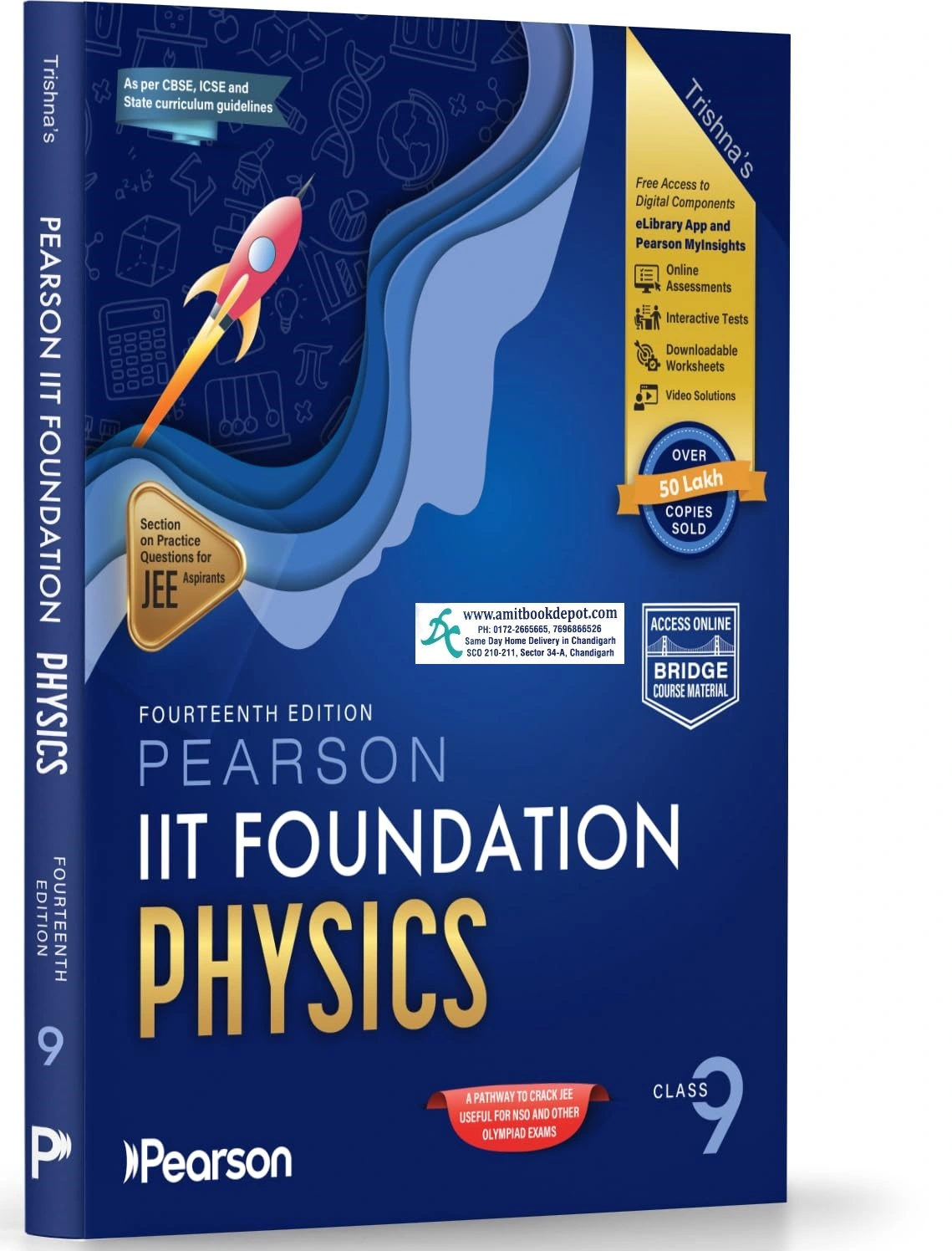
The Pearson IIT Foundation Series Physics for Class 9 is an essential academic resource meticulously crafted for students beginning their journey towards engineering entrance examinations like JEE Main, JEE Advanced, and other national/state competitive exams. Authored and published by Pearson Education, a global leader in educational content, this book serves as a definitive guide to mastering the fundamentals of physics for the academic year 2026-27and beyond. It is specifically aligned with the syllabi of major educational boards in India, including CBSE, ICSE, and various state boards, ensuring comprehensive coverage of all prescribed topics.
The primary objective of this series is to build an unshakeable conceptual foundation right from the secondary school level. Rather than focusing solely on rote memorization, the book employs a graded, concept-based approach that encourages deep understanding and analytical thinking. It is designed to transition students smoothly from the standard Class 9 NCERT physics curriculum to the more challenging realm of competitive examinations, thereby bridging the gap between school education and rigorous entrance test requirements.
The content is strategically organized into six logical units, each breaking down complex physical laws into digestible segments. Unit I: Basic Physics begins with Units and Measurements, establishing the language and tools of science. Unit II: Mechanics forms the cornerstone, with in-depth chapters on Kinematics (motion), Dynamics (forces and laws of motion), Gravitation (universal law, celestial motion), and Fluid Mechanics (properties, pressure, buoyancy). This unit is critical for developing strong problem-solving skills and a quantitative understanding of the physical world.
Unit III: Waves and Sound introduces students to the principles of wave motion and sound, covering propagation, characteristics, and phenomena like resonance and echoes. Unit IV: Thermodynamics delves into Thermodynamics—I, explaining concepts of heat, temperature, thermal expansion, and heat transfer, which are vital for higher studies in physics and engineering. Unit V: Electricity and Magnetism explores Electricity—I (current, circuits, Ohm’s law) and Magnetism—I (magnetic fields, properties), laying the groundwork for electromagnetic theory. Finally, Unit VI: Light covers reflection, refraction, lenses, and optical instruments, demystifying the behavior of light through clear diagrams and explanations.
Each chapter is structured to facilitate step-by-step learning. It starts with clear learning objectives, followed by conceptual explanations enriched with real-life applications of physics principles. Numerous solved examples illustrate the application of theories and formulas, demonstrating effective problem-solving techniques. The illustrative diagrams and graphs enhance visual learning and aid in understanding abstract phenomena. To consolidate learning, chapters include a wide range of practice exercises, categorized by difficulty level. These include theoretical questions, numerical problems, and multiple-choice questions (MCQs) that mirror the pattern of competitive exams like NTSE and Olympiads. This rigorous practice is aimed at boosting exam readiness and confidence.
Key features that distinguish this IIT Foundation book include its emphasis on conceptual clarity over mere information, the integration of board exam preparation with competitive exam preparation, and the development of scientific aptitude. It not only prepares students for their Class 9 annual exams but also instills a problem-solving approach that is indispensable for future success in engineering entrances. The language is student-friendly, making complex topics accessible.
For parents and educators seeking a reliable resource to guide young aspirants, this book is an invaluable investment. It is more than just a syllabus book; it is a tool that nurtures logical reasoning and a genuine interest in the sciences. By building a strong physics foundation in Class 9, students are better positioned to handle the advanced topics in Classes 10, 11, and 12, ensuring a seamless and stress-free preparation trajectory for JEE.
The Pearson IIT Foundation Series Physics for Class 9 is, therefore, the recommended choice for dedicated students aiming for excellence in both academic and competitive spheres, setting them on a proven path to success.






.jpg)