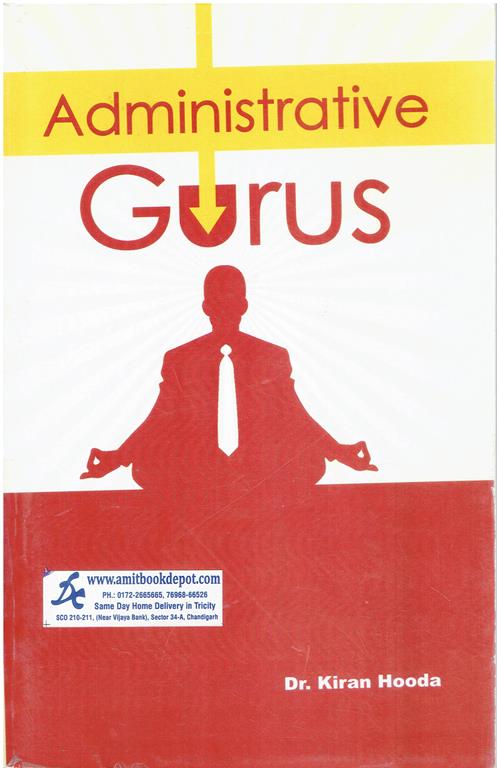
Mohindra Administrative Gurus, authored by Dr. Kiran Hooda and published by Mohindra Capital Publishers, stands as a definitive and comprehensive exploration of the seminal thinkers who have shaped the theory and practice of public administration and organizational management across centuries and continents. This meticulously researched volume serves as an essential academic resource and a practical guide for students, scholars, civil service aspirants, and professionals seeking to understand the foundational ideas that govern modern administrative systems. The book’s unique strength lies in its holistic approach, seamlessly weaving together classical Indian thought, Western management principles, and contemporary behavioral theories into a coherent intellectual tapestry.
The book is structured through a detailed examination of nineteen pioneering figures, offering a systematic and in-depth analysis of each guru’s life, core philosophies, and enduring contributions. Dr. Hooda commences with an exploration of Kautilya, the ancient Indian strategist, whose Arthashastra provides timeless insights on statecraft, bureaucracy, and ethical governance, establishing a crucial indigenous foundation for administrative thought. The journey then progresses to the moral and political philosophy of Mahatma Gandhi, focusing on his concepts of trusteeship, decentralized governance (Swaraj), and ethical administration.
From these roots, the text expands into the influential domain of Western theorists. It delves into the political-economic critique of Karl Marx and the reform-oriented politics-administration dichotomy of Woodrow Wilson, often hailed as the father of public administration. The rigorous analyses of Max Weber’s bureaucratic ideal type, Frederick Winslow Taylor’s scientific management, and the structural frameworks of Luther Gulick and Lyndall Urwick (through POSDCORB) and Henry Fayol provide a solid grounding in classical organizational theory.
Mohindra Administrative Gurus expertly transitions into the human-centric approaches that revolutionized management thinking. It covers the human relations movement pioneered by Elton Mayo, the cooperative system theory of Chester Barnard, and the decision-making models of Herbert Simon. The exploration of motivation and leadership is thorough, featuring Frederick Herzberg’s Two-Factor Theory, Douglas McGregor’s Theory X and Theory Y, Chris Argyris on maturity-immaturity, and Abraham Maslow’s hierarchy of needs. This section is vital for understanding behavioral public administration.
The book brings the discourse into the modern era with incisive chapters on Peter Drucker, the pioneer of management by objectives (MBO), and Rensis Likert’s participative management systems. It concludes with a critical examination of Fred Riggs and his prismatic-sala model, offering a robust comparative administrative perspective essential for understanding administration in developing societies.
Each chapter follows a logical structure: a biographical introduction, a clear presentation of key concepts and theories, a critical evaluation of their relevance, and a discussion of their application in contemporary public and private administration. The Select Bibliography included is a valuable resource for further research and scholarly pursuit.
Keywords integrated throughout this essential text include public administration, administrative thinkers, management theories, organizational behavior, Kautilya Arthashastra, classical management, bureaucracy, scientific management, human relations movement, behavioral theory, motivation, leadership, comparative administration, governance, civil service exam, UPSC, NET, public policy, and management principles.
Published by Mohindra Capital Publishers, this book is renowned for its academic rigor and clarity. It is an indispensable textbook for university courses in public administration, political science, and management studies. For competitive exam candidates, especially for the UPSC, State PSCs, and UGC NET, it provides concise, accurate, and exam-focused summaries of complex theories. Practicing administrators and managers will find in it a valuable reference to contextualize their challenges within established theoretical frameworks.
Conclusion
Mohindra Administrative Gurus by Dr. Kiran Hooda is more than just a compilation of biographies; it is a critical dialogue with the intellectual architects of administration. It empowers readers to appreciate the historical evolution of administrative thought and equips them with the conceptual tools to analyze and improve governance and organizational effectiveness in the 21st century.








.jpg)